Crossing Into New Brunswick by ATV
A Maine trail may run close to New Brunswick without giving you a legal route across the international border. Riders need to plan for trail permission, Canadian entry requirements, local permits, insurance, and the return trip—not just fuel and maps. This guide explains how to prepare for a Maine-to-New Brunswick ATV ride and where to verify the details before leaving home.
Start by separating trail access from border entry
A trail near the border is not automatically a crossing
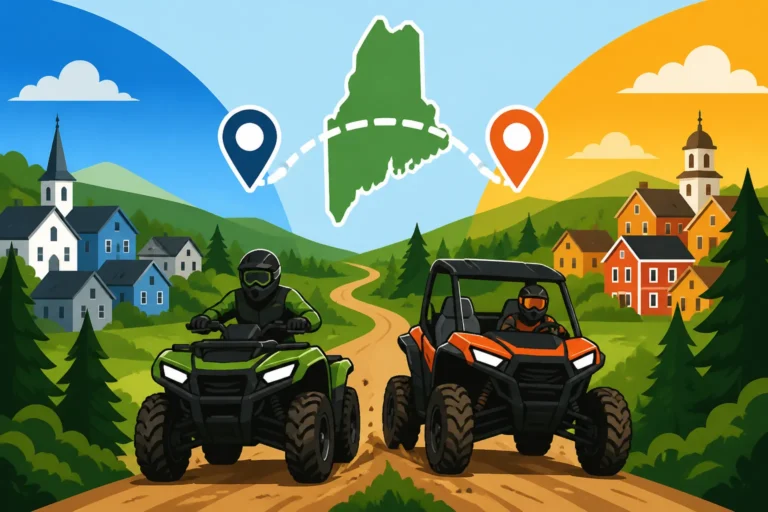
Northern Maine has ATV networks near communities such as Fort Kent, Madawaska, and Van Buren, but proximity to the border does not mean a trail is open to international ATV travel. A club trail may end at a road, private property, a closed section, or the boundary itself. Even where a route appears to continue on a map, you need to know that the trail is open, that you have permission to use it, and that the border can be crossed legally at that location.
Do not ride across a wooded boundary, river, bridge, or unstaffed point simply because it looks like a convenient continuation. International entry must follow the requirements of the border authorities, and a trail crossing is not a substitute for an authorized border crossing. If the route is unclear, stop and ask the relevant trail club or land manager rather than guessing. A wrong turn can become a border or trespass problem very quickly.
This distinction matters especially in Aroostook County, where trail routes can connect small towns and remote woods. A map can help you understand the surrounding trail network, but it cannot establish permission to cross an international border. Tools such as onX Offroad can help with route planning and orientation; use them alongside current club information and official border guidance, not in place of either.
If your plan involves riding from Maine into New Brunswick, first identify the legal land crossing you intend to use and confirm that your ATV may be taken through it in the way you propose. Then find out whether the ATV must be transported on a trailer for part or all of the journey. For background on how the state’s limited Canadian arrangement differs from ordinary riding permission, see [Maine's Three-Day Agreement With New Brunswick and Quebec] and [The Three-Day Canadian Exception in Maine].
Check each side’s riding rules separately
Maine registration and permission to ride in Maine do not automatically give you permission to ride in New Brunswick. Likewise, a New Brunswick registration, permit, or trail pass does not by itself authorize riding on Maine trails. Treat the trip as two separate riding plans, each with its own rules, trail access, and documentation.
Before entering New Brunswick, check the province’s current requirements for visiting ATV riders. These may involve registration, a trail permit, insurance, age or safety rules, and restrictions on where ATVs may travel. Requirements can differ depending on the machine, the rider, and whether you are using a public road, a managed trail, or private land. Do not assume that a permit for one trail system covers every route in the province.
The same care applies when returning to Maine. A New Brunswick trail pass is not a substitute for whatever Maine requires for your machine and situation. The limited Canadian exception is not a blanket exemption for any visitor, any route, or any length of trip. Read [Which Days Count Under Maine's Three-Day Rule] before relying on it, and verify whether it applies to your circumstances. For the broader rules for visitors riding on the Maine side, see [Maine ATV Rules for Canadian Visitors].
Prepare your ATV and travel documents
Confirm the machine’s paperwork before departure
Gather the documents that identify the ATV and show that you may use it. Depending on your situation, that can include registration, proof of ownership, proof of insurance, and permission to operate a machine registered to someone else. If you are bringing a borrowed, rented, or business-owned ATV, ask what additional documents the border authorities and the rental provider may require.
Keep the information consistent. If the person riding is not the registered owner, a written authorization from the owner can help clarify why you have the machine, but it does not replace any formal requirement. If you are hauling an ATV across the border rather than riding it through, have the machine’s ownership and registration details readily available. Review [Crossing the Border With an ATV on a Trailer] and [Customs Rules for Bringing an ATV Across the Border] before you travel.
Riders should also confirm what identification they need to enter Canada and return to the United States. Requirements depend on a traveler’s citizenship and circumstances, so check the relevant border agencies’ current guidance for every person in your group. Do not assume that one person’s travel document or citizenship status determines what everyone else needs.
Keep important documents accessible rather than buried under riding gear. A practical setup is a waterproof folder in the tow vehicle with copies of ownership, registration, insurance, and rental or authorization paperwork, plus secure access to the originals or accepted digital records. Make sure someone in the group knows where the documents are.
Verify insurance and any permit before riding
Ask your insurer directly whether your ATV policy covers riding in New Brunswick and whether it applies to the types of trails and roads you plan to use. Coverage for an ATV may have geographic limits, exclusions, or conditions; do not infer cross-border coverage from the fact that the machine is insured in Maine. Carry proof of any coverage required by the province or trail operator.
New Brunswick trail access may require a local permit, and buying one does not necessarily give you permission to use every trail. Check which organization or authority issues the permit, what locations it covers, and whether any additional local requirements apply. If an online purchase option is available, use the provider’s official channel and save the confirmation where you can retrieve it offline. The guide [Buying a New Brunswick Trail Permit Online] can help you identify the questions to ask, while [Trail Permits for Riding in New Brunswick] provides related context.
| Before the trip | What to confirm | Why it matters |
|---|---|---|
| Trail route | Open status, landowner permission, club boundaries, and legal connection to a border crossing | A mapped trail is not automatically open or authorized |
| Border crossing | Whether your chosen crossing can accommodate your travel plan and ATV | Not every crossing or route is suitable for an off-road machine |
| ATV documents | Registration, ownership, and any authorization for a borrowed or rented machine | Border officials or trail operators may ask who owns or may use the ATV |
| Rider documents | Entry and return requirements for each traveler | Requirements can vary by citizenship and individual circumstances |
| New Brunswick access | Registration, permit, insurance, and local riding rules | Maine paperwork does not automatically cover riding in New Brunswick |
| Return to Maine | Maine registration or any narrow applicable exception | Canadian riding permission does not automatically satisfy Maine requirements |
| Communications | Offline maps, emergency contacts, and a backup plan | Cell service may be limited on remote routes |
Plan the route, crossing, and return before you ride
Build a route with confirmed access points
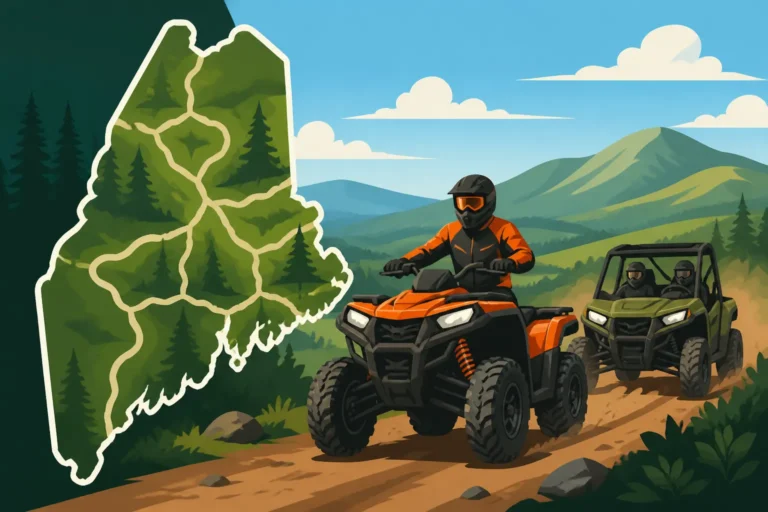
Plan from known locations rather than drawing a line across the map and assuming every connecting trail is usable. Start with the Maine trail club or clubs responsible for the route, then verify the New Brunswick trail operator or land manager for the other side. Ask specifically whether the trail is open to the type and width of machine you ride, whether the route reaches a legal border crossing, and whether seasonal closures or local restrictions apply.
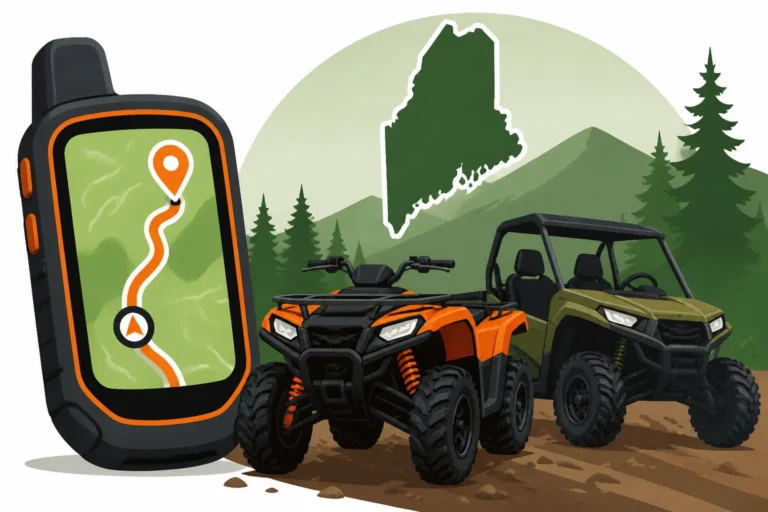
Map apps can be useful for comparing terrain and keeping your group oriented, but trail data may not reflect a new closure, private-land withdrawal, or a route that is not authorized for ATVs. In onX Offroad, save the route and any useful map area for offline access before you leave. Then compare that plan with current club notices and official information. Do not treat a digital line as proof of permission.
Build in a conservative turnaround point. If the route to a legal crossing is closed, if the crossing does not accept your plan, or if you cannot confirm the trail beyond the border, turn back or switch to a road-legal transport plan. The inconvenience of changing plans is far smaller than getting stranded or entering a country outside an authorized crossing.
When you contact a club or outfitter, ask concrete questions instead of simply asking whether “the trail goes through.” For example:
- Is this specific trail section open to ATVs today?
- Does the route legally connect to an authorized border crossing?
- Can an ATV be ridden through that crossing, or must it be trailered?
- Are permits or local permissions required on either side?
- Are there width, machine, or seasonal limits?
- Where should a rider turn around if the route is closed?
Plan for fuel, communication, and unexpected delays
Cross-border trips can take longer than a familiar local ride. Border processing, detours, trail closures, weather, or mechanical trouble can all change your schedule. Set a conservative fuel plan, know where the next confirmed fuel stop is, and do not count on a remote store being open just because it appears on a map.
Share your itinerary with someone who is not riding. Include the planned route, expected check-in times, vehicle and trailer details, and the name of the person to contact if you do not return as planned. In areas with patchy cell coverage, download maps ahead of time and consider what backup communication method suits the remoteness of your route. A phone with a map app is helpful, but it is not a complete emergency plan.
Group rides need a clear border and regrouping procedure. Keep the group together before reaching the crossing, make sure every rider knows where the documents are, and agree on a safe place to stop if one machine develops a problem. Avoid letting faster riders continue ahead while others are still dealing with questions or paperwork.
Common mistakes that can derail a cross-border ride
Assuming a reciprocity rule covers the whole trip
A limited reciprocal arrangement or exception can sound broader than it is. Riders may hear that a registration is recognized for a short period and assume that they can ride anywhere, cross anywhere, or skip a local permit. Those are separate questions. An arrangement may apply only to a defined set of riders or circumstances, and it does not erase border-entry rules, trail closures, insurance requirements, or landowner permission.
Read the exact rule that applies to your machine and itinerary, including the dates or days it covers. Do not rely on a friend’s experience from a previous season as proof that the same route and conditions apply to you. If you are unsure whether the exception covers your situation, contact the appropriate Maine authority before departure. [Taking a Maine ATV to New Brunswick] is a useful companion topic for separating Maine requirements from the Canadian side of the trip.
Treating a trail map as an official authorization
A map can show a trail, road, or apparent connection without telling you whether it is currently open or whether ATVs may legally use it. This is especially important near private land, where access depends on permission and can change. Respect posted signs, gates, and landowner directions. Do not bypass a closure because the route looks passable or because another rider says it was open before.
Check conditions shortly before leaving, not just when you first plan the trip. Rain, spring mud, trail maintenance, landowner decisions, or local events can affect access. Carry a backup route that stays on confirmed trails, and be willing to cancel the cross-border portion if the access information is incomplete.
The simplest planning rule is to confirm three things independently: the legal border crossing, the ATV’s permission to enter and ride in New Brunswick, and the machine’s permission to ride on the Maine return route. When any one of those remains uncertain, pause and get an answer before setting out. That extra call can save you a long detour, a missed crossing, or a ride that ends before it properly begins.
Disclaimer
This article is for general informational purposes only and does not constitute professional advice. Laws, prices and regulations vary by location and change over time. Consult a qualified professional for guidance on your specific situation.