Does a Maine UTV Need a License Plate?
The dream of hopping on your UTV and cruising down a Maine road for a quick errand or to connect trails is a common one, but the reality of vehicle classifications and regulations can be a frustrating maze. Many UTV owners wonder if their machine needs a traditional license plate, like a car or truck, to be compliant. This guide is here to untangle the complexities of Maine law regarding UTV registration, limited road use, and the elusive concept of a "street-legal" side-by-side, so you can ride confidently and within the rules.
Maine's UTV Classification: Off-Road Vehicle Status
Let's get right to the heart of the matter: in Maine, UTVs (Utility Terrain Vehicles) are generally classified as off-road recreational vehicles, much like ATVs. This fundamental classification dictates how they are registered and, crucially, what type of identification they display. Unlike cars, trucks, or motorcycles, which are designed and intended for primary use on public roads and require state-issued metal license plates, UTVs are primarily designed for off-highway use.
This distinction is important because it means the standard "license plate" you're picturing for a road vehicle isn't typically what Maine requires for a UTV. Instead, UTVs fall under the umbrella of "all-terrain vehicles" in Maine's statutes, which have their own specific registration process. The state understands that these machines serve a different purpose, often traversing rugged terrain, logging roads, and designated trail systems rather than asphalt highways. This focus on off-road capability influences everything from registration to safety requirements.
The frustration often stems from seeing UTVs in other states that do allow them to be registered and plated for street use. Maine's approach is more conservative, treating UTVs as machines for exploration and work in the backcountry. So, while you might wish for the convenience of a traditional plate, Maine's legal framework places UTVs firmly in the off-road category first and foremost.
When Your UTV Needs Registration (And What Kind)
Before we talk about plates, let's talk about registration. If you plan to operate your UTV on any land not owned by you, or even on your own land if you wish to ride directly from there to a trail system, it absolutely needs to be registered. This isn't just a suggestion; it's a legal requirement that wardens and other law enforcement take seriously. The registration process for a UTV in Maine is similar to that for an ATV. You'll go through the Maine Department of Inland Fisheries and Wildlife (IF&W) or a local registration agent, typically your town office, to get your machine legal.
Instead of a metal license plate, what you'll receive upon successful registration is a set of registration decals and a paper certificate. These decals, not a metal plate, are the primary identifier for your UTV. They prominently display your registration number and the expiration year. You must affix these decals to your UTV in a visible manner, typically on the front and rear, as specified by IF&W guidelines. These decals serve the same purpose as a traditional license plate in allowing law enforcement and other trail users to identify your machine and verify its registration status. You'll also need to carry your paper registration certificate with you while riding, as wardens will often ask to see it during routine checks.
The process involves providing proof of ownership, such as a bill of sale, and paying the applicable registration fees and sales tax if it's a new purchase or you're bringing it in from out of state. For many new residents, navigating the nuances of [Moving to Maine With an Out-of-State ATV] can be a bit tricky, but the principles generally apply to UTVs as well. While the decals may not look like a car's license plate, they are your UTV's official identification for legal operation in Maine's vast trail network. Without them, you risk significant [Penalties for Riding an Unregistered ATV in Maine], which can quickly turn a fun day into a costly mistake.
Limited Road Use: Requirements Beyond Just a Plate
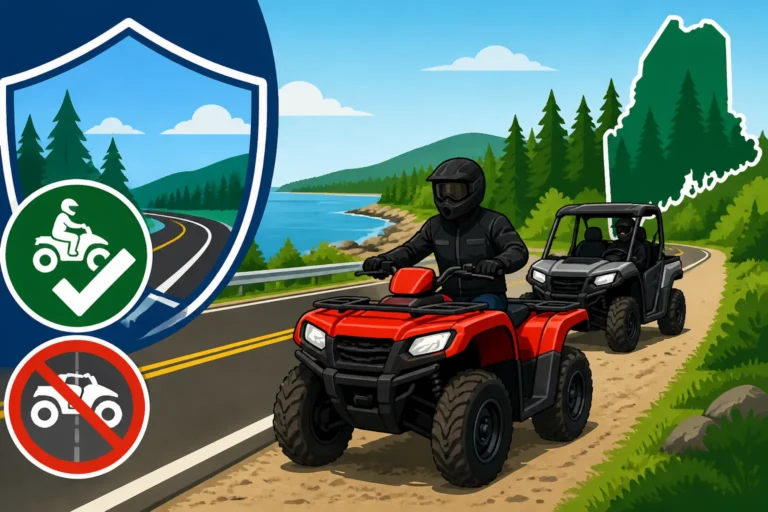
Now, here's where the waters get a little murky, and the desire for a "license plate" often comes into play. While Maine UTVs don't get a traditional metal plate, there are specific, limited circumstances under which you can operate your registered UTV on public ways. It's critical to understand that this is not the same as making your UTV "street legal" in the way a car or motorcycle is. These are exceptions for connectivity, not a blanket permission to drive on roads.
Maine law allows for operation on public ways under very strict conditions, primarily for crossing purposes or on designated ATV-access routes. For instance, you might be allowed to cross a public way at a 90-degree angle to get from one trail segment to another, or to travel up to [Maine's 500-Yard Limit on a Public Way] to access services like a gas station or restaurant. Some towns have also established specific [Maine ATV-Access Routes and How Towns Post Them] that allow UTVs to share a portion of the public road.
Even for these limited uses, your UTV needs certain equipment to be compliant and safe, even if it doesn't have a metal plate:
- Headlights and Taillights: Essential for visibility, especially if you're riding at dawn, dusk, or night. Maine has [Maine Lighting Requirements for Night Riding] that apply.
- Brake Lights: To signal your deceleration to anyone behind you.
- Horn: A signaling device for safety. You need to meet [Maine Horn Requirements for Road Riding].
- Mirrors: A rear-view mirror is crucial for awareness of traffic behind you. Check [Maine ATV Mirror Rules] for specifics.
- Muffler and Spark Arrestor: To control noise and prevent wildfires.
Many UTVs come equipped with some of these items from the factory, but for others, or for enhanced safety, you might look to aftermarket providers. Companies like SuperATV offer a wide range of accessories, from full lighting kits with turn signals to mirrors and horns, that can help bring your UTV into compliance with these limited road-use requirements. While these upgrades are fantastic for safety and compliance, remember they don't magically confer "street-legal" status for unlimited road driving. They enable legal limited access where permitted. Wardens will check for these items, and failing to have them could result in fines.
The Quest for a "Street-Legal" UTV in Maine: Reality Check
The idea of a truly "street-legal" UTV in Maine, one that could be registered with a traditional metal license plate and driven freely on public roads like a car, is generally a challenging, if not impossible, endeavor for most riders. Maine's vehicle codes are quite clear: UTVs are primarily considered off-road vehicles. While some states have specific classifications and pathways to register UTVs as low-speed vehicles or mini-trucks for street use, Maine's framework doesn't offer a straightforward route for this for typical UTVs.
The desire to make a UTV street legal often comes from wanting to avoid the hassle of trailering for short distances or to enjoy scenic road drives. However, attempting to register a UTV as a "motor vehicle" for road use in Maine would typically require it to meet all the stringent federal and state safety and emissions standards that apply to cars, trucks, and motorcycles. This includes things like crash-worthiness, advanced emissions controls, proper VIN verification as a road vehicle, and compliance with all road-vehicle equipment requirements. Most factory UTVs, even those with many safety features, are simply not manufactured to these standards for street use.
Some individuals explore niche avenues, like modifying a UTV to such an extent that it might technically fit the definition of a custom-built low-speed vehicle (LSV) or even going the [Montana LLC Registration for a UTV] route, though the latter carries significant risks and is often frowned upon by Maine authorities. An LSV, for example, has very specific speed limitations and can only be operated on roads with speed limits typically 35 mph or less, and would need specific factory certification or extensive modification and inspection. The cost and complexity of such a conversion and the subsequent inspection process are usually prohibitive for the average UTV owner, making it an impractical path for most.
Ultimately, while you'll get registration decals and a registration number for your UTV in Maine, the goal of obtaining a traditional metal license plate for general street use remains largely out of reach. It's why focusing on legal off-road riding and understanding the precise rules for [Maine's 500-Yard Limit on a Public Way] and designated access routes is the most realistic and compliant approach for UTV owners in the Pine Tree State.
Here's a quick reference on what your UTV needs for common situations in Maine:
| Situation | Primary Identification Required | Additional Road-Use Equipment (if applicable) | Traditional Metal Plate Issued? |
|---|---|---|---|
| Off-Road Trail Riding | Maine Registration Decals | None beyond basic UTV features | No |
| Crossing a Public Way (90-degree) | Maine Registration Decals | Headlights, Taillights, Brake Light, Horn, Rear-view Mirror | No |
| Designated ATV-Access Route (Limited) | Maine Registration Decals | Headlights, Taillights, Brake Light, Horn, Rear-view Mirror, Potentially Turn Signals | No |
| Driving on Your Own Private Land | None (Registration recommended) | None | No |
| Attempting "Street Legal" Conversion | Varies (often difficult/impractical for UTVs) | Must meet all federal/state motor vehicle standards (extensive) | Extremely Rare/Difficult |
Understanding these distinctions is key to staying out of trouble. While you might invest in quality aftermarket parts from companies like SuperATV to enhance your UTV's safety and functionality for off-road and limited road use, they won't change its fundamental classification as an off-road recreational vehicle in Maine. Always check local town ordinances for specific [Maine Town Ordinances That Restrict ATVs] or allow access, as rules can vary from one community to another.
Disclaimer
This article is for general informational purposes only and does not constitute professional advice. Laws, prices and regulations vary by location and change over time. Consult a qualified professional for guidance on your specific situation.