Landowner Relations on Maine ATV Trails
Maine ATV access often depends on a landowner’s willingness to let riders cross private property. A trail on a map is not automatically open, and one careless shortcut can put a club’s access agreement at risk. This guide explains how to ride respectfully, understand permission and closures, and help keep good relationships between riders, clubs, and Maine landowners.
Why landowner relations matter on Maine ATV trails
Many trails rely on private-property access
A Maine trail may look like a continuous route through woods, fields, and small towns, but the land beneath it can have several different owners. A club might maintain a trail across private parcels, a town road, or a section of public land. If even one private landowner withdraws permission, a familiar route may need to close or be rerouted.
That reality is especially important when planning longer rides around places such as Moosehead Lake, Jackman, The Forks, or Aroostook County. A route that connects communities may cross multiple properties, and each owner has a say in access to their land. Riders benefit from the route, but they do not acquire a permanent right to use it simply because it appears on a map or has been open in previous seasons.
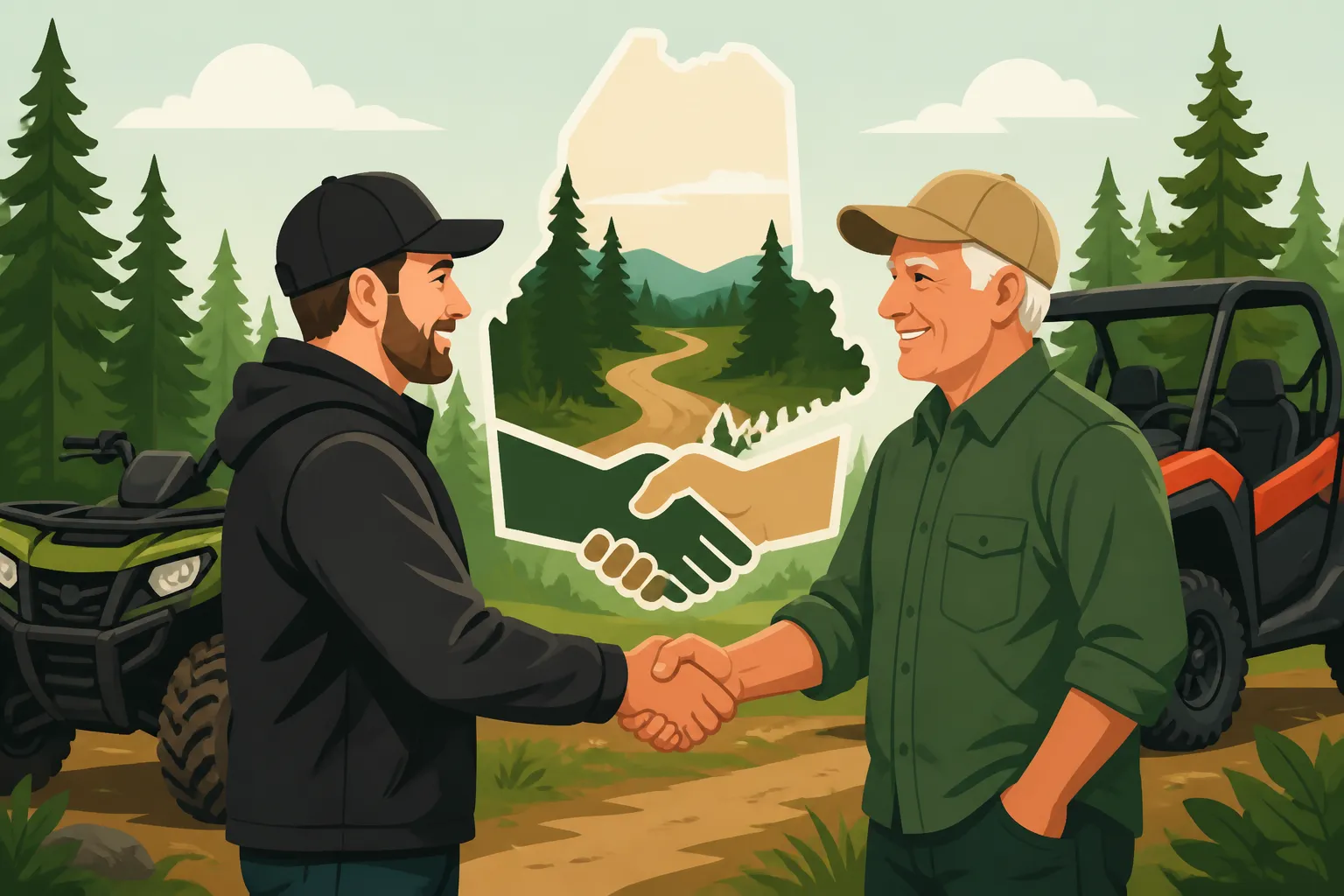
This is why Maine ATV clubs and the trails they keep open are so important to riding access. Clubs often serve as the link between landowners and riders: they communicate about routes, help with maintenance, post signs, and respond to concerns. For riders, the simplest way to support that work is to follow the route as marked and treat access as something granted, not guaranteed.
Permission is specific, not a blanket invitation
Permission to use one trail does not mean permission to explore adjoining woods, ride through a field, cut across a yard, or follow a tempting road beyond the marked route. A landowner may allow a club to maintain a particular trail while restricting all other motorized access on the property. Stay on the authorized corridor, even when an unofficial track looks easier or more interesting.
It also helps to distinguish club-authorized access from a personal invitation. If a neighbor or camp owner tells you that you can ride a private road, that permission may apply only to you, a specific date, or a particular destination. It should not be treated as permission for your entire riding group or for future visitors. If the boundaries are unclear, ask before riding rather than trying to interpret a casual comment in the woods.
For the same reason, learning Maine landowner permission rules is useful before a trip, especially if you are new to the state or riding an unfamiliar region. When in doubt, stop and clarify access with the club responsible for the trail or the property owner. Do not assume that a path is public simply because it is wide, well traveled, or connected to a familiar trail system.
What respectful riding looks like on private land
Stay on the marked trail and respect barriers
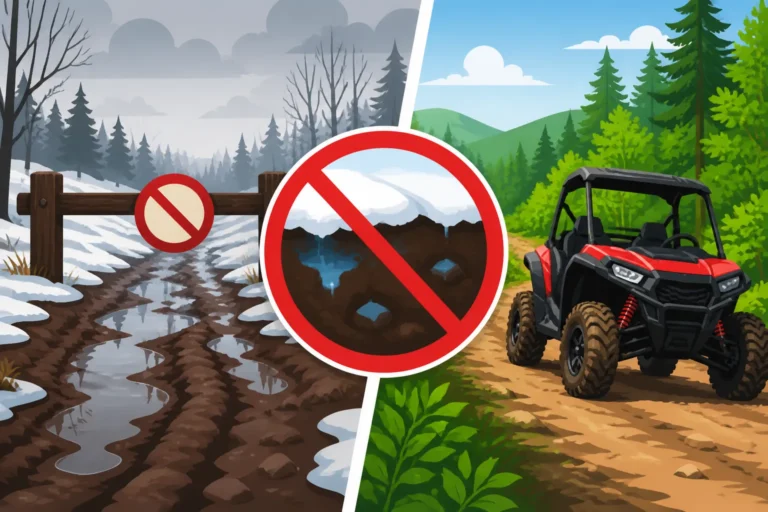
The most basic courtesy is also the most protective: stay on the trail that is open and marked for ATV use. Do not make a new line around mud, a puddle, a fallen branch, or a rough section unless the club or authorized trail staff has marked a detour. A quick bypass can widen into a second trail, damage vegetation, and create a maintenance problem that the landowner never agreed to host.
Gates, barriers, ropes, and closure signs are not invitations to find another way through. Do not move a barrier, lift a gate for the next rider, or follow an unmarked path around a closure. If the trail appears blocked, turn around where it is safe and report the issue to the club. A closed section may be protecting a wet area, responding to a landowner request, or addressing a hazard that is not obvious from the trail.
Respecting signs includes giving posted land the same attention as a physical barrier. Purple paint marks and no-trespassing signs communicate that access is restricted. If you are unsure what a marking means or whether it applies to a nearby route, do not ride through to find out. Review [What Purple Paint Means in the Maine Woods] and [Access by Permission Only Markings] before heading into an area where boundaries or trail permissions may be confusing.
Ride quietly and slowly near homes and working land
Noise is one of the complaints most likely to affect a landowner’s experience. Keep your machine in good repair, use an appropriate muffler, and avoid revving or accelerating hard near homes, camps, livestock, and farm buildings. A route that feels remote to a rider may pass close to a house, a seasonal camp, or a place where people are working.
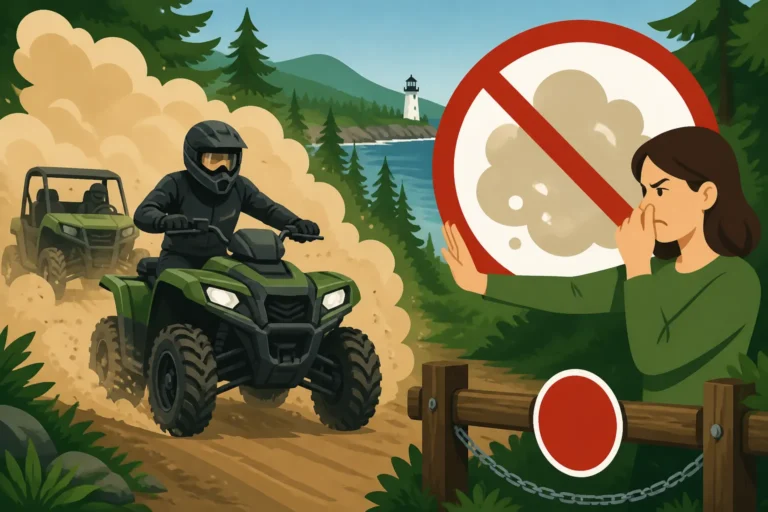
Speed matters for more than safety. Dust and flying debris can bother residents and damage the relationship that allows a trail to cross their property. Slow down near buildings, driveways, livestock, and people on foot. If you are riding in a group, leave enough space between machines to avoid a long, noisy stream passing a home all at once. Be especially considerate in the early morning and evening, when engine noise carries through quiet areas.
Maine ATV trail etiquette with landowners includes the small moments riders sometimes overlook: closing a gate if the trail instructions tell you to, not stopping in a driveway, and not leaving litter behind. If you see a landowner nearby, a friendly greeting and a brief acknowledgment can help. Do not crowd them with questions while they are working, but do make it clear that you are willing to follow the route rules.
Treat fields, roads, and trail crossings with care
A marked trail may cross a farm field or a private woods road. That does not mean the full field or road is open to riding. Stay on the designated line and avoid widening turns or cutting across planted, harvested, or wet ground. A muddy shortcut can leave ruts that remain after the riding season and create repair work for the landowner or club.
When a trail crosses a driveway or private road, approach cautiously and watch for vehicles, people, and equipment. A person working in a field may not expect an ATV to appear from behind a tree line. Reduce speed, give others room, and avoid blocking access. If a landowner is moving equipment or asks riders to wait, stop and cooperate rather than pressing through.
Not every visible woods road is part of the trail network. A logging road, camp road, or utility access may look like a natural continuation, but the owner may not have granted ATV access. The guidance in [Rules for Riding a Private Woods Road] can help riders think through that distinction. When a trail crosses a working property, the courteous choice is to use only the crossing and route that are clearly authorized.
How clubs, maps, and signs support access
Clubs are the best first contact for trail questions
A local ATV club usually knows which sections it maintains and where riders should go for updates or clarification. If you find a confusing sign, a washed-out bridge, a fallen tree, or a trail that seems to cross private land without clear markers, contact the club rather than asking a landowner to resolve a club-level route issue. That gives the people managing the trail a chance to investigate and respond appropriately.
Clubs can also tell visitors about local expectations that may not be obvious from a statewide map. A route may have a seasonal closure, a detour around a sensitive area, or a section where riders need to be particularly quiet near homes. The details can vary from one town or trail system to another, so a quick check before setting out is worthwhile. A club’s local knowledge is often more useful than relying on assumptions from a different region.
When riding in areas such as Presque Isle, Greenville, or the Jackman region, identify the club or trail organization responsible for the route you plan to use. [Maine ATV Club Membership and Dues] explains one way riders can support the organizations that help maintain access. Even if you are visiting for a single weekend, following club guidance and reporting problems constructively helps protect the trail network for the next group.
Maps help with planning but do not grant permission
A trail map is a planning tool, not proof that every line is open today or that you may ride beyond the marked route. Trail status can change because of weather, landowner requests, maintenance, or seasonal conditions. Before leaving the trailer, check the latest information from the local club or other official trail source and pay attention to signs on the ground.
Digital tools such as onX Offroad can be useful for understanding your general location, planning a route, and keeping track of where you are when cell service is unreliable. But a mapped line should never override a closure sign, a gate, or a landowner’s request. A GPS display can show where a track goes; it cannot establish that the property owner has authorized public ATV use there.
| Situation | Best action | What to avoid |
|---|---|---|
| A map shows a trail but the route is not marked on the ground | Confirm status with the local club before riding | Assuming the mapped line is open |
| A signed trail has a closed gate | Turn around and report the closure if needed | Moving the gate or finding a bypass |
| A track appears to continue onto a private road | Stop and verify access | Treating the road as a public connector |
| A trail is blocked by a fallen tree | Use the marked route or turn back | Cutting a new path around the obstruction |
| Your GPS shows a nearby shortcut | Stay on the authorized trail | Using the shortcut because it looks established |
For navigation without cell service, prepare before you leave and carry a backup plan. onX Offroad may help you follow your planned route, but keep a paper map or other suitable backup when the ride takes you into a remote area. Do not let a device distract you while operating, and stop in a safe place before checking directions. For more planning advice, see [Maine ATV Trail Maps and Club Boundaries] and [Navigating Trails Without Cell Service].
Report damage and access problems constructively
If you notice a new rut, a damaged bridge, a missing sign, or evidence that riders have left the trail, report what you saw to the club responsible for the area. Include a clear location, the date, and a brief description. If it is safe, a photo can help the club understand the problem, but do not trespass farther onto private land to investigate or confront someone you suspect caused the damage.
A helpful report is factual rather than accusatory. For example, “There is a washout just past the marked junction, and the trail is difficult to pass” gives a club something actionable. Speculating about who caused it or posting an unverified claim online can create unnecessary conflict. If a landowner is present and raises a concern, listen, stay calm, and pass the information to the club.
Do not repair structures or move heavy obstacles unless you are authorized and equipped to do so. A well-meaning rider might try to shift a barrier or rebuild a bridge, but that can create safety and liability problems. Clubs can organize appropriate repairs, coordinate with owners, and determine whether a section should remain closed. [Reporting a Downed Tree on a Trail] is a useful reference for handling one common trail issue responsibly.
Handling closures, complaints, and difficult conversations
A closure is a direction to stop, not a challenge
When a trail is closed, do not assume that the closure is temporary, mistaken, or limited to other riders. A closure may be posted because a landowner has withdrawn permission, a route is unsafe, or work is underway. Even if you have ridden the section for years, past access does not override a current closure.
Turn around before reaching the blocked area whenever possible, and do not ride around the sign to reconnect with the route farther ahead. A bypass can create new damage or expose riders to a hazard the closure was intended to prevent. If the closure makes your planned ride impossible, choose another open route rather than trying to negotiate access from the machine.
Trail status can change quickly, so check with the local club before a ride and look for notices at trailheads and junctions. [Where Maine Trail Closure Notices Are Posted] can help you build that check into your planning. If a closure seems unclear, ask the organization responsible for the route when it is practical to do so; do not treat uncertainty as permission.
Respond calmly when a landowner raises a concern
If a landowner asks you to stop, stop safely and listen. Avoid arguing about a map, a sign, or what another rider said. Even if you believe you are on an authorized route, a calm conversation is more useful than a roadside dispute. Ask what the concern is, follow a clear request to leave or wait, and contact the trail club afterward to clarify the route.
Do not promise that you can change club policy or speak for other riders. You can acknowledge the concern and say that you will pass it along. If there is a genuine misunderstanding about whether the route is open, the club can follow up with the landowner and confirm the correct access. Keeping the exchange respectful can prevent one bad interaction from becoming a larger conflict.
Avoid photographing or recording a person in a way that escalates the situation, and do not post identifying details online. Public arguments can make cooperation harder and may expose private information. A concise, factual report to the club is usually a better next step. The goal is not to win a dispute; it is to understand the access conditions and avoid making the problem worse.
Know when to leave and when to report
If the property boundary or trail authorization is uncertain, the safest response is to stop and retrace your route to the last clearly marked section. Do not cross a posted boundary just to reach a trailhead or shorten the ride. If a route appears to enter private land without clear permission, contact the club or landowner through an appropriate channel before returning.
For a safety emergency, use the appropriate emergency response rather than attempting to handle a dangerous situation alone. For non-emergency access concerns, contact the local club, town office, or relevant land manager as appropriate. Keep your report focused on the location and what happened. This creates a useful record without turning a question about access into a confrontation.
Riders should also understand that registration, trail access, and landowner permission are separate issues. A registered ATV does not automatically have permission to use any particular property. If you are uncertain about the distinction, [What a Maine ATV Registration Does Not Cover] is a helpful companion topic. The same principle applies to a route shown on a map: the map can help with navigation, but access still depends on the rules and permissions for that land.
Practical habits that help keep trails open
Prepare for the ride before reaching the trailhead
Before loading up, identify the club or organization responsible for the area and check for trail conditions, detours, and closures. Plan a route that stays on marked trails, and have a reasonable alternative in mind in case a section is closed. This avoids the pressure to improvise a shortcut after you have already driven a long distance to the trailhead.
Make sure everyone in your group understands the same expectations. A single rider who breaks away to explore an unmarked road can create a problem for the whole group and the landowner. Set a clear rule before the ride: stay together, follow signs, and stop at junctions until the group is accounted for. Keep the pace appropriate for the least experienced rider and for the conditions.
If you are using onX Offroad or another navigation app, download or prepare the information you need before entering an area with weak service. Use it to orient yourself, not to override posted directions. Carry water, basic supplies, and a way to communicate in an emergency. A well-planned ride is less likely to end with a rushed decision that sends riders onto land they do not have permission to use.
Leave the property as you found it
Pack out trash, secure anything that could blow off a machine, and avoid disturbing gates, fences, crops, or equipment. Do not leave food scraps or bottles at a trailhead, and do not dump fluids or maintenance waste on the property. These details may seem small during a long day, but landowners notice whether riders leave a place clean and undamaged.
Be considerate when stopping. Park clear of gates, driveways, and farm access points, and keep machines off lawns and planted areas. If someone needs to pass, move promptly and safely. At a busy trail junction, keep the group compact rather than spreading machines across a private road or blocking access for other users.
The same care applies when the ride ends. Check the staging area for litter and equipment, and make sure trailers are parked where they are allowed. If you are uncertain about overnight parking or access to a nearby business, ask first. For more on courteous behavior along private property, see [Maine Trail Etiquette With Landowners] and [Why 80 Percent of Maine Trails Sit on Private Land].
Support the people who make access possible
Respectful riding is the baseline, but riders can also help sustain access by supporting local clubs, volunteering when possible, and sharing accurate trail information with other riders. A club work day may involve clearing brush, maintaining signs, or repairing a section with proper coordination. Those efforts show that riders are willing to contribute rather than simply use the route.
Visitors can help by joining a club, donating where appropriate, or following the organization’s requests about trail use and maintenance. If you are not local, ask what kind of help is useful instead of starting an unapproved project. A club may prefer a report about a problem rather than an individual attempting a repair that affects a landowner agreement or creates a safety concern.
Most importantly, speak about access responsibly. Do not advertise an unofficial shortcut, share directions to a closed trail, or encourage others to ride beyond marked boundaries. If a route is closed, explain that it is closed rather than presenting it as a secret option. The long-term health of Maine ATV riding depends on landowners seeing that riders respect the boundaries and responsibilities that come with permission.
Disclaimer
This article is for general informational purposes only and does not constitute professional advice. Laws, prices and regulations vary by location and change over time. Consult a qualified professional for guidance on your specific situation.