Volunteering With a Maine ATV Club
Volunteering with a Maine ATV club can mean much more than swinging a chainsaw on a muddy trail. Clubs need help with bridge repairs, trail checks, landowner communication, event support, and everyday organizing. If you want to pitch in but aren’t sure what the work involves or whether you need special equipment, this guide explains how to find a good fit and get started safely.
What volunteering with a Maine ATV club involves
Trail work is only one kind of help
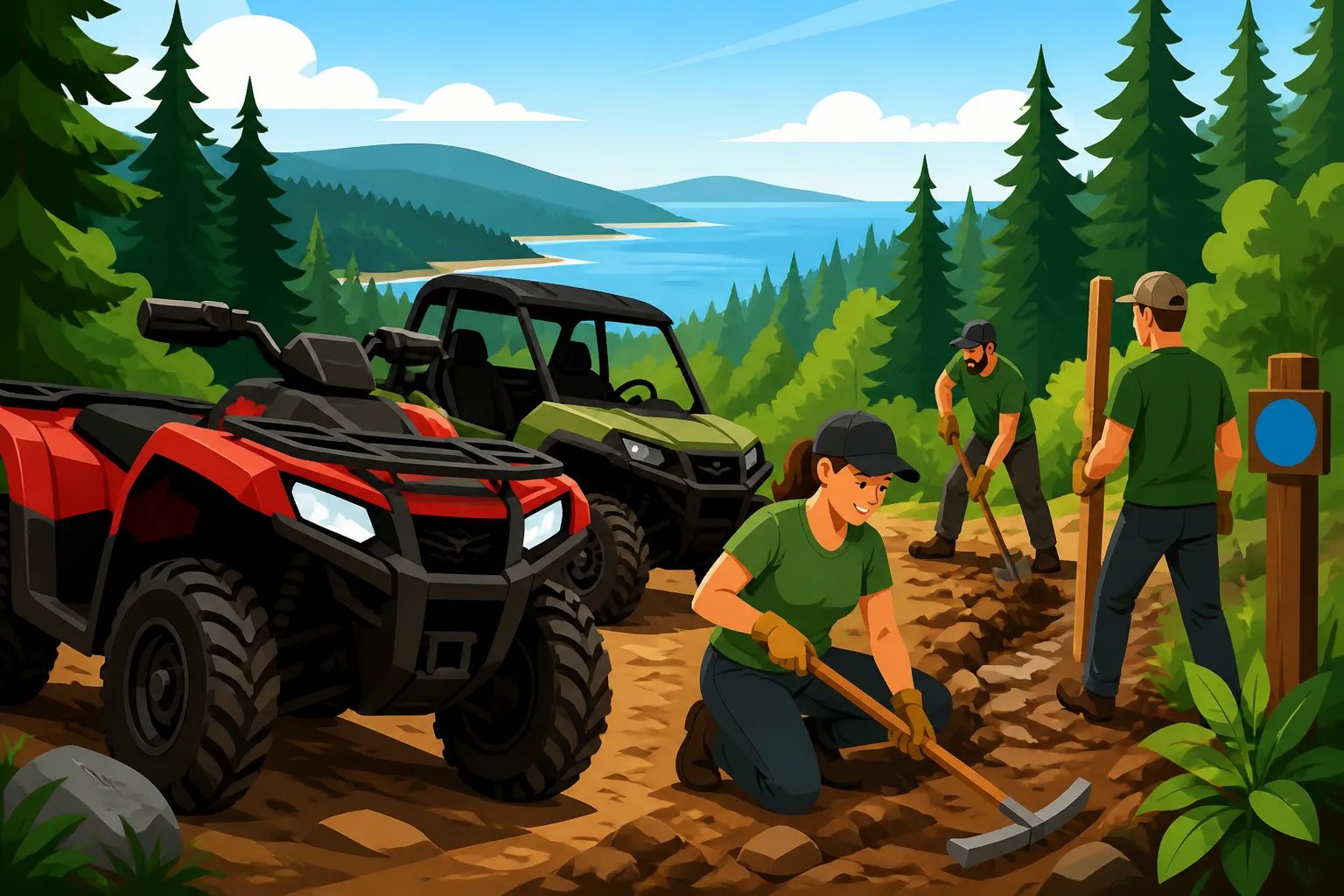
Trail work is the most visible volunteer role, but it is only part of what keeps a trail network usable. Depending on the club and the time of year, volunteers may clear small branches, repair signs, help maintain bridges, check drainage, or report sections that need attention. Some work is hands-on, while other tasks involve planning and coordination.
A club may also need help at meetings, trailhead events, fundraisers, or organized rides. Volunteers can assist with sign-in, parking, food, route information, or communicating updates to riders. These jobs can suit someone who wants to contribute but isn’t comfortable operating tools or working in rough terrain.
There is no single volunteer job description shared by every club. One group may have a regular trail crew, while another relies on a smaller number of members who handle several responsibilities. Looking into [Maine ATV Clubs and the Trails They Keep Open] can help you understand why local clubs matter to access, but the best way to learn what a particular group needs is to ask its officers or trail coordinator.
Clubs need both occasional and ongoing volunteers
You do not necessarily have to commit to every work day to be useful. Some clubs welcome people who can help with a single cleanup, event, or trail inspection. Others may be looking for members who can take responsibility for a recurring job, such as checking a section of trail or helping organize volunteer days.
It helps to be honest about your availability from the start. If you live nearby only part of the year, work weekends, or can help only with event setup, say so. A club can match you with realistic tasks more easily than if you agree to a regular commitment you cannot maintain.
Before joining, ask how the club communicates work dates and last-minute changes. Some groups use email, social media, club meetings, or direct messages. Ask whether nonmembers can attend a work day, whether membership is expected for certain duties, and whether volunteers need to bring their own tools. Membership details vary, so check the club’s current guidance and learn more about [Maine ATV Club Membership and Dues].
How to find a club and choose a role
Start with the riding area you know
A practical first step is to look for a club connected to the trails or town where you ride. Local clubs are often most familiar with the landowners, trail conditions, access points, and seasonal challenges in their area. If you ride in several parts of Maine, you may find that different clubs maintain different networks.
Ask riders at a local trailhead or business whether there is an active club in the area, then confirm details directly with the organization. You can also check club pages or community announcements for meeting dates, volunteer calls, and trail updates. Do not assume an old post reflects a club’s current needs; membership, officers, and work plans can change.
If you are new to the area, explain where you usually ride and what kind of help you can offer. A club may suggest a nearby group, or it may have a project that is especially well suited to a newcomer. The statewide trail network depends on local relationships and maintenance, so a club can often point you toward work that has a clear, immediate purpose.
Match the work to your experience and comfort
You do not need to arrive as an experienced trail builder. Many tasks can be learned through a crew leader’s instructions, especially when the job is basic cleanup, carrying materials, checking signs, or helping at an event. Still, be clear about your experience with tools, machinery, and backcountry conditions.
If you have relevant skills, mention them without assuming they will automatically be needed. Someone with carpentry experience may be useful on a bridge project; a person comfortable with maps or computers may help organize trail information. A volunteer who is good at welcoming people may be a strong fit for an event even if they have never done trail maintenance.
It is also fine to set boundaries. If you are not comfortable using a chainsaw, crossing a stream, lifting heavy materials, or working far from a road, tell the coordinator before the work day. There may be another task available, or the club may be able to explain what the job involves so you can decide. The right assignment is one you can do safely and reliably—not the most demanding one on the crew.
Common volunteer jobs and what they involve
Trail checks, cleanup, and signs
A trail check may involve riding or walking a route to look for fallen trees, damaged signs, erosion, standing water, or other changes. The goal is to report what needs attention, not to make unauthorized repairs. A crew leader can explain which tasks volunteers may do and how to record a problem so it reaches the person responsible.
Cleanup can range from picking up litter to moving small branches from a trail. Even a modest amount of debris can make a narrow route difficult to use, but clearing a larger tree or changing the trail’s course may require specialized equipment and approval. Don’t cut, move, or reroute anything unless the club has specifically assigned that work and confirmed it is permitted.
Sign work also calls for care. A missing or damaged sign can leave riders confused, but signs should be placed according to the club’s plan and any applicable permission. If you notice a problem while riding on your own, report its location and description rather than installing a replacement yourself. For a clear reporting process, see [Reporting a Downed Tree on a Trail].
Bridges, drainage, and larger projects
Bridge and drainage projects can involve more planning than routine trail cleanup. Crews may need to assess materials, access, terrain, water flow, and the condition of the existing structure before work begins. A volunteer’s role might be carrying supplies, clearing the work area, helping with measurements, or assisting an experienced crew.
Do not treat a bridge or water crossing as a do-it-yourself project. A structure can appear stable from one angle and still be unsafe, and work near water may create risks for both people and the trail. Follow the crew leader’s instructions, stay clear of equipment unless assigned a role, and ask before handling materials or entering a work zone.
Clubs may coordinate larger repairs with landowners or other organizations, and some work may be connected to funding or a formal project plan. Volunteers can help by showing up prepared, following the assigned scope, and reporting new damage rather than making unapproved changes. For a deeper look at the work involved, explore [Maine ATV Trail Grooming and Bridges] and [Maine ATV Trail Grant Program].
Events and behind-the-scenes support
Not every contribution happens out on the trail. Clubs may need help preparing for meetings, communicating with members, welcoming visitors, organizing a work-day sign-up, or supporting a club event. These roles can be especially useful when the people with the most trail experience are already stretched between maintenance and coordination.
Event work is a good way to learn how a club operates before taking on a larger responsibility. You can see how volunteers divide tasks, how members share trail information, and what kinds of support are needed during a busy day. If you are shy about joining a group, a specific assignment—such as checking people in or restocking supplies—can make the first visit feel less awkward.
Behind-the-scenes help may also include updating records, taking notes, preparing notices, or helping organize photos and maps. If you have a useful skill, ask whether the club has a need before committing to a project. Tools such as onX Offroad may help a volunteer orient themselves or review mapped routes, but always follow the club’s approved route information and instructions. A map app does not grant permission to ride or work on private land.
Preparing for a safe and useful work day
Confirm the plan before you head out
Before a work day, confirm the meeting location, start time, expected duration, and the task planned for the crew. A vague message such as “meet at the trail” is not enough if the access point is remote or several routes converge nearby. Ask for a clear location and a contact person in case you arrive late or cannot find the group.
Find out whether the club expects you to bring tools, food, water, protective gear, or a machine. Do not assume that every volunteer day involves riding, or that bringing an ATV or UTV is appropriate. Some jobs are easier and safer on foot, and some locations may have specific access arrangements.
Check what happens if weather or trail conditions change. Maine work sites can be wet, uneven, buggy, or far from services, and a plan may need to shift. The crew leader should decide whether conditions are suitable and what tasks can continue. If you are unsure whether you are physically ready for a job, raise that before leaving for the site rather than after the crew has started.
Bring practical gear and follow crew direction
For a basic work day, think in terms of sturdy footwear, weather-appropriate layers, water, food, and any personal protective equipment the club requests. The right gear depends on the task. Gloves that are suitable for carrying brush may not be adequate for specialized tool work, and ordinary clothing should not be treated as protection around machinery.
Use tools only if you have been asked to and know how to operate them. Keep a safe distance from equipment, stay visible to the crew, and stop if you do not understand an instruction. A reliable volunteer is not the person who takes the biggest risk; it is the person who communicates, follows the plan, and avoids creating a second problem for the crew.
Leave the site as the club directs. That may mean packing out trash, returning tools, noting unfinished work, or reporting a hazard that could not be addressed. If you find an unexpected issue, tell the crew leader. Avoid making independent changes to trail signs, land boundaries, or routes.
Use maps as a supplement, not permission
Maps can help you understand the general layout of an area, but they cannot replace a club’s current directions or landowner authorization. A route shown on a map may be outdated, closed, or unsuitable for the task at hand. Confirm where volunteers are allowed to travel and whether machines are needed before heading onto a trail.
onX Offroad can be useful for viewing mapped routes and orienting yourself, particularly when a club work site is unfamiliar. Still, the club’s current instructions should take priority. If a route looks different on the ground than it does on a screen, stop and check with the crew rather than guessing which way to go.
You can also help the club by communicating location details clearly. When reporting a fallen tree or damaged sign, include the trail name if known, a nearby landmark, the direction of travel, and a description of the issue. A map reference or saved location may be helpful if the club uses that information, but ask what format its volunteers prefer. onX Offroad may support that kind of orientation, but it should not be used to bypass closures or permission boundaries.
Working with landowners and fellow riders
Respect access and landowner relationships
Maine ATV trails often depend on access across private property, so landowner relationships are a central part of trail stewardship. Volunteers should follow the club’s guidance about where work is authorized, which roads or trails are open, and whether a project needs landowner approval. Never assume that a route is available simply because it appears on a map or has been used in the past.
If you meet a landowner, be courteous and avoid speaking on behalf of the club unless you have been asked to do so. A friendly conversation can be welcome, but questions about a boundary, access agreement, or future route should go to the person designated by the club. Even well-meant changes can create confusion if they conflict with an existing arrangement.
The relationship is protected by small, consistent actions: stay on the approved route, close gates as instructed, avoid unnecessary noise, and leave the property as you found it. These habits matter during volunteer work as well as recreational riding. More on this shared responsibility is covered in [Landowner Relations on Maine ATV Trails] and [Maine Trail Etiquette With Landowners].
Make the crew easier to work with
Volunteers bring different levels of experience, and that can be a strength when people communicate clearly. If you are new, ask questions before starting unfamiliar work. If you have done the task before, offer your experience without overriding the crew leader or assuming that a previous club’s methods apply to this project.
Arrive when you say you will, let the coordinator know if plans change, and be realistic about how long you can stay. A crew can plan around a volunteer who is available for only part of a day; it is harder to plan when someone leaves without telling anyone. If a task feels unsafe or beyond your ability, speak up rather than quietly trying to keep pace.
A positive work day also depends on respecting people’s different reasons for volunteering. Some members are there for trail access, others for community, and some because they enjoy practical outdoor work. You do not have to agree on everything to share a task. Focus on the work, listen to local knowledge, and give credit to the people who organize and complete projects.
Choosing a volunteer commitment that lasts
Start small, then take on more if it fits
Your first work day does not need to become a major commitment. Start with a task that matches your schedule and comfort level, then decide whether you want to return. A single event or cleanup can help you understand the pace, group culture, and practical demands before you take responsibility for a recurring role.
Afterward, reflect on what worked. Did you have enough information before arriving? Was the work physically manageable? Did you feel comfortable asking questions? These are useful things to share with the coordinator, especially if the club wants to make future volunteer days easier for newcomers.
If the role suits you, ask what the next useful step would be. That might mean attending a meeting, joining a trail crew, helping with communications, or learning how the club tracks maintenance needs. If it does not fit, you can still contribute occasionally or look for another kind of task. A sustainable volunteer is more valuable than someone who overcommits and disappears.
Keep learning about the trails and the club
A volunteer learns a lot by listening to local riders and crew leaders. Trail conditions, landowner arrangements, seasonal work, and club priorities can vary across Maine. Ask how the club shares updates, what to do when you see damage, and how it wants volunteers to report concerns. To understand the broader trail network, you may also find [Why 80 Percent of Maine Trails Sit on Private Land] useful.
Keep personal notes about the tasks you have learned, tools you are comfortable using, and questions to bring to the next meeting. If you use onX Offroad to orient yourself, note that app information can differ from the club’s latest directions. Confirm routes and work locations directly, especially when a project is near a property boundary or a closed section.
The most helpful contribution is often steady and straightforward: show up when you can, follow the plan, respect landowners, and communicate clearly. Whether you spend a morning carrying materials, help welcome riders at an event, or become a regular trail crew member, your effort supports the local people who keep access and maintenance moving forward.
Disclaimer
This article is for general informational purposes only and does not constitute professional advice. Laws, prices and regulations vary by location and change over time. Consult a qualified professional for guidance on your specific situation.