Maine ATV Trail Grooming and Bridges
Maine ATV trails need more than a packed surface to stay rideable. Brush grows in, spring mud softens the ground, and a small bridge can become the weak point on an otherwise easy route. This guide explains what trail grooming involves, how clubs and landowners help maintain access, and how to cross bridges and water safely without damaging the trail.
What trail grooming means on Maine ATV trails
Grooming is more than smoothing the trail
For ATV riders, “grooming” usually means practical trail maintenance rather than the kind of regular machine grooming associated with snowmobile trails. Work may include trimming brush, clearing fallen limbs, reshaping a rough section, improving drainage, replacing trail markers, and building or repairing bridges. The aim is to keep an approved route passable while limiting damage to the land around it.
The work varies from trail to trail. A wide, well-drained section may need little attention beyond clearing branches and checking signs. A low spot through wet ground may need a carefully built bridge or other approved crossing. In places such as the Moosehead Lake region, the Katahdin area, or northern Aroostook County, trail conditions can differ considerably even within one riding area. One stretch may be firm gravel; another may be narrow, rocky, or muddy after rain.
That is why “groomed” should not be read as “smooth,” “dry,” or “open in every kind of weather.” Maintenance improves a trail, but it cannot remove every rut or make soft ground safe for repeated traffic. Before leaving home, check local conditions and closures through the trail club or other responsible source. [Checking Maine Trail Status Before You Drive] is useful if you want to make that check part of your trip planning.
Why trail work changes with the season
Maine’s freeze-thaw cycles can leave trails especially vulnerable in early spring. A route that seemed firm during a cold spell may turn soft when temperatures rise. Tires can dig into saturated soil, pushing mud aside and creating deeper ruts. Once those ruts begin holding water, the surface may take longer to dry and become harder to repair.
Heavy rain can create similar problems later in the riding season. Runoff may cut channels across a slope, wash gravel away, or expose a drainage problem that was less obvious in dry weather. Brush and downed trees bring a different kind of issue: a tree across the route may tempt riders to go around it, widening the trail and trampling vegetation. It is usually better to report the obstacle than to create a new line around it.
Maintenance timing depends on ground conditions, access permissions, volunteers, and the kind of work required. A club may need to wait until soil is firm enough to support equipment or until a landowner has approved a repair. Respecting seasonal closures is part of protecting the route, not an inconvenience to work around. See [Maine Trail Openings and Mud Season] for more context on why some trails remain closed when riders are eager to get out.
Who maintains the trails
Maine ATV trails often depend on a combination of local clubs, landowners, volunteers, and public agencies. A club may organize brushing days, inspect signs, coordinate bridge repairs, or communicate with the people who allow a trail to cross their property. The exact arrangement is not the same everywhere, so a rider should not assume that one organization maintains every trail in a region.
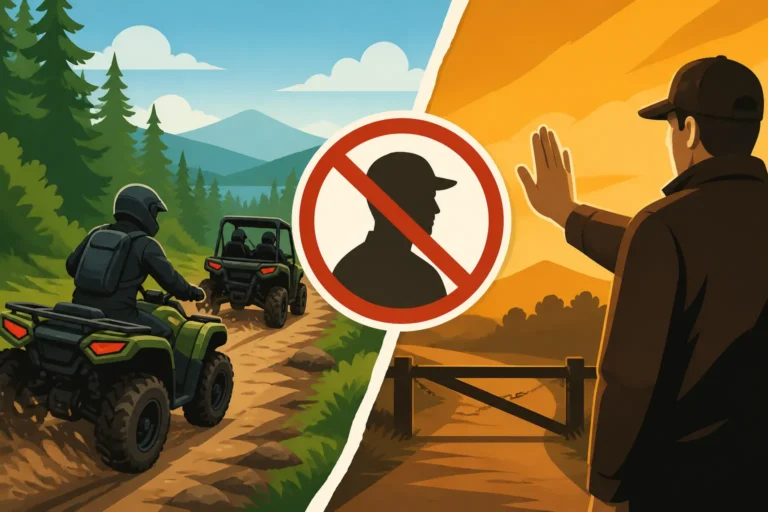
Landowners are a crucial part of the picture. A route can cross private land only while access is allowed, and maintenance work may require specific permission. A club might have permission to clear brush but still need to coordinate before using machinery, changing a crossing, or making a larger repair. If riders damage a trail or ignore a closure, the result can be more than a rough patch: it may make a landowner reconsider access for everyone.
If you want to help, start by contacting a local club and asking what work is authorized and where volunteers are needed. Do not independently cut trees, move signs, build a crossing, or reroute around a wet section. [Volunteering With a Maine ATV Club] and [Landowner Relations on Maine ATV Trails] offer useful background on how riders can support trail access responsibly.
How clubs plan and carry out trail maintenance
Routine work that keeps routes usable
A lot of trail care is unglamorous. Volunteers may spend a day trimming branches that catch helmets or mirrors, clearing leaves from a drainage dip, replacing a damaged marker, or walking a route to identify a hazard. Those small jobs can prevent larger problems: clear signs help riders stay on the authorized route, while open drainage helps water move off the riding surface instead of cutting into it.
More substantial work may involve grading or reshaping a damaged section, adding drainage features, stabilizing a slope, or repairing a bridge. The right approach depends on the soil, water flow, trail width, and landowner requirements. A repair that works on a dry, firm section may be inappropriate in a wetland or on a steep hillside. Work also needs to account for the size of the machines using the trail and any limits set by the club or property owner.
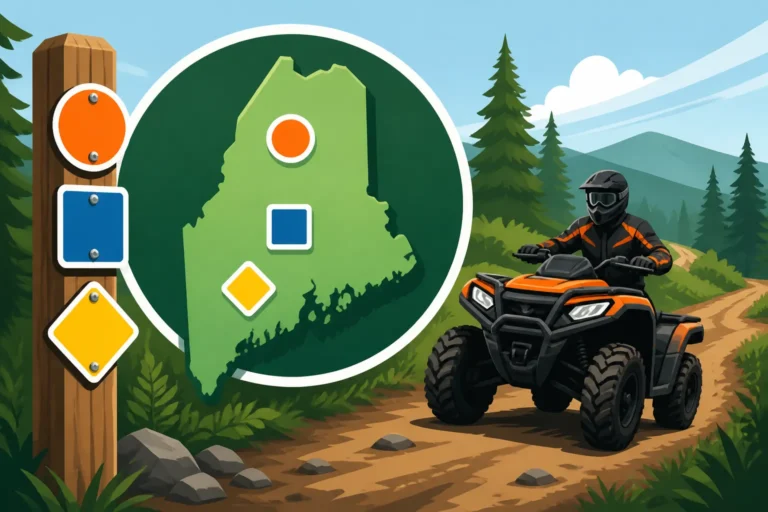
Riders can make routine maintenance easier by staying on the marked route and avoiding sudden detours around puddles, branches, or rough ground. If a trail is passable but inconvenient, that does not necessarily mean it is safe to alter. Follow posted signs, and avoid riding around barricades or into areas that look like unofficial bypasses. [Maine ATV Trail Signs and Markers] can help explain why markers and directional signs are part of trail safety, not just navigation.
Reporting a problem without making it worse
When you find a hazard, note the trail name or nearby junction and describe what you saw. A useful report might say that a tree blocks the route just beyond a marked intersection, or that a bridge approach has washed out on one side. If it is safe and lawful to do so, a location pin can help a club identify the spot. Avoid sharing an image or location publicly if doing so could encourage riders to enter a closed or sensitive area.
Do not try to fix a substantial hazard during a ride unless you are part of an authorized work crew and have the right training and equipment. A branch may be manageable; a leaning tree, damaged bridge, unstable bank, or fast-moving stream is not a casual cleanup job. Moving a barrier can also expose later riders to a danger the club deliberately closed the route to avoid.
The appropriate reporting contact depends on who manages the trail and the type of issue. A local club is often the best first contact for a club-maintained route; a public-land issue may need to go to the responsible agency. For guidance on where trail damage should be reported, see [Maine Trail Damage Reports to the Bureau of Parks]. For a fallen tree on a route, [Reporting a Downed Tree on a Trail] is another helpful reference.
Funding, permissions, and the limits of maintenance
Trail work takes time, materials, tools, and coordination. A bridge may need lumber or other approved materials, while a drainage repair may call for equipment and skilled labor. Club volunteers often contribute many hours, but larger projects can depend on grants, fundraising, donated materials, or other support. [Maine ATV Trail Grant Program] explains one part of the broader funding picture.
Funding does not automatically mean that a project can happen wherever it seems useful. Permission, environmental considerations, landowner agreements, and the trail’s approved alignment all matter. A club cannot assume that a new bridge, widened trail, or relocated route is acceptable simply because it would make riding easier. In some cases, the best decision is to close or reroute a section rather than attempt a repair that could harm the land or water.
For riders, the practical takeaway is to treat trail access as something maintained through cooperation. A courteous call to a club, respect for a posted closure, and a specific report about damage are more useful than an improvised repair. If a trail is closed, choose another open route rather than assuming the closure is temporary or optional.
Bridges and water crossings on ATV trails
Why bridges are built and what they protect
A bridge can keep tires out of a stream, wetland, or low, saturated area. By carrying riders over a sensitive crossing, it may reduce rutting, erosion, and sediment entering the water. Bridges also help make a trail more predictable: rather than asking each rider to guess where the firmest spot is, a built crossing provides a defined route.
Bridges vary in size and design. Some are simple structures over a narrow drainage; others are larger, engineered crossings built to handle repeated use. A bridge that appears sturdy from the approach is not automatically suitable for every vehicle or load. The posted restrictions, if any, should be taken seriously, and a rider should never assume that a structure can carry a wide or heavy side-by-side just because a smaller quad has crossed it.
A bridge is only one part of a crossing. The approaches, railings, surface, drainage, and surrounding ground all matter. If an approach has washed out or the bridge deck is damaged, the structure may be unsafe even if the middle span looks intact. A repair may require the club or landowner to inspect the full crossing before it reopens.
Reading the crossing before you ride onto it
Slow down well before the bridge. Look for signs, barriers, water, loose boards, uneven edges, and a clear line across the deck. If another machine is on the bridge, wait until it has crossed and the approach is clear. Avoid turning sharply or stopping in the middle unless you need to respond to an immediate safety issue. A controlled, steady crossing is generally easier than a sudden correction.
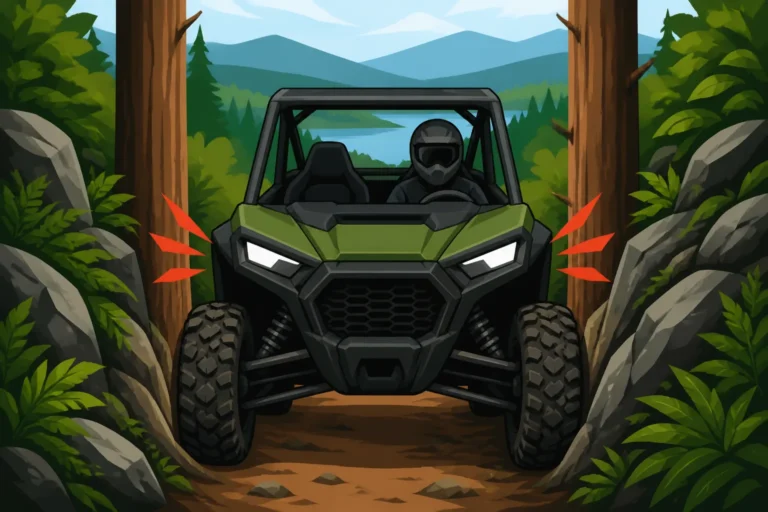
The bridge should be approached as a narrow trail feature, not a place to test traction. Keep your wheels aligned with the usable surface, avoid riding onto the edge, and do not pass another machine on a narrow deck. On a side-by-side, confirm that the machine fits within the available width before committing. If you cannot tell whether there is enough room, stop at a safe distance and assess rather than trying to squeeze across.
A bridge may be slippery from rain, mud, leaves, or frost. Traction can change quickly between the trail surface and the deck, so avoid abrupt throttle or braking inputs. If the structure looks damaged, blocked, or outside your ability to cross safely, turn around only where it is safe and permitted, then report the condition. [Trail Bridges and Water Crossings] and [Bog Bridges and How to Ride Them] cover related crossing situations and riding considerations.
What to do at an unbridged water crossing
Not every stream or wet area has a bridge, and not every visible crossing is authorized. Follow the marked route and posted instructions. Do not create a new crossing to avoid a closed bridge or muddy approach. Riding through a stream can disturb the bed and banks, send sediment downstream, or expose a rider to hidden rocks and changing depth.
If the trail includes an authorized ford, assess it from the designated approach. Water depth, current, bottom conditions, and the exit bank all affect whether a crossing is safe. A fast current or a soft, steep bank can make a shallow-looking crossing hazardous. If the bottom is not visible, the water is moving strongly, or the exit is damaged, do not assume the machine can handle it. Turning back may be the safest choice.
Do not ride around a bridge closure or barrier to reach the water. The closure may reflect structural damage, a landowner request, or a concern that is not obvious from the trail. A closed crossing is not an invitation to find a nearby workaround. For broader guidance on wet trail surfaces, see [Trail Mud After a Heavy Rain].
Riding responsibly around trail work and closures
Recognizing signs of active maintenance
A work site may have fresh gravel, cut brush, tools, equipment, barriers, or temporary signs. Slow down as soon as you notice activity and follow directions from workers. If a crew is clearing a tree or operating equipment, give them room and wait until they say it is safe to proceed. Do not ride through a work zone simply because the route looks passable.
Fresh work can be fragile. A newly shaped trail surface may need time to settle, and a repaired bridge approach may not be ready for traffic. A barrier or temporary closure should be treated as official unless the responsible club or land manager says otherwise. Even a short detour can damage soft ground or put riders into a location where the public does not have permission to travel.
Keep in mind that maintenance signs may be easy to miss when riding in a group. The lead rider should communicate changes clearly, and everyone should leave enough distance to stop safely. If the trail is closed ahead, do not crowd the entrance while deciding what to do. Turn around at a suitable location and choose a route that is confirmed open.
Avoiding damage on soft or muddy sections
When a trail is open but muddy, ride within your ability and stay on the established route. Repeatedly accelerating hard can deepen ruts and throw soil into surrounding vegetation. If a puddle or rut looks too difficult, do not widen the trail by going around it. Stop in a safe place, consider whether the route is still manageable, and turn back if necessary.
Large groups should be especially careful. Several machines passing through the same soft area can multiply the damage, even if each rider is cautious. Leave space between vehicles and avoid stopping where wheels will spin or block the route. If conditions change during a ride, it is reasonable to shorten the trip instead of pressing on because the group has already come a long way.
For trip planning, use trail maps and current local information rather than assuming that a route shown on a map is open today. Tools such as onX Offroad can help riders orient themselves and review mapped routes, but a map is not a substitute for current closure notices or permission. You can also use onX Offroad as one planning aid alongside club updates and posted signs. [Maine ATV Trail Maps and Club Boundaries] can help explain why route boundaries and local trail information matter.
Supporting the trail system as a visitor
If you are riding outside your home area, take a few minutes to learn which club maintains the route and what local rules apply. A visitor may not know that a short connector crosses private property or that a particular section is closed after heavy rain. Ask before riding if a route’s status is unclear, and avoid treating a map line as proof that access is currently allowed.
Joining a club, attending a work day, or contributing in a way the club requests can support the people who keep trails open. Even when you cannot volunteer, good riding habits matter: stay on marked routes, keep noise and speed considerate near homes, pack out what you bring in, and report hazards without trying to make unauthorized changes. These small choices help protect relationships with landowners and the wider riding community.
If you are unsure where to begin, [Maine ATV Club Membership and Dues] and [Maine ATV Club Trail Grooming and Bridges] may be relevant starting points for understanding club involvement and maintenance. Always confirm local details directly with the organization responsible for the trail you plan to ride.
Choosing and preparing for a bridge-heavy ride
Check your machine and equipment
Before heading out, inspect tires, brakes, steering, and lights. A bridge crossing is not the place to discover that a tire is losing pressure or the brakes feel weak. On a side-by-side, consider the machine’s width and turning space, and make sure cargo is secured so it cannot shift while crossing uneven approaches. Heavy or awkwardly loaded machines require extra care, especially on narrow structures.
Carry basic items appropriate to the length and remoteness of the ride, such as water, a charged phone, a first-aid kit, and a way to navigate if service drops. A paper map can be useful where cell coverage is unreliable. A digital map, including onX Offroad, may help with orientation, but download or prepare what you need before entering an area where service may be limited.
Do not plan a route solely around the number of miles shown on a map. A trail with multiple bridges, rocky approaches, or muddy sections can take longer than a smoother route of similar distance. Build in time to stop, check conditions, and turn back if a crossing is closed or unsafe.
Compare common trail features before setting out
| Trail feature | What to watch for | A responsible response |
|---|---|---|
| Narrow wooden bridge | Wet or uneven deck, limited width, damaged boards | Slow down, cross one machine at a time, and do not pass |
| Bridge with a rough approach | Washout, loose gravel, steep edge, standing water | Assess the approach before crossing and report damage |
| Bog bridge | Slick boards, narrow riding line, muddy ground beside it | Stay centered and avoid leaving the established route |
| Unbridged stream | Current, hidden rocks, soft banks, unclear depth | Use only an authorized crossing and turn back if uncertain |
| Freshly repaired section | Loose surface, equipment, temporary barriers | Follow signs and directions from the work crew |
| Closed or blocked route | Barricades, closure notices, missing or damaged crossing | Do not bypass it; choose another open trail |
Make a plan that can change
Pick an intended route, but leave room to adjust. Check the trail’s status before departure, tell someone where you expect to ride, and decide where you can turn around if a bridge or crossing is closed. If your route depends on reaching a specific town, such as Greenville or Millinocket, identify an alternative rather than assuming every connecting segment will be open.
During the ride, watch for fresh damage and changes in water or ground conditions. A crossing that looked manageable on the way out may be less safe after rain or after several machines have passed through. If a bridge feels unstable, the approach is badly eroded, or a closure is posted, stop and reassess. Completing the planned loop is never worth risking a crash or damaging access.
Most importantly, treat maintenance as a shared responsibility. Clubs and landowners do much of the work behind the scenes, but riders influence whether that work lasts. Staying on the route, respecting closures, and reporting problems carefully helps keep Maine ATV trails and their bridges usable for the next rider.
Disclaimer
This article is for general informational purposes only and does not constitute professional advice. Laws, prices and regulations vary by location and change over time. Consult a qualified professional for guidance on your specific situation.