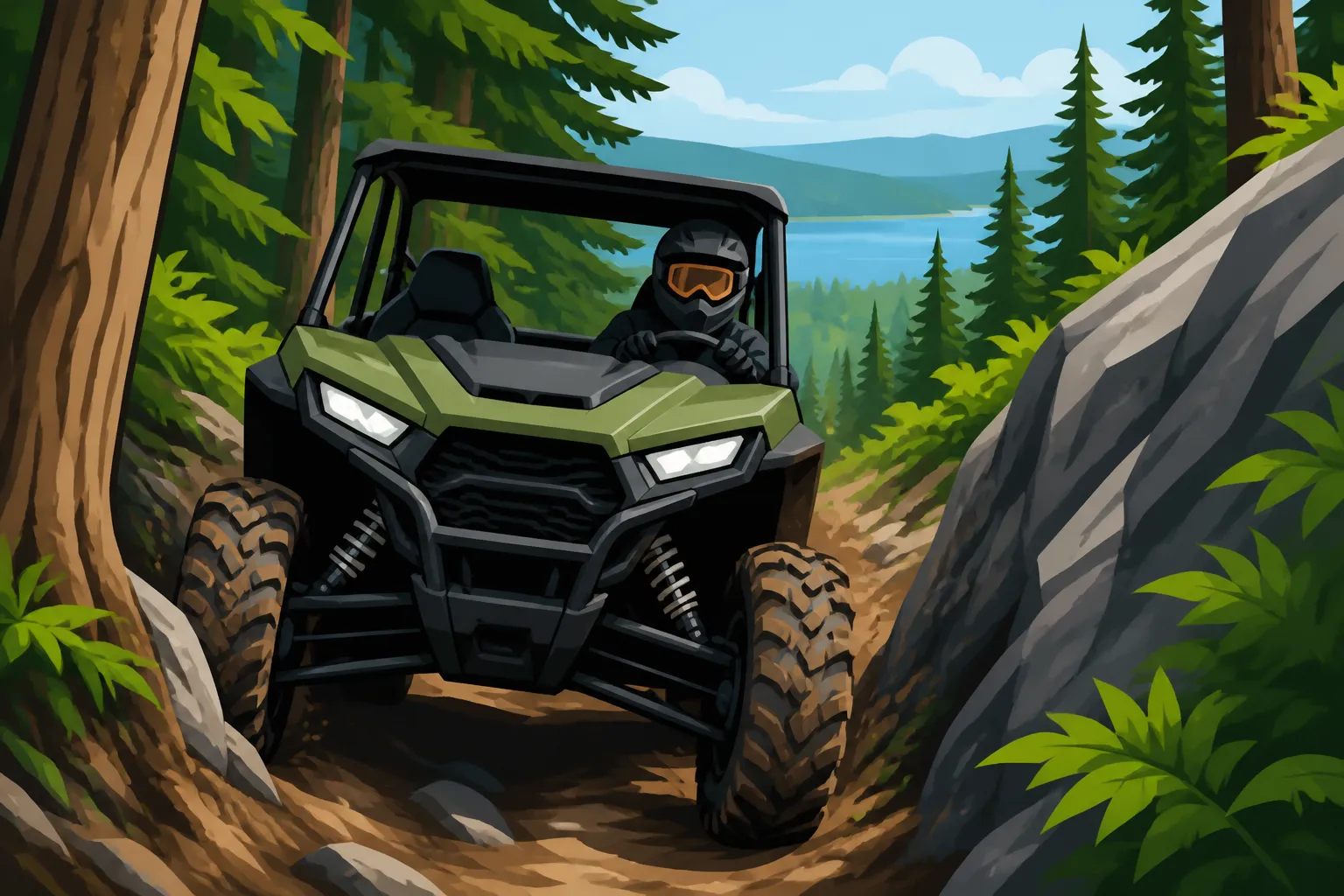
Wide Side-by-Sides on Narrow Maine Trails
A wide side-by-side can feel perfectly manageable in an open field, then become awkward fast on a Maine trail that pinches between trees, rocks, ditches, or a bridge rail. This guide explains how to judge whether your machine fits, plan a suitable route, ride tight sections without damaging the trail, and avoid assuming that every trail welcomes every UTV.
Why a wide side-by-side can be a poor fit
Trail width is more than the space between two trees
The word “wide” can mean different things on the trail. The usable corridor may narrow at a bridge, bog crossing, gate, ledge, or sharp bend, even if the main trail looks broad. A machine might fit between trees but still lack enough room for its tires, mirrors, or bodywork to clear obstacles while turning.
Width is only one part of the fit. A longer wheelbase can make a tight corner harder to negotiate, while a larger turning radius may require backing up or making several careful adjustments. A tall or heavy machine also behaves differently on a narrow, uneven trail: a sloped edge, soft shoulder, or rut can make it harder to keep the vehicle centered.
That’s why a route that looks wide enough on a map, or from the trailhead, may still be uncomfortable for a full-size side-by-side. The ride can change from open and forgiving to narrow and technical in a short distance. A machine that is easy to handle on a gravel road may feel like a tight squeeze on a wooded club trail.
Width limits and trail access are not the same everywhere
Maine’s ATV trail network includes routes managed with help from clubs and landowners, and conditions can vary from one segment to the next. A posted limit, club rule, physical barrier, or landowner restriction may determine whether a machine is allowed. Even where a trail is technically open to a type of vehicle, its width and surface may make it a poor practical fit.
Don’t treat a trail’s presence on a map as proof that your specific UTV can use it. Some trails are designed or maintained with smaller ATVs in mind; others include wider corridors or connections where a side-by-side may be more comfortable. Rules can also differ between connected trail sections, so check the route as a whole rather than relying on what you know about one familiar stretch.
A useful starting point is [Trail Width Limits Set by Clubs](Trail Width Limits Set by Clubs) and [Trails Too Narrow for a 64-Inch Machine](Trails Too Narrow for a 64-Inch Machine). These are reminders to verify the actual restriction and trail condition, not to assume that every Maine club applies the same limit or that every section has the same width.
Compare your vehicle with the route, not just its advertised size
Before choosing a trail, check the exact width of your UTV in the configuration you’ll ride. A model’s listed width may not include accessories or changes such as wider tires, wheel spacers, mirrors, doors, or aftermarket parts. If your machine has been modified, measure its widest point yourself and use the manufacturer’s specifications as a starting reference.
| Machine or trail factor | What to check | Why it matters |
|---|---|---|
| UTV width | Measure the widest point, including accessories | The body or tires may reach farther than expected |
| Trail corridor | Check club guidance and known pinch points | A route can narrow at bridges, turns, and obstacles |
| Turning space | Consider wheelbase and turning radius | A machine may fit straight through but struggle to turn |
| Surface and slope | Look for ruts, soft edges, rocks, and off-camber sections | Limited room to correct a line can increase risk |
| Route status | Confirm current openings and restrictions | Access and conditions can change by segment |
Use the comparison as a planning check, not a guarantee. A nominal width that seems close to the available space leaves little room for steering corrections, suspension movement, or uneven ground. If your machine would need to brush trees or ride an unstable shoulder to pass, choose another route rather than trying to force it through.
How to plan a Maine ride for a wider UTV
Start with current club information
The most reliable planning begins with the people who know and maintain the trail. Look for information from the relevant ATV club or land manager, paying attention to vehicle-size guidance, posted restrictions, bridge limitations, and route closures. If anything is unclear, ask before loading the machine. A quick call or message can save a long trailer haul to a trailhead where your UTV is not a suitable fit.
Maine trail conditions are not static. Seasonal changes, storm damage, maintenance work, landowner decisions, and mud can affect access or the passability of a section. A route that worked for a smaller ATV last season may have changed, and an open route may still be a poor choice for a wide machine after heavy rain or a washout.
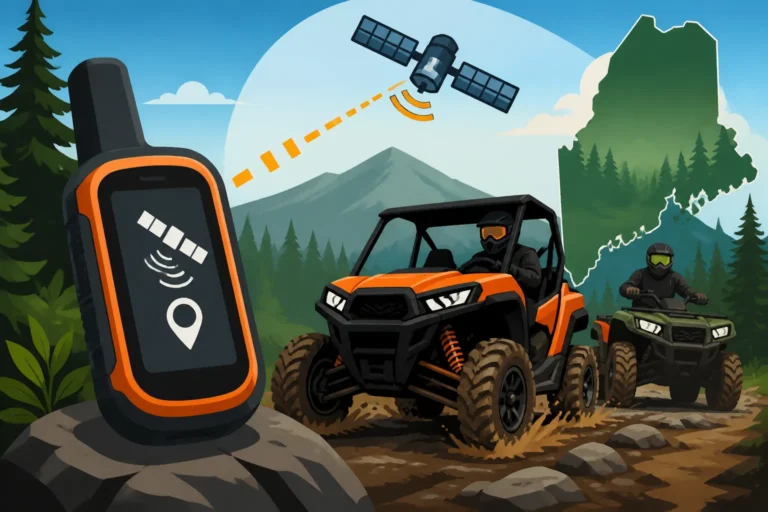
Use [Checking Maine Trail Status Before You Drive](Checking Maine Trail Status Before You Drive) as part of your pre-trip routine. Map apps, including onX Offroad, can help you review a route and organize waypoints, but treat them as planning aids rather than final permission or proof of current access. Cross-check the app’s information with the club or land manager responsible for the trail.
Build a route around confirmed connections
A common planning mistake is selecting a destination first and assuming the trails connecting it will all suit the vehicle. Instead, map a route segment by segment. Identify the starting point, intended trail connections, likely narrow sections, fuel or rest stops, and a turnaround option. If a route depends on one uncertain connector, find out whether there is a wider alternative before leaving.
Maine trail systems can cross a mix of terrain and land ownership. A wider section near a town does not mean the next wooded segment is equally spacious, and an ATV-access route on a road is not necessarily a substitute for a trail connection. Confirm that each link is open to your vehicle and that you are permitted to use it. When in doubt, choose a shorter loop that stays within confirmed, suitable sections.
A paper map or saved offline route can be helpful where cell service is limited. onX Offroad can support route planning and help you keep track of your intended line, but it should sit alongside local information rather than replace it. Save key club contacts and a plan for turning back before you enter an area where you may not be able to get a signal.
Plan the trailer and staging details too
A ride can be well planned on the trail and still go sideways at the parking area. A wide UTV and its trailer need room to enter, turn, unload, and park without blocking other riders or nearby roads. Before driving to a remote trailhead, check whether the staging area can accommodate your trailer and whether overnight parking is allowed if that’s part of your plan.
Look at the approach as well as the lot. A narrow access road, tight turn, low branch, or soft shoulder can be a challenge for a tow vehicle and trailer even if the trailhead itself is spacious. Ask local organizers or clubs about practical access where posted information doesn’t answer the question.
[Trailhead Parking That Fits a Trailer](Trailhead Parking That Fits a Trailer) can help you think through the logistics before leaving home. For a broader understanding of how trail types and riding conditions differ around the state, review [Maine ATV Trail Difficulty by Region](Maine ATV Trail Difficulty by Region). Neither a regional overview nor an online map replaces checking the exact trail and staging area for your intended vehicle.
Riding narrow sections with more control
Slow down before the trail narrows
If a route is confirmed as open and suitable but has occasional tight spots, approach them slowly. Reduce speed before reaching the pinch point, scan for the widest clear line, and look beyond the immediate obstacle so you can anticipate a bend or change in slope. A passenger can help spot clearances, but the driver remains responsible for controlling the machine and deciding whether to continue.
Avoid making a rushed turn between trees or around a rock. A wide UTV may need more room than expected to swing through a corner, and steering sharply can bring a rear tire or body panel closer to an obstacle. Small, deliberate movements are usually easier to judge than a quick correction. If you’re not confident that the machine will pass without striking trees or riding over a fragile edge, stop and reassess.
On unfamiliar trails, treat sudden changes as a reason to pause. A narrowing corridor, damaged bridge approach, deep rut, or sloping bank may make the next few metres more difficult than the section behind you. It’s better to stop while you still have room than to discover that turning around is impossible after entering a tight spot.
Use a spotter carefully
A passenger or riding partner can help estimate clearance around a tree, rock, or bridge rail. Before moving, agree on simple signals and make sure the spotter stands where the driver can see them without being in the vehicle’s path. The spotter should never stand between the UTV and an obstacle, near a tire, or where a slip or unexpected movement could trap them.
Move only as fast as the driver can respond to the guidance. If the spotter disappears from view, stop immediately. Don’t guess at a signal or continue moving while someone is repositioning. On uneven ground, the vehicle may shift or roll slightly as the tires climb a rut or rock, so both people need to stay aware of the machine’s path and the surface.
A spotter can help with judgment, but can’t make an unsuitable trail suitable. If there isn’t enough width to keep all tires on stable ground, or the machine needs to push through branches, damage vegetation, or climb a fragile edge, turn around if you can do so safely. Respectful riding means accepting that a route may not be right for your vehicle today.
Protect trail edges, bridges, and landowner relationships
On a narrow trail, the temptation can be to widen the path by driving around a tree, rut, or muddy patch. That can tear up vegetation, erode a bank, or create a new track that wasn’t approved. It may also concern the landowner whose permission helps keep the route open. Stay on the established trail and avoid creating a bypass unless the club or land manager directs riders to use one.
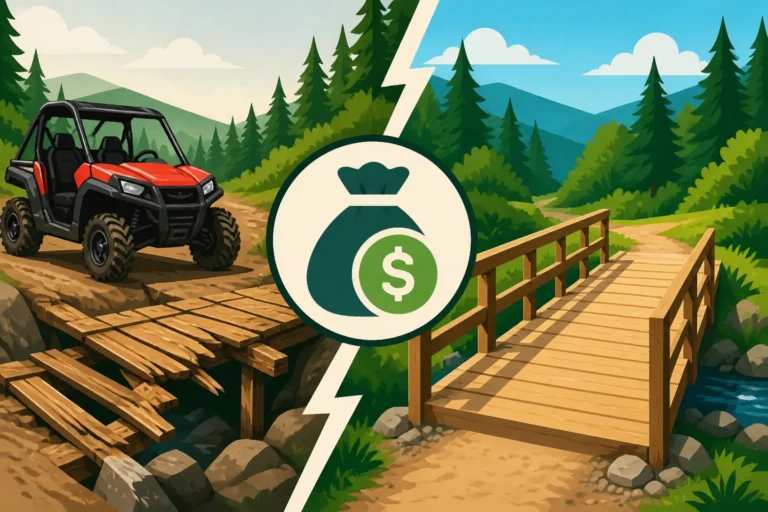
Take extra care at bridges and culverts. A narrow crossing may have limited room for the tires, and an approach that is soft or uneven can leave little space to correct your line. Don’t assume a bridge can bear your vehicle simply because an ATV crossed it. Follow posted restrictions, use only crossings confirmed for your machine, and turn back if the structure or approach looks damaged.
A few courteous choices matter across the wider trail network: slow down near homes, farms, and other users; keep noise and dust down where practical; and don’t block a gate or access road while stopping. For more on shared responsibility, see [Maine ATV Trail Etiquette With Landowners](Maine ATV Trail Etiquette With Landowners). Trail access often depends on continued cooperation, and a machine’s size makes careful conduct especially important on tight routes.
Choosing a more suitable trail and machine setup
Match the machine to the ride you want
If your main goal is exploring narrow, wooded routes, a smaller machine may be a better fit than a full-size side-by-side. If you need a UTV for passengers, cargo, or work at camp, you may prefer a wider model but need to plan around routes known to accommodate it. Neither choice is universally better; the right one depends on how you’ll actually ride.
Think through the whole trip, not only the trail itself. A wider machine may offer the seating or cargo capacity you need, but can limit route options. A narrower machine can be easier to place between obstacles yet still be too large for a particularly tight turn or restricted crossing. Check the owner’s manual and manufacturer specifications, and avoid assuming that one model’s dimensions apply to another in the same product family.
If you’re buying or renting, ask specific questions about trail compatibility in the area you plan to visit. “Can it ride Maine trails?” is too broad to be useful. Ask whether that exact machine has been used on the particular system, whether there are width restrictions, and which sections the provider recommends avoiding. Local knowledge is most helpful when it refers to the actual route and vehicle.
Consider tires and accessories before the trip
Aftermarket changes can affect clearance. Wider tires, wheel spacers, oversized fenders, mirrors, doors, racks, windshields, and other accessories may increase the machine’s practical footprint or make it harder to judge how close the vehicle is to trees. Even if the tires fit within the body, they may catch an obstacle or edge in a tight corridor.
Before leaving, walk around the machine and identify its widest points. Check that added equipment is secured and that nothing protrudes farther than you expect. If an accessory affects visibility or makes the cab harder to judge in close quarters, practice on a safe, open area before riding a narrow trail. A passenger can also confirm which parts of the machine are hardest for the driver to see.
Don’t remove safety equipment or make a modification simply to squeeze through a route. If the only way to pass is to alter the machine in a way that compromises safe operation, the route is not a good match. Choose a different trail or vehicle rather than treating a tight clearance as a challenge to overcome.
Look for routes built for larger machines
Some trail systems or sections are more accommodating to full-size UTVs than others. Search for routes that clubs identify as suitable for wider machines, and confirm any limitations at bridges, gates, or connectors. [Maine ATV Trails for Full-Size Machines](Maine ATV Trails for Full-Size Machines) is a useful related topic when comparing route options, but check details directly with the club that maintains the area.
In practice, “wide trail” does not always mean a smooth or easy ride. A broad corridor can still include rocks, steep grades, soft ground, deep ruts, or narrow structures. Conversely, a narrower-looking corridor may have a firm, maintained surface and enough clearance for a particular UTV. Consider terrain, turning space, obstacles, and vehicle restrictions together rather than relying on one label.
onX Offroad can help you compare possible routes and keep a planned track available offline, but local confirmation remains essential. Save more than one option when possible. If a club reports a closure or a section appears unsuitable when you arrive, having an alternate route can turn a frustrating no-go into a shorter, safer ride elsewhere.
Group rides, turnarounds, and common mistakes
Leave space and communicate in a group
A group that includes both ATVs and side-by-sides needs to think about width and spacing. A wide UTV should not crowd another rider at a pinch point, and faster machines should not pressure someone ahead to continue through an obstacle they’re assessing. Establish who is leading and who is sweeping, agree on stop points, and make sure everyone knows what to do if the route becomes unsuitable.
Don’t park a group across a narrow trail while discussing the route. Move to a safe, wider area when possible, keeping gates, driveways, bridges, and road access clear. If a machine needs to turn around, let the rest of the group know and give it room. On an unfamiliar trail, the most useful group decision may be to reverse course before the terrain becomes more restrictive.
For a detailed look at coordinating multiple machines, see [Riding Trails With a Large Group](Riding Trails With a Large Group). Good communication reduces the chance that riders will bunch up at a narrow crossing or follow the lead machine into a section that doesn’t fit everyone.
Know when to turn around
Turning around is not a failure; it is a normal part of responsible trail planning. Watch for warning signs such as repeated contact with branches, tires nearing an unstable edge, a bridge that appears too narrow, or a trail becoming progressively tighter. If the vehicle needs force, significant wheelspin, or repeated repositioning just to continue, stop and reconsider before the situation worsens.
Choose a turnaround point while you still have enough room. On a tight trail, that may mean backing carefully to a wider spot rather than attempting a multi-point turn on a slope or near a ditch. Use a spotter when available, keep the path clear, and move slowly. If you cannot turn safely, don’t improvise a route through brush or onto private land; seek help from the group or the relevant club.
It’s also sensible to carry basic recovery and communication equipment suited to the trip. Tell someone where you plan to ride and when you expect to return. Remote routes can have limited cell service, so consider how you would contact help if a machine becomes stuck or damaged. A route that is marginal for your vehicle is even less appealing when assistance is far away.
Avoid these assumptions
The most common mistake is assuming that a UTV’s trail access is determined by its registration alone. Registration does not tell you whether a specific trail segment is wide enough, whether a club or landowner allows your machine, or whether a bridge can accommodate its weight and dimensions. Verify all of those details separately.
Another frequent mistake is relying on a friend’s past experience without checking what has changed. A friend may have ridden a smaller machine, used a different trail connection, or visited before a closure or maintenance issue. Likewise, an online route line can be helpful, but it may not communicate the narrowest point, current condition, or local restriction clearly enough for your decision.
Finally, don’t treat a tight squeeze as an invitation to widen the trail. Avoid knocking down branches, driving off the established route, or using a private road or field as an unapproved bypass. If a section is too narrow, turn back and report a problem or ask the club for guidance. The best trip is one where both riders and the trail are in good shape when everyone gets home.
Disclaimer
This article is for general informational purposes only and does not constitute professional advice. Laws, prices and regulations vary by location and change over time. Consult a qualified professional for guidance on your specific situation.