Closing Gates Behind You on a Trail
A gate on a Maine ATV trail is more than an obstacle: it may keep livestock in, mark a property boundary, or control access to a private woods road. If you open it to pass, close it behind you unless a sign or the landowner clearly says otherwise. This guide explains how to handle gates safely, respectfully, and without putting trail access at risk.
Why gates matter on Maine ATV trails
A gate can protect more than the trail
Many Maine riding routes cross private land, including farm fields, working forests, and roads leading to camps or woodlots. A gate may keep cattle or other animals from wandering, limit vehicle access during a logging operation, or help a landowner manage who enters the property. Even a gate that looks simple or unused may serve a purpose that is not obvious from the trail.
For riders, the key point is that an open gate is not automatically a signal to ride through, and a closed gate is not an invitation to find another way around. Access can depend on permission from the landowner, a club agreement, posted rules, and current trail conditions. If you are unsure what access is allowed, stop and check before proceeding rather than guessing.
Respectful gate handling is part of Maine Trail Etiquette With Landowners. A rider who leaves a gate open can create trouble for a landowner, even if the rider meant no harm. If livestock escape or a property owner has to make an extra trip to secure a gate, the consequences may affect more than one rider: the landowner may question whether the trail should remain open.
A gate may mark a changing access situation
Gates can also signal temporary or seasonal changes. A woods road may be closed while logging equipment is working, a farm lane may be restricted during a particular activity, or a landowner may close access after wet weather damages the route. A gate that is locked, newly closed, or accompanied by a notice deserves particular attention.
Maine trail access relies on continued cooperation between landowners, clubs, towns, and riders. Do not assume that a familiar trail is open just because you rode it last week or because it appears on a map. Check club notices and trail updates before heading out. Checking Maine Trail Status Before You Drive can help you avoid arriving at a route that has closed or changed.
A map app can help with navigation, but it cannot establish permission to ride. onX Offroad may help you understand where you are and keep track of your route, but treat posted signs, landowner instructions, and current club information as the authority on whether you may proceed.
What to do when you reach a gate
Stop, read, and assess before opening it
Slow down well before the gate. Give yourself room to stop without blocking the trail for riders behind you, then look for signs, notices, locks, and other instructions. Check whether the route appears to continue on the other side and whether there is a safe place to pause. Do not treat a gap beside the gate as an alternate trail unless the route is clearly designated that way.
If a sign says the trail is closed, access is prohibited, or the gate must remain secured, follow that instruction. Do not unlatch, lift, climb over, cut, or drive around a closed or locked barrier. A gate is not a puzzle to solve; it may be protecting a work area, animals, private property, or a route that is no longer open to riders. If the notice is unclear, turn around and contact the local ATV club or another appropriate trail contact when you have a safe opportunity.
When the route is open and the gate is intended for riders to pass, take a moment to identify how it opens and secures. Some gates swing; others slide or lift. Look for a latch, chain, or tie and avoid forcing hardware that does not move easily. Do not handle electric fencing or wires. If a gate is damaged, jammed, or unsafe to operate, do not improvise a repair or leave it unsecured. Report the problem to the club or landowner contact.
Close it the way you found it
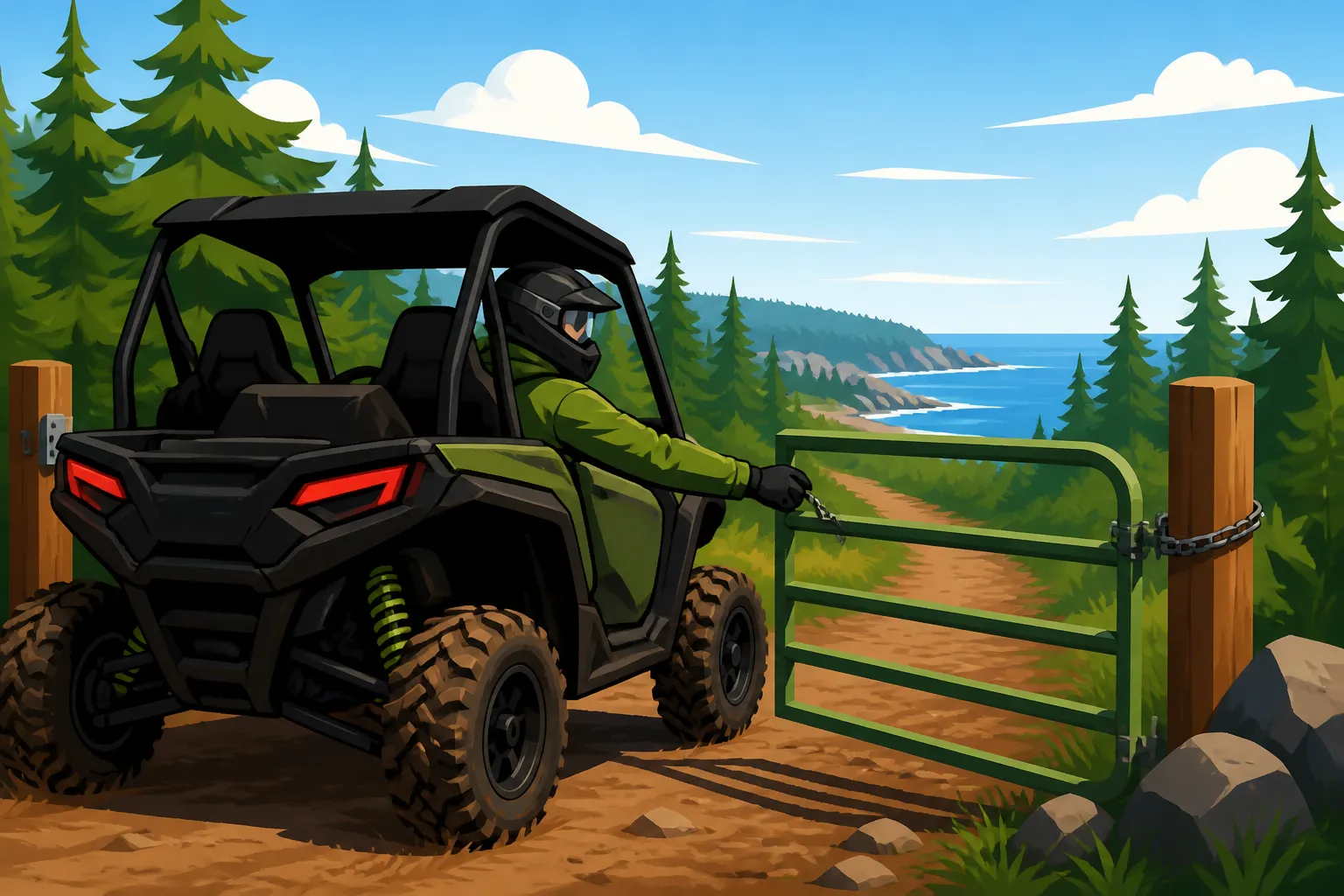
If you open a gate, close it behind you unless clear instructions say otherwise. Secure the latch, chain, or tie as you found it, and make sure the gate is actually caught before riding away. A gate that is pushed nearly closed but left unlatched can swing open in the wind or after an animal nudges it.
The “leave it as you found it” principle is useful, but it does not override a direct instruction. If the gate is closed when you arrive and the route is clearly open to riders, pass through and close it again. If it is intentionally propped open with a sign or other clear direction to leave it open, follow that direction instead. When there is no sign and no obvious explanation, closing it is generally the safer choice after you pass.
Avoid making your own changes. Do not prop a gate open with a rock, tie it to a tree, remove a chain, or leave a latch hanging where it could snag an animal or another rider. The goal is not merely to get through. It is to leave the barrier in the condition its owner intended.
| What you find | Sensible response |
|---|---|
| Open gate with no instruction to leave it open | Pass only if the route is open, then close and secure it |
| Closed gate and a clearly open trail beyond | Open it only if it is designed for rider access, then close it again |
| Locked gate or sign saying the route is closed | Do not pass, climb over, or go around |
| Gate marked to remain open | Follow the posted instruction |
| Damaged gate or confusing notice | Do not force it; stop safely and report or verify access |
| Livestock near the gate | Move slowly, avoid startling animals, and secure the gate carefully |
How to handle a gate with a group or a UTV
Assign one rider to manage the gate
On a group ride, do not let everyone crowd the entrance. Stop far enough back that riders can line up without blocking the route, and choose one person to open and secure the gate. The first rider can pass through, stop in a safe place, and hold the gate only if doing so does not create a hazard. The last rider should be responsible for checking that it is secured.
A simple verbal cue helps prevent the familiar “I thought you closed it” problem. The person handling the gate can tell the group when it is open, and the last rider can confirm that it is latched before leaving. Keep the conversation brief and clear, especially if other riders or vehicles are approaching.
If the gate is awkward to manage while mounted, stop the machine in a stable place and dismount only when it is safe to do so. Keep the ATV or UTV out of the gate’s swing path, and never leave a machine idling where it could roll or block the trail. On a slope, in deep mud, or in a narrow spot with poor visibility, take extra care to avoid creating a second hazard while dealing with the first.
Give wider machines and trailers extra room
A side-by-side may need more clearance than a quad, particularly when the gate opens narrowly or the approach is uneven. Check the width and turning space before committing. Do not scrape the gate, push it with the bumper, or use the machine to hold it open. If the opening is too tight to pass without contact, do not force the maneuver; check whether another authorized route exists or turn back.
Trailers make gate crossings even more demanding. A rider may clear the gate but leave the trailer close enough to strike it while turning. Pause to plan the full path of the machine and trailer, including the swing at the rear. If the gate cannot be opened wide enough without stressing it, do not attempt to squeeze through.
A navigation tool such as onX Offroad can be useful for keeping your group oriented when you need to retrace a route or locate a trail junction. But an alternate line on a screen is not permission to bypass a gate. Stay on the designated route, and do not create a new path across fields or around a barrier. For broader guidance about respecting access on private routes, see Maine Trails That Cross Private Land and Landowner Relations on Maine ATV Trails.
Common gate mistakes and how to avoid them
Do not assume an open gap means permission
Riders sometimes see a gate standing open and conclude that the trail is unrestricted. The gate may have been left open for farm equipment, a landowner, or another authorized user. Look for signs and confirm that the route is open to ATVs or UTVs before proceeding. If you cannot confirm access, do not treat the gate’s position as proof.
It is also a mistake to go around a gate through brush, a field, or the edge of a woods road. That can damage property, widen the trail, or create a new route that the landowner never approved. A bypass may also put riders into a ditch, fence, or soft ground that is less safe than the marked route. If a gate blocks your way and you do not have clear permission to pass, turn around.
Likewise, do not rely on an old track, saved route, or map line as proof that the trail remains open. A route may have changed since it was recorded. Use mapping tools to understand your location, then check local trail updates and signs on the ground. Maine ATV Trail Maps and Club Boundaries is useful context when planning a ride across connected trail systems.
Avoid rushing or leaving the next rider to guess
The most common preventable problem is riding away before checking the latch. Take a second to look back. Is the gate fully closed? Is the chain or hook secured? Could the gate swing open on its own? That final glance is especially important after a long ride, when everyone is tired and focused on reaching the next stop.
If the gate is difficult to close, do not leave it in a half-secured position and hope it stays there. If you can safely secure it as intended, do so. If not, record the location and report the issue to the relevant club or landowner contact. A report should be specific enough to identify the spot, such as the nearby trail junction, road crossing, or marked feature. Do not post private property details publicly if that could encourage unauthorized access.
Keep track of other trail conditions while you are there. A broken latch, fallen tree, or washed-out approach may affect the next group as well. For a downed tree or similar obstruction, Reporting a Downed Tree on a Trail offers related guidance. For signs that identify route rules, closures, and boundaries, see Maine ATV Trail Signs and Markers. If you encounter purple paint or posted notices, do not dismiss them as decoration; What Purple Paint Means in the Maine Woods explains why those markings deserve attention.
The habit is simple: pause, read the instructions, use the gate only when the trail is open, and leave the barrier secured as directed. On Maine’s shared trail network, that small act helps protect landowner relationships and keeps access safer for the riders who come after you.
Disclaimer
This article is for general informational purposes only and does not constitute professional advice. Laws, prices and regulations vary by location and change over time. Consult a qualified professional for guidance on your specific situation.