Maine Poker Runs and Club Events
A Maine ATV poker run can sound simple until you’re trying to figure out where to meet, whether your machine fits the route, what the entry fee covers, and how to ride legally between checkpoints. This guide explains how club events usually work, what to confirm before you go, and how to prepare for a safer, smoother day on Maine’s trails.
What to expect at a Maine ATV poker run
How the ride and poker-hand format usually work
A poker run is generally a club-organized ride with several stops along a planned route. At each checkpoint, participants receive a playing card or another method of recording a card. At the end, the cards are compared to determine a poker hand. The route and hand format vary by organizer, so check the event details rather than assuming every run follows the same rules.
The ride is usually more about spending a day on the trail and supporting a local club than about gambling. Some events offer prizes, raffles, food, or other activities, but the details differ. Ask the organizer what the entry fee includes, how winners are selected, and whether you need to be present at the finish to claim a prize.
A route may loop back to the starting point, connect several trail sections, or use designated checkpoints in nearby communities. In regions such as Aroostook County, the Moosehead Lake area, or The Forks, the scenery and distances can feel very different from a shorter local club ride. Don’t rely on the word “poker run” to estimate the day’s length: get the route distance, expected riding time, and last-checkpoint information from the event organizer.
Club rides and other events are not all the same
Maine ATV clubs may host poker runs, group rides, trail work days, fundraisers, seasonal gatherings, or community events. A poker run is typically organized around a route and checkpoints; a group ride may focus more on riding together; and a work day is likely to involve clearing brush, checking signs, or maintaining trail infrastructure. Read the event description carefully so you know whether you’re signing up to ride, volunteer, or both.
Some events are open to visiting riders, while others may have registration limits, machine requirements, or club-specific participation rules. If you’re visiting from out of state, don’t assume your home registration automatically covers riding in Maine. Review [Maine ATV Registration for Non-Residents] and Maine ATV Rules for Canadian Visitors if either situation applies to you.
If the event is promoted as family-friendly, ask what that means in practice. It might mean a shorter route, a relaxed pace, or activities at the start and finish, but it does not necessarily mean every machine or trail section is suitable for young or inexperienced riders. For routes involving children, check the applicable rules and supervision expectations in [Maine ATV Age Rules for Riders Under 16].
How to prepare before the event
Confirm the route, machine fit, and registration requirements
Before traveling to an event, confirm the exact meeting location, start time, check-in process, route length, and expected finish time. Ask whether the ride is intended for ATVs, side-by-sides, or both. A wide UTV may not fit every trail section, even when it is permitted at the event. If you ride a larger machine, ask about trail width and whether any parts of the route are unsuitable for your vehicle.
Make sure your machine is registered for the riding you plan to do, and bring the required paperwork. An event entry or club membership is not a substitute for a state registration. If you need to sort out the process, What It Takes to Register an ATV in Maine explains the basic considerations, while Maine ATV Registration Confirmation for Immediate Riding is useful if you have recently completed a registration and are unsure what documentation to carry.
Also ask whether participants need to register in advance or can sign up at the event. Organizers may need to cap attendance for parking, meal planning, checkpoint staffing, or trail capacity. If you’re coming with a group, find out whether everyone checks in individually and whether machines need to arrive together.
| What to confirm | Why it matters | Question to ask the organizer |
|---|---|---|
| Route length and estimated duration | Helps you plan fuel, food, and travel time | How long should riders expect to be out? |
| Machine types and trail width | Some routes may not suit wider UTVs | Are side-by-sides allowed on the full route? |
| Registration and entry | Requirements and included activities can vary | What does the entry process or fee include? |
| Checkpoint and finish times | Late arrivals may miss a stop or closing time | When does the final checkpoint close? |
| Fuel and food access | Remote stretches may have few services | Are fuel stops or meals available along the route? |
| Parking and staging | Trailers need room to unload and turn | Where should trucks and trailers park? |
| Trail status | Conditions and access can change | Where will official route updates be posted? |
Use maps as backup, not as permission to ride
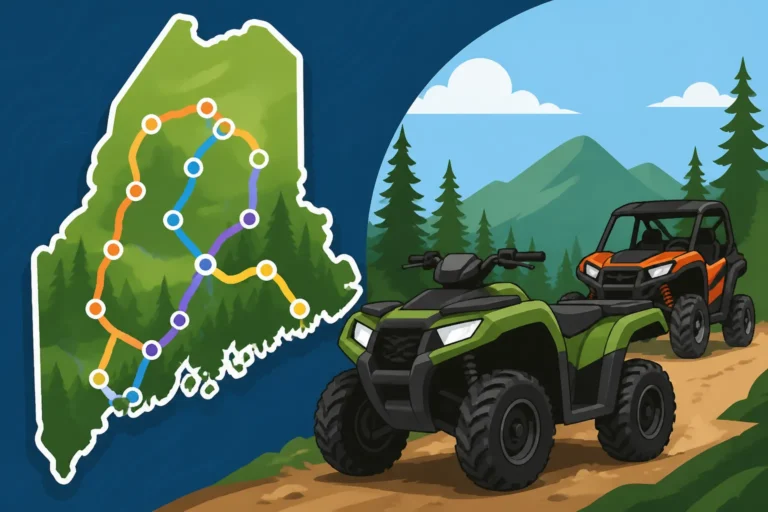
A route map can help you understand the general area and prepare for turns, but a map alone doesn’t establish that a trail is open or that you have permission to use it. Maine trails often depend on landowner permission and local club relationships. Routes may change because of weather, maintenance, logging activity, or a landowner’s decision.
Ask the event organizer which route information is official and how changes will be communicated. A map app such as onX Offroad can be helpful for reviewing the surrounding area and keeping a sense of direction, but treat the organizer’s route instructions and current trail markings as the authority for the event. Download or save what you need before leaving an area with reliable cell service. In the woods, phone coverage can be inconsistent.
Carry a paper map or written route notes if the organizer provides them. Keep your phone charged, and consider a power bank, especially if you rely on it for navigation or emergency calls. If your group becomes separated, agree ahead of time on a simple plan: stop at a safe place, avoid making unplanned route changes, and follow the event’s instructions for reconnecting.
For more general planning, Maine ATV Trail Maps and Club Boundaries can help explain how club trail systems fit together. For navigation when service drops, Navigating Trails Without Cell Service and Carrying a Paper Map in the Backcountry offer practical preparation ideas.
Ride safely and respectfully during the event
Follow the leader, posted signs, and event instructions
At check-in, listen to the ride briefing even if you’ve ridden in Maine before. The organizer may explain route changes, checkpoint procedures, group spacing, local hazards, or sections where riders need to slow down. Pay attention to instructions about where to stop and how to move through villages, road crossings, and shared trail areas.
Ride at a pace that leaves you room to react. Don’t assume the rider ahead can see you, and avoid crowding another machine on a narrow trail. If someone stops, slow down and leave enough space for the people behind to respond safely. At a road crossing, follow signs and event directions, and do not treat a group ride as a reason to ignore ordinary traffic rules. See Maine ATV Road Rules Riders Get Wrong for a closer look at common public-way mistakes.
It’s also worth checking the event’s rules for passengers and young riders. A machine that appears to have room for another person may not be designed or equipped to carry a passenger safely. Make sure each rider understands the plan and can manage the route’s conditions. If a participant is inexperienced, tell the organizer before the ride so the group can choose a suitable position and pace.
Be considerate of landowners and local communities
Many Maine ATV routes depend on landowners who allow clubs to maintain or cross private property. Staying on the marked trail, closing gates when instructed, and keeping noise down near homes are small actions that help preserve access. Do not cut across a field, bypass a closure, or follow an unofficial shortcut simply because someone else appears to have done so.
Checkpoints may be hosted at a club property, business, community space, or trail junction. Follow parking directions, leave access clear for others, and take trash with you. If a checkpoint is busy, keep your machine out of the way and follow the volunteers’ directions. A friendly attitude matters: organizers and club members often put in substantial volunteer effort to make the event possible.
Conditions can also change during the day. A dry route may become muddy after rain, and a section that feels easy on a small ATV may be awkward for a wide side-by-side. Respect temporary signs and organizer reroutes. For context on how access and landowner relationships affect riding, read Why 80 Percent of Maine Trails Sit on Private Land and Maine Trail Etiquette With Landowners.
What to bring and how to make the day go smoothly
Pack for a long day, not just a short loop
Even a well-organized event can take longer than expected. Bring water, food or snacks, weather-appropriate layers, gloves, and any personal medication you may need. Maine weather can shift, and a chilly start or light rain can make a long ride uncomfortable if you’re dressed for only the first hour.
Before leaving, check your machine’s fuel level and basic condition. Look at tires, brakes, lights, and controls, and carry any small tools or repair supplies you know how to use. Bring registration documents and any required safety equipment. If you’re unfamiliar with the route, a basic first-aid kit and a way to contact your group can be especially helpful. For a fuller packing list, see What to Carry on a Remote Trail Ride.
If you’re hauling your machine, make sure the trailer and tie-downs are ready before the morning rush. Confirm that the staging area can accommodate your truck and trailer and that parking is permitted for the duration of the event. Maine ATV Trail Parking and Staging can help you think through arrival and unloading logistics.
Ask clear questions before you leave home
A quick call or message to the organizer can prevent a frustrating drive. Ask whether registration is required in advance, whether there are separate routes for different machines, what time check-in closes, and whether food or fuel is available. If the event listing is brief, ask how participants will receive updates if weather or trail conditions force a change.
It can also help to coordinate with your riding group before the event. Agree on a meeting point, make sure everyone knows the event location, and decide what to do if someone arrives late or has a mechanical problem. Keep the group size manageable enough that riders can stay together without blocking the trail or pressuring slower participants.
Most importantly, be willing to adjust your plans. If the route is beyond your experience, your machine is not a good fit, or trail conditions feel unsafe, it’s better to skip a section or turn back than to push through. A club event should be enjoyable; a little preparation makes it easier to focus on the ride, the scenery, and the community that keeps local trails available.
Disclaimer
This article is for general informational purposes only and does not constitute professional advice. Laws, prices and regulations vary by location and change over time. Consult a qualified professional for guidance on your specific situation.