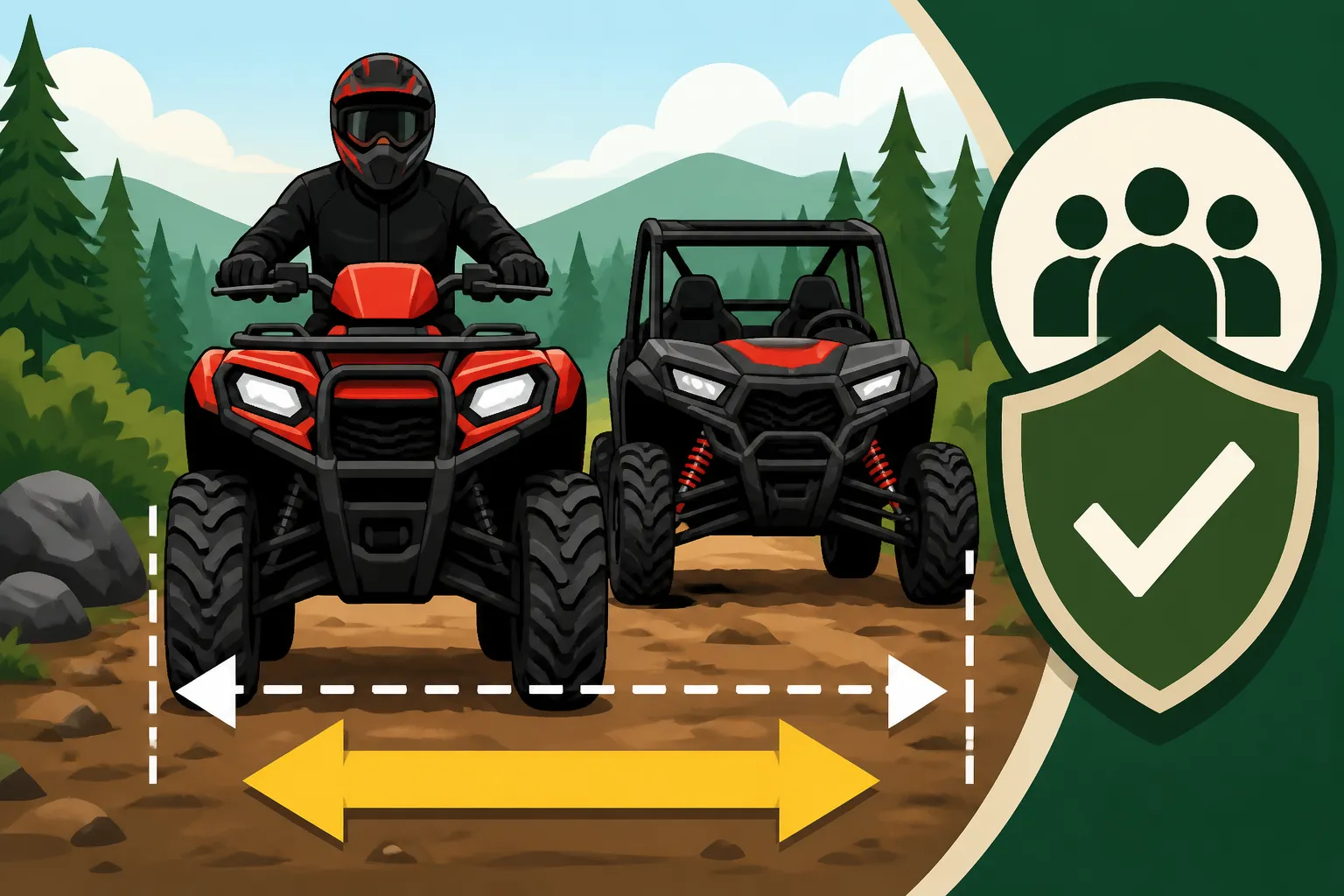
Trail Width Limits Set by Clubs
A machine that fits comfortably on your driveway may be too wide for a particular Maine trail, especially where trees, rocks, bridges, or soft shoulders narrow the route. Clubs may set width limits to protect trails and respect landowner agreements, but the rules can vary from one trail system to the next. This guide explains how to check a restriction and decide whether your ATV or UTV is a suitable fit.
Why Maine ATV clubs set trail width limits
Trail width is about more than the trail surface
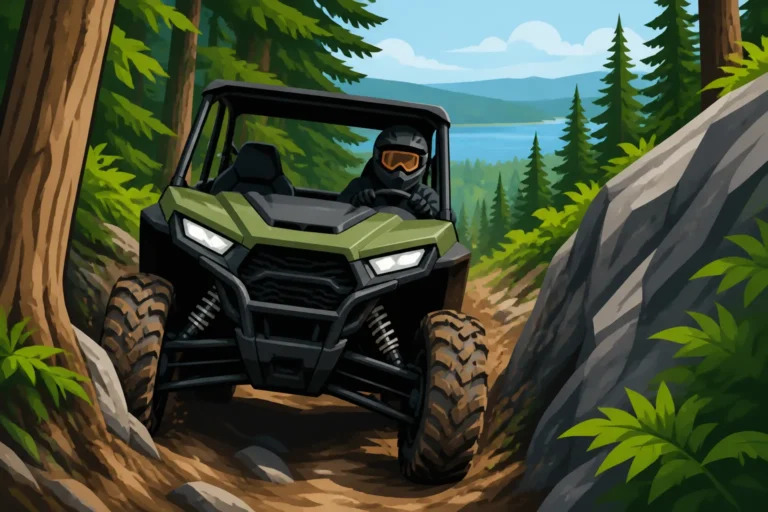
A trail may look broad on a map or in a parking area, then tighten suddenly between trees or at a wetland crossing. Its usable width is not always the same as the width of the packed, visible track. A machine needs room for its tires, bodywork, mirrors, and any accessories that stick out. The rider also needs space to steer without scraping trees or pushing into soft shoulders.
Clubs may also consider what happens when a vehicle meets another rider. On a narrow route, two machines may not be able to pass safely. One may need to back up to a wider spot, and that can be difficult on a muddy slope, a bridge approach, or a trail with a steep edge.
A width restriction is therefore not just about whether a machine can physically squeeze through one tight point. It is about whether riders can travel the route without damaging it, creating a safety problem, or making access harder for everyone who follows.
Club and landowner conditions can differ by trail
Many Maine ATV routes rely on permission to cross private property. The landowner’s agreement with a club may include conditions about where riders can go and what kinds of machines may use a section. A club may also set practical limits based on the width of a bridge, the condition of a trail, or the space available between obstacles.
That means a restriction on one route should not be treated as a statewide rule for every route. A trail system may welcome a machine on some sections and exclude it from others. Even nearby routes can have different conditions because they cross different properties or are maintained by different clubs.
These local arrangements matter. If you are planning a long ride, review the route one section at a time rather than assuming that permission on one trail carries over to the next. For background on how access depends on private property, see Why 80 Percent of Maine Trails Sit on Private Land and Maine Trail Etiquette With Landowners.
Width limits help protect trails and keep access open
A wide machine can brush trees, tear up soft edges, or force a rider around an obstacle and into vegetation. On wet ground, that detour can widen a trail into a muddy mess. Damage may be especially hard to avoid when the machine’s tires already fill most of the track.
There is also the question of trail infrastructure. A bridge, culvert, gate, or narrow trail entrance may have less clearance than the route leading to it. A machine might fit along most of the trail but be unable to cross a particular structure safely. Trying to “make it through” can damage the structure or leave the rider stuck in a difficult spot.
Clubs have an interest in preventing those problems before they happen. Respecting a posted restriction helps protect the route and the relationships that allow riders to use it. When access depends on cooperation, a single damaged section or repeated conflict can affect more than one ride.
How to tell whether your ATV or UTV fits
Check the machine’s actual width
Start with the manufacturer’s stated width for your specific machine and configuration. Model names alone may not tell the whole story: versions of the same machine can differ, and accessories such as wider tires, wheel spacers, or added bodywork can change the practical clearance you need.
If you are measuring the machine yourself, check the widest point from outside edge to outside edge. Depending on the setup, that may be at the tires, fenders, mirrors, or another protruding part. Measure it as it will actually be ridden, not in a stripped-down configuration that you do not use on the trail.
A careful measurement at home is more useful than a rough guess at the trailhead. But it still does not tell you whether the route allows that width. Use your measurement alongside the club’s posted conditions, and leave extra room for steering and uneven ground. A machine that is exactly as wide as a stated limit may have little margin at a bend or narrow crossing.
Do not assume all routes have the same clearance
Trail width can change from one section to another. A route may pass through open gravel road, then enter a tight wooded corridor or cross a narrow bridge. The tightest point can determine whether a machine is appropriate for the entire route.
This is why broad labels such as “ATV trail” or “UTV trail” are not enough by themselves. Look for specific machine-width restrictions and route notes. If you ride a side-by-side, pay special attention to information for full-size machines. The guide Wide Side-by-Sides on Narrow Maine Trails discusses the kinds of fit issues riders may encounter, while Trails Too Narrow for a 64-Inch Machine focuses on routes where a particular width can be a concern.
Width is only one part of fit. A machine’s turning radius, ground clearance, and ability to reverse in a tight spot can matter too. A wide vehicle that technically meets a posted limit may still be difficult to manage on a winding trail with close trees or limited passing areas.
Maps can help you plan, but they are not a substitute for restrictions
Trail maps are useful for understanding the general route, nearby towns, and connections between trail sections. They may not show every narrow spot, temporary closure, or club-specific width limit. Treat a map as a planning aid, not proof that every machine can use every segment.
You can use a tool such as onX Offroad to review a route and its surroundings before leaving, then compare that route with current club information and posted notices. Do not rely on a map alone to confirm that a wide UTV is allowed. If a restriction is unclear, ask the club responsible for that section before riding it.
For a broader planning process, use Maine ATV Trail Maps and Club Boundaries and Checking Maine Trail Status Before You Drive. Those checks are particularly worthwhile when a planned ride crosses several club areas. A route that looks continuous on a screen may include a section with different access conditions.
| What to check | Why it matters | Practical next step |
|---|---|---|
| Machine width in its riding configuration | Tires and accessories can make the machine wider than expected | Measure the widest point before the trip |
| Club or trail-system restriction | Limits can vary by section and club | Check the responsible club’s current information |
| Bridges, gates, and narrow entrances | These can be tighter than the trail itself | Look for route notes and ask about known pinch points |
| Recent trail conditions | Mud or damage can make a passable trail less suitable | Check for temporary notices before departure |
| Route boundaries | A ride may cross into another club’s area | Confirm restrictions for each section |
How to check a club’s width rules before riding
Use more than one source
Begin with the club that maintains or manages the trail section. Look for posted width guidance, access notes, trail maps, and announcements about closures or restrictions. Signs at trail entrances can provide important information, but riders should not assume every entrance has a sign that explains every condition for the whole route.
If a map or website gives a width limit, check whether it applies to the whole trail system or only to certain sections. If the wording is unclear, contact the club and ask a direct question: “Is a machine measuring this wide allowed on this route, including the bridge and connector sections?” That is more useful than asking whether the system is generally open to UTVs.
Keep in mind that route information can change with trail conditions, maintenance needs, or landowner requests. A ride that worked last season may not be appropriate after a washout, a bridge repair, or a new restriction. Review Maine ATV Trail Signs and Markers as part of understanding what posted information may tell you once you reach the route.
Plan for the narrowest section, not the easiest one
Before choosing a route, look for sections that are likely to be tight: bridges, gates, wooded connectors, sharp bends, and approaches to wet areas. If the club identifies a limit for a particular segment, use that information to decide whether the whole planned route is suitable. Do not count on turning around at the restriction unless you know there is a safe place to do so.
Think about the ride as a sequence of trail sections. For example, a family may plan to leave a staging area, take a broad gravel connection, then follow a wooded route to a village. If the wooded section has a lower width allowance, the broad opening at the start does not make the full ride suitable for a wider machine.
It can be helpful to have a second route in mind. If a restriction rules out your preferred trail, a different route may better match your machine. The Maine ATV Trail Difficulty by Region guide can help frame route choice around more than width alone, including the general character of trails in different areas.
Ask clearly when details are missing
When the information is incomplete, ask the club or trail contact for specifics rather than relying on assumptions from another rider’s experience. Useful questions include:
- Does the width limit apply to the entire trail or only to named sections?
- Is the stated width measured at the tires or at the machine’s widest point?
- Are there narrow bridges, gates, or trail entrances along the planned route?
- Are there recent closures or temporary restrictions?
- Is there an approved alternate route for wider machines?
A clear answer can save you from hauling a machine to a trailhead only to discover that the route is unsuitable. It can also help avoid a stressful turnaround on a narrow trail. If the club cannot confirm that a section is open to your machine, choose a route with clear guidance rather than testing the restriction in person.
What to do when your machine is too wide
Choose a route that matches your setup
If your machine exceeds a club’s stated limit, do not try to squeeze through or assume that careful riding makes the restriction optional. Choose a trail system or route where your machine is allowed. This protects the trail and helps avoid damaging a bridge, rutting a shoulder, or blocking access for other riders.
For riders who own both a smaller ATV and a larger UTV, the route may determine which machine makes sense for the day. A narrow wooded loop may suit the smaller machine, while a wider route may be a better choice for the side-by-side. If you are riding with friends, make sure the entire group’s machines meet the conditions for every planned section.
It is also worth checking whether a route is suitable for your particular machine rather than simply searching for a general “UTV-friendly” label. Width, clearance, turning room, and trail surface all affect whether a ride will feel manageable. The goal is not just to get onto the trail; it is to complete the route without putting your machine, other riders, or access at risk.
Avoid modifying the trail to make room
Do not cut branches, move barriers, widen a trail edge, or drive around an obstacle to create clearance. Those actions can damage the route and may violate club or landowner conditions. Even small changes can encourage water to run across the trail or leave a wider muddy track that grows with repeated use.
If a trail appears blocked or unexpectedly tight, stop somewhere safe and reassess. Do not force the machine through a gap that risks damage to the vehicle, trail, or surrounding property. If you cannot turn around safely, contact your riding group or the relevant trail contact for guidance.
Report a serious obstruction or damaged crossing through the club’s preferred process. A useful report includes the trail or nearby landmark, what is blocked, and whether riders can pass safely. Avoid posting private access details or encouraging others to use an unapproved detour. Respecting Maine ATV Trail Signs and Markers and the route’s posted conditions helps keep access dependable for the next ride.
Make width checks part of trip preparation
A quick check before loading the trailer can prevent a long, frustrating drive to a trailhead. Record your machine’s width, identify the route’s club areas, and review the latest available restrictions. If you have added tires or accessories since your last ride, measure again rather than relying on an old note.
For a group ride, compare every machine with the route requirements. One oversized vehicle can complicate the whole group’s plan if the trail narrows after the riders have committed to a long section. Agree on a suitable route before departure, and make sure everyone knows the plan if a closure or restriction changes access.
Good preparation is especially useful when riding unfamiliar trails or connecting routes across multiple towns. Tools such as onX Offroad can help with route planning, but pair any map view with club guidance and posted notices. When the width rule is uncertain, confirm it before you ride.
Disclaimer
This article is for general informational purposes only and does not constitute professional advice. Laws, prices and regulations vary by location and change over time. Consult a qualified professional for guidance on your specific situation.