Carrying Extra Fuel on a Trail Ride
A fuel stop that looked close on a map can be farther away than expected once you account for trail detours, slow going, hills, mud, and a machine working hard in low gear. This guide explains how to estimate your range, choose and secure extra fuel, and plan for Maine’s remote trail sections without turning a routine ride into a stressful gamble.
Plan your fuel range before leaving
Treat the dashboard range as an estimate
Your ATV or UTV’s advertised range is a starting point, not a promise. Actual fuel use changes with the machine, its load, riding style, terrain, weather, and trail condition. A side-by-side carrying passengers and gear may use fuel differently from a lightly loaded quad, even if both are headed along the same trail system.
Maine terrain can make estimates especially tricky. A long stretch of rolling trail around Aroostook County may feel very different from a steep, rough, or muddy section near the Moosehead Lake region. Deep mud, repeated climbs, soft sand, frequent stops, and low-speed maneuvering can all increase fuel use. Cold starts, idling, and detours add more uncertainty.
If you are new to your machine, do a few shorter rides before planning a long backcountry day. Fill the tank, record the distance, and note the conditions. Repeat the test on a route that resembles the one you plan to ride. The result will still be an estimate, but it will be based on your own machine rather than a best-case figure from a brochure.
Build in a reserve rather than planning to run the tank low
Plan around the fuel you can safely use, not the tank’s full listed capacity. A practical approach is to identify a conservative turnaround point: the point at which you head back or change plans while you still have a meaningful reserve. The right margin depends on your machine, route, and conditions, so avoid treating any one rule of thumb as universal.
A common planning mistake is to count only the distance from the trailhead to the destination. You need fuel for the outbound ride, the return, and any extra distance caused by a closed trail, missed turn, slow detour, or unexpected stop. If your route crosses several junctions, mark alternatives in advance and decide which options you will skip if the fuel gauge drops faster than expected.
For a route that reaches a town or service area, check whether fuel is actually available where and when you expect it. Do not assume a convenience store, pump, or trail connection will be open just because it appears near the route. The planning issues covered in [Fuel Range Between Remote Trail Towns](Fuel Range Between Remote Trail Towns) are especially relevant when a ride takes you away from established services.
Map the route and fuel options together
Review the route before unloading the machine. Look at the trail system, likely turnaround points, fuel stops, and the distance between them. A map app such as onX Offroad can help you view your planned route and nearby trail connections, but use it alongside current local trail information. Digital maps can help you prepare; they do not guarantee that a trail is open, passable, or connected as shown.
This matters in areas where rides can cover substantial distances between communities. Around Greenville, Jackman, and The Forks, a route can feel remote even when you started near a familiar town. In northern Maine, large trail networks may offer several route choices, but that does not mean every choice is appropriate for your fuel reserve or machine. Review [Maine ATV Trail Maps and Club Boundaries](Maine ATV Trail Maps and Club Boundaries), and check local updates through the relevant club or trail organization.
Before departing, check [Checking Maine Trail Status Before You Drive](Checking Maine Trail Status Before You Drive). A closure or reroute can turn a planned loop into a longer ride. If you are depending on a particular fuel stop or trail connection, confirm that the route is usable rather than discovering the problem after you have committed to the longer leg.
Choose and carry extra fuel safely
Use a container made for gasoline
Carry gasoline only in a properly designed, approved portable fuel container intended for that purpose. A random water jug, household bottle, or unmarked can is not a safe substitute. A suitable container should have a secure closure and be in good condition, with no cracks, damage, leaks, or signs of deterioration.
Choose a size that makes sense for the ride and the machine. A larger container provides more reserve, but it also takes up room, adds weight, and can be harder to secure. A smaller container may be easier to handle but may not provide enough backup for a long route. Think through the amount you may realistically need, then consider how you will carry it without interfering with passengers, cargo, visibility, or access to controls.
Follow the container manufacturer’s instructions for filling, transport, and storage. Leave appropriate expansion space rather than filling a portable container to the brim, and keep fuel away from sparks, flames, hot exhaust components, and other ignition sources. Never smoke while handling gasoline. If you are unsure whether a container or carrying method is suitable for your machine, check the owner’s manual or ask a qualified dealer.
Secure the container so it cannot shift or spill
A fuel container should not be loose in a cargo box, strapped loosely to a rack, or wedged where it can rub against sharp gear. Vibration and bouncing are part of an ATV ride. A container that seems stable while parked can move once the machine hits washboard, roots, or a rough trail crossing.
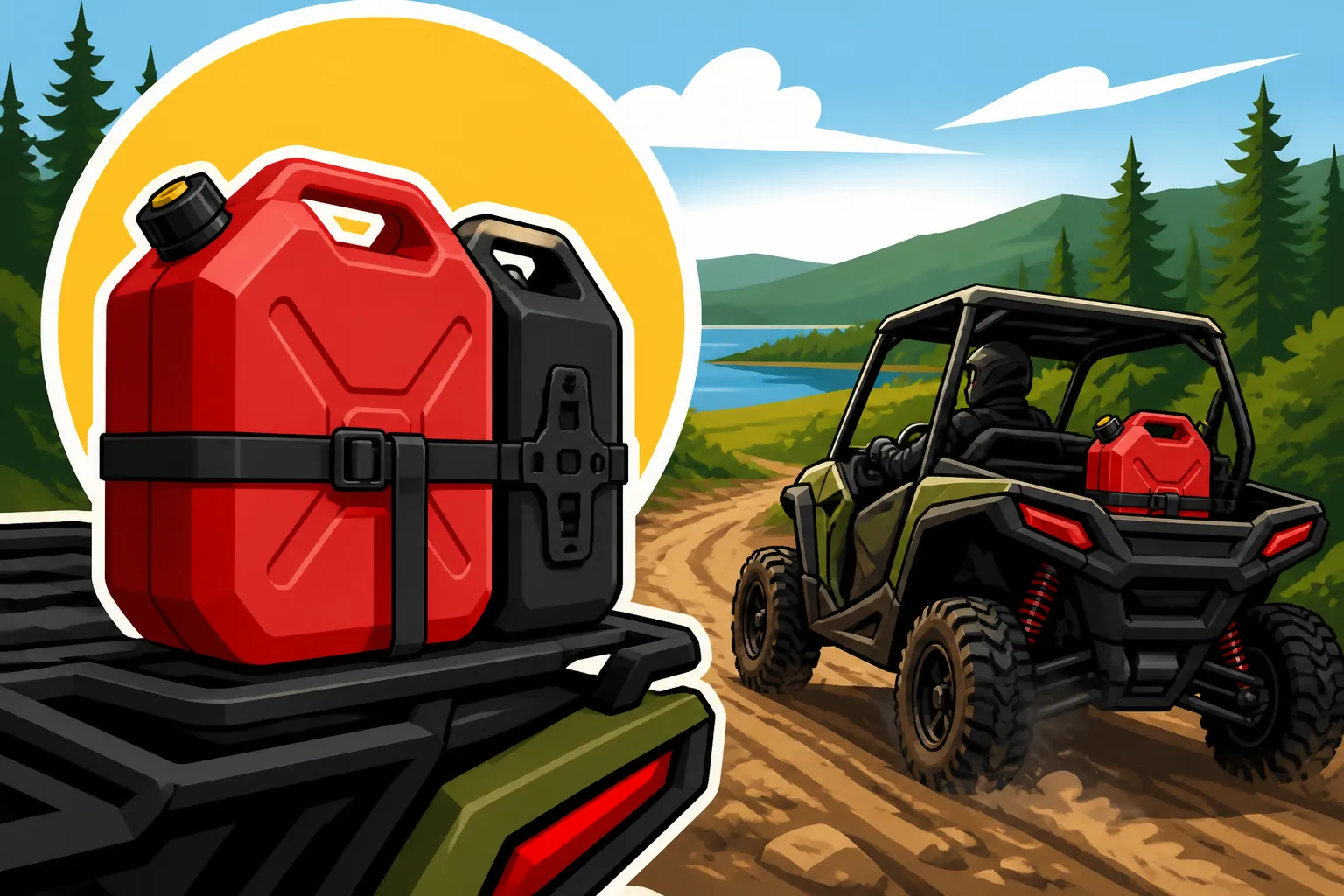
Use a secure mounting location and suitable restraints designed to hold the container in place. Keep it upright, protected from impact, and away from hot exhaust parts. Do not place it where it can block lights, obscure the operator’s view, interfere with a passenger, or prevent quick access to important equipment. On a UTV, consider how cargo could shift in a rollover or abrupt stop; a fuel container should not become a loose object in the cab.
Before each ride, check the container and its mounting points. After the first rough section, stop in a safe place and make sure the restraint has not loosened. If you smell gasoline or notice a wet spot, do not ignore it. Stop, shut off the machine, move away from ignition sources, and address the leak safely before continuing. Avoid refueling on a hot machine or while it is running.
Keep fuel separate from food, clothing, and passengers
Gasoline fumes can make a ride unpleasant and create a hazard if fuel leaks onto clothing or gear. Keep portable fuel away from food, drinking water, medications, and items that need to stay clean. Do not carry it inside the passenger area, next to a child, or in a place where a leak could soak personal gear.
Pack gloves and a small amount of absorbent material appropriate for minor drips, but do not assume a spill kit makes an unsafe location acceptable. If fuel spills, keep people and ignition sources away. Follow the container and machine instructions for cleanup, and do not ride away with gasoline on a hot component or leaking onto the ground. Be especially careful near streams, wetlands, and other sensitive areas; a small spill can create a mess well beyond the machine.
For a broader checklist that includes tools, communication, and emergency supplies, see [What to Carry on a Remote Trail Ride](What to Carry on a Remote Trail Ride). If you are using onX Offroad to keep track of your route, remember that route information is only one part of preparation: fuel, communication, and a realistic turnaround plan still matter.
Refuel and ride with a clear routine
Stop somewhere safe before opening the container
Choose a stable, well-ventilated place away from other riders, traffic, dry vegetation, and ignition sources. Turn off the engine and allow hot components to cool before refueling. Keep the machine steady and follow the directions for both the ATV or UTV and the fuel container. Do not refuel while seated on the machine or while someone is smoking nearby.
Avoid spilling fuel on the seat, plastics, tires, or exhaust. If fuel does spill, do not restart the machine until you have dealt with the spill and are confident there is no fuel on hot surfaces. Close the container securely and return it to its mounted position before riding. Leaving a cap loose or placing a container on the ground beside the trail is an easy way to lose it or create a hazard for other riders.
If you are riding with a group, communicate before anyone starts refueling. Give the person handling fuel enough space, keep other machines back, and make sure nobody starts an engine until the area is clear. A calm, consistent routine is safer than trying to refuel quickly while the group waits impatiently.
Use the fuel reserve as backup, not as a reason to push farther
Extra fuel can create a false sense of security. A spare container does not make an unknown trail passable, guarantee a fuel source will be open, or remove the need to turn around when conditions change. If your machine is consuming fuel faster than expected, reassess the route early rather than waiting until the gauge is nearly empty.
Keep track of distance and fuel use as the ride progresses. If you are traveling with others, agree on a plan for machines with different tank sizes and fuel consumption. The group’s route should work for the machine with the least practical range, not just the one with the biggest tank. Do not split up casually to send someone for fuel; remote trails may have weak or nonexistent cell service, and a separated rider can be difficult to locate.
When cell coverage is unreliable, download maps or save route information before leaving service. A tool such as onX Offroad may help you review and follow a saved route, but carry a backup plan as well. The guidance in [Navigating Trails Without Cell Service](Navigating Trails Without Cell Service) can help you prepare for dead zones, while [Riding Trails Solo Safely](Riding Trails Solo Safely) is worth reviewing if you plan to ride without a group.
Leave trails and private property in good condition
A fuel spill is not only a machine-maintenance problem. It can damage vegetation, contaminate water, and create problems for the landowners who allow trail access. Keep fuel containers sealed, clean up small drips promptly, and never dump leftover gasoline along a trail or at a trailhead. Take contaminated absorbent material and waste with you for proper disposal.
Maine’s trail network depends heavily on landowner cooperation, so small considerate habits matter. Stop in appropriate locations, avoid blocking gates or access roads while handling fuel, and pack out everything you bring in. If a landowner, club volunteer, or trail sign directs you to avoid an area, follow that instruction rather than trying to find a shortcut. The advice in [Maine ATV Trail Etiquette With Landowners](Maine ATV Trail Etiquette With Landowners) is useful for keeping access relationships positive.
Match the fuel plan to the ride
The right amount of extra fuel depends on the machine, the route, and how much uncertainty you can reasonably manage. A short, familiar loop near services may not call for the same setup as a full day exploring a remote section of the Aroostook trail network. Use the table as a planning prompt rather than a one-size-fits-all fuel formula.
| Ride situation | What to plan for | Extra-fuel approach |
|---|---|---|
| Short, familiar loop near town | Confirm the route is open and estimate the return distance | Bring fuel only if your normal reserve or machine condition warrants it |
| Long day ride with several trail junctions | Allow for detours, wrong turns, and slower terrain | Carry a securely mounted container and set a clear turnaround point |
| Remote ride between trail towns | Verify route connections and fuel availability before leaving | Plan conservatively and do not rely on an unconfirmed stop |
| Group ride with different machines | Account for the shortest practical range in the group | Agree on refueling stops and keep the group together |
| Wet, muddy, hilly, or heavily loaded ride | Expect fuel use to differ from an easy-condition estimate | Increase the reserve and be ready to shorten the route |
If your machine is new to you, start with shorter rides and learn how it performs before attempting a long remote route. If you are riding in a region you do not know well, plan the route, check local conditions, confirm fuel options, and carry a container you can secure properly. A little preparation makes it easier to enjoy the ride without watching the fuel gauge every few minutes.
Disclaimer
This article is for general informational purposes only and does not constitute professional advice. Laws, prices and regulations vary by location and change over time. Consult a qualified professional for guidance on your specific situation.