Taking Your Quad to Vermont Trails
Taking a Maine quad to Vermont can involve more than loading it onto a trailer and following a trail map. Your Maine registration, Vermont’s operating requirements, and permission to use a particular trail are separate questions. Sort out all three before you travel, then confirm local trail status and route access close to your ride.
Check registration and trail-access rules separately
A valid Maine registration does not necessarily give you permission to ride every Vermont trail, and trail access does not automatically settle what registration Vermont requires. Treat those as two separate checks.
Before leaving, contact the Vermont agency responsible for ATV registration and ask what a Maine-registered quad needs for temporary use in Vermont. Confirm whether your current Maine registration is recognized for the kind of riding you plan to do, or whether Vermont requires an additional registration or other document. Ask what proof you need to carry, and whether the rules differ for a resident, a visitor, or a machine used only on private property.
Then check with the organization or land manager responsible for your intended trail network. Vermont trails may cross private land, and access can depend on a landowner’s permission, a local club’s rules, or a required pass. A registration document is not a substitute for that permission. Likewise, a trail pass, membership, or landowner’s approval should not be taken as proof that your registration obligations are satisfied.
Maine riders may remember that ATV reciprocity between Maine and some neighboring jurisdictions has been a moving target. Do not assume that the rules that apply in one state apply in another. For context on why it is worth checking rather than relying on old assumptions, see Maine’s ATV Reciprocity, and Why It Ended. If you are planning a trip in the other direction, [Riding a New Hampshire ATV in Maine] covers a separate border-crossing question; it does not establish what Vermont requires.
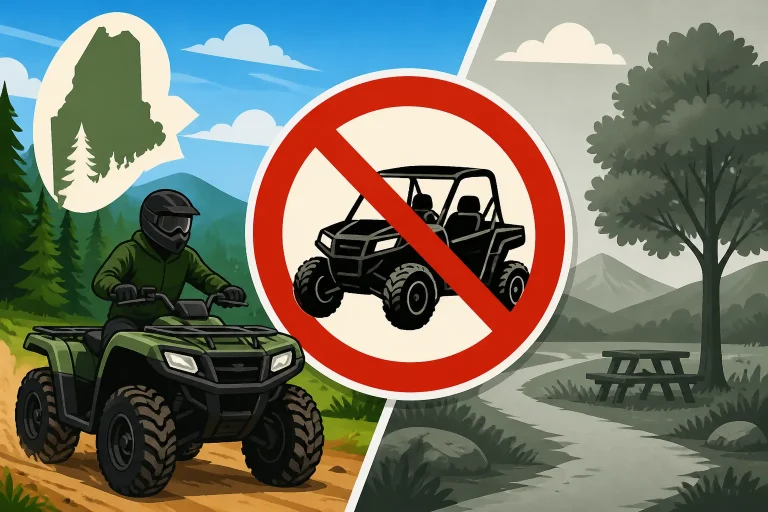
When you contact Vermont officials or a trail organization, give them specific details. Ask about a Maine-registered quad, the dates you expect to ride, whether you plan to use an organized trail network or private property, and whether you will be riding alone or with a group. If your machine is a side-by-side rather than a traditional quad, say so. Size, passenger capacity, and machine classification can affect which rules or trail restrictions apply.
| What to confirm | Why it matters | Who to ask |
|---|---|---|
| Whether Maine registration is accepted for your planned use | A home-state registration may not cover every kind of out-of-state riding | Vermont’s ATV registration authority |
| Whether Vermont registration or another document is required | Requirements can depend on the machine and where it will be operated | Vermont’s ATV registration authority |
| Whether a trail pass, membership, or permission is needed | Registration does not grant access to private trails | The trail organization, club, or land manager |
| Whether the route is currently open to your machine | A mapped trail may be closed or subject to limits | The local trail organization or land manager |
| What paperwork to carry | You may need to show registration or permission during a stop | The relevant Vermont agency and trail organization |
Keep notes from those conversations, including the office or organization you contacted and any instructions they gave you. If you buy a pass or complete an application, save the confirmation and bring whatever proof the provider says you need. Do not rely on a screenshot alone unless the provider confirms that it is acceptable.
For a useful comparison of how registration and trip planning can differ across borders, see Taking a Maine ATV to New Brunswick and Taking a Maine ATV to Quebec. Those are different destinations with their own rules, so use them as separate planning topics rather than as a guide to Vermont.
Confirm that the trails you want to ride are open to you
Vermont trail access is not as simple as finding a line on a map and riding it. Some routes may run across private property, and access can depend on an agreement with the landowner. A trail network, club, or local organization can explain what access arrangements apply and whether visitors are allowed to ride a particular section.
Start with the trail organization responsible for the area you want to visit. Ask whether visitors from Maine can ride there, what access requirements apply, and whether your quad’s size is suitable for the route. A club map can show the general network, but it may not tell you whether a segment is temporarily closed, whether a bridge or road crossing has restrictions, or whether a trail is limited to certain machines.
Do not assume that a trail shown online is open just because it appears on a map or in a navigation app. Maps can remain available after a route changes, and a track shared by another rider may not reflect current access conditions. Confirm the route with the local organization before setting out, especially if you are visiting a new area.
Before the trip, check:
- Whether the organization accepts out-of-state riders and what you need to qualify.
- Whether a pass, club membership, landowner permission, or another authorization is required.
- Which trail sections are open to your particular machine.
- Whether there are restrictions on width, passenger capacity, noise, or equipment.
- Where the permitted trailhead and parking area are.
- Whether any roads or public ways on the route have separate operating rules.
- Where and how to check for closures on the day of your ride.
If you are crossing between trail systems or plan to leave the organized network, get clear permission for each additional section. Permission for one route does not automatically extend to neighboring land, a private woods road, or an unmarked connection. If a route is blocked, posted, or unclear, stop and choose another authorized route rather than trying to find a way around the restriction.
This is particularly important when a trail crosses land that is not visibly fenced. A lack of a gate or sign is not reliable proof that riding is allowed. Ask the responsible club or landowner when in doubt, and follow any posted directions while riding. Maine riders already navigating a network of club and landowner access may find Maine ATV Trail Maps and Club Boundaries useful for understanding why maps and permission are not always the same thing.
Trail conditions can change with weather, maintenance, or landowner decisions. A route that was open during a previous visit might not be open for your trip. Check the trail organization’s current notices shortly before departure and again on the day you ride. This habit is useful at home, too; Checking Maine Trail Status Before You Drive explains the same basic planning principle for Maine trails.
Prepare your machine and paperwork for the trip
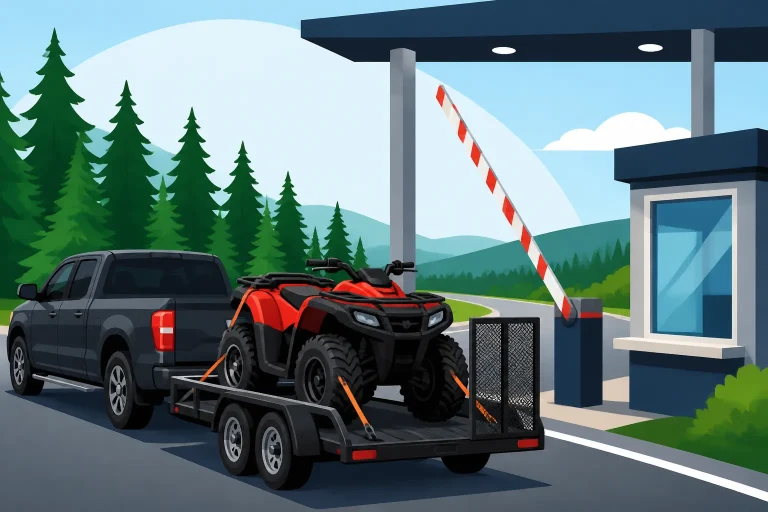
Once you have verified that your machine can be operated in Vermont and that you have access to a specific trail system, prepare the quad as a travel vehicle as well as a trail machine. That means securing it properly for the road journey, checking its condition before departure, and organizing the documents you may need to produce.
Bring your current Maine registration and any Vermont registration, pass, membership confirmation, or written permission that applies. Carry identification and the contact details for the trail organization or land manager. If the machine’s ownership or registration status is not straightforward, resolve that before traveling. A bill of sale or other ownership record may be useful background, but it does not replace an operating registration or trail authorization.
Store the documents so they stay legible and accessible. A waterproof pouch from Amazon or another retailer can help protect paper copies from rain and mud; it is a convenience, not a substitute for carrying the documents required by the relevant authority. Keep a second copy in your vehicle or with another member of your group, and save digital copies where you can reach them without relying on cellular service.
A practical pre-trip document check includes:
- Current Maine registration.
- Any Vermont registration or other authorization required for your planned use.
- Proof of trail access, such as a pass, membership confirmation, or written permission.
- Identification and relevant ownership information.
- Emergency contacts and the trail organization’s contact details.
- Copies of confirmations for any online applications or purchases.
Inspect the quad before loading it. Check the tires, brakes, steering, lights, throttle return, fluids, and visible fasteners. Make sure the tie-down points and straps are in good condition, and secure the machine so it cannot shift during transport. If you are transporting more than one machine, check the trailer’s load and balance rather than assuming each quad is secured well enough on its own.
For a trail ride, bring the gear suited to the route and weather. A helmet and eye protection are sensible essentials; carry gloves, weather layers, water, basic first-aid supplies, and a way to contact help. A phone may be useful, but service can be unreliable away from towns. For a remote route, carry a paper map or an offline map and make sure everyone in the group knows the planned route and meeting point.
Insurance is another separate item to check. Ask your insurer whether your coverage applies while riding in Vermont and whether there are exclusions for trail use, passengers, or particular types of machines. Do not infer coverage from an automobile policy or from the fact that the quad is registered. For background on the distinction between registration and coverage in Maine, see Maine ATV Insurance and When You Need It. Your insurer should confirm how your own policy applies outside Maine.
If you normally carry paperwork while riding at home, do not assume the Vermont requirements are identical. Confirm what must be on the machine or with the operator and whether an electronic copy is accepted. The related Do You Carry Registration Papers While Riding? can help you think through document storage, but Vermont’s requirements must be checked separately.
Make a day-of-ride plan and avoid common mistakes
A well-planned trip starts with a specific trailhead, a confirmed route, and a clear plan for getting back to the trailer. Before unloading, make sure the trail system is open and that the entry point you chose is authorized for your group. If a club or land manager gives you instructions, follow those rather than a route suggested by an app.
Share the plan with someone who is not riding. Include the trailhead, intended route, approximate return time, vehicle description, and a way to contact the group. If the route changes, let that person know when possible. For a group ride, agree on a pace and regrouping points before leaving the staging area. Riders should know what to do if someone has a breakdown or becomes separated.
On the trail, follow posted rules and give other users room. Slow down near homes, people, animals, and road crossings. Stay on authorized routes, and do not use a nearby road or trail as an unapproved shortcut. If a route is closed or a sign conflicts with a map, treat the closure as controlling until the responsible organization confirms otherwise.
The most common planning errors are avoidable:
- Assuming Maine registration automatically covers Vermont. Confirm the requirement with Vermont’s registration authority.
- Treating registration as trail permission. Check with the organization or landowner responsible for the route.
- Using an old map as proof of current access. Verify closures and restrictions close to the ride.
- Assuming a pass applies everywhere. Ask which specific trail sections the pass or membership covers.
- Relying on cell service for navigation or emergencies. Save maps offline and carry a backup plan.
- Leaving paperwork at home. Carry the documents and confirmations the relevant providers require.
- Bringing a machine without checking trail fit. Confirm width, route conditions, and any machine-specific limits before unloading.
If you cannot confirm the rules or access for a trail, postpone that route or choose one where the responsible organization can clearly explain the requirements. It is better to spend time checking than to risk riding without valid authorization or losing access for other riders.
A Maine quad can be part of a Vermont trip, but the safe assumption is that home-state registration, Vermont operating requirements, and permission for a particular trail are distinct. Verify each one with the appropriate source, keep the confirmation with your travel paperwork, and recheck trail status before you unload.
Disclaimer
This article is for general informational purposes only and does not constitute professional advice. Laws, prices and regulations vary by location and change over time. Consult a qualified professional for guidance on your specific situation.