Taking a Maine ATV to Quebec
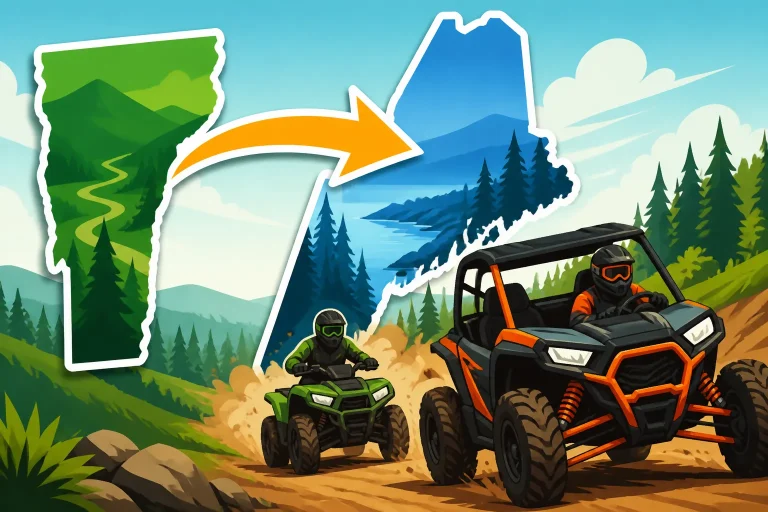
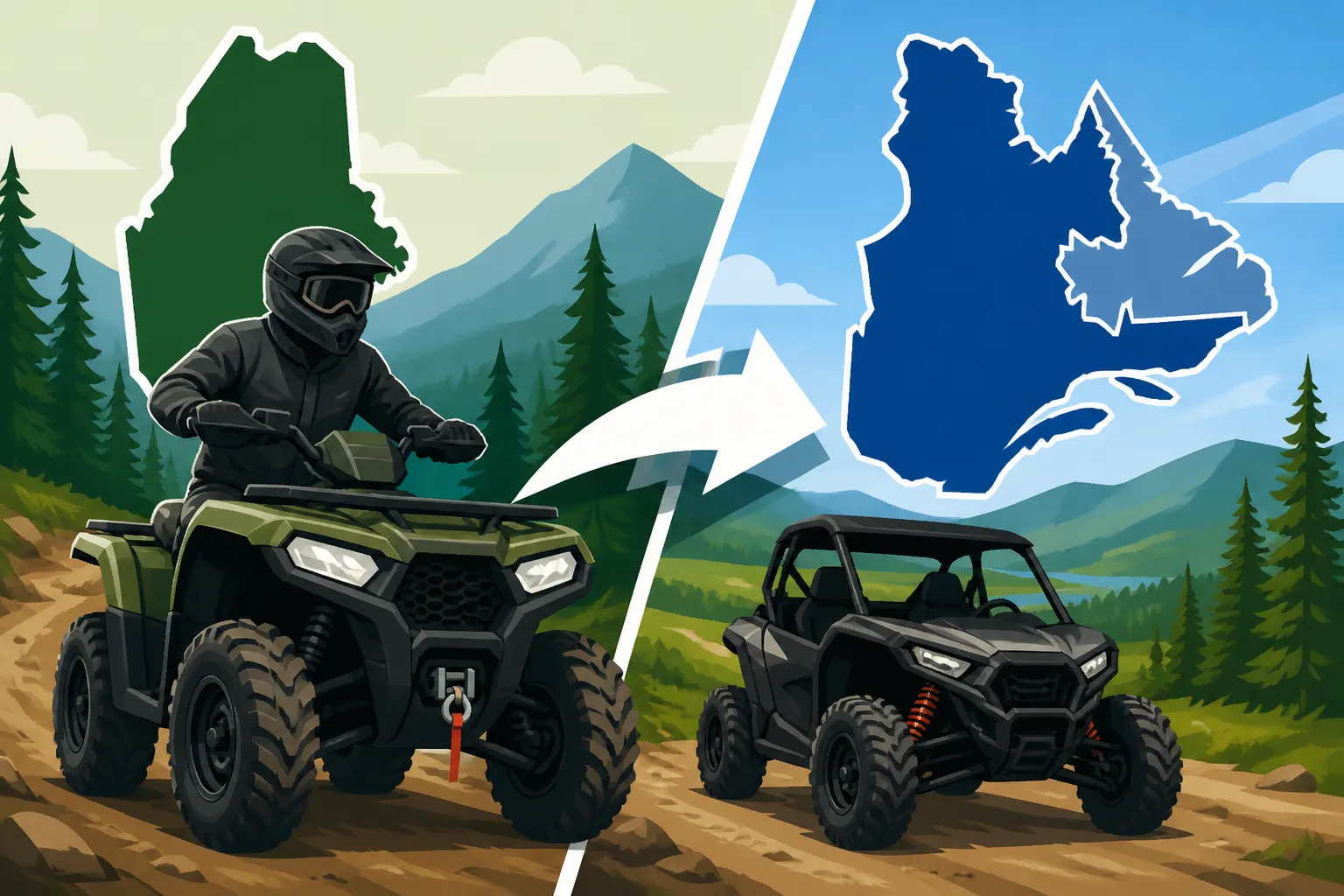
Taking a Maine ATV to Quebec can mean riding a different trail system with its own access rules, permit requirements and road restrictions. Your Maine registration does not automatically give you permission to use Quebec trails. Plan for the border crossing, check insurance and ownership documents, and confirm the trail permit and local rules that apply to your machine and route.
What to arrange before leaving Maine
Treat the trip as two separate tasks: bringing your ATV into Canada legally and getting permission to ride once you arrive. A Maine registration is important for identifying the machine, but it is not a Quebec trail permit. Likewise, a Quebec trail permit does not replace registration or other documents you may need for the border.
Check trail access and buy the right permit
Quebec’s organized ATV trails are maintained through local clubs and the province’s quad federation, the Fédération Québécoise des Clubs Quads (FQCQ). Riders generally need the applicable trail access permit to use those trails. Permit availability, validity periods, eligible machine types and purchase methods can change, so check the current rules through the FQCQ or the club responsible for the area you plan to ride. The details in Buying a Quebec Trail Permit Online and Trail Permits for Riding in Quebec can help you understand what to verify.
Do not assume that a permit for one period or machine category fits your trip. Confirm that it covers your travel dates and the ATV or UTV you are taking. Ask whether you need to display a decal, carry a permit document, or do both. If you are planning a multi-day route through several areas, check that your permit covers the trail system throughout the route—not just the first club’s trails.
A permit is access to the trails covered by its terms, not a blanket pass to ride anywhere. It does not authorize riding on closed trails, private property without permission, or roads where ATVs are prohibited. Look for current club notices and signs before setting out. For general context on how reciprocity differs from a trail permit, see Maine’s ATV Reciprocity, and Why It Ended.
Confirm your registration and ownership documents
Bring the ATV’s current Maine registration paperwork and make sure the machine’s registration information matches its identification details. Keep the documents accessible rather than buried in a packed trailer or locked away at your lodging. It is also sensible to carry a copy of the sales document or other proof of ownership, especially if the ATV is recently purchased, registered in someone else’s name, or being transported by a person who is not its owner.
If there is a mismatch between the name on the registration and the person travelling with the machine, sort out the explanation and supporting documents before departure. A bill of sale, written authorization from the owner, or other relevant paperwork may help clarify the situation, but do not assume a particular document will satisfy every border or enforcement question. See Proof of Ownership for a Maine ATV Registration if you need to review what ownership records to assemble.
For a borrowed machine, ask the owner for written permission to take it across the border and confirm that the insurance policy allows it. For a rented or financed ATV, check the agreement before making travel plans; restrictions can apply even when the machine is otherwise registered and insured.
Keep a record of the ATV’s vehicle identification number and take clear photos of the machine and its registration information before travel. These are useful reference details if documents are lost or a question arises, but photos do not replace original documents when an official requires them.
Ask your insurer about Quebec coverage
Do not assume a Maine policy automatically covers every kind of ATV use in Quebec. Call the insurer and ask specifically whether the policy covers the machine in Canada, whether liability coverage applies on Quebec trails and permitted roads, and whether the policy has exclusions for a UTV, passenger, commercial use or a particular type of trail riding.
Ask for written confirmation and carry proof of coverage. Check whether the document identifies the ATV, policyholder and coverage period clearly. If the insurer can provide proof in French as well as English, that may make it easier to present, but verify what the insurer can issue and what Quebec authorities require. Do not rely only on a credit card benefit, a homeowners policy, or the fact that another vehicle in your household is insured. Maine ATV Insurance and When You Need It explains why coverage for one machine or use does not necessarily settle another.
If your insurer says the policy does not cover the planned trip, ask about an appropriate option before crossing. A trail permit and insurance solve different problems: one grants trail access under its terms, while the other addresses covered losses and liability. Neither should be treated as a substitute for the other.
Crossing the border with an ATV
The ATV’s paperwork and the way you transport it matter at the border. If you are hauling the machine on a trailer, check the requirements for both the ATV and the trailer, including registration, ownership records and any documents needed for the towing vehicle. Crossing the Border With an ATV on a Trailer and Customs Rules for Bringing an ATV Across the Border cover issues to check before you set out.
Be ready to explain the trip and the machine
Carry the ATV’s registration and proof of ownership, along with your travel identification and insurance documents. If the owner is not travelling, bring written permission and any relevant ownership or loan paperwork. Have the VIN available and make sure it is legible on the machine. If the VIN plate is damaged, obscured or inconsistent with the documents, resolve that problem before travel rather than hoping it will not be noticed.
Answer border officials’ questions accurately and declare items as required. Be prepared to explain that the ATV is entering temporarily for recreation and will be taken back to the United States, if that is your plan. Requirements can depend on the circumstances, including ownership, how long the machine will remain in Canada and whether it is being sold or left there. Confirm current entry and return requirements with official border agencies before travelling; do not treat a trail permit or registration card as a customs clearance document.
If you are bringing fuel, tools, firearms, food or other regulated items, check the rules for those items separately. The fact that they are packed with an ATV does not make them exempt from border requirements.
Do not confuse a trailer route with a riding route
A legal route for driving a truck and trailer into Quebec is not permission to unload and ride on nearby roads or land. Plan where you can park, unload and access the trail system. Use designated staging areas where available, and confirm that parking is permitted for a vehicle and trailer of your size. Avoid blocking trail entrances, private driveways or road shoulders.
Likewise, do not ride across the international boundary on a trail or forest road unless it is an authorized crossing and you have followed the applicable border process. A trail that approaches the border is not necessarily a legal way to cross it. If the trip includes riding close to the border, check the route with the responsible trail club and the relevant border agency.
For a return trip, keep the same records organized and be prepared to account for the machine. If you bought parts or other goods while away, check the rules for declaring them rather than assuming the ATV’s temporary trip determines how those purchases are treated.
Riding Quebec trails safely and legally
Once in Quebec, follow Quebec rules and the local trail system’s instructions. Maine rules do not automatically carry over simply because the ATV is registered in Maine. Trail access, road connections, rider qualifications, protective equipment and permitted routes can differ by location. Before riding, check the current provincial requirements and the club’s rules for the specific network.
Read local signs and confirm every road connection
Some Quebec trails use public or private road sections to connect one trail segment to another. That does not mean every road is open to ATV traffic, or that an open section remains open in all conditions. Follow posted signs, barriers and directions from the local club. If a trail reaches a road, confirm the permitted crossing or travel segment rather than assuming that a short connection is allowed.
Town or municipal restrictions may also affect access. A route shown on a map can be changed, temporarily closed or subject to local conditions. Use current maps and notices, and ask the club responsible for the area if a route is unclear. Do not ride around a closure or use an unmarked shortcut through private land. Permission on one section does not automatically extend to adjoining property.
A trail permit does not guarantee that every mapped trail will be open on the day you arrive. Weather, maintenance, landowner decisions and other local conditions can affect access. Check status shortly before the ride, and have a backup route in case a section is closed.
Match the route to your machine and group
Confirm that your ATV or UTV is permitted on the trails you intend to use. Machine width, weight, passenger capacity and trail design can all matter. A route suitable for a narrow quad may not be suitable for a wide side-by-side, and a machine’s ability to fit physically is not proof that the trail permits it. Check restrictions with the local club rather than relying on a general map description.
Plan the ride around the least experienced rider and the machine with the most restrictive range or capability. Identify fuel stops, turnaround points and places where the group can safely stop without blocking the trail. If riding with children, check Quebec’s applicable age, supervision and equipment rules before departure; do not assume Maine’s youth rules apply.
Carry the documents you may need while riding, including registration, permit and proof of insurance. Store them in a secure, weather-resistant place, and keep a backup copy separate from the originals. A phone image can be useful in an emergency, but it may not be accepted in place of a required original or official document.
Prepare for remote conditions
Quebec’s trail systems can include long stretches between services. Cell coverage may be limited, and a group can become separated after a mechanical problem or wrong turn. Download or carry current maps before leaving service, tell someone your planned route and expected return time, and bring basic repair and recovery supplies appropriate to your machine.
Before departure, check the ATV’s tires, brakes, lights, steering, belts or chains, and fuel system. Make sure the machine is suitable for the planned terrain and that any added cargo is secured without obstructing controls or visibility. Wear a helmet and other protective equipment that meet the rules for the ride, and bring layers and rain protection even if the forecast looks clear.
A practical pre-ride checklist:
- Confirm that the Maine registration is current and the machine’s VIN matches its documents.
- Carry proof of ownership, insurance and any written permission needed for a borrowed machine.
- Verify the current Quebec trail permit requirements and purchase the correct permit for the machine and travel dates.
- Check with your insurer that coverage applies to the planned Quebec use and carry written proof.
- Confirm border, trailer and customs requirements for both the trip into Canada and the return.
- Check trail status, local restrictions, staging and parking before unloading.
- Pack maps, communications, tools, safety equipment and enough supplies for a delay or reroute.
For a cross-border ride in the other direction, the requirements are not necessarily the same. Taking a Maine ATV to New Brunswick covers a different destination, while Maine ATV Rules for Canadian Visitors concerns Canadian riders coming into Maine. Treat each trip as its own compliance check.
A simple planning sequence
The most reliable approach is to confirm the trip in the order that can prevent expensive surprises. First, choose the trail area and ask the local club which trails are open to your machine. Then verify the Quebec permit required for those trails and how it must be carried or displayed. Next, check insurance, registration and ownership documents, followed by border and trailer requirements. Finally, make a current route plan with parking, fuel and backup options.
If a key detail is uncertain—such as whether a wide UTV can use a particular trail, whether a policy covers Quebec, or whether a loaned ATV can cross the border—get an answer from the organization responsible before travelling. A general map, a past trip report or another rider’s permit may not reflect the rules for your machine and dates.
Taking a Maine ATV to Quebec is manageable when the paperwork and access rules are treated separately. Maine registration identifies the machine; insurance addresses covered risks; border documents support the temporary trip; and the Quebec trail permit and local rules determine where you may ride. Confirm each part before loading up, and recheck trail conditions just before departure.
Disclaimer
This article is for general informational purposes only and does not constitute professional advice. Laws, prices and regulations vary by location and change over time. Consult a qualified professional for guidance on your specific situation.