Vermont Riders Coming to Maine Trails
Vermont riders planning a Maine trail trip need to sort out two things before unloading: whether their Vermont registration is enough, and where they’re actually allowed to ride. Maine’s reciprocity rules can be easy to misread. Here’s how to handle registration, trail access and trip planning without assuming your Vermont paperwork covers everything.
Does a Vermont ATV registration work in Maine?
In general, don’t treat a Vermont ATV registration as a substitute for a Maine registration. Maine ended its broad ATV registration reciprocity arrangement with other states, so a Vermont registration alone does not usually meet Maine’s registration requirement for a visiting rider. The important distinction is that your home-state paperwork identifies your machine at home; it does not automatically grant permission to ride on Maine trails.
Maine offers non-resident registration options, including a shorter-duration option and an annual option. The right one depends on how long you expect to ride in Maine and whether you’ll return during the same registration period. Check the current requirements and availability through the Maine registration system before your trip. For details on the shorter option, see Maine Non-Resident Seven-Day ATV Registration. If you expect to make more than one trip, compare it with Maine Non-Resident Annual ATV Registration.
| Your situation | Practical starting point |
|---|---|
| You’re visiting from Vermont for a short trip | Check whether a Maine short-term non-resident registration fits your dates |
| You expect to ride in Maine more than once | Compare the annual non-resident option with the short-term option |
| Your ATV is registered in Vermont | Don’t assume the Vermont registration replaces Maine’s |
| You plan to ride in New Brunswick or Quebec as well | Check those destinations’ separate registration or trail-permit rules |
| You’re bringing a side-by-side | Confirm the requirements for your machine type; an ATV and UTV may not follow identical procedures |
Maine has a limited exception associated with certain Canadian visitors. It does not make Vermont a reciprocal state, and it should not be used to infer that any out-of-state registration is accepted. The background is explained in Maine’s ATV Reciprocity, and Why It Ended. If you’re travelling with Canadian riders, or crossing a border during the same trip, check the rules that apply to each rider and destination separately.
A Maine registration also isn’t a general trail permit. It addresses registration, not land access. You still need to ride only on routes open to ATVs, follow applicable town and trail rules, and respect landowner restrictions. A machine can be properly registered and still be somewhere it isn’t allowed.
Get your registration sorted before the ride
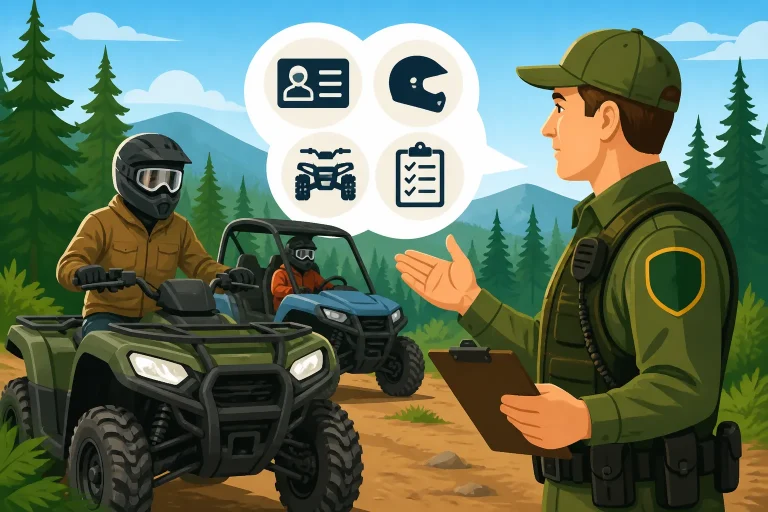
The simplest way to avoid a last-minute problem is to choose your Maine registration option before you leave Vermont, then complete the application using the official process. Check what information and documents the current system requests. Keep your Vermont registration and ownership paperwork available in case you need to confirm identifying details about the machine.
If you plan to apply online, read the instructions carefully and save the confirmation and any receipt. Don’t assume that submitting an application means every registration step is complete, or that the confirmation page automatically replaces any required registration document or decal. Check the current instructions for when you may ride and what proof you need to carry. Buying a Maine Non-Resident Registration Online covers the online process, while Riding in Maine on the Confirmation Page addresses the question of riding before a decal arrives.
Before your trip, check that the machine information on your Maine registration matches the ATV you’re bringing. A mismatch in identifying information can create delays or confusion during a stop. If the machine is borrowed, recently purchased, or registered to someone else, clarify what documents you should have with you rather than relying on an informal explanation at the trailhead.
A practical pre-trip paperwork folder can include:
- Your Maine non-resident registration confirmation and any required registration documents or decals.
- Your Vermont registration and proof of ownership.
- Contact details for the person or business that owns the machine, if it isn’t yours.
- Any required safety-course documentation for a young rider.
- Notes on the planned trail system and the club or local contact providing current access information.
For a side-by-side, check the rules specifically for that machine rather than assuming the ATV steps apply without changes. Maine UTV Registration and How It Differs explains why it’s worth checking the category. This matters especially if your UTV has a different registration history or is being used for a purpose beyond ordinary trail riding.
If you’re bringing children or teenagers, check age, supervision and safety-course requirements before setting out. Rules can depend on the rider’s age and the circumstances of the ride, so don’t rely only on what is allowed in Vermont. Start with Maine ATV Safety Course Requirements and verify the current requirements for the young rider in your group.
Registration does not guarantee trail access
Maine trail access is a separate question from registration. Many ATV routes depend on permission from private landowners, and access can change if a landowner closes a route or a club posts a temporary restriction. A line on an old map, a route your friend rode last summer or a GPS track saved from a previous trip is not proof that the trail is open today.
Before leaving Vermont, choose a specific trail system and check its current status with the local club or other responsible source. Look for closures, seasonal restrictions, construction, mud-related conditions and any posted limits on machine size. For trip planning, Checking Maine Trail Status Before You Drive and Maine ATV Trail Maps and Club Boundaries are useful starting points.
Treat every crossing and road connection as its own permission question. An ATV trail may connect to a town road, but that doesn’t mean you can ride along the road wherever you like. Public-way use depends on applicable state rules and local designations. Confirm that the route is authorized for ATV use, and follow posted signs and town restrictions. For an overview, see Where Maine Lets You Ride an ATV.
Likewise, never assume that a trail is public simply because it is visible, appears on a map or passes through woods. If access depends on permission, get it from the appropriate landowner or trail organization and follow any conditions. Landowner Permission on Maine ATV Trails explains what to check. Stay on marked routes, close gates if instructed, avoid creating new paths, and leave the route if it is posted closed.
Plan around your machine, not just the map. A wide side-by-side may not fit a narrow trail or bridge, even if the route is open to some ATVs. Confirm width restrictions and surface conditions with the local club, especially when travelling with a full-size UTV. If a route is unsuitable, don’t try to squeeze through or bypass a closure; choose a route designed for your machine.
A Vermont-to-Maine trip checklist
A little planning helps prevent the most common mix-up: having the right registration but no legal or practical route to ride. Before loading your machine, work through these steps:
- Choose the Maine registration option. Estimate how many days you’ll ride and whether you expect another Maine trip within the relevant registration period. Confirm current requirements with Maine’s official registration service.
- Complete the registration process and save the proof. Keep the confirmation, receipt and any required documents accessible. Verify whether you must wait for a decal or other item before riding.
- Check the machine category. Confirm whether your vehicle is treated as an ATV or UTV for registration and trail purposes. Don’t rely on its casual name or appearance.
- Pick a trail system and verify access. Contact the local club or check current notices before you travel. Confirm the trail is open, suitable for your machine and connected to a legal staging area.
- Review rider-specific rules. Check requirements for minors, supervision, safety courses and helmets. Make sure each rider has the equipment and documentation required for their situation.
- Prepare for a change of plan. Trails may close, weather may affect conditions, and private access can be withdrawn. Have an alternate route or a non-riding activity in mind rather than entering a closed trail.
If you’re bringing a group, assign one person to check the registration and route details, but make sure every rider understands the plan. Share the trail system name, staging location, closure information and a return time. A group should not assume that everyone’s home-state registration or safety paperwork is identical.
For a short visit, the main takeaway is straightforward: a Vermont registration does not automatically authorize riding in Maine. Arrange the appropriate Maine non-resident registration, confirm what proof must be carried, and verify that the specific trail is open and accessible. Those checks are separate, and both matter before you ride.
Disclaimer
This article is for general informational purposes only and does not constitute professional advice. Laws, prices and regulations vary by location and change over time. Consult a qualified professional for guidance on your specific situation.