Maine ATV Safety Course Requirements
A Maine trail ride can turn stressful fast when a young rider reaches a trailhead and nobody knows whether a safety certificate is required. This guide explains who generally needs an ATV safety course, how to choose an approved course, what the certificate does and does not allow, and how to prepare before riding. It also covers the extra checks that matter for families and visitors.
Who needs a Maine ATV safety course
The main age-based requirement
Maine’s ATV safety-course rules are especially important for riders under 16. A young person may need to complete an approved ATV safety course before operating an ATV, particularly when riding somewhere other than land owned or leased by a parent or guardian. The exact rules can depend on the rider’s age, the land, and the circumstances, so do not treat a course certificate as a substitute for checking the rules that apply to the ride you have planned.
For a family, the practical approach is simple: if a child under 16 will ride anywhere beyond a parent’s or guardian’s own property, check the current Maine requirements and arrange an approved course before the trip. That gives you time to confirm the course is recognized, complete any required parts, and keep proof of completion available. It is much less frustrating than discovering a missing requirement after you have driven to a trail.
The course requirement is separate from other youth-riding rules. Age restrictions, adult supervision, machine size, helmet use, and where a child may operate can all matter independently. A certificate does not automatically make every ride lawful or appropriate. For the broader age-related rules, see Maine ATV Age Rules for Riders Under 16.
Adults and the difference between required and recommended
Adults are not generally subject to the same age-based course requirement as riders under 16, but taking a course can still be useful. A new rider may feel comfortable steering around the yard and still be unprepared for a narrow trail, an unexpected washout, a road crossing, or a machine that handles differently under braking. A course can help turn vague confidence into specific habits for controlling the ATV and making safer decisions.
Even experienced riders can benefit from a refresher, especially after a long break or when moving from a small quad to a heavier machine or side-by-side. A UTV’s wider stance, passenger load, and different rollover risks make it feel unlike a single-rider ATV. Training can also help a rider recognize when the conditions are beyond their skill level, which is often the most valuable lesson of all.
A course certificate may be required for a particular rider or situation, but it is not a blanket permission slip. It does not replace registration, landowner permission, trail access rules, age restrictions, or safe operating practices. If you are an adult riding with children, learning the same safety principles can make supervision more useful than simply following behind.
How age, land, and supervision affect the rules
Riding on a parent or guardian’s land
Rules may treat a young rider differently when operating on land owned or leased by a parent or guardian than when riding on public or other private land. That distinction can be easy to miss when a family property connects to a trail, woods road, or neighboring parcel. A child starting on the family’s land does not necessarily have permission to continue onto a trail that crosses land owned by someone else.
Before a ride, identify where the property boundary is and whether the route leaves the family’s land. A familiar path can cross a boundary without an obvious gate or sign. If it does, the rules for the next section may change, and separate landowner permission may be needed. Do not assume that permission to ride at home extends to club trails, public land, or a neighbor’s woods road.
If you are relying on an exception connected to family land, confirm that the exception applies to the rider and the exact type of riding planned. The safest interpretation is not to stretch a narrow exception to cover a longer route or different property. For related details, read Maine ATV Rules for Riders Under 16 on Roads and Adult Supervision Rules for Maine Youth Riders.
Supervision is not the same as training
Adult supervision and a completed safety course serve different purposes. Supervision means a qualified adult is present as required by the rules; it does not automatically satisfy a separate course requirement. Likewise, taking the course does not mean a young rider can operate without supervision where supervision is required.
Good supervision is active. The adult should be able to see or quickly reach the young rider, understand the route, and respond if the child gets stuck, becomes separated, or encounters traffic. A parent riding several minutes ahead around a bend may technically be part of the same group, but that arrangement may not provide the kind of practical oversight a new rider needs.
It helps to decide the supervision plan before the engines start. Agree on who rides in front, who stays behind the child, where the group will stop, and what to do if anyone loses sight of the others. When a child is still learning, choose a short, familiar route with room to stop and regroup rather than a long ride with difficult terrain.
Choosing and completing an approved course
Confirm approval before enrolling
A course that discusses ATV safety is not automatically a course that meets Maine’s requirement. Before enrolling, confirm that the provider and course are accepted for Maine’s ATV safety-course rules. A course offered for another state, a general online lesson, or a dealer’s safety briefing may be informative without fulfilling Maine’s requirement.
Start with Maine’s official outdoor-safety course information and use its guidance to identify a recognized option. Check what the course includes, what the student must complete, and how completion is documented. If the course has separate online and in-person components, be certain that both are finished when required. A registration confirmation or partially completed lesson may not be the same as a completed certificate.
Course options and delivery methods can vary. Some riders may find a class convenient; others may prefer an instructor-led setting where they can ask questions and practice skills. Families should consider the student’s reading level, attention span, and experience when choosing a format. A young rider who clicks through material without understanding it has not gained much, even if the screen shows progress.
Know what the course covers
A quality ATV safety course should help riders understand how to control the machine, assess terrain, and make safer choices before and during a ride. Topics commonly include basic operating controls, starting and stopping, turning, balance, protective equipment, hazards, and the importance of following applicable laws. The course is also a useful opportunity to talk about the difference between riding on private property and riding on a managed trail network.
For a young rider, connect each lesson to something real. If the course discusses stopping distance, ask the child how speed and loose gravel might affect stopping on a local trail. If it covers terrain, talk through how a wet slope, exposed roots, or a hidden rut could change the safest route. These conversations help the rider apply the lesson instead of treating it as a quiz to pass.
The course should also prompt the rider to recognize limits. A rider who is unsure how to cross an obstacle should stop and ask for help rather than follow another machine into it. If a trail narrows, visibility drops, or the surface changes unexpectedly, slowing down or turning back is a sound decision—not a failure. The best training supports judgment, not bravado.
Plan for proof of completion
When a student finishes the course, make sure you understand how the completion record is issued and how to retrieve it later. Save the certificate or confirmation in a place you can access while travelling. A printed copy can be useful as a backup, while a digital copy can be convenient if your phone has service and battery power.
Check that the record belongs to the correct student and identifies the course completed. If a name is misspelled or the certificate is missing, resolve that before the riding day rather than assuming the issue will not matter. Families with several young riders should keep each person’s documentation clearly labeled; it is easy to mix up paperwork when multiple children complete training around the same time.
For details on the document itself and what to do if it is misplaced, see Maine ATV Safety Certificate and Whether It Expires. Keep in mind that course records are only one part of the paperwork picture. They do not prove that a machine is registered or that the group has permission to use a particular trail.
What the course certificate does and does not do
It does not replace registration or permission
A safety certificate is evidence of training. It is not an ATV registration, trail pass, landowner permission, or authorization to ride on a road. A family can complete every required course and still need to register the machine and make sure the route is open to ATVs.
This distinction matters in Maine because many trails rely on landowner permission and club relationships. A route shown on a map may be closed, seasonal, or limited to certain types of machines. Before a ride, check current trail status and follow posted signs. If the route crosses private land, do not assume the safety certificate gives you access.
The same goes for public ways. A course does not create a right to ride an ATV on a town road or highway. Road access depends on applicable state law and local authorization, and a town’s rules can affect where ATVs may travel. Riders should review Maine Helmet Requirements by Age and road-specific rules separately rather than treating a course as a complete legal checklist.
It does not override age or machine-size rules
Young riders may be subject to restrictions beyond the course requirement, including limits related to age, supervision, and the machine they operate. A child’s ability to complete a course does not establish that a particular ATV is suitable for them. A powerful, heavy machine can be difficult to control even for a child who knows the safety rules.
Choose a machine the rider can handle comfortably. They should be able to reach the controls, operate the brake, sit in a stable position, and steer without straining. The machine should not be selected on the assumption that the child will “grow into it” while riding. A poor fit can make it harder to respond quickly or keep control on uneven ground.
For youth riders, review Maine ATV Safety Course for Riders 10 to 15 alongside the relevant age and machine rules. If the ATV will be used on roads or road crossings, confirm those rules separately too. A successful course is a starting point for safer riding, not a replacement for matching the rider, machine, and route.
It does not guarantee a risk-free ride
Training can reduce avoidable mistakes, but no course can remove every hazard. Trail conditions change with weather, maintenance, traffic, and seasonal closures. A route that was easy on a dry afternoon may become slippery after rain or difficult to read in fading light.
Even after training, riders need to inspect their machine, wear suitable protective equipment, and ride at a pace that allows them to respond. A certificate does not make it safe to carry an extra passenger on a single-rider machine, attempt an unfamiliar steep descent, or follow another rider into a route that is too narrow for the vehicle.
Parents sometimes feel pressure to let a child keep up with older riders. It is okay to split the group, shorten the loop, or skip a section. The better ride is the one that leaves everyone comfortable enough to want to ride again—not the one that pushes a young rider past their ability.
Preparing for a course and a first ride
Build a practical readiness checklist
Before the class, confirm the student’s enrollment details, course format, and completion requirements. Make sure the student has time to focus, especially if the course includes online lessons. If it is instructor-led, check the meeting location, what to bring, and whether any equipment is needed for the practical portion.
Before the first ride, check the machine and the route. Confirm the registration is current, the route is open, and permission is in place where needed. Inspect tires, brakes, throttle response, lights, and basic controls. A brief walk-around can reveal a loose part or a damaged tire that is easy to miss when everyone is eager to leave.
Use this table as a planning aid, not as a substitute for checking the requirements that apply to your specific rider and route.
| Before the ride | What to confirm | Why it matters |
|---|---|---|
| Course | The course is accepted for Maine and all required parts are complete | Not every safety lesson fulfills a state requirement |
| Certificate | The student’s completion record is saved and accessible | Avoid last-minute confusion about proof |
| Rider | Age, supervision, and machine-size rules have been checked | A certificate does not override other youth rules |
| ATV or UTV | Registration, condition, and operating controls are checked | Training does not authorize an unregistered machine |
| Route | Trail status, land access, and local restrictions are confirmed | Access can change by location or season |
| Gear | Helmet and other protective equipment fit correctly | Poor fit can undermine protection and comfort |
| Group plan | Adults agree on pace, stops, and regrouping points | A clear plan helps prevent separation |
Choose gear that fits the rider
A helmet should fit securely and be appropriate for the type of riding. A loose helmet can shift, while one that is too tight may become uncomfortable and distract the rider. Check the fit before the trip, not in a trailhead parking lot when the group is ready to go. Review the applicable helmet rules by age, and remember that legal minimums are not the same as a complete safety setup.
Goggles or suitable eye protection can help keep dust, insects, and small debris out of a rider’s eyes. Gloves, sturdy footwear, and clothing suited to the weather can also make a ride more comfortable and controlled. Avoid clothing that could catch in moving parts, and bring layers for conditions that may change during the day.
If you are comparing protective gear online, treat product descriptions as a starting point rather than proof of fit or suitability. An Amazon listing may help you compare options, but the rider still needs to check the manufacturer’s sizing guidance and the relevant standards. If a helmet feels wrong or will not sit securely, try a different size or model instead of hoping it will break in.
Make the first outing deliberately easy
For a new young rider, begin on a controlled area where stopping and practicing are straightforward. Go over the controls and basic signals before moving. Let the rider practice starting, stopping, turning, and looking ahead at a slow pace. If the child seems anxious or becomes overwhelmed, pause and reset rather than pushing through.
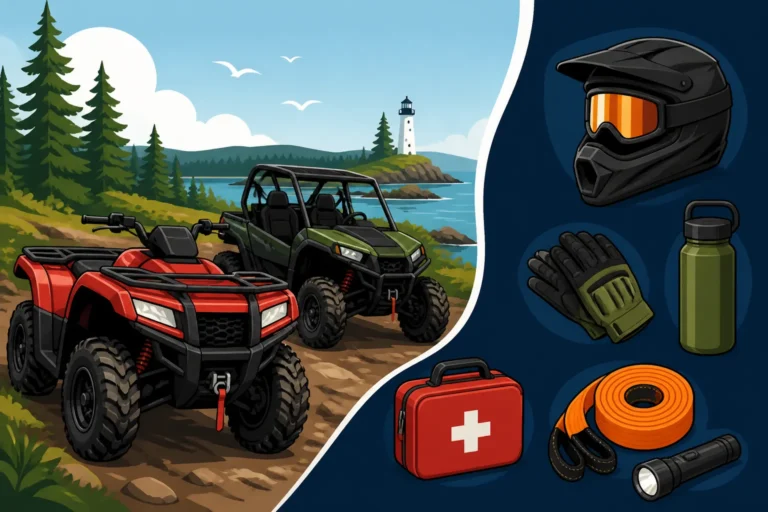
Pick a short ride with a simple turnaround point. Avoid a route that depends on keeping up with faster machines, includes unfamiliar road crossings, or has terrain the young rider has not practiced. Bring water, a basic first-aid kit, and a way to contact help if the route allows. Tell someone who is not riding where you expect to go and when you plan to return.
At the end of the ride, ask what felt manageable and what felt difficult. A child may say “fine” to avoid disappointing an adult, so ask specific questions: Was braking comfortable? Did the pace feel too fast? Was there a spot where the machine felt hard to control? Those answers help you choose a suitable next ride and reinforce that speaking up is part of being a responsible rider.
Out-of-state riders and family groups
Visitors should verify course recognition
Visitors sometimes assume a safety certificate from their home state automatically satisfies Maine’s requirements. Recognition can depend on the certificate, the course, and the applicable rule. Before travelling, confirm whether the student’s course is accepted in Maine rather than relying on a friend’s experience or an old certificate card.
Ask the issuing organization what the certificate represents and whether it documents successful completion of an ATV safety course. Keep the record accessible during the trip. If you are unsure, check with Maine’s official information before setting out, especially if a child under 16 will ride on trails or other land away from the family’s property.
The same careful approach applies to a rider who completed a course in Canada or another U.S. state. A course that was valid where it was taken may not automatically settle every Maine requirement. See Out-of-State Safety Certificates Accepted in Maine for the recognition question, and confirm any other age, supervision, registration, or trail-access rules separately.
Keep each rider’s requirements straight
In a group with children of different ages, the rules and readiness of one child may not match another’s. One rider may have completed a course and be ready for a supervised trail ride, while a younger sibling may need more practice or may be limited to a different setting. Avoid making the entire group’s plan based on the most experienced child.
Write down the key details before leaving: each child’s age, machine, course status, supervising adult, and planned route. This does not need to become a complicated form. A simple family checklist can prevent confusion when several machines are being loaded and everyone is asking where the helmets are.
If you are buying or borrowing gear, avoid assuming that a child can use an adult’s equipment safely. An Amazon search might help locate different sizes, but online availability does not confirm that an item fits the rider. Try gear on when possible, check fit and condition, and replace equipment that is damaged or no longer fits properly. Safety gear is personal equipment, not just another item to share among siblings.
Common mistakes and how to avoid them
Assuming any course counts
A frequent mistake is enrolling in the first ATV course found online without checking whether Maine accepts it. Another is confusing a brief rental orientation or dealer demonstration with a formal safety course. Those experiences may be useful, but they should not be assumed to meet a legal requirement.
Avoid the problem by confirming the provider and course before paying or committing time. Read the course details and ask what document is issued when the student completes it. If the course has multiple steps, confirm that the student has finished all of them and knows how to retrieve the final record.
A second common mistake is waiting until the week of the trip. Course availability, travel, family schedules, and documentation issues can all take longer than expected. Get the course question settled early, then use the remaining planning time to check the machine, route, registration, and gear.
Treating the certificate as the whole safety plan
A completed course can create a false sense that the major risks are handled. In reality, a trained rider can still be caught out by speed, fatigue, poor visibility, unexpected trail conditions, or pressure from the group. The lesson has to carry over into decisions made on the ride.
Set expectations before departure. Agree that the group will stop if a rider asks, no one will pressure a child to attempt an obstacle, and the pace will suit the least experienced rider. Let young riders know that turning around is a responsible option. This makes it easier for them to speak up before a small concern becomes a serious problem.
Also avoid treating a certificate as proof of access. A ride still needs to comply with registration requirements, route closures, landowner permission, and any local rules. When planning routes, confirm current information rather than relying solely on a printed map or a memory of where you rode last year.
Letting the group set the pace
A child who is trying to keep up with adults may ride faster than they can safely manage. This is especially likely on an unfamiliar route where the rider does not know what is around the next bend. A safety course cannot make a young rider immune to peer pressure or the excitement of a group ride.
Place an adult where they can monitor the young rider and set the pace from the front or rear as appropriate. Plan regular stops, keep the group together, and choose terrain suited to the least experienced person. If the child is tired, cold, distracted, or uncomfortable, take a break or end the ride.
A calm, predictable ride builds better habits than a demanding one. The goal is not to cover as many miles as possible. It is to help each rider recognize hazards, stay in control, and make sound choices throughout the ride.
Frequently asked questions
Does every adult need to take an ATV safety course in Maine?
Adults are not generally subject to the same age-based course requirement as riders under 16, but training remains a sensible choice for beginners and returning riders. Check whether a specific activity, organized event, employer, rental provider, or other rule adds its own training condition. A course can improve practical skills even when it is not required for that adult.
Does taking a course let a child ride alone?
No. Course completion does not automatically remove supervision requirements or other restrictions that may apply to a young rider. Check the rules for the child’s age, the land, the machine, and the route. For a fuller explanation of course timing and age-specific details, read Maine ATV Safety Course Requirements.
Can an online course satisfy the requirement?
That depends on whether the specific online course is accepted for Maine and whether it includes every required component. Do not assume that a general online lesson or a course approved in another jurisdiction automatically qualifies. Confirm the provider, completion steps, and certificate before enrolling.
Does a safety course register the ATV?
No. Training and registration are separate. You still need to meet the registration requirements for the machine and confirm that the planned route allows ATV use. For registration steps, see What It Takes to Register an ATV in Maine.
What if a rider has lost the certificate?
Contact the course provider or the organization that issued the record and ask how to retrieve or replace proof of completion. Keep the replacement where it can be accessed during a ride, and save a backup copy at home. Do not assume that a photo of an old card or an enrollment email proves course completion.
Where can I find a course?
Start with Maine’s official course information and confirm that the listed option meets the requirement for the rider. Availability and formats can vary, so plan early rather than assuming a class will fit your schedule at the last minute. The related guide Where to Take a Maine ATV Safety Course can help you focus your search.
Disclaimer
This article is for general informational purposes only and does not constitute professional advice. Laws, prices and regulations vary by location and change over time. Consult a qualified professional for guidance on your specific situation.