Maine’s Three-Day Agreement With New Brunswick and Quebec
A Canadian registration does not automatically give every visitor unlimited access to Maine’s ATV trails. The three-day arrangement involving New Brunswick and Quebec is a narrow exception, and confusing it with full reciprocity can lead to a frustrating stop—or a ride on a trail you were never authorized to use. This guide explains what the arrangement means, what to check before crossing the border, and how to plan a compliant trip.
What Maine’s three-day arrangement means
It is a limited exception, not full reciprocity
The three-day arrangement is commonly understood as a limited allowance for qualifying ATV riders from New Brunswick and Quebec to operate in Maine without first obtaining the usual Maine nonresident ATV registration. The important words are limited and qualifying. It is not a blanket agreement that makes every Canadian ATV registration valid for every Maine ride, for any length of stay.
That distinction matters when you are planning more than a quick visit. A Canadian visitor who assumes that a provincial registration covers an entire vacation could discover that the exception does not apply to their machine, their trip dates, or their planned riding. If your trip will go beyond the permitted period, arrange the appropriate Maine registration before riding rather than treating the exception as a general substitute.
The arrangement also does not grant access to every road, trail, or parcel of private land. Registration or an exemption addresses whether the machine may be operated under the applicable registration rules; it does not automatically grant permission to ride a particular route. You still need to follow Maine’s trail access rules, posted closures, landowner permissions, and any local restrictions.
The three-day limit needs careful interpretation
Do not assume “three days” means any three separate riding days spread across a longer holiday. Unless the relevant authority confirms otherwise for your circumstances, plan conservatively: treat it as a short, consecutive period, and do not expect a border crossing, overnight stop, or change of trail system to restart the clock.
Keep a simple record of when the machine entered Maine and when you began operating it. This can help you explain your itinerary if a warden or other enforcement officer asks. A fuel receipt or lodging record may help you keep your own timeline straight, but it should not be treated as a substitute for the registration or proof required for the exception.
If your itinerary is close to the limit, ask Maine’s Department of Inland Fisheries and Wildlife, commonly called Maine IF&W, how the applicable period is counted before you ride. The distinction between calendar days, consecutive days, and a rolling period can affect trip planning. For a more focused look at that issue, see Which Days Count Under Maine’s Three-Day Rule.
The agreement does not replace ordinary riding rules
A registration exception is not a safety-course waiver, a helmet exemption, or permission to ride wherever a trail appears on a map. Riders remain responsible for applicable Maine operating rules, including age-related requirements, passenger restrictions, equipment rules, and any rules that apply when using an ATV-access route or crossing a public way.
The same practical approach applies to trail access. A route that appears on a mapping app may cross private land, pass through a temporarily closed section, or require the rider to use a designated connection. Clubs and landowners may set conditions that are stricter than what a visitor expects from a map. Follow posted signs and local directions, and do not treat silence or an old online route as permission.
If you are a first-time visitor, build in time to confirm both registration eligibility and route access. That extra check is far less stressful than reaching a closed gate, discovering you need different paperwork, or having to turn back after unloading your ATV.
Who may qualify and which machines are covered
Confirm the rider’s connection to New Brunswick or Quebec
The arrangement is associated with New Brunswick and Quebec, but that does not mean every person with a Canadian passport or Canadian mailing address automatically qualifies. The relevant question is usually whether the operator and machine meet the conditions tied to the province’s registration and the Maine exception.
A visitor from another province should not assume they can use the same arrangement simply because they are Canadian. Likewise, a person who lives in New Brunswick or Quebec but is riding a machine registered elsewhere should verify whether the exception applies to that combination. It is the relationship between the rider, the machine, the registration, and the conditions of the rule that needs checking.
If your group includes people from different provinces, different machine owners, or a mix of Canadian and U.S. registrations, check each machine separately. A group ride can look uniform from the trail, while the paperwork behind each ATV differs. One person’s eligibility does not automatically cover a companion’s machine.
Check that each machine has its own valid registration
Treat the registration as machine-specific. Carry the documents associated with the ATV you are actually riding, and make sure the identifying details are consistent. If the provincial document lists a registration number or vehicle identifier, compare it with the machine before leaving home.
This is especially worthwhile when a family owns several similar quads. It is easy to put one ATV’s papers in another machine’s storage compartment, or to grab an expired document from the household file. A few minutes checking the paperwork at the trailer can prevent a confusing roadside conversation later.
For a side-by-side or UTV, do not assume that a rule described for ATVs automatically covers every type of off-road vehicle in exactly the same way. Check how Maine classifies your machine and whether the exception applies to it. The overview Maine UTV Registration and How It Differs can help you identify the questions to ask.
Out-of-province and borrowed machines need extra scrutiny
The simple version of the arrangement—Canadian visitor, provincially registered ATV, short Maine stay—can become less straightforward when a machine is borrowed, leased, rented, recently purchased, or registered in a province other than the rider’s home province. In those situations, avoid relying on a friend’s verbal assurance that “the Canadian registration is fine.”
Ask the owner to provide the registration document and any ownership or authorization paperwork relevant to the trip. If the name on the registration does not match the person operating the machine, be ready to explain the relationship and confirm whether additional documentation is recommended. A bill of sale, rental agreement, or written permission may help clarify the situation, but none of those documents should be assumed to replace a required registration.
For machines from New Brunswick, review New Brunswick Registrations Honored in Maine. For machines from Quebec, review Quebec Registrations Honored in Maine. These topics are useful starting points, but for a mixed or unusual situation, confirm the details with Maine IF&W before you cross the border.
Documents to prepare before leaving home
Carry proof tied to the machine
Keep the original registration document or the official proof accepted for your circumstances with the machine. A phone image can be a useful backup, but do not assume that a photograph alone will satisfy every documentation requirement. Service may also be unreliable in remote parts of Maine, so a paper copy is a practical safeguard.
Make sure the document is legible and current. If it is folded into a dusty glove box, protect it in a clear waterproof sleeve or document pouch. A small pouch from Amazon or another retailer can help keep papers together, but the key is that the contents are accurate and accessible—not where you bought the pouch.
Before you load the machine, create a short paperwork check: registration, proof of identity if relevant, ownership or borrowing documents where needed, and any trip-specific permits. Store the documents where the operator can reach them without unloading gear or emptying a cargo box on the trail shoulder.
Keep ownership and borrowing details clear
A registration document may not answer every question about who owns the ATV or why someone else is operating it. If you are borrowing a machine, ask the owner to provide written permission and a way to contact them. If you rented it, keep the rental agreement and any instructions from the outfitter with your trip papers.
This is not a reason to carry a thick folder of unnecessary documents. It is a way to avoid an awkward moment where the rider has no explanation for a name mismatch or cannot show where the machine came from. The more unusual the arrangement—recent sale, family transfer, employer-owned vehicle—the more useful clear documentation becomes.
If a machine was bought shortly before the trip, check that the registration reflects the current status and that the ownership paperwork is complete. A sales receipt may support the story, but it does not necessarily establish that registration requirements have been met. Maine ATV Registration for a Machine Bought Out of State covers a related situation for machines arriving from outside Maine.
Keep a simple trip record and emergency information
Write down the date the machine enters Maine, the first intended riding day, and the date you plan to stop riding. Keep that note with the registration papers. If you are traveling with several machines, record each machine’s registration identifier beside the rider’s name so the group does not mix up documents.
Add emergency contacts and lodging details to your trip folder. This is useful for any remote ride, but especially for visitors unfamiliar with the area. A paper map and written directions can still matter if a phone battery dies or a trail system has weak coverage. A waterproof map case or compact notebook, which you might find on Amazon, is more helpful than relying on a phone screen alone.
If you use a navigation app, download the information you need before leaving a service area. Keep the paper record as a backup, and make sure a companion knows where the paperwork is stored. That way, a rider who is separated from the group is not left without the basic information needed to explain the trip or get help.
| Before the trip | What to check | Why it matters |
|---|---|---|
| Province and registration | Confirm the machine is registered in a province covered by the arrangement and that the registration is valid | A Canadian address alone may not establish eligibility |
| Machine type | Confirm whether the arrangement applies to your ATV or UTV | Different vehicle classes may be treated differently |
| Trip dates | Verify how the three-day period is counted and record your dates | Avoid assuming the period resets or means three scattered riding days |
| Paperwork | Carry machine-specific registration and relevant ownership or borrowing documents | Makes it easier to explain the machine’s status |
| Route | Check trail access, closures, and local restrictions | Registration does not grant permission to ride every route |
| Longer stay | Arrange the appropriate Maine registration if needed | The exception should not be treated as unlimited reciprocity |
How the exception relates to registration and trail access
Registration and permission are separate questions
It helps to think about your trip as involving two separate checks. First: is the machine properly registered, or does it qualify for the limited exception? Second: are you allowed to ride the route you have chosen? A “yes” to one does not automatically answer the other.
For example, a visitor may have paperwork that supports the three-day arrangement but still encounter a trail that is closed, private, or restricted to a specific club route. The reverse can also happen: a landowner may have granted access to a trail, but that permission does not resolve a registration issue. Both sides need to be in order.
This distinction is easy to miss when a route is described as an ATV trail in a tourism brochure or online map. Treat the route description as a planning aid, not as a legal permission slip. Check the current local information, respect signs, and contact the relevant club or landowner when access is unclear.
A map does not establish legal access
Maine’s trail network depends heavily on landowner cooperation, and access can change. A track saved from a previous trip may no longer be open, while a route shown on a third-party map may include public-road sections with special rules or private connectors. Before riding, look for current local trail information and heed any closure notices.
When planning a longer trip, identify fuel stops, staging areas, lodging, and the points where the route crosses roads or changes jurisdiction. These details matter more when you are coming from outside the state because you may not know which businesses welcome ATV traffic or which roads permit a particular kind of use.
A digital route can be convenient, but do not let a navigation line override posted restrictions. If you carry a paper map, mark the trailhead, overnight stops, and alternate routes. That extra preparation is useful if a trail closes unexpectedly or your group needs to turn back.
Road use has its own rules
The three-day registration arrangement does not make an ATV street legal. Maine has specific rules for public ways, designated ATV-access routes, road crossings, and restricted roads. A trail ride that includes a short road connection may therefore involve operating requirements beyond the registration question.
Before using a road section, confirm that it is open to ATV traffic and learn the conditions that apply there. Do not assume that a road is an ATV route because other riders use it, because it appears on a GPS track, or because it connects two trails. Local permissions and posted designations matter.
Visitors planning a route that uses roads should review Riding an ATV on the Road in Maine and the more specific guide Maine ATV-Access Routes and How Towns Post Them. These topics can help you separate trail riding from public-way operation and identify questions to resolve before you depart.
Planning a compliant ride in Maine
Confirm eligibility before crossing the border
Start by identifying each ATV or UTV, its registration province, the person who will operate it, and the length of the planned Maine stay. Then confirm whether the three-day arrangement applies to that exact situation. If a machine is borrowed, recently purchased, or registered somewhere other than the rider’s province of residence, flag that detail when asking.
Do not wait until you are standing at a trailhead to sort out the paperwork. If the exception does not fit your plans, you may need to obtain a Maine nonresident registration or adjust the length of the trip. Reviewing Maine ATV Registration for Non-Residents and Maine Non-Resident ATV Registration Options can help you compare the questions involved.
Keep a written note of the guidance you receive, including the date and the office or contact point, especially if your trip is close to the three-day limit. A clear note will not change the rule, but it helps your group remember what was confirmed and reduces last-minute disagreements about whether a fourth riding day is allowed.
Build your dates around the rule, not the other way around
Set your riding window only after you understand how the three-day period is counted. If you are arriving late in the day, departing on a travel day, or planning to ride across a weekend, ask whether those dates count under the applicable interpretation. Avoid working from assumptions such as “we only rode for a few hours” or “we crossed back into Canada overnight.”
For a longer vacation, decide early whether you will obtain a Maine registration rather than trying to squeeze all riding into a limited exception. A change in weather, a mechanical problem, or a trail closure can easily disrupt a tightly scheduled ride. A plan that depends on every riding day going exactly as expected leaves little room to adapt.
It is also helpful to distinguish between your time in Maine and your riding time. A stay may include days spent traveling, sightseeing, or waiting out poor conditions. Whether those days affect the exception is a question to confirm in advance; do not infer the answer from how many hours the ATV is actually moving.
Make a plan for trail information and group communication
Choose a primary route and at least one practical alternative. Check the trail status close to departure, and make sure the whole group understands where the route runs and where it may intersect with roads or private land. If a route is closed, do not improvise a shortcut through posted property.
Agree on a simple group routine: who carries the registration papers, who has the map, where you will regroup if riders become separated, and what to do if a machine breaks down. For a remote ride, tell someone who is not riding where you expect to go and when you plan to return.
Packing thoughtfully helps reduce small problems that can become major disruptions. A phone power bank, paper map, basic first-aid supplies, water, and a weather-appropriate layer are sensible additions. If you are buying a waterproof case or charging accessory through Amazon, check that it fits your equipment and can handle the conditions you expect; no accessory replaces route planning or reliable communication.
Common misunderstandings and how to avoid them
Assuming “reciprocity” means unlimited riding
The word reciprocity can sound broader than the arrangement actually is. Riders may hear that New Brunswick or Quebec registration is recognized and assume it works for every trip, every machine, and every duration. That is precisely the kind of assumption that the three-day limitation makes risky.
A safer approach is to ask a specific question rather than relying on a broad label: “This machine is registered in this province, this person will operate it, and we plan to ride on these dates. Does the three-day exception cover us?” A precise question is more likely to reveal an exception or condition that a general search result misses.
If your trip falls outside the exception, do not try to make it fit by changing how you describe the ride. Find the proper registration option or revise the itinerary. Maine’s ATV Reciprocity, and Why It Ended provides background on why a limited exception should not be confused with full reciprocity.
Assuming a registration document covers every rider
An ATV’s registration and an operator’s eligibility are related but not always identical questions. A machine may have valid provincial paperwork while the person riding it does not meet a condition attached to the exception. That can happen when a family member, friend, visitor, or employee operates a machine registered to someone else.
Before the trip, list the intended operator for each machine. If riders will switch ATVs during the day, confirm that the arrangement still applies to each person and machine combination. Do not assume that a registration document in one rider’s pocket covers the entire group.
For group trips, make one person responsible for checking the paperwork but ensure each operator knows the basics. Everyone should know where their documents are, what period the group is relying on, and who to contact if a warden or trail official asks a question.
Assuming a club trail is automatically open
A familiar trail name or an old GPS track can create a false sense of certainty. Maine trails may depend on seasonal access, landowner permission, club maintenance, and local decisions. A route that was open when a friend rode it may be closed when you arrive.
Look for current trail notices and signs. If a gate is closed, a route is marked for no access, or a landowner’s instruction conflicts with your planned track, turn around. Do not follow another group through a closure simply because they appear to know the area.
Visitors can also reduce the risk of losing access by riding courteously: slow down near homes, keep noise under control, stay on the marked route, and avoid leaving litter. The trail network relies on ongoing permission, and respectful behavior helps protect access for local riders and future visitors.
A practical pre-ride checklist for Canadian visitors
The night before your first ride
Set out the registration papers and check that they match the machine. Confirm that the identifying details are readable and that the document is valid. If you are relying on the three-day arrangement, make sure the eligibility and date-counting questions have been resolved rather than left to a guess.
Review the route and its status, then check the weather and expected riding conditions. Confirm where you will stage, where you can refuel, and how you will return if a trail is closed or a machine has a problem. Share the plan with someone who is not riding with you.
Put important documents in a secure, waterproof place that the operator can reach. Keep a backup copy separate from the original if practical, but do not depend only on a phone image. Make sure a second person in the group knows where the paperwork and emergency contacts are stored.
At the trailhead
Before unloading or starting the ride, check the posted information at the trailhead. Look for closures, route changes, local rules, and any notices that affect the day’s ride. If the signs contradict the route you planned, follow the signs and seek clarification rather than assuming the map is more current.
Do a quick equipment check: brakes, lights where required, tires, fuel, and any safety gear needed for the route. Make sure passengers are on machines designed and permitted to carry them, and that young riders meet the applicable requirements. A paperwork exception does not reduce the need for a safe machine and a responsible operator.
Tell the group how long you expect to be out and where you plan to regroup. Agree that no one will ride past a closure or take an unplanned shortcut. Those simple agreements can prevent the familiar trail-day problem where one person follows a different track and the rest of the group has no idea where they went.
When a warden or trail official asks questions
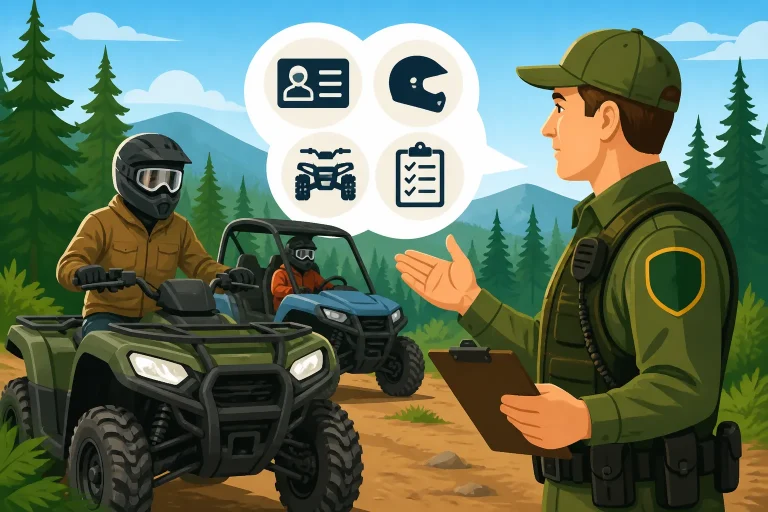
Stay calm, stop safely, and answer clearly. Have the registration or other relevant paperwork ready, and explain the trip dates and the basis on which you believe the machine qualifies for the limited arrangement. If you are unsure about a detail, say so rather than guessing or arguing over an interpretation you have not confirmed.
Keep the machine’s papers together and avoid handing over a pile of unrelated documents. If the official asks for something you do not have, be respectful and ask what information is needed. A clear, cooperative conversation is more useful than insisting that a forum post or another rider’s experience settles the issue.
After the stop, note any instruction or clarification that affects the rest of your trip. If you learn that your situation needs different registration, do not continue riding while hoping the issue will not come up again. Pause and resolve the requirement before returning to the trail.
Where to get reliable answers before your trip
Ask a question that includes the details that matter
When you contact Maine IF&W or another relevant authority, include the province where the ATV is registered, the type of machine, who will operate it, whether it is borrowed or rented, and the dates you intend to ride. Those details help distinguish a straightforward visitor trip from a case that may not fit the standard explanation of the exception.
Ask directly whether the three-day allowance applies to your situation, how the period is counted, what proof you should carry, and what to do if your stay lasts longer. If you are bringing a UTV, ask whether it is treated the same way as the ATV in the information you have found.
Also check whether there are additional requirements for the routes you plan to use. Registration questions and trail-access questions may have different answers and may involve different local organizations. Keeping those questions separate can prevent an incomplete answer from giving you false confidence.
Cross-check the route with local trail information
Before departure, identify the club or organization responsible for the trail system you intend to ride and check its current notices. Local clubs often know about temporary closures, detours, landowner changes, and conditions that are not obvious from a general map.
If your route passes through several towns or connects multiple trail systems, check each section. A trip that looks like one continuous line may involve separate access rules and road connections. Make sure your planned fuel and lodging stops are actually accessible by the route you intend to use.
Keep a backup plan in case a trail closes. That might mean shortening the ride, choosing another confirmed route, or spending the day on a non-riding activity. A flexible itinerary is safer and more enjoyable than trying to force a route through a closure because the group has already driven a long way.
Keep registration and trail access in perspective
The three-day arrangement can be useful for eligible visitors taking a short trip from New Brunswick or Quebec, but it is not a replacement for checking the details. Treat it as a narrow exception that needs to match your machine, your operator, and your dates.
The most reliable plan is straightforward: confirm eligibility, understand how the period is counted, carry the right paperwork, verify trail access, and arrange Maine registration if the exception does not cover the trip. That approach gives you a much better chance of spending the day riding instead of sorting out avoidable paperwork or access problems.
Disclaimer
This article is for general informational purposes only and does not constitute professional advice. Laws, prices and regulations vary by location and change over time. Consult a qualified professional for guidance on your specific situation.