Maine ATV Registration for Non-Residents
Arriving at a Maine trailhead with an out-of-state ATV registration can leave you wondering whether your machine is actually legal to ride. Maine’s registration rules, limited Canadian exception, and separate trail-access requirements can be easy to mix up. This guide explains what non-residents generally need, how to choose a registration option, and what to check before unloading.
Do non-residents need to register an ATV in Maine
In most cases, a non-resident needs a Maine ATV registration to ride in Maine. Having a registration from your home state or province does not automatically make it valid for Maine trails. The main exception is a narrow arrangement involving certain Canadian registrations, not broad reciprocity for every visitor.
It also helps to separate three different questions: Is the ATV registered? Is the place you want to ride open to ATVs? Do you have permission to use that trail or property? A Maine registration addresses the first question. It does not, by itself, answer the other two.
Why an out-of-state registration may not be enough
Riders sometimes assume that a registration valid at home will carry over when they cross into Maine. That assumption can create a problem at the trailhead, especially for visitors towing a machine from New Hampshire, Massachusetts, Vermont, or farther away. Maine’s registration rules generally require non-residents to obtain a Maine registration unless they qualify for a specific exception.
Broad ATV registration reciprocity with other U.S. states ended years ago. That means an out-of-state registration should not be treated as a substitute for Maine registration simply because the machine is properly registered where it lives. This is different from some road-vehicle situations, where a state may recognize another state’s registration for ordinary highway travel.
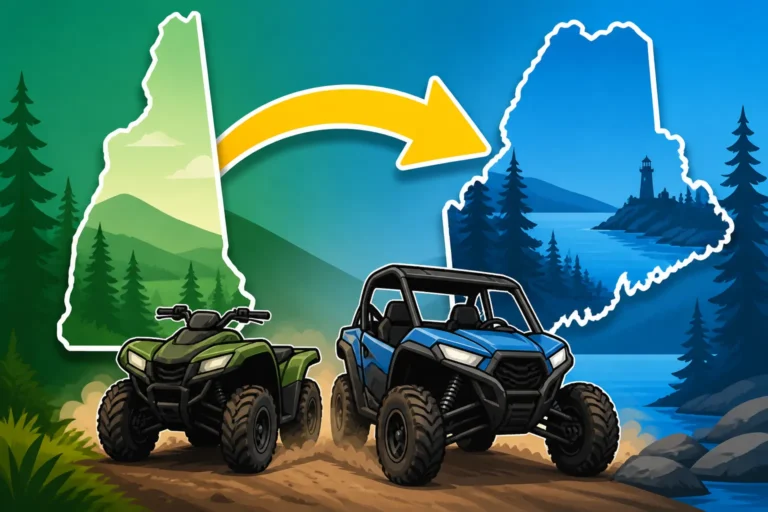
If you are coming from New Hampshire, see Do New Hampshire Riders Need a Maine Registration? for a focused look at that common question. Riders from other states should also check the applicable rules rather than assuming that their home-state sticker is enough.
Registration is not the same as trail permission
A Maine registration does not give you blanket access to every trail, woods road, or parcel of land. Many Maine ATV routes cross private property, and access depends on landowner permission and the trail’s current status. A route may be closed, temporarily blocked, or unavailable to a particular type of machine even if your paperwork is in order.
This distinction matters when planning a trip around a lodging property or a familiar trail map. A machine can be properly registered but still be riding where access has been withdrawn. Before setting out, check local club information, posted signs, and current route notices. The guide to [Landowner Permission on Maine ATV Trails] explains why permission is a separate part of legal access.
A useful way to think about it is: registration makes the machine eligible to be operated where ATV riding is allowed; it does not create the right to ride on a particular piece of land. Treat those as separate checks every time you plan a route.
Maine’s reciprocity rules and the Canadian exception
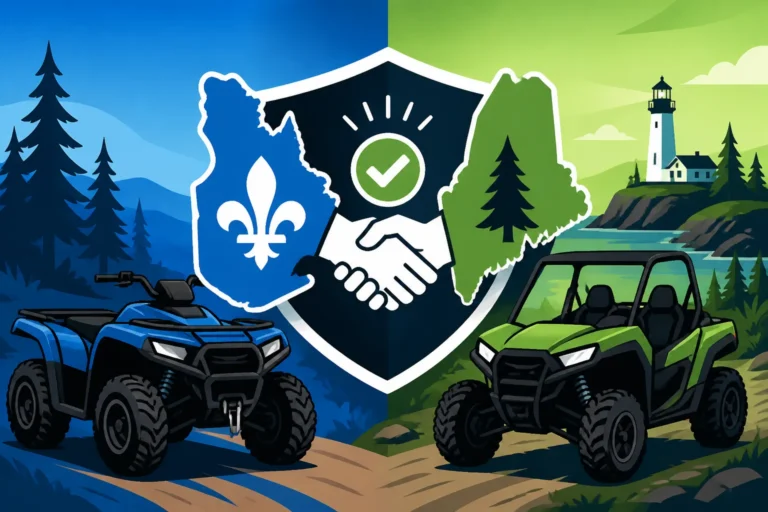
The word “reciprocity” can be confusing because it sounds like Maine accepts every visitor’s registration. That is not the case. Maine ended broad ATV registration reciprocity with other states, while a limited arrangement exists for qualifying riders from New Brunswick and Quebec.
Because an exception can have specific eligibility and time limits, do not rely on a casual description or a friend’s past experience. Confirm the applicable terms before traveling, particularly if your trip crosses a border or lasts more than a few days.
What the three-day exception means
Maine has a limited three-day arrangement associated with eligible ATV registrations from New Brunswick and Quebec. It is not the same as general reciprocity, and it does not mean that every Canadian rider can ride indefinitely in Maine without a Maine registration. The details matter: the machine’s home registration, the rider’s circumstances, and the length and timing of the ride may all affect whether the exception applies.
If you are considering using the exception, confirm the current requirements with Maine’s ATV registration authority before you leave home. Ask specifically which registrations qualify, how the allowed days are counted, and what proof you must carry. Do not assume that a Quebec or New Brunswick plate automatically qualifies simply because the machine is registered there.
The background is covered in Maine’s Three-Day Agreement With New Brunswick and Quebec and Which Days Count Under Maine’s Three-Day Rule. Those details are especially useful if your trip includes several riding days separated by travel or rest days. A small misunderstanding about the allowed period can turn a convenient exception into an avoidable compliance problem.
Why U.S. riders should not assume reciprocity
For riders coming from another U.S. state, the safer planning assumption is that a Maine registration is required unless Maine’s rules specifically say otherwise for your situation. A valid home-state registration is useful paperwork, but it does not automatically grant access to Maine’s trail network.
For example, imagine a Massachusetts rider towing a registered quad to northern Maine for a long weekend. The quad may be fully legal to operate at home, and the rider may have current proof of ownership. Those facts do not, on their own, establish that the machine has the Maine registration required for riding there.
The same caution applies to riders arriving from New Hampshire, Vermont, or New York. The visitor-focused guide Maine’s ATV Reciprocity, and Why It Ended explains the general history, while [Riding a New Hampshire ATV in Maine] addresses a frequent border-state concern. If you are unsure, resolve the registration question before planning around a narrow exception.
Choosing between a seven-day and annual registration
Maine offers non-resident registration options designed for visitors, including short-term and annual choices. The best fit depends on how long you expect to ride, whether you may return later, and how you want to handle registration for additional machines. Check the official registration page for current fees, terms, and eligibility before choosing; those details can change.
Do not compare the options only by the number of days on your itinerary. A trip can change because of weather, trail closures, mechanical trouble, or a late arrival. Think about how much flexibility you need and what the registration’s stated validity period actually covers.
| Option | Often worth considering when | Questions to check before purchase |
|---|---|---|
| Seven-day non-resident registration | You have a short, defined visit and do not expect to ride outside that period | When does the validity period begin, how are the days counted, and does it cover your full itinerary? |
| Annual non-resident registration | You expect multiple trips or a longer riding season | What is the registration year, when does it expire, and will it remain valid for your planned return visit? |
| Canadian three-day exception | You have an eligible New Brunswick or Quebec registration and believe the limited exception applies | Does your registration qualify, what proof is required, and exactly how are the permitted days counted? |
When a seven-day registration may fit
A seven-day option may suit a visitor who has a single, clearly defined trip. If you are driving to Maine for a week of riding, it can be simpler to choose an option aligned with that visit than to buy an annual registration you do not expect to use again.
Still, build your plan around the official validity dates, not just the phrase “seven-day.” Confirm whether the period begins on the date you select, the date of purchase, or another specified date. If your travel schedule includes a day of arrival when you do not ride, check whether that day counts. The answer can affect whether your planned final ride falls within the registration period.
Also consider what could disrupt the trip. A storm, a machine repair, or an unexpected trail closure could push riding to another day. If the schedule is tight, know the rules for extending or buying another registration before you head into an area with limited internet or cell service.
When an annual registration may make sense
An annual option may be worth comparing if you expect to visit Maine more than once, stay for an extended period, or ride across several parts of the season. It can reduce the need to handle registration again for every separate trip, but the registration’s term and expiration date still matter. An annual registration is not necessarily valid for twelve months from the day you buy it.
Think through your likely riding pattern. A visitor who takes one short trip may prefer a short-term option, while someone who returns to Maine for multiple weekends may value the flexibility of an annual registration. Compare the current terms directly rather than assuming that annual always means better value or that a short-term option is automatically cheaper for your situation.
If several relatives are bringing separate machines, remember that a registration applies to the machine, not to the whole group. One person’s paperwork does not cover a second quad or a side-by-side. For more on handling multiple machines, see [Maine ATV Registration for a Second Machine].
How to get a Maine non-resident ATV registration
Visitors can generally arrange registration online or through an authorized registration agent, depending on the available options and the type of transaction. Before starting, gather the machine details and ownership information you may be asked for. Doing this at home is much easier than trying to locate a VIN or an old receipt in a parking area.
Use the official registration channel or an authorized agent, and follow the current instructions for non-residents. Be careful with unofficial sites that appear in search results: they may provide general information without being able to issue the registration you need.
Gather the information before you begin
Have the ATV’s vehicle identification number, make, model, and other requested machine details available. You may also need information about ownership, your residence, and the registration period you are selecting. Requirements can differ according to the transaction, so use the current application instructions as your checklist.
If you bought the machine recently, keep the bill of sale and any prior registration or ownership documents accessible. A new owner may need to show how the machine was acquired, especially if the paperwork is incomplete or the VIN is hard to read. The related guides Proof of Ownership for a Maine ATV Registration and Maine ATV Bill of Sale: What to Include explain what to prepare for common ownership questions.
Take a moment to compare the VIN on the machine with the number on your paperwork. A missing digit or transposed character can slow down an application and create a headache later. If the number is damaged, obscured, or inconsistent across documents, sort that out before submitting the registration details.
Complete the transaction and keep proof handy
Follow the official application steps carefully, selecting the non-resident option that matches your trip. Review the information before submitting it. Check that the machine details are correct, that you selected the intended registration period, and that you used a reliable email address if confirmations are delivered electronically.
Save the confirmation and any receipt or registration document you receive. Downloading a copy to your phone is useful, but keep an accessible backup as well. A phone can lose power, be damaged, or have no service at a remote trailhead. If the official system provides a printable confirmation, consider carrying a paper copy; Printing a Registration Confirmation Page covers why a backup can help.
A compact waterproof pouch is useful for carrying printed documents where they are less likely to get soaked or torn. Some riders already have one in their gear; others look at outdoor retailers or marketplaces such as Amazon when assembling a basic ride kit. The important part is not where you buy it, but making sure your proof stays readable and available.
What to carry and display while riding
Finishing the registration transaction is only part of the job. Make sure you know what proof must be available during a ride and what display requirements apply to your registration. Do not rely on remembering that you completed the online process; keep the document and registration details accessible.
The exact decal placement and paperwork requirements are best checked against current Maine instructions. Requirements can be easy to overlook if you are used to a different state’s system, especially when the placement of another jurisdiction’s sticker looks familiar.
Keep registration proof accessible
Carry the registration document or confirmation in the manner allowed by Maine’s rules. A photo or downloaded file may be a helpful backup, but do not assume it replaces any document that must be carried in a particular form. Check the official instructions for what is accepted.
It is sensible to have both a digital copy and a paper backup when practical. A phone may run out of battery during a full day outdoors, and coverage can be limited in remote areas. Store the paper copy where it will not be crushed, soaked, or lost when you unload your machine. Keep a second copy with your travel paperwork if you are towing several vehicles.
A rider who is stopped far from town will be glad not to be digging through a trailer full of helmets and tools to find registration proof. Put it in a predictable place before leaving the staging area, and let anyone who may operate the ATV know where it is. For additional practical context, see Do You Carry Registration Papers While Riding?.
Check decal and machine identification requirements
Confirm where the Maine registration decal must be placed and how it must be displayed. Do not assume that a decal location used by your home state will satisfy Maine’s requirements. If you are registering a side-by-side rather than a quad, check the instructions for that machine type as well.
Before departure, look over the VIN and any registration information on the machine. Make sure the number is legible and corresponds with the paperwork. If a decal is peeling, damaged, or difficult to see, address it before riding rather than waiting for a roadside check to reveal the issue. The guides Where to Stick a Maine ATV Registration Decal and Maine ATV Registration Numbers and Where They Go offer more detail on display and identification.
If you keep basic maintenance supplies in the machine or trailer, a small cleaning cloth and a document pouch can help protect the decal and paperwork. Riders who are already shopping for trail gear may find those items through a local sporting-goods store or Amazon, but avoid placing anything over a decal or machine number that needs to remain visible.
Registration differences for ATVs and UTVs
Visitors often use “ATV” as a general term for every off-road machine, but a UTV or side-by-side may have different classification or documentation details. A registration process that seems straightforward for a quad may not answer every question for a larger machine.
Before registering a UTV, describe the machine accurately and follow the category that applies to it. Do not choose an ATV option merely because it appears to be the closest match on a form. If the machine’s classification is unclear, ask the registration authority or agent before completing the transaction.
Confirm how your machine is classified
Look at the manufacturer’s documentation and the machine’s identifying information, then compare those details with the official registration categories. Width, seating, and vehicle design can make a difference in how a machine is treated. The goal is to register the vehicle as what it actually is, not simply as what the owner casually calls it.
This is particularly important for visitors bringing a side-by-side that is registered under a different category at home. A home-state document may use a label that does not line up neatly with Maine’s terms. If the paperwork describes the machine as a UTV, side-by-side, or off-road vehicle, have that information in front of you when seeking guidance.
For a closer comparison, read Maine UTV Registration and How It Differs. Even if your machine is already registered elsewhere, check whether Maine requires a separate registration or different supporting information for your planned use.
Do not confuse ATV registration with road-vehicle status
A Maine ATV registration does not automatically make a quad or UTV legal for ordinary public-road travel. Road access depends on separate rules, including whether a particular road is designated for ATV use and what operating requirements apply there. A route that appears on a map may include a public-way segment with its own restrictions.
Likewise, fitting mirrors, lights, or other equipment to a UTV does not automatically convert it into a street-legal vehicle. If your travel plan includes using a road to connect trail sections, verify the local route designation and the rules for that road. Do not use the existence of a Maine ATV registration as proof that a public road is open to your machine.
This distinction can prevent a common trip-planning mistake: choosing a route because it seems to connect two trail systems, then discovering that the connecting road is not open to ATVs. Check local signs and current route information before riding, and keep registration, trail access, and road-use rules separate in your planning.
Plan the rest of your Maine ride
Once registration is settled, turn to the practical parts of the trip: trail status, staging, fuel, weather, and the machine’s suitability for the routes you want to ride. Maine’s trail network includes long distances and remote areas, so a little preparation can save a frustrating day.
Non-residents may be unfamiliar with how much access depends on local clubs and private landowners. A trail shown in an older map or saved on a device may not reflect a recent closure. Check information close to your departure and again before riding.
Check trail status and access before traveling
Use current trail information from local clubs and relevant land managers. Confirm the trail system is open, that your machine type is allowed, and that the route connects as expected. Spring conditions and heavy rain can affect access, while landowner decisions can change a route even after a map has been printed.
If you are traveling to a particular region, contact a local ATV club or lodging provider for practical information. Ask about open trail segments, parking for a truck and trailer, and any local restrictions. Do not treat a trail map as permission to cross land where access has been withdrawn or where signs indicate closure.
It is worth keeping an offline map or a paper backup if your ride enters an area with weak cell service. A paper map from a club or local source can be useful when a phone battery is low or a navigation app loses its signal. If you prefer to assemble physical trip supplies online, Amazon may be one place riders look for map cases or notebooks, but the route information itself should come from a reliable, current source.
Prepare for distance, weather, and limited services
A Maine ride can take longer than expected when trails are rough, wet, or busy. Check your fuel range, identify likely fuel stops, and avoid assuming that every small town has a convenient station open when you arrive. If your route crosses remote terrain, carry the basics needed for a delay or minor mechanical problem.
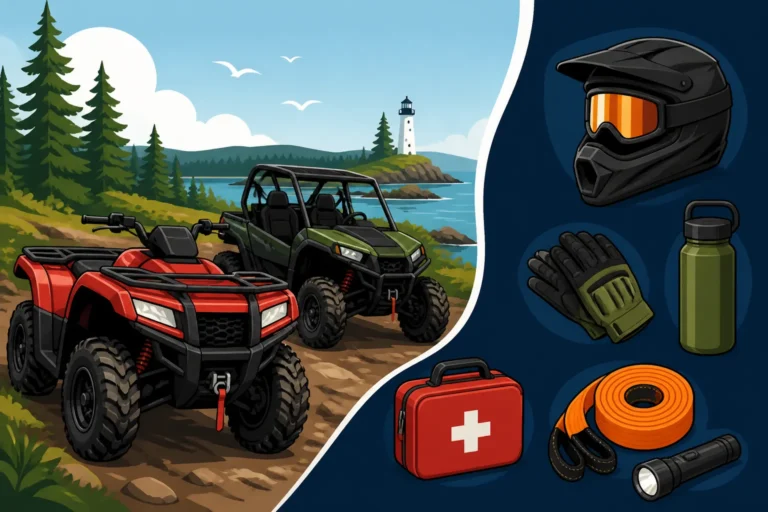
Bring clothing suitable for changing conditions, water, food, and a first-aid kit. A comfortable sunny start does not guarantee comfortable conditions later in the day, especially when wind or rain moves through. Tell someone where you plan to ride and when you expect to return, particularly if you are unfamiliar with the area.
For a longer outing, consider what happens if the ATV breaks down or a rider gets separated from the group. Agree on meeting points, carry a way to communicate, and know how to describe your location. A registration can make the machine legally registered, but it does not replace safe trip planning or a realistic backup plan.
Common non-resident registration mistakes to avoid
Most registration problems come from assumptions rather than complicated paperwork. Visitors may believe their home registration is enough, confuse a confirmation with permission to ride, or wait until they reach a remote trailhead to sort out a question that could have been handled at home.
A simple pre-trip review helps catch those issues. Check the machine, the dates, the documents, and the route. If any part of the plan depends on an exception, get a clear answer before traveling.
Assuming the exception applies to every Canadian visitor
The three-day arrangement is limited and should not be treated as a general pass for all riders from Canada. A visitor may have a valid registration but still need to confirm whether the machine and circumstances meet the exception’s requirements. The number of days and the paperwork involved are important details.
If you are from New Brunswick or Quebec, verify the exact terms and carry the required proof. If you are from another province, or if you plan to ride beyond the allowed period, ask whether a Maine non-resident registration is needed. Do not base your trip on a forum post or a recollection from a previous season.
Buying too late or overlooking the validity period
Waiting until the evening before a ride can make a small registration question feel urgent. Online access may be unreliable at a campground, and an agent may not be open when you arrive. Complete the transaction early enough to review the confirmation and correct any errors before unloading.
Check the start and end of the registration period against your actual schedule. A late arrival, an extra riding day, or a trip extension can change which option makes sense. Keep a reminder of the expiration date, especially if you make a second visit later in the season.
Treating registration as permission to use any route
A registration does not override a landowner’s decision, a posted closure, or a local restriction. Do not ride through a closed gate or onto an unmarked road simply because a map suggests that the route once connected to a trail system. The landowner relationship is central to trail access in Maine.
Before each ride, review the intended route and watch for current signs. If a club or land manager reports a closure, adjust your plan rather than trying to find a way around it. Responsible access helps protect the trail network that makes a Maine trip worthwhile.
A practical pre-trip checklist for non-residents
Use this checklist before putting the ATV or UTV on the trailer. It is designed to catch the easy-to-miss details that can cause delays after you reach Maine.
- Confirm the machine category. Determine whether you are bringing an ATV, UTV, or another type of off-road vehicle, and use the correct registration information.
- Choose the registration option. Compare the seven-day and annual terms with your itinerary, and verify current fees and validity dates through the official channel.
- Check whether an exception applies. If relying on the New Brunswick or Quebec arrangement, verify eligibility, day-counting rules, and required documents before departure.
- Prepare ownership details. Keep the VIN, bill of sale, and any prior ownership or registration paperwork available.
- Save your proof. Store the registration confirmation where you can access it, and carry a backup if permitted and practical.
- Check decal instructions. Confirm where the decal belongs and make sure the machine’s identification remains visible.
- Verify trail access. Check current conditions, local club notices, landowner restrictions, and machine-width limitations for your planned route.
- Plan for the ride itself. Identify fuel, parking, communications, and emergency contingencies, especially for remote routes.
A non-resident registration is one important piece of a Maine ATV trip, but it is not the whole plan. Handle the registration before you travel, confirm any exception rather than guessing, and check the trail conditions and access rules for every route you intend to ride.
Disclaimer
This article is for general informational purposes only and does not constitute professional advice. Laws, prices and regulations vary by location and change over time. Consult a qualified professional for guidance on your specific situation.