What Maine Riders Need Before They Ride
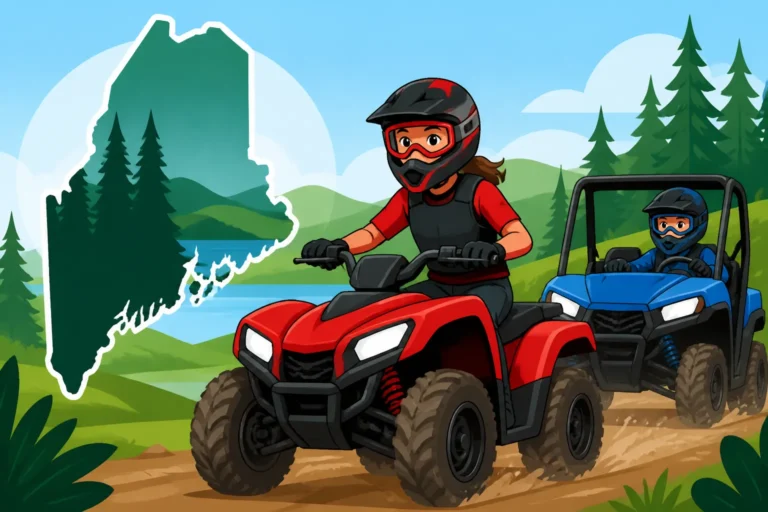
Before you load the trailer, make sure the machine is legally ready, the route is actually open, and everyone riding knows the rules. Maine’s trail access depends on more than registration: non-resident status, landowner permission, youth requirements, local road rules and seasonal closures can all change what is allowed. This guide helps you check the essentials before heading out.
Start with the right registration and paperwork
For most trail rides, registration is the first practical check. A registration from your home state should not be treated as automatic permission to ride in Maine. Maine’s reciprocity arrangement has a history of changes, and the rules can differ depending on where the machine is registered and who is operating it.
Maine’s general approach is that visiting riders need to meet Maine’s registration requirements unless a specific exception applies. The narrow arrangement sometimes discussed for certain Canadian visitors is not a general waiver for every out-of-state ATV. If you are relying on an exception, confirm that your location, registration, travel dates and intended use meet the current conditions before you leave home.
For many visitors, the simplest option is to obtain a Maine non-resident registration that fits the length of the trip. Maine offers short-term and longer-term options, but the exact terms and current fees should be checked with the official registration provider before purchase. An annual registration may make more sense if you expect to return several times; a short-term option may suit a single trip. Compare the coverage period with your actual travel dates rather than assuming a registration lasts for a particular weekend or calendar period.
If you are a Maine resident, check that your registration is current for the machine you plan to use. A registration for one ATV does not automatically cover another family member’s machine. Registration rules can also differ for a side-by-side or other UTV, so check the machine category rather than assuming an ATV registration applies. For more on visitor options, see Maine ATV Registration for Non-Residents. If you are considering the limited Canadian arrangement, read The Three-Day Non-Resident Exception in Maine and confirm the current conditions with the official source.
| Before the trip | What to confirm | Why it matters |
|---|---|---|
| Registration | It is valid for the machine, rider’s status and trip dates | Home-state registration alone may not satisfy Maine requirements |
| Decal or number | It is attached and displayed as directed | A valid registration still needs to be shown correctly |
| Registration record | You can produce the required proof while riding | A digital record may be useful, but do not assume it replaces every required document |
| Route access | The trail or road segment is open to your machine | Registration does not grant access to private land or closed routes |
| Youth rider requirements | Training, supervision, age and machine rules are met | Requirements can depend on the rider and where the machine is operated |
| Insurance | You understand what your policy does and does not cover | Coverage for an ATV or UTV may differ from your road-vehicle policy |
Keep your registration information accessible, not buried under a trailer load or left back at the cabin. A paper copy in a dry pouch is a useful backup if your phone loses power or service. For more detail on what to carry, see Do You Carry Registration Papers While Riding?. If you have just registered online, check what proof you are expected to carry and whether it is valid for immediate use before setting out.
A registration is not the same thing as a trail pass that lets you ride anywhere. It does not provide permission to cross private property, open a closed trail, or use a public road that is not legally available to ATVs. Think of registration as one part of being ready, not an all-purpose access document.
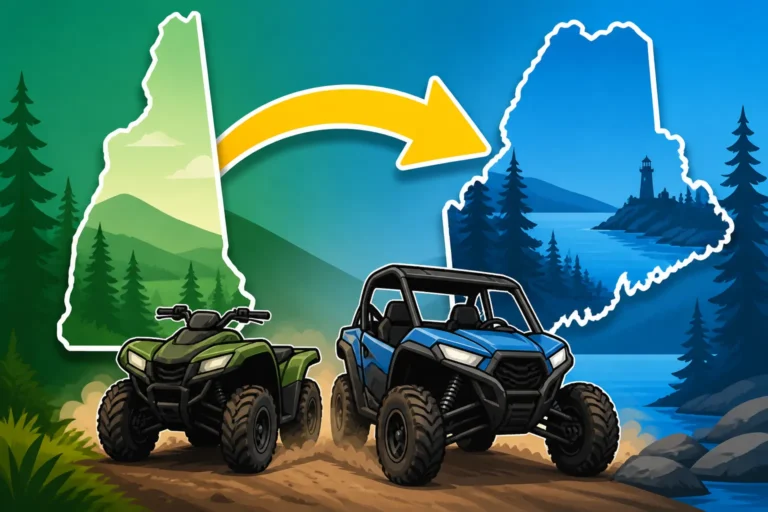
Check reciprocity before you bring an out-of-state machine
Reciprocity is one of the easiest parts of trip planning to get wrong because a rider may assume that a registration accepted in one state will be accepted everywhere. That assumption can lead to a frustrating stop—or a ride that should not have started.
Maine’s ATV reciprocity policy is not a simple promise that all neighboring registrations are recognized. It changed after a broader reciprocity arrangement ended, and any remaining exception is limited. The relevant details can include the jurisdiction that issued your registration, whether you are a resident or visitor, how long you will ride in Maine, and what documentation you can show.
The safest planning rule is straightforward: identify the exact registration you hold, then check the current Maine requirements for that registration before traveling. Do not rely only on a friend’s experience from a past season, a forum post, or a statement that “everyone rides that way.” A rule may have changed, and a rider’s situation may not match yours.
Maine’s past reciprocity arrangements are explained in Maine’s ATV Reciprocity, and Why It Ended. Use that background to understand why a narrow exception should not be mistaken for broad reciprocity. If your trip depends on the three-day arrangement, confirm the details directly before departure. Do not assume it applies simply because you are coming from New Brunswick or Quebec; check the terms that apply to your specific machine and visit.
Make a decision before you travel
Use this sequence rather than trying to resolve registration at a trailhead:
- Identify the machine and its registration. Note the jurisdiction that issued it, whose name is on the record, and whether the registration is current.
- Decide where and when you will ride. A private property visit, a club trail ride and a public-road connection can raise different access questions.
- Check the applicable Maine option or exception. Use current official information, especially if you believe you qualify for a limited reciprocity provision.
- Complete any required registration before riding. Leave enough time to resolve a problem with the paperwork or online transaction.
- Save proof in more than one form. Keep the confirmation or registration record available, and retain a backup that can be read without cellular service.
- Check again if the trip changes. Adding a day, crossing into another trail system or switching machines may affect what you need.
If you have any doubt about eligibility, the lower-risk choice is to obtain the Maine registration required for your visit rather than rely on an exception you have not verified. That may mean extra planning or cost, but it is usually less trouble than discovering the issue after you have unloaded the machine.
For a long trip, make a small paperwork folder for each ATV or UTV. Keep registration proof, purchase or ownership documents if relevant, and insurance information together. The exact documents needed can vary by situation, so check official guidance rather than treating a bill of sale or registration printout as a substitute for a requirement that does not apply to it.
Confirm that your route is open and authorized
The biggest practical mistake visitors make is treating a trail map as proof that the trail is open. A map can show where a trail has been, but access can change with landowner decisions, maintenance work, weather, mud season or local restrictions. In Maine, a route may cross private property, and continued access depends on permission.
Before you leave, check the current status of the trail system with the local ATV club or other responsible source. Look for updates about temporary closures, damaged bridges, washouts, detours, seasonal openings and machine-width limits. A route shown on an older printed map may have changed since the map was produced. Checking Maine Trail Status Before You Drive is a useful companion when you are planning a route from home.
Private land access deserves special attention. Many Maine trails cross land owned by individuals or businesses. A marked trail or an established route does not mean that every nearby road, field, spur or driveway is open to ATV use. Stay on the marked route, obey signs and barriers, and never assume that a trail continues past a closed gate. When access is by permission, that permission applies to the designated trail and conditions, not to the whole property. See Landowner Permission on Maine ATV Trails for a closer look at how access works.
Treat closures as part of the route
Mud season can make trails especially vulnerable. A machine can cut deep ruts, damage soft ground and create repair work that affects access for everyone. A trail that appears passable is not necessarily open. If a club or landowner has closed it, do not ride around the barrier or follow tire tracks through an alternate path.
The same principle applies after heavy rain, flooding or a storm. A bridge may be damaged, a stream crossing may be unsafe, or a trail crew may be working. If the information is unclear, call the club, campground, outfitter or other local contact before driving to the trailhead.
Build a flexible route. Identify a shorter option or a place to turn back if a connection is closed. Avoid a plan that only works if every segment is open and every fuel stop is available. In remote areas, a closure can make a day ride much longer than expected.
Separate trail access from road access
A trail route may use a public-road connection, but that does not mean you can ride on any road to reach it. Maine has specific rules for ATVs on public ways, and towns may designate or restrict local routes. Road use can depend on posted signs, the type of road, the town’s decisions and the reason for using the road. Do not assume that a dirt road, logging road or shoulder is automatically open to ATVs.
Plan crossings and road sections in advance. If you cannot confirm that a segment is permitted, choose a route that avoids it. A navigation app may display a road as a convenient connection without indicating whether ATV travel is lawful there. Use current local information and obey signs on the ground.
Trails can also have limits on machine size or width. A broad UTV may not fit a narrow trail, gate or bridge even if an ATV can use it. Confirm that the route is suitable for your machine before loading up. Where a trail is marked for a width limit, measure the machine as equipped, including accessories that extend beyond the tires.
Prepare riders, especially children and first-time operators
A safe ride begins with choosing a machine that fits the rider and the terrain. A rider who can reach the controls while seated may still lack the strength, judgment or experience to handle a steep grade, deep mud, an unexpected obstacle or a sudden stop. Do not treat engine starting as proof that someone is ready to ride.
Maine has specific rules for younger operators, and those requirements may involve age, safety education, supervision, equipment and where the ATV is being operated. Check the current rules for each youth rider before the trip. Maine ATV Safety Course Requirements explains the training side, while Maine ATV Rules for Riders Under 16 is useful for age-related questions. Do not rely on a general rule of thumb when the rider’s age or the route makes the distinction important.
If a child is riding, an adult should stay close enough to supervise effectively—not merely be somewhere else on the trail system. The adult should know the route, understand the child’s abilities and be ready to intervene. Set an easy-to-understand rule for what happens if the group becomes separated: stop in a safe place, stay on the trail and wait for the group rather than riding off to search.
Match the plan to the least experienced rider
For a mixed-ability group, plan around the person with the least experience. That may mean choosing a shorter loop, avoiding difficult terrain and allowing more time for breaks. A route that seems easy to an experienced rider can become demanding when it includes loose gravel, steep descents, deep ruts, water crossings or a long stretch without a safe place to stop.
Before moving, agree on basic group habits:
- Ride at a pace that keeps the group together without pressuring anyone to exceed their ability.
- Leave enough space to stop safely and see the rider ahead.
- Stop in a safe, visible place if the group becomes separated.
- Do not pass another rider unless the trail and group rules make it safe.
- Tell the group before changing direction or taking a side route.
- Keep children within the supervision plan agreed on before the ride.
Passengers need their own attention. Do not carry a passenger on a machine designed for one rider. For a side-by-side, use the installed seating and restraints as intended, and follow the machine’s passenger and occupant limits. A passenger should know where to hold on, how to sit and what to do if the vehicle stops or tips.
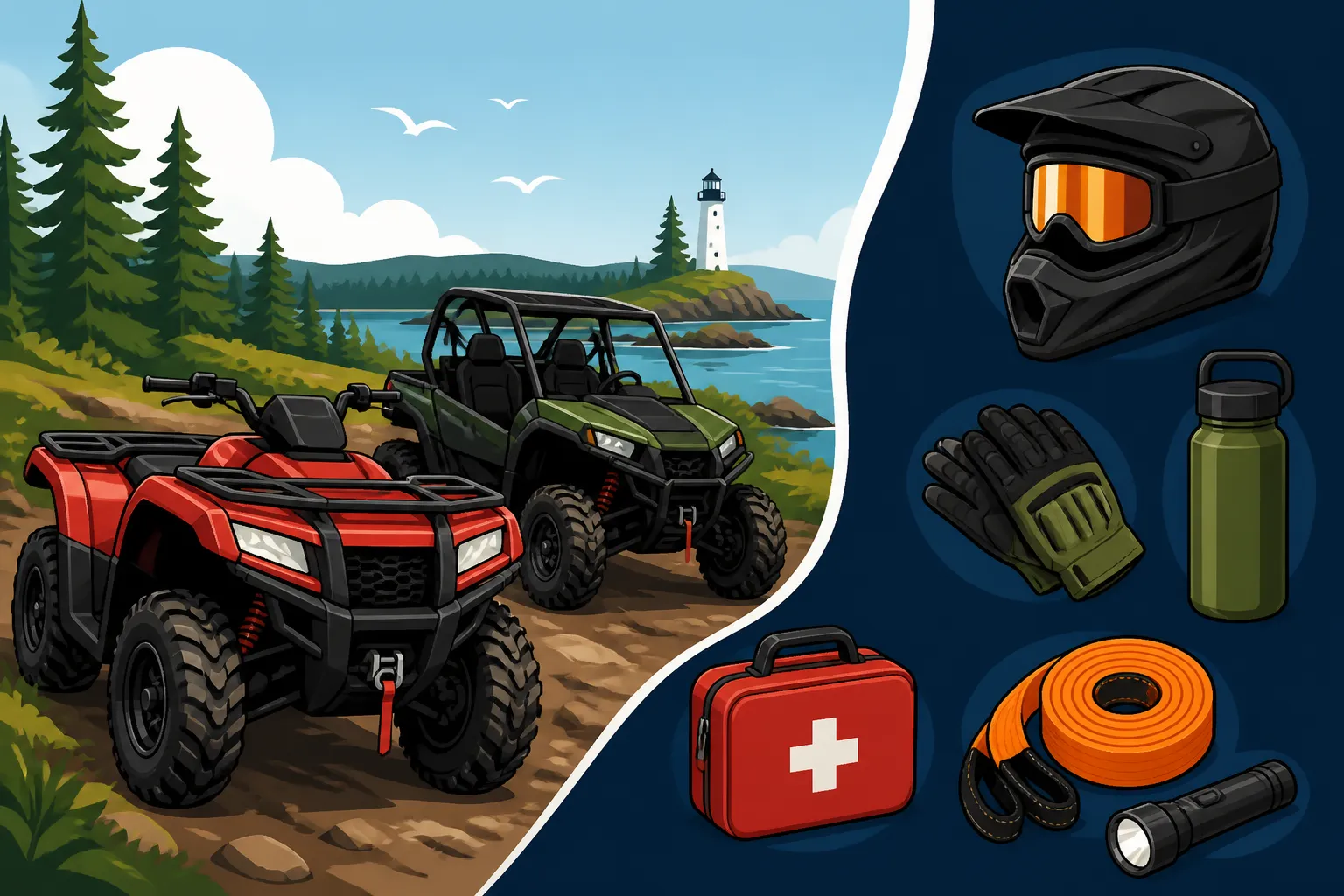
Helmets and protective clothing are practical essentials, not items to decide on after reaching the trailhead. Check the current helmet rules for the rider’s age and circumstances. A properly fitting helmet should be in good condition and secured correctly. Eye protection, gloves, sturdy footwear, long sleeves and long pants help protect against dust, branches, debris and contact with hot parts. Bring layers suited to the weather, because conditions can change between town and a shaded backcountry trail.
A first-time operator should have time to learn the controls in a safe, permitted area before joining a group ride. Review how to start and stop, use the brakes, shift if necessary and turn off the machine. Point out the limits of the machine and the rider. A short practice session can reveal a poor fit or a control problem before it becomes a trail emergency.
Carry a practical kit and plan for being out of service
Cell service is unreliable in parts of Maine’s trail network. A phone is useful, but it should not be your only navigation, communication or emergency plan. Download maps for offline use before leaving, carry a backup power source, and tell someone who is not riding where you plan to go and when you expect to return.
A paper map is still useful when a phone is wet, cracked, out of power or unable to locate itself. Keep it protected from rain and make sure someone in the group can read it. A waterproof map case, small first-aid supplies, a flashlight and a portable power bank are examples of items riders often source from retailers such as Amazon; choose equipment that fits the trip and test it at home rather than discovering a problem on the trail.
Your kit should reflect the ride’s length, remoteness, weather and group. For a short ride near a town, you may need less than for a remote full-day loop. At a minimum, think through these categories:
- Navigation: current trail information, an offline map, a paper backup and a compass or other reliable orientation method.
- Communication: charged phones, a battery bank and a way to contact help that suits the area and trip. In remote terrain, consider whether a satellite messenger is appropriate.
- Basic first aid: supplies for minor cuts and scrapes, plus any personal medication that a rider may need.
- Repair and recovery: basic tools that fit the machine, tire repair items if appropriate, and a plan for a disabled or stuck vehicle.
- Weather protection: rain layers, warm clothing, dry socks and protective gear suitable for the forecast.
- Water and food: enough for the planned ride and a delay, especially if the route is remote.
- Visibility: lights in working order and a flashlight or headlamp for an unexpected late return.
- Emergency information: a route plan, a contact person and any essential medical information for the group.
Do not overload the machine or place items where they can fall, snag or interfere with the controls. Secure bags and loose gear before riding. On a UTV, keep items inside the cargo area and secure them so they cannot shift during a turn or sudden stop. On a quad, check that a pack does not block the rider’s movement or obscure lights and registration markings.
Fuel planning matters more in remote areas. Estimate the ride using your own machine’s fuel use, terrain, load and riding style rather than relying on a best-case range figure. Identify fuel stops before departure and confirm they are available and reachable on your route. Do not assume that a store or pump shown on a map is open or accessible to ATVs. Carrying extra fuel requires suitable approved containers and careful handling; keep fuel away from heat and secure it properly.
Give the group a realistic turnaround time. If you are not at a planned point by that time, shorten the route. A late start, slow section, mechanical problem or unexpected closure can turn a reasonable plan into a ride that ends in the dark. Make the decision to turn back while there is still time and light to do so safely.
Check insurance, machine condition and trip logistics
Registration and insurance are separate questions. Having one does not prove that you have the other, and insurance that covers a car may not cover an ATV or UTV used on trails. Review the wording of your policy or contact the insurer before the trip. Ask what is covered for property damage, injury, theft, transport and use by another rider. Maine ATV Insurance and When You Need It can help you think through the questions to ask.
Coverage can depend on the machine, how it is used, who owns it and who is operating it. A policy may have limits or exclusions for racing, commercial use, borrowed machines or particular types of damage. If you are riding a rented machine, read the rental agreement and confirm what the rental provider requires. Do not assume a credit card, homeowners policy or auto policy will cover a trail incident without checking the actual terms.
Before loading, inspect the machine. A quick check can catch problems that are easier to fix at home than in a remote area. Look at tires, wheels, brakes, throttle movement, steering, lights, fluid levels and visible damage. Check that the machine starts and stops normally. For a side-by-side, inspect seat belts, doors or nets, mirrors if equipped and any cargo that could shift. Follow the owner’s manual for maintenance and operating checks.
A used or borrowed machine deserves extra attention. Make sure you know who owns it, that the registration status is understood and that the person lending it has authorized the ride. If the machine’s registration or ownership information is unclear, resolve that before traveling. Do not try to sort out a paperwork problem at a roadside stop.
Plan the trailer and staging arrangements as carefully as the trail route. Confirm that the trailhead or staging area allows parking for a trailer and that there is room to turn around. Avoid blocking a gate, private driveway, emergency access or business entrance. If you are staying overnight, ask the lodging provider about trailer parking, machine storage and direct trail access. “Near a trail” does not necessarily mean you can ride from the property.
Set a clear plan for the day:
- Choose a route that matches the machine and group.
- Verify the route is open and lawful for that machine.
- Mark fuel, rest and turnaround points.
- Share the plan and return time with someone outside the group.
- Check weather and trail updates again before unloading.
- Agree on a pace, stopping signals and what to do if separated.
- Recheck the machine and secure all cargo before starting.
If the group is traveling from out of state, leave room in the schedule to handle registration or equipment questions. The first morning of a trip is a poor time to discover that a registration has not been completed, a trail is closed or the UTV is too wide for the route.
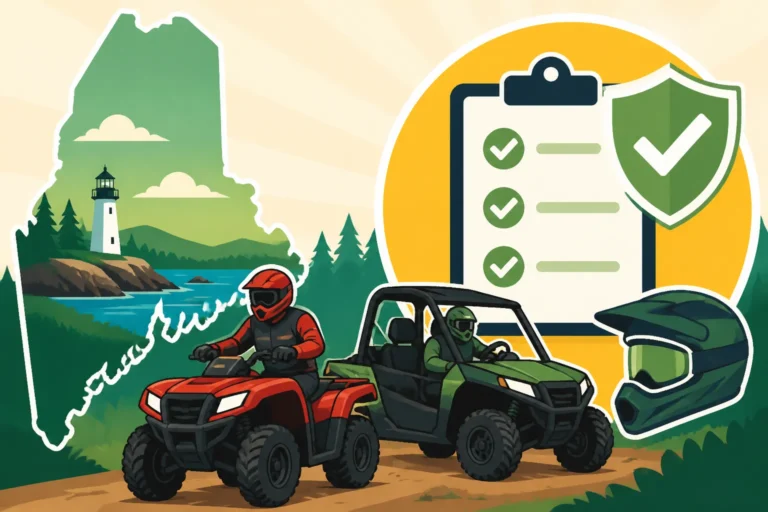
Use this final pre-ride checklist
A checklist works best when it is short enough to use at the trailer and thorough enough to catch the common oversights. Run through it before each ride, even if the machine was ready the day before. Weather, route status and group plans can change overnight.
Paperwork and access
- The registration is valid for this machine and trip.
- Any required decal or registration number is displayed as directed.
- You can produce the required registration proof while riding.
- You have checked whether an exception applies rather than assuming reciprocity.
- The route is open and permitted for the type and width of machine.
- You have confirmed any road connections and local restrictions.
- You have permission for private-land access where required.
- Each youth rider meets the relevant safety, supervision and operating requirements.
Rider and machine
- Every rider has a properly fitting helmet and suitable protective clothing.
- The machine fits the operator’s size and experience.
- Passengers are permitted by the machine’s design and are seated safely.
- Brakes, steering, tires, throttle and lights have been checked.
- Registration markings are visible.
- Cargo is secure and does not interfere with the controls.
- Each rider knows the basic plan and how to stop or respond if separated.
Route and emergency plan
- Maps or route information are available offline, with a paper backup.
- Someone outside the group knows the route and expected return time.
- Fuel is sufficient for the planned distance and a reasonable delay.
- Water, food, weather layers and basic first aid are packed.
- You have a way to contact help that suits the area.
- The group has agreed on a turnaround time and a shorter backup route.
- You have checked the latest trail or closure notice before unloading.
A “no” answer does not always mean the ride must be canceled, but it does mean you should pause and resolve the issue. Sometimes that means changing the route, leaving a machine at camp, completing registration, waiting for a trail update or choosing a different day. Those are better outcomes than riding into a closure, getting separated without a plan or finding out that a machine is not properly covered.
The most dependable approach is to verify the rules, route and paperwork using current official or local information, then prepare for the conditions that a map cannot predict. Maine rides can be rewarding precisely because they reach remote places; that remoteness also makes preparation matter. When the machine, riders and route are all ready, the day is more likely to be about the ride rather than solving avoidable problems.
Disclaimer
This article is for general informational purposes only and does not constitute professional advice. Laws, prices and regulations vary by location and change over time. Consult a qualified professional for guidance on your specific situation.