Maine ATV Rules for Riders Under 16 on Roads
Navigating Maine's ATV and UTV trails is a joy for many families, but when it comes to riding on or crossing public roads, the rules can get incredibly complex, especially when you have younger riders in your crew. It's easy to feel overwhelmed by the distinctions between trail riding, road crossings, and designated access routes, and the worry about getting it wrong with a child on board is very real. This guide aims to demystify Maine's specific regulations regarding ATV and UTV operation on public ways for riders under 16, helping you understand exactly what's allowed, what's prohibited, and how to keep your family safe and legal.
The Core Challenge: Road Access for Young Riders
It's a common scenario: you're out on the trails with your kids, enjoying a beautiful Maine day, and suddenly you come to a public road. Maybe it's a short stretch to connect to another trail, or just a crossing to keep going. As an adult, you might be familiar with the rules, but when it comes to your child, who might be an enthusiastic and capable rider on the trails, the rules governing public ways become a whole different ballgame. Maine law takes a very cautious approach to young operators on roads, and for good reason – safety is paramount.
Why Road Rules Are Different for Kids
Maine's legal framework for ATV operation makes a clear distinction between off-road trail riding and any interaction with public ways. This distinction becomes even more pronounced when children are involved. The state's primary concern is public safety, and roads, by their very nature, introduce variables like vehicle traffic, speed limits, and complex intersections that require a higher level of judgment and experience than most children possess.
Imagine a busy two-lane road in a small town; even if it's not a major highway, cars can be traveling at considerable speeds. A young rider, perhaps focused on their machine or the trail ahead, might not have the peripheral awareness or quick reaction time needed to safely navigate such an environment. The law acknowledges these inherent risks by placing stricter limitations on minors. It's not about doubting your child's riding skills on a controlled trail; it's about protecting them from the unpredictable nature of public traffic. We understand the frustration this can cause, especially if a short road section is the only link between two fantastic trail systems. It often means a momentary pause, re-evaluating the route, or even trailering the machine a short distance.
The General Prohibition and Limited Exceptions
Let's be absolutely clear from the outset: the general rule in Maine is that a person under 16 years of age may NOT operate an ATV on a public way. This blanket prohibition is designed to keep children off roads where they could encounter dangerous situations. This means no riding alongside the road, no riding on the shoulder, and no using the road as a connecting route, even for a short distance.
However, as with many laws, there are very specific, narrow exceptions, primarily related to crossing a public way under strict supervision. These exceptions are not an invitation for general road riding. They are tightly controlled scenarios designed to facilitate legitimate trail connections while minimizing risk. It's crucial not to interpret these exceptions as loopholes that allow for more extensive road use. Think of them as a very narrow gate that you can pass through, but only under specific conditions, rather than an open path. It's a common misunderstanding that if you can cross, you can also ride a short distance, but that's generally not the case for young riders.
Specific Scenarios and What Maine Law Says
Understanding the general prohibition is the first step, but the real confusion often comes with the specific scenarios riders encounter. Let's break down what Maine law permits for riders under 16 when they encounter public ways.
Crossing a Public Way Under Supervision
The most common and often the only permissible interaction a rider under 16 can have with a public way on an ATV is to cross it. But this isn't a free-for-all. It's a highly regulated maneuver requiring specific conditions to be met:
- Adult Supervision is Mandatory: The young rider must be directly accompanied by a person who is at least 18 years of age. This supervisor isn't just a passenger; they are actively responsible for ensuring the crossing is done safely and legally.
- The Adult's Role: The accompanying adult must also be operating an ATV and be in a position to supervise the minor's crossing effectively. This means they are likely riding with or immediately behind the young rider. For the supervisor, it's about more than just presence; it's about active guidance and ensuring the child understands and executes the crossing properly.
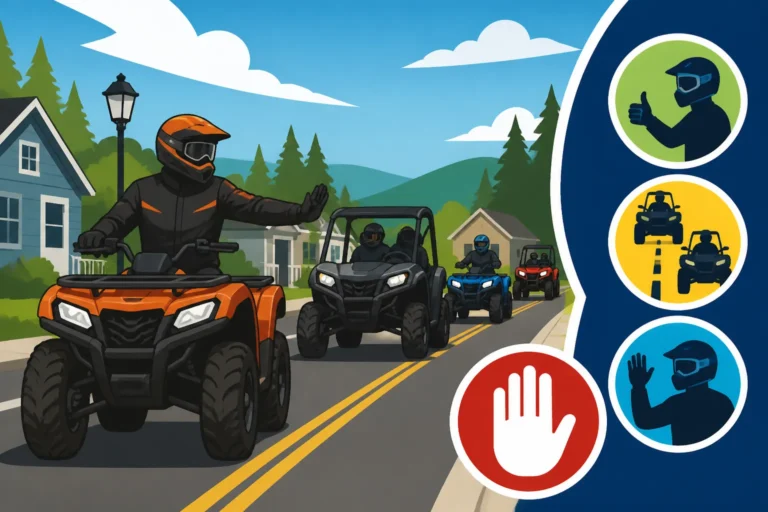
- Specific Crossing Rules: When making the crossing, both the adult and the young rider must adhere to strict traffic laws. This includes making a [Complete Stop Before Entering a Maine Public Way]. You must bring your ATV to a full stop before entering the paved or public way, just like you would in a car. From there, you must [ATV Yield Rules in Traffic] to any oncoming traffic that could pose a hazard. Only when it's safe to proceed can you make the crossing. The crossing itself must be done as directly as possible, at approximately a 90-degree angle to the public way, and you must [Riding the Extreme Right of a Maine Road] if you must travel a very short distance on the public way to complete the crossing (though for minors, this travel is almost universally prohibited beyond the direct crossing itself).
- Visibility and Awareness: Before even approaching the road, ensure your child understands the importance of looking both ways, listening for traffic, and making eye contact with drivers if possible. The goal is to minimize time spent in the roadway and maximize safety. This is where bright colors on helmets and gear can really make a difference.
The 500-Yard Limit and Young Riders
Maine law does allow for licensed adult operators to ride on a public way for a distance not exceeding 500 yards (or 500 feet, depending on the specific situation and whether it's part of an access route, so always verify the exact footage for your location) to connect to another trail, or to access services like gas or food. This is often referred to as [Maine's 500-Yard Limit on a Public Way].
However, this 500-yard rule generally does NOT apply to riders under 16. Even with adult supervision, a minor is typically not permitted to operate an ATV for this connecting distance on a public way. The intent of the law is to keep young riders off public ways for anything more than the absolute minimum required for a direct crossing. It's a critical distinction, and a common mistake is to assume that if an adult can ride 500 yards, a supervised minor can too. Unfortunately, that's not the case. This is one of those rules where the letter of the law is very specific about who can and cannot do what. Always assume the most restrictive interpretation when it comes to young riders and public roads.
Riding on Designated ATV Access Routes
Many Maine towns have embraced ATV tourism and have designated specific public ways or sections of public ways as [Maine ATV-Access Routes and How Towns Post Them]. These routes are clearly marked and allow ATVs to travel on them, often to access trailheads, local businesses, or to connect different parts of the trail system. You can often find information on [How a Maine Town Designates an ATV-Access Route] through local town offices or ATV clubs.
While these routes offer fantastic convenience for adult riders, it's important to understand that riders under 16 are generally NOT permitted to operate ATVs on these designated public ways, even if they are posted as ATV access routes. The designation often comes with conditions, such as requiring operators to be licensed drivers (which minors under 16 typically are not) or to be 16 years of age or older.
Always, always check the specific town ordinances for any designated ATV access route your ride might take you on. While a town may have opened a road to ATVs, they often retain the right to impose additional restrictions, including age limits. It's not safe to assume that because a route is "ATV friendly" it extends to all riders, especially those under 16. If in doubt, stick to designated off-road trails, or trailer your child's machine across the road section.
Safety, Supervision, and Legal Requirements
Beyond the specific rules for road interaction, there are foundational safety and legal requirements that apply to all young ATV riders in Maine, and these become even more critical when there's any potential for public way interaction.
Mandatory Safety Course for Young Riders
Before any rider aged 10 to 15 can operate an ATV in Maine, whether on trails or in the limited scenarios involving road crossings, they are required to complete an approved ATV safety course. This isn't just a suggestion; it's the law. The [Maine ATV Safety Course Requirements] are designed to teach young operators fundamental safety practices, trail etiquette, and an understanding of the laws governing ATV use.
The course covers crucial topics like reading trail signs, understanding machine capabilities, safe operating procedures, and, yes, the rules for interacting with public roads. Even if your child is an experienced rider, the structured learning environment helps reinforce good habits and instills a sense of responsibility. Upon successful completion, they'll receive a safety certificate, which they must carry with them while riding. This certificate does not expire, but it's important to keep it safe. [Maine ATV Safety Certificate and Whether It Expires] is a common question, and thankfully, once earned, it's good for life. This certificate is their ticket to legal operation within their age group's allowances.
Helmet and Eye Protection Rules
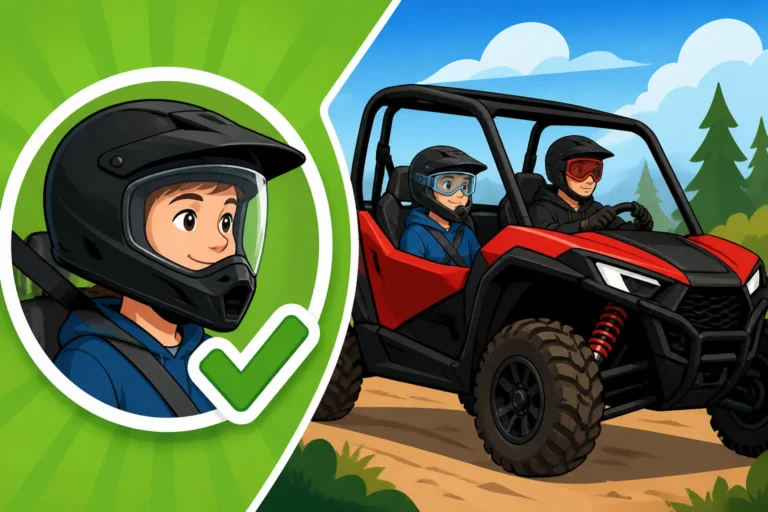
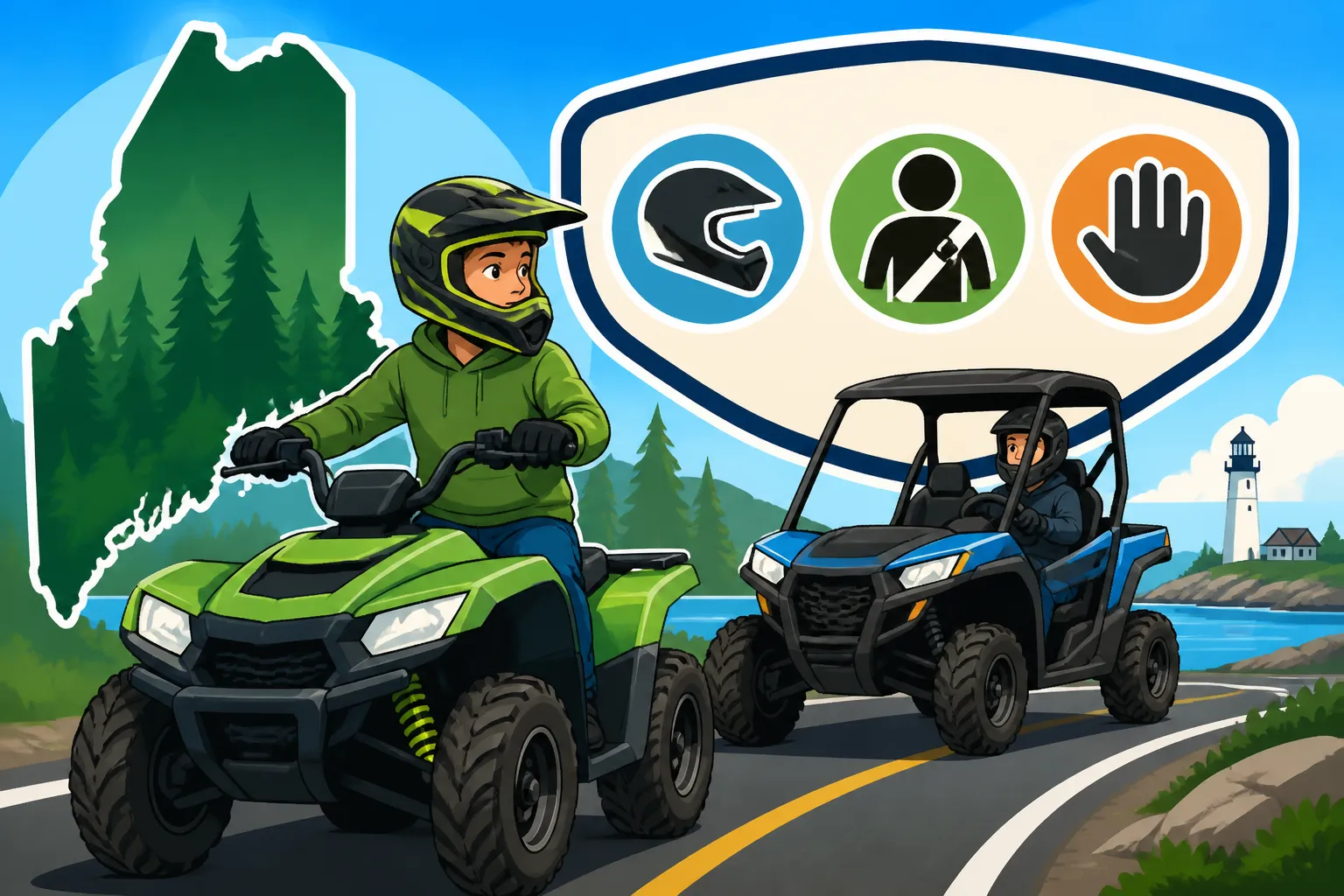
When operating an ATV on a public way, or even crossing one, the stakes are higher due to potential traffic. For riders under 18, Maine law makes helmet use non-negotiable. Specifically, anyone under 18 years of age who operates or is a passenger on an ATV must wear protective headgear. This is outlined clearly in the [Maine Helmet Rules for Riders Under 18].
But it's not just any helmet. The helmet must meet specific safety standards, such as those set by the U.S. Department of Transportation (DOT) or the American National Standards Institute (ANSI). Understanding the difference between [DOT vs ANSI Helmet Standards for Riders] is important when purchasing protective gear. Ensure your child's helmet fits snugly, is in good condition, and is properly fastened. Beyond the helmet, eye protection – whether goggles or a face shield – is also highly recommended to shield against dust, debris, and insects, further enhancing safety and visibility. These protective measures are your child's first line of defense in the event of an unforeseen incident.
Adult Supervision: What It Really Means
The concept of "adult supervision" often causes confusion. It's more than just having an adult in the general vicinity. When it comes to operating an ATV on or across a public way, the supervision must be direct and effective. Maine law stipulates that an adult (at least 18 years old) must "accompany" the child. [Supervising a Young Rider on the Road] means being close enough to immediately intervene, communicate instructions, and take responsibility for the minor's actions.
For a road crossing, this usually means the adult is also on an ATV, riding directly with or slightly ahead/behind the child, guiding them through the maneuver. It requires constant vigilance and communication. The supervising adult is legally accountable for the minor's compliance with all ATV laws. This isn't a passive role; it's an active one that demands the adult's full attention to the road conditions, traffic, and the young rider's execution of the crossing. If the adult isn't a licensed driver themselves, their ability to guide the minor through a safe road interaction is significantly hampered, emphasizing the importance of experienced, responsible adult supervision.
Consequences and Avoiding Violations
The rules for young riders on Maine roads are strict because the potential consequences of a violation are serious, both legally and, more importantly, in terms of safety. Understanding these repercussions can help reinforce the importance of adherence.
Penalties for Non-Compliance
Operating an ATV on a public way when prohibited, especially by a minor, can lead to various penalties. The specific fines can vary, but violations often result in monetary penalties for the adult supervisor or owner of the machine. These fines can add up quickly. It's not just about age; operating an unregistered ATV also carries significant [Penalties for Riding an Unregistered ATV in Maine], which can sometimes be stacked with age-related violations.
Beyond monetary fines, there's also the potential for the loss of riding privileges. Serious or repeated violations could lead to a suspension of the minor's ability to operate an ATV, or even the adult's. In some extreme cases, authorities might even impound the ATV. Imagine the disappointment for a young rider if their machine is taken away, or if they're banned from the trails due to an avoidable road violation. It's a stark reminder that responsible riding extends to every aspect of ATV use. [Losing Trail Access After a Violation] is a real consequence that no rider wants to face.
Prioritizing Safety Over Convenience
Ultimately, these strict rules for young riders on public ways are in place for one overriding reason: safety. While it might be inconvenient to trailer a machine for a short road section or to find an alternative route, that inconvenience pales in comparison to the risk of an accident involving a young rider and a motor vehicle. Roads are designed for cars and trucks, and ATVs, especially those operated by children, are often simply not equipped or visible enough to safely share that space.
As parents and guardians, we have a responsibility to instill a strong sense of safety and respect for the law in our young riders. This means sometimes making the harder, safer choice. It's an opportunity to teach them about responsible outdoor recreation and the importance of following rules designed to protect them. Encourage your kids to ask questions about the rules, and make sure they understand why certain restrictions exist.
| Rule Category | Applies to Under 16 on Roads? | Specifics/Conditions |
|---|---|---|
| General Road Operation | No | Generally prohibited on public ways (riding alongside, on shoulder, or as a connecting route) unless extremely rare, specific conditions are met and explicitly stated by law. |
| Supervised Crossings | Yes, Limited | Permitted only for direct, perpendicular crossings of a public way. Must be accompanied by an adult (18+) who is also on an ATV and actively supervising. Both must execute a [Complete Stop Before Entering a Maine Public Way], [ATV Yield Rules in Traffic] to all traffic, and cross at approximately a 90-degree angle, staying on the [Riding the Extreme Right of a Maine Road] if necessary for the shortest possible distance across the pavement. |
| 500-Yard/Foot Limit | Generally No | The allowance for adult, licensed operators to ride up to 500 yards/feet on public ways (e.g., [Maine's 500-Yard Limit on a Public Way]) to connect trails or access services typically does NOT extend to riders under 16, even with adult supervision. This is a crucial distinction. |
| Designated Access Routes | Often No | [Maine ATV-Access Routes and How Towns Post Them] (roads designated as open to ATVs) are generally restricted to licensed drivers or operators 16 years of age or older. Always check specific local town ordinances, as a town's designation of an access route does not automatically grant minors permission to operate on it. |
| Mandatory Safety Course | Yes | Required for all ATV operators aged 10-15, regardless of where they ride. This course, detailed in [Maine ATV Safety Course Requirements], is foundational for understanding safe operation and legal responsibilities, and the certificate (see [Maine ATV Safety Certificate and Whether It Expires]) must be carried. |
| Helmet Use | Yes | Mandatory for all ATV operators and passengers under 18 years of age whenever riding. Helmets must meet DOT or ANSI standards (see [DOT vs ANSI Helmet Standards for Riders]). This is a critical safety measure, especially in any scenario involving public ways. |
| Adult Supervision | Yes, Mandatory | For any limited permissible interaction with public ways, a rider under 16 must be directly accompanied and actively supervised by an adult at least 18 years of age. This adult is responsible for ensuring compliance with all laws and should be a licensed driver if on public ways, as detailed in [Supervising a Young Rider on the Road]. The supervisor is legally accountable for the minor's actions. |
Resources for Up-to-Date Information
Maine's ATV laws are periodically reviewed and updated, and local ordinances can change. To ensure you always have the most current and accurate information, your best resources are the official channels. The Maine Department of Inland Fisheries and Wildlife (IF&W) website is the definitive source for state regulations. You can also contact your local Maine Warden Service office directly; the wardens are out on the trails and roads every day and are the ultimate authority on enforcement. They are often asked questions about specific rules and can provide clarity, even on complex scenarios. Knowing what [Maine Warden Service ATV Patrols] are looking for can help you stay compliant. Don't hesitate to reach out if you're ever unsure about a particular rule or situation.
This article is for general informational purposes only and does not constitute professional advice. Laws, prices and regulations vary by location and change over time. Consult a qualified professional for guidance on your specific situation.