Helmet Rules for Maine Passengers Under 18
Riding ATVs and UTVs in Maine offers some of the most breathtaking experiences, from winding through dense forests to cruising along old logging roads. However, when you're bringing along younger passengers, a common question often pops up: "What are the rules for helmets?" It's a completely valid concern that many parents and guardians grapple with, and misunderstanding these regulations could not only lead to fines but, more importantly, put a child's safety at risk. This guide is here to untangle the specifics of Maine's helmet laws for ATV and UTV passengers under 18, ensuring your family stays safe and compliant on the trails.
Understanding Maine's Core Helmet Law for Young ATV/UTV Passengers
Maine's approach to ATV and UTV safety, especially concerning youth, is rooted in preventing serious injuries. The state understands that these machines, while incredibly fun, come with inherent risks, and protecting our youngest riders and passengers is paramount. This isn't just about avoiding a citation; it's about safeguarding precious lives.
Who Maine Considers a "Young Passenger"
When the law talks about "young passengers," it's specifically referring to anyone under the age of 18. This distinction is crucial because it sets them apart from adult riders and passengers, for whom the helmet requirements are different. It doesn't matter if they're 5 years old or 17 years old; as long as they haven't celebrated their 18th birthday, they fall under these specific rules. This broad definition ensures that all minors, regardless of their perceived maturity or experience level, receive the same protective measures.
It's a common scenario: you've got your nephew visiting for the summer, or your neighbor's teenager wants to join your family ride. Even if they're experienced riders from another state, the moment they hop on your ATV or UTV in Maine as a passenger and they're under 18, Maine's helmet law applies to them. There's no wiggle room based on their origin or the duration of their stay; the law is clear and universally applied to anyone in that age bracket enjoying the trails within the state's borders.
The "Under 18" Mandate: What It Means for Passengers
For any ATV or UTV passenger under the age of 18 in Maine, wearing an approved helmet isn't just a recommendation—it's a legal requirement. This isn't a suggestion from a safety brochure; it's codified in the state's statutes. This mandate is a non-negotiable part of responsible riding when minors are involved, designed to provide a critical layer of protection against head injuries in the event of an accident. Whether you're on a designated trail, a private woodlot with permission, or an approved town access route, the rule remains the same.
This means that if you're planning a family outing or bringing along younger friends, the helmet situation needs to be sorted out before anyone even steps foot on the machine. You can't just throw on an old bike helmet or a construction hard hat and call it good. The law specifies approved helmets, meaning those that meet certain safety standards, which we'll delve into shortly. The onus is squarely on the operator of the ATV or UTV to ensure that all underage passengers are properly equipped before hitting the ignition.
Why Maine Takes Helmet Safety Seriously for Youth
The primary reason Maine, and many other states, has stringent helmet laws for youth is straightforward: to prevent severe head trauma. Children and teenagers, by virtue of their developing bodies and often less cautious judgment, are particularly vulnerable in ATV and UTV accidents. Their skulls are still maturing, and their reaction times might not be as sharp as an adult's. A fall or collision that might result in a bruise for an adult could lead to a concussion or worse for a younger individual.
Beyond the physical vulnerability, there's also the aspect of experience. Even if a young person has ridden before, they likely don't possess the comprehensive judgment or hazard recognition skills of an experienced adult operator. The dynamic nature of off-road riding, with its unpredictable terrain, sudden turns, and potential for obstacles, presents continuous risks. A properly fitted, certified helmet acts as a crucial barrier, absorbing impact and significantly reducing the risk of life-altering injuries. It's an investment in their future, far more valuable than the cost of the helmet itself. [Maine ATV Safety Course Requirements] emphasizes the importance of understanding these risks from a young age.
Deciphering Helmet Standards: What Qualifies as Legal in Maine
Simply wearing a helmet isn't enough to comply with Maine's law or, more importantly, to ensure maximum safety. The state specifies that helmets must meet certain recognized safety standards. This ensures that the headgear provides a tested and proven level of protection, not just a false sense of security.
The Importance of DOT and ANSI Certifications
Maine law mandates that helmets for ATV/UTV passengers under 18 must be approved by recognized safety organizations. The two most common and widely accepted certifications you'll see are DOT (Department of Transportation) and ANSI (American National Standards Institute). A helmet bearing a DOT sticker or an ANSI label indicates that it has undergone rigorous testing to meet specific performance requirements for impact absorption, penetration resistance, and retention system strength.
The DOT certification, in particular, is a federal standard in the United States, meaning any helmet sold as "motorcycle legal" in the U.S. will have this sticker. For ATV and UTV use, this is a strong indicator of an appropriate helmet. ANSI, while perhaps less common for recreational helmets specifically, also sets demanding standards for protective equipment. When you're shopping for a helmet for a young passenger, looking for these specific certifications—usually found on a sticker on the back of the helmet or inside the padding—is your first and most critical step. Without one of these, even the most robust-looking helmet may not offer the necessary protection or meet legal requirements. [Helmet Standards That Meet the Law] provides more detail on what to look for.
Beyond the Sticker: Features of a Safe Youth Helmet
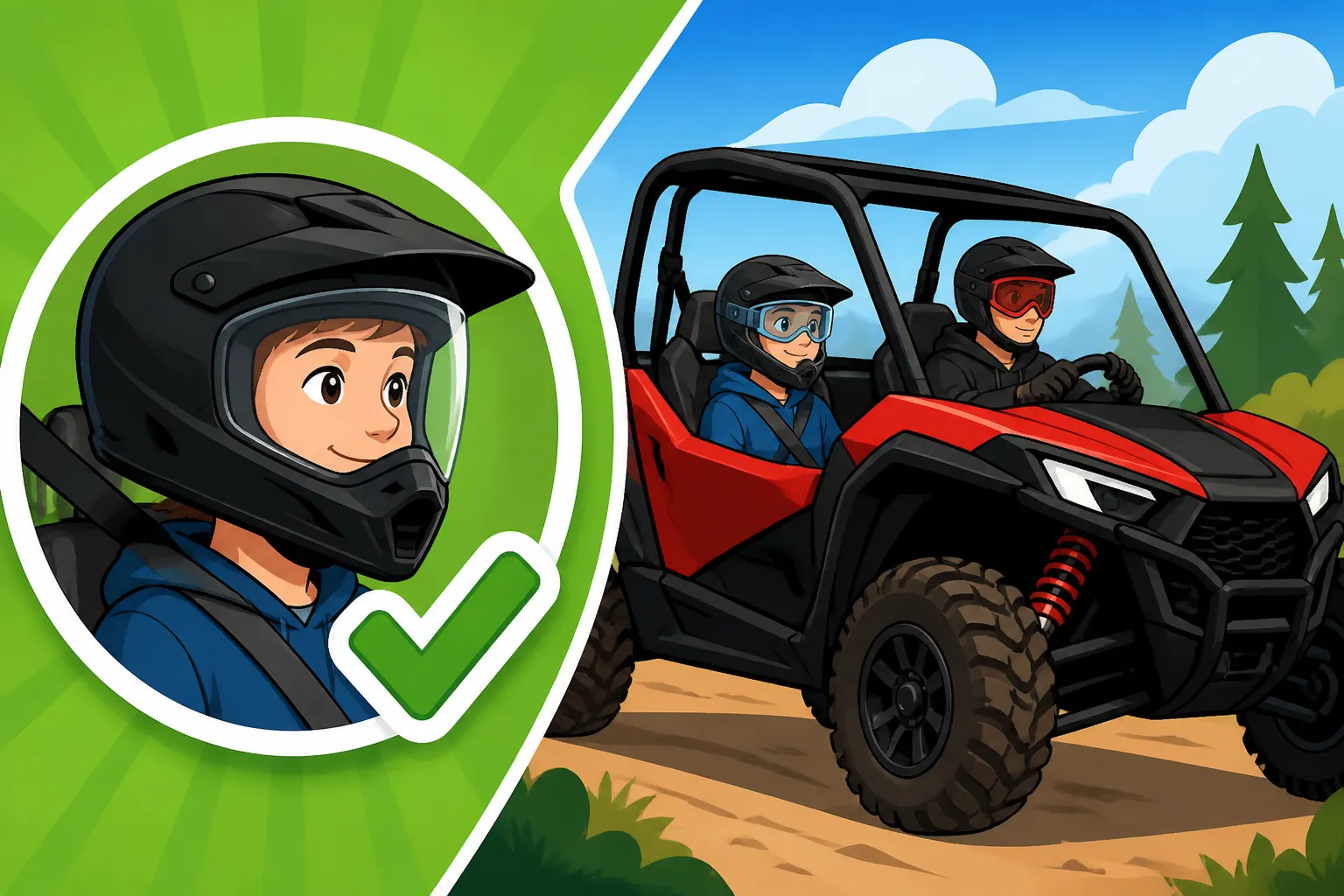
While the DOT or ANSI sticker is crucial, a truly safe youth helmet offers more than just a label. You want to look for features that enhance protection, comfort, and visibility. A full-face helmet, for instance, offers the best all-around protection, shielding the jaw and face from impacts, flying debris, and branches. It also provides built-in eye protection, which is absolutely vital. If a full-face helmet isn't chosen, then a separate pair of goggles or impact-resistant glasses is non-negotiable for eye safety.
Other features to consider include a well-ventilated design to prevent overheating, especially during warmer Maine summers, and a removable, washable liner. Young riders get sweaty, and a clean helmet is a comfortable helmet. The shell material also plays a role; composite materials tend to be lighter yet extremely strong. Ensure the retention system (chin strap) is easy to buckle and unbuckle but holds securely. Remember, even with the best helmet, if it's not worn correctly and securely fastened, its protective capabilities are severely compromised. This attention to detail is why companies like SuperATV, while known for vehicle accessories, also emphasize the importance of high-quality protective gear in their broader safety messaging.
The Risks of Uncertified or Ill-Fitting Helmets
Using a helmet that doesn't meet DOT or ANSI standards, or one that simply doesn't fit properly, is almost as dangerous as not wearing a helmet at all. An uncertified helmet might crack or shatter on impact, offering minimal to no protection. Its chin strap could fail, causing the helmet to fly off in an accident. These helmets are often cheaply made, with inferior materials and construction, and they haven't been subjected to the rigorous testing that certified helmets have. Don't be tempted by a lower price tag if it means compromising on safety.
An ill-fitting helmet, on the other hand, presents its own unique set of dangers. If a helmet is too big, it can shift around on the head, obstructing vision and failing to provide proper impact absorption. In a crash, it could come off completely. If it's too small, it will be uncomfortable, causing distractions and potentially leading a young rider to wear it incorrectly or even remove it. There's also the risk of pressure points and headaches, which can detract from the riding experience and focus. Choosing the right size and ensuring a snug fit is just as important as the certification itself. Think of it like a seatbelt—it only works if it's properly worn. [Buying a Helmet That Meets the Standard] is a great resource for making an informed purchase.
Practical Considerations for Riding with Young Passengers
Taking a young passenger out on the trails is a fantastic way to share the joy of ATV and UTV riding, but it requires diligent preparation. Beyond just the helmet, there are several key factors to consider to ensure their safety and comfort.
Choosing the Right Helmet Size and Fit
Finding the perfect helmet fit for a young passenger can feel a bit like a puzzle, but it's arguably the most important step after selecting a certified helmet. Here’s a simple guide:
- Measure their head: Use a flexible tape measure and wrap it around the largest part of their head, about an inch above their eyebrows. This measurement will correspond to the helmet's size chart.
- Try it on: The helmet should feel snug all the way around, with no excessive pressure points. It shouldn't wiggle or slide when they shake their head.
- Check for movement: Ask them to hold their head still while you try to rotate the helmet side to side and front to back. If the helmet moves independently of their skin, it's too big.
- Chin strap: Fasten the chin strap securely. It should be snug enough that you can't slip more than one finger between the strap and their chin. The helmet should not come off when you gently pull it from the back.
Remember, children grow, so their helmet size will change. It’s crucial to re-measure and check the fit periodically. A helmet that fit perfectly last year might be too small this year. Never compromise on fit; it’s directly linked to the helmet's ability to protect.
Carrying Passengers Safely on Different Machine Types
Maine's rules regarding carrying passengers are also important to consider when you have a minor with you. Generally, an ATV (All-Terrain Vehicle) is designed for a single operator unless it is specifically manufactured and designated by the manufacturer for carrying a passenger. Trying to squeeze a passenger onto a single-rider ATV, even if they're small, is incredibly dangerous and often illegal. It can throw off the machine's balance, limit the operator's control, and expose the passenger to unprotected hazards.
UTVs (Utility Terrain Vehicles), also known as side-by-sides, are different. They are designed with multiple seats, seatbelts, and often a roll cage, making them inherently safer for carrying passengers. When carrying a young passenger in a UTV, ensure they are properly seated, buckled in with the available seatbelts, and that their hands and feet are kept inside the vehicle at all times. Remember, even with the added safety features of a UTV, the helmet law for those under 18 still applies. [Carrying Passengers on a Road Ride] details specific considerations for riding on public ways.
Beyond the Helmet: Other Essential Safety Gear
While the helmet is the centerpiece of protection for young passengers, it's part of a broader safety ensemble. Here's a look at other gear that can significantly reduce the risk of injury:
| Gear Item | Purpose | Why It's Important for Youth Passengers |
|---|---|---|
| Eye Protection | Shields eyes from dust, debris, insects, and branches | Young eyes are vulnerable; prevents distractions and potential injury. |
| Long-Sleeved Shirt | Protects arms from scratches, sun, and minor abrasions | Reduces scrapes from branches, brush, and sunburn. |
| Long Pants | Protects legs from scrapes, burns, and sun | Similar to long sleeves; also protects against engine heat and exhaust. |
| Gloves | Improves grip, protects hands from blisters and abrasions | Keeps hands warm, protected from impact, and provides better hold. |
| Over-the-Ankle Boots | Protects feet and ankles from impacts, twists, and hot components | Prevents foot injuries, provides ankle support, protects from engine heat. |
Even for passengers, closed-toe, over-the-ankle footwear is crucial to prevent foot injuries. Wearing sturdy boots protects against debris, impacts, and potential burns from hot engine components. Layering clothing is also a smart idea, as weather conditions in Maine can change quickly. Encouraging your young passenger to wear all this gear, even for what seems like a short ride, instills good safety habits for life.
Common Scenarios and Misconceptions About Youth Helmet Laws
Maine's ATV and UTV laws can sometimes feel like a maze, especially with different rules for various age groups and riding environments. Let's clarify some common points of confusion regarding helmet requirements for young passengers.
Riding on Private Land vs. Public Trails
One of the most persistent misconceptions is that helmet laws (or any ATV laws, for that matter) don't apply when riding on private land. This is simply not true in Maine, particularly concerning youth helmet laws. The law states that "a person under 18 years of age operating an ATV or riding as a passenger on an ATV must wear protective headgear." There is no exception stated for private land.
This means if you're riding with your child, grandchild, or any minor under 18 on your own property or a friend's private land, they are still legally required to wear an approved helmet. The intent here is clear: the risk of head injury doesn't diminish just because the land is privately owned. Wardens may still enforce these laws if they observe violations, and more importantly, neglecting this rule puts your young passenger at significant risk, regardless of the property lines. It's a critical safety measure that applies everywhere. [Maine Registration Exemption on Your Own Land] discusses other aspects of private land use, but safety rules generally remain.
What About Helmets for Adults? A Quick Comparison
It's natural to wonder why the law is so strict for young passengers but seems different for adults. In Maine, operators and passengers 18 years of age or older are generally not legally required to wear a helmet when operating or riding as a passenger on an ATV or UTV. This often leads to confusion and sometimes the false assumption that if an adult doesn't need one, neither does a teenager.
However, this distinction is based on the legal recognition of adulthood and the assumption that adults can make their own informed choices regarding personal safety. It does not imply that helmets are unnecessary for adults. Many seasoned riders, even those over 18, choose to wear helmets for their own protection, recognizing the inherent risks of off-road riding. The law specifically singles out the under-18 age group because of their increased vulnerability and the state's responsibility to protect minors. Always remember that regardless of legal mandates, wearing a helmet is always the safest choice for any rider or passenger, regardless of age.
Enforcement and Penalties for Non-Compliance
Maine's Inland Fisheries and Wildlife (IF&W) wardens are responsible for enforcing ATV and UTV laws, and they take youth safety very seriously. If an operator is found with an underage passenger who is not wearing a legally approved helmet, they can face citations and fines. The penalties are designed to be a deterrent, reinforcing the importance of adhering to these safety regulations.
Beyond the immediate financial penalty, there's the broader implication of setting a poor example for young riders and potentially contributing to a serious accident. Wardens conduct routine patrols on popular trails, and they are vigilant about checking for compliance with helmet laws, especially when children are present. [Maine Warden Checks and What They Ask] outlines what you might encounter during a trail stop. It's not just about avoiding a ticket; it's about protecting the well-being of the young people enjoying the outdoors with you. Taking the time to ensure proper headgear is a small effort for a huge safety gain.
Educating Young Riders and Their Guardians
Ensuring young passengers are safe goes beyond just strapping a helmet on them. It involves ongoing education, setting a good example, and leveraging available resources to build a strong safety culture around ATV and UTV use.
Leading by Example: Adult Rider Responsibility
As an adult operator or guardian, you are the primary role model for any young passenger. Your actions speak volumes. If you insist on a helmet for them but don't wear one yourself (even if not legally required), it sends a mixed message. Wearing a helmet, along with other appropriate safety gear, demonstrates your commitment to safety and reinforces the idea that helmets are not just a "kid rule" but a smart practice for everyone.
Furthermore, responsible riding behavior is crucial. This includes adhering to speed limits, riding within your skill level, staying on marked trails, and never operating under the influence. Young passengers observe everything. Seeing you navigate challenging terrain carefully, respect trail etiquette, and prioritize safety teaches them invaluable lessons that will serve them well if they become operators themselves one day. Companies like SuperATV promote responsible riding and proper gear, understanding that accessories are only part of the safe riding equation.
The Role of Maine ATV Safety Course Requirements
While the Maine ATV safety course is primarily designed for young operators (those aged 10 to 15 years old who want to operate an ATV on land other than their own or their immediate family's), it also instills a strong understanding of general ATV safety, including the importance of protective gear. Even if a young person is only ever a passenger, understanding the dynamics of the machine, potential hazards, and the role of safety equipment can make them a more aware and proactive passenger.
Guardians and parents can also benefit immensely from reviewing the course materials or even taking a safety course themselves. It provides a deeper insight into the risks associated with ATV and UTV operation and reinforces the rationale behind laws like the youth helmet mandate. Knowledge is power, and when it comes to safety, more knowledge means better protection for everyone on the machine. [Maine ATV Age Rules for Riders Under 16] provides further context on youth operation rules.
Where to Find Reliable Information and Resources
Staying informed about Maine's ATV and UTV laws is an ongoing process, as regulations can sometimes be updated. Here are some reliable sources where you can always find the most current and accurate information:
- Maine Department of Inland Fisheries & Wildlife (IF&W): This is the official source for all ATV and UTV laws, registration information, safety course schedules, and trail maps. Their website is typically up-to-date and offers comprehensive guides.
- Local ATV Clubs: Maine has an extensive network of ATV clubs, many of which are responsible for maintaining trails and advocating for rider safety. Club members are often a wealth of practical information and can provide local insights into specific trail rules or town ordinances.
- Maine Bureau of Parks and Lands: For information on specific trails, particularly those on public lands, this bureau is an excellent resource.
- Certified ATV Dealers: Reputable dealers in Maine often have staff knowledgeable about current state laws and can provide guidance on appropriate safety gear, including helmets that meet legal standards.
By staying connected with these resources, you can ensure you're always up-to-date on [Maine Helmet Rules for Riders Under 18] and all other regulations, keeping your family safe and your rides enjoyable for years to come.
Disclaimer
This article is for general informational purposes only and does not constitute professional advice. Laws, prices and regulations vary by location and change over time. Consult a qualified professional for guidance on your specific situation.