Maine ATV Safety Course for Riders 10 to 15
A 10- to 15-year-old can be keen to ride, but a parent still has to sort out the course, supervision, machine size and trail rules before heading out. This guide explains how Maine’s ATV safety course fits into those decisions, what to check before enrolling, and how to turn the lessons into safer habits on a real ride.
What the safety course does for young Maine riders
A safety course is more than a registration step. It gives a young rider structured practice with the decisions that are easy to overlook when excitement takes over: checking a machine, choosing a safe speed, reading terrain, handling hills and turns, and responding when something goes wrong.
For Maine riders aged 10 to 15, treat an approved safety course as a core part of getting ready to ride. State rules for young operators include course and supervision requirements, and those obligations can depend on where and how the ATV is being used. A course certificate does not replace the other rules. Before a ride, confirm the current requirements with the Maine Department of Inland Fisheries and Wildlife, especially if the child will ride on a trail, public land, or property that is not owned by a parent or guardian. The broader requirements are summarized in Maine ATV Safety Course Requirements
The course is useful whether a child is new to ATVs or has already ridden around a family property. Familiarity can build confidence, but it does not always teach safe habits. A child who has practiced on flat ground may not yet know how to judge a side slope, stop smoothly on loose gravel, or respond to a rider ahead who brakes suddenly.
A course can help young riders learn to:
- Inspect basic controls and safety equipment before starting.
- Use the brakes and throttle smoothly instead of making abrupt inputs.
- Keep a suitable speed for visibility, surface and experience.
- Approach hills, turns and uneven ground with more care.
- Recognize hazards such as soft shoulders, water, branches and unstable ground.
- Understand why passengers, poor visibility and distractions increase risk.
- Know when to stop and ask an adult for help.
The exact lesson format and exercises depend on the provider. Ask what the course includes before enrolling, and do not assume that a brief online lesson offers the same hands-on practice as an in-person session.
A certificate is only one part of readiness
Passing the course does not mean a child is ready for every machine or every trail. A 10-year-old who completes a course still needs an ATV that is appropriate for their size and ability, close adult supervision, protective gear and a route that matches their experience.
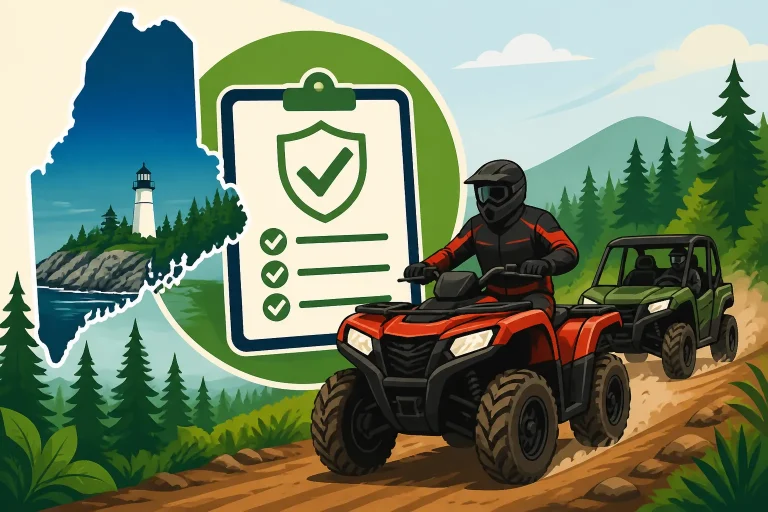
Think of course completion as one box in a larger safety checklist:
| Readiness item | What to confirm |
|---|---|
| Approved course | The course is recognized for Maine requirements and the rider has completed all required parts |
| Certificate | The child or parent has a reliable way to show proof of completion |
| Machine | The ATV fits the rider and is suitable for their age and experience |
| Supervision | A responsible adult can monitor the rider and respond quickly |
| Protective gear | The helmet and other equipment fit properly and are in good condition |
| Route | The planned ride is open, appropriate for the machine, and within the rider’s ability |
| Other rules | Registration, land access and any applicable operating rules have been checked |
If you are also trying to understand age-related operating restrictions, review Maine ATV Age Rules for Riders Under 16 and Adult Supervision Rules for Maine Youth Riders before planning a ride. These are separate from the course itself. Having a certificate does not automatically authorize a child to ride alone or operate on every type of land.
How to find and choose an approved course
Start by checking Maine IF&W’s current ATV safety education information. That is the best place to verify which course formats and providers count for the state requirement. Course availability, registration steps and delivery options may change, so do not rely solely on an old flyer, a social media post or a course offered by a provider in another state.
For help locating a class, see Where to Take a Maine ATV Safety Course The practical details matter: a class may have limited seats, a particular age range, a required in-person component, or equipment instructions that are easy to miss if you register at the last minute.
Ask these questions before enrolling
Before paying or committing to a date, confirm:
- Is the course accepted for Maine? Ask directly whether completing it satisfies the Maine ATV safety course requirement for a rider in the 10-to-15 age range.
- What is the minimum age? Some offerings may be intended for a specific age group. Check that your child is eligible on the course date.
- Is it online, in person, or a combination? If it is online, ask whether a hands-on session, field exercise or other step is also required.
- What does the student need to bring? The provider may specify clothing, identification, paperwork, a helmet or other equipment.
- How is completion recorded? Ask how the certificate or proof is issued and how long it usually takes to receive it.
- What happens if the rider misses a session? Find out whether a missed class requires a new enrollment or can be made up.
- Does a parent or guardian need to attend? Even if attendance is not required for the entire class, a parent should understand what the child is taught and how to reinforce it.
If you are considering an online option, verify it carefully rather than assuming that any ATV safety course found on the internet counts. The format and acceptance rules can differ. Taking the Maine ATV Safety Course Online is a useful next step when comparing options, but confirm the provider and completion requirements with the official program before enrolling.
A course provided by a retailer, club, school or out-of-state organization may be helpful, but the name of the organization alone does not establish that Maine will accept its certificate. Ask the provider for clear confirmation, then check that information against Maine IF&W’s current instructions. This small bit of checking is easier than discovering after the ride has been planned that a course did not satisfy the requirement.
Plan for more than the class date
A course can fill quickly, particularly when families are preparing for the riding season. Leave time for registration, any required online work, the in-person session and delivery or retrieval of proof of completion. Do not schedule a ride on the assumption that a child can take a class that morning and be ready to ride legally that afternoon.
For a child who is nervous about riding, an early course can also reduce pressure. They can learn the basics before a family trip, ask questions without a group waiting behind them, and practice skills gradually on appropriate private land when permitted. A last-minute class followed by an immediate long ride is not a good substitute for building confidence over time.
What to expect from the course and how to prepare
Course content and teaching methods vary, so the provider’s instructions should take priority. In general, a youth course will cover safe operation, basic machine knowledge, risk awareness and the rider’s responsibilities. Depending on the format, students may study material, take a knowledge check, demonstrate skills or complete a combination of these.
The goal is not to make a young rider fearless. It is to help them recognize what they can handle, what they cannot, and when to stop. A child who learns to say “I’m not comfortable with this hill” is showing good judgment, not failure.
Prepare the child to participate
Before class, tell your child that the course is not a race or a test of toughness. They should listen, ask questions and be honest about what feels difficult. If they have never operated an ATV, say so. If they have ridden before, they should still be willing to learn a different technique.
Useful preparation includes:
- Read the provider’s instructions together and complete any assigned material.
- Make sure the child has eaten and is rested enough to concentrate.
- Choose practical clothing that suits the session and weather.
- Bring any required documents or equipment.
- Tell the instructor about relevant concerns, such as a medical issue or limited riding experience.
- Avoid teaching shortcuts that conflict with the course. If a family habit differs from the instructor’s advice, discuss it rather than asking the child to guess which rule to follow.
If the provider asks students to bring a helmet or protective gear, confirm the required standard and fit before the class. A helmet should be made for the intended use, fit securely and be in usable condition. Do not rely on a helmet that is cracked, poorly fitting or of uncertain history. Parents who shop at a local dealer or on Amazon should check the product’s labeling and specifications carefully rather than choosing by appearance alone.
The same care applies to gloves, eye protection, sturdy footwear and clothing. A purchase is not automatically protective just because it is sold as riding gear. Confirm the course’s recommendations and prioritize fit, condition and compatibility with the machine.
Parents should learn the same basics
A parent does not have to be the instructor to support safe riding. But adults should understand the same basic controls and decisions the child is learning. If the parent is unfamiliar with ATVs, this is a good time to learn how to shut the machine off, identify key controls, check the brakes and explain a safe stopping distance.
Talk through simple scenarios after class:
- What should you do if you cannot see the trail clearly?
- What if another rider is too close behind you?
- What if the machine feels wrong or makes an unfamiliar sound?
- What if you reach a steep or muddy section that you do not want to ride?
- What should you do if the group becomes separated?
Do not turn the conversation into a memory quiz. Ask the child to explain their reasoning, then reinforce the course’s advice. It helps a young rider understand that stopping, turning back or asking for help is always an acceptable choice.
Choosing the right machine, supervision and first rides
One of the most important lessons for parents is that a safety certificate does not make an oversized machine appropriate. A child needs to reach and operate the controls comfortably, understand how the machine responds, and manage its weight and power. A machine that a child can start but cannot control reliably is not a suitable match.
Review the machine’s manufacturer guidance and Maine’s youth operating rules before deciding what the child will ride. The details can depend on the rider’s age and the ATV’s characteristics. For related guidance, see Engine Size Limits for Maine Riders Under 16 and Youth Machine Size Limits for Maine Riders Don’t use engine size as the only measure of fit. Seat height, weight, throttle response, braking, the child’s reach and their ability to stop the machine all matter.
What good supervision looks like
Supervision should be active, not just an adult being somewhere nearby. The supervising adult needs to be able to observe the child, communicate clearly and intervene if the situation changes. On a trail, that may mean keeping the child within sight, choosing a pace they can maintain, and stopping before difficult sections to explain the route.
Before riding, decide:
- Which adult is responsible for watching the young rider.
- How the group will communicate if it stops or gets separated.
- Where the child should ride in the group.
- What the child should do if they feel uncomfortable or the machine develops a problem.
- Which route is appropriate and where the group will turn around if needed.
Do not let peer pressure set the pace. A group of experienced adults may naturally ride faster than a new young operator can manage. If the group cannot slow down and stay together, the child should not be included in that ride.
Supervision requirements are a legal matter as well as a safety practice. Confirm the current rule for the rider’s age and circumstances instead of assuming that a parent watching from a distance is enough. A safety course does not waive supervision requirements.
Start with easy, controlled practice
After the course, give the child time to practice basic control in a suitable, permitted area before attempting a long trail ride. Begin with simple tasks: starting and stopping, gradual turns, looking where they intend to go, and maintaining a conservative speed. Keep practice short enough that fatigue does not erode attention.
Build up only when the child is steady and calm. A useful progression might be:
- Practice basic controls in a clear, level area with an adult close by.
- Introduce gentle turns and changes in surface at low speed.
- Practice stopping smoothly and responding to simple instructions.
- Try a short, easy route that is open to the machine and appropriate for the rider.
- Add more distance or terrain only after the child shows consistent judgment.
This is not a prescribed state course sequence; it is a practical way to avoid moving from classroom lessons straight to challenging terrain. If the child is tired, upset or reluctant, stop. Pushing through discomfort can turn a manageable ride into a preventable incident.
Keep proof, reinforce the lessons and check the rules before riding
Once the rider completes the course, keep the certificate or other official proof somewhere it can be found. Save a digital copy and keep the original according to the program’s instructions. If the certificate is lost, contact the issuing provider or official program to ask how to replace it; do not assume that a photo of an old document will always satisfy a check.
A course completion document is useful, but it is not the only paperwork a family may need. Registration, landowner permission and any trail-specific conditions are separate issues. For a broader checklist, see What Maine Riders Need Before They Ride If you are unsure what proof to carry or keep available, confirm the current guidance before leaving home.
Make the course part of family riding habits
Children learn as much from what adults do as from what instructors say. If adults ride too fast, skip checks or ignore posted restrictions, a young rider may conclude that the course rules are optional. Show the child that riders can be responsible by doing the small things consistently:
- Check the machine before each ride.
- Wear the right protective gear.
- Follow posted signs and stay on routes that are open.
- Keep a safe following distance.
- Slow down when visibility, surface or traffic changes.
- Stop when a rider is uncomfortable, tired or separated from the group.
- Respect private land and any restrictions set by landowners or clubs.
This matters especially in Maine, where access may depend on landowner permission and trail conditions can change. A rider’s course certificate does not grant access to private property or guarantee that a route is open. Check local trail information and get permission where it is required. If you are making a first outing, choose a short route and make sure the planned machine is appropriate for the trail width and conditions.
If a certificate or course question comes up
If a provider, family member or out-of-state certificate creates uncertainty, get a direct answer from Maine IF&W before relying on it. Keep a note of whom you contacted and what steps they said to follow. This is especially helpful when a child has completed a course elsewhere, took an online class, or is returning to riding after a long break.
For a certificate’s continued validity and replacement options, consult Maine ATV Safety Certificate and Whether It Expires Course records and program procedures can differ, so use the issuing organization or official state guidance rather than relying on a general assumption.
The simplest approach is to finish the course early, retain proof, confirm the child’s age-specific rules, match the machine to the rider, and plan an easy first ride with attentive adult supervision. That gives the young rider room to learn without treating a certificate as a green light for every machine, trail or situation.
Disclaimer
This article is for general informational purposes only and does not constitute professional advice. Laws, prices and regulations vary by location and change over time. Consult a qualified professional for guidance on your specific situation.