Adult Supervision Rules for Maine Youth Riders
A youth rider may be ready to steer an ATV long before they’re ready to judge speed, terrain, traffic, or risk. Maine’s supervision rules set a legal baseline, but meeting that baseline is not the same as making every ride safe. Here’s how to understand adult supervision, safety-course expectations, and the practical choices that help adults stay responsible on the trail.
The basic adult-supervision rule in Maine
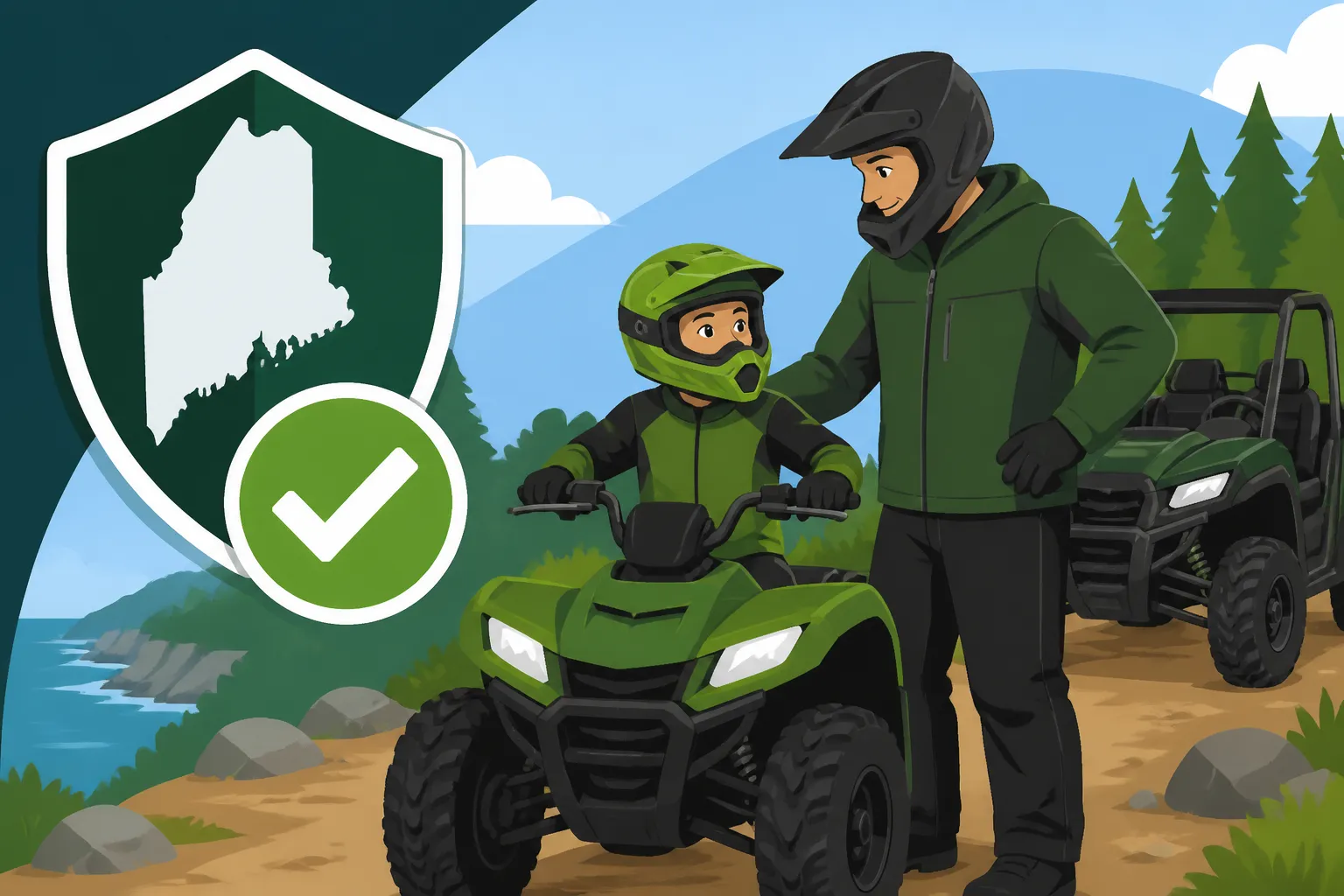
Maine generally requires a person under 16 to be accompanied by an adult while operating an ATV. That rule is an important starting point, but it is only one part of the requirements that can apply to young riders. Age, safety-course completion, machine type, riding location, and the route’s access rules can all matter.
For a wider age overview, see Maine ATV Age Rules for Riders Under 16. The key practical point is that an adult’s presence does not automatically make an otherwise prohibited ride legal. Supervision does not cancel age restrictions, training requirements, rules about public ways, or landowner conditions.
What “accompanied” means in practice
Parents often ask whether an adult has to ride on the same machine. Don’t assume that carrying a youth as a passenger is the only way to meet the supervision requirement. “Accompanied” has a legal meaning, and the details should be confirmed against current Maine rules rather than guessed from everyday usage. For a closer look at that question, see What Counts as an Accompanying Adult.
Even when separate machines are allowed, the adult needs to be close enough to supervise effectively. Following far behind, riding ahead out of sight, or letting a youth travel independently to meet the group can undermine both safety and the purpose of supervision. A responsible adult should be able to see what the young rider is doing, notice trouble quickly, and reach them without relying on a phone signal.
There’s also an important difference between legal accompaniment and good supervision. The legal standard sets a minimum. Good supervision means choosing a manageable route, matching the machine to the rider, communicating expectations, and being prepared to stop or turn back.
Supervision is not a substitute for other requirements
Before planning a ride, check the requirements that apply to the rider and the machine. Depending on the circumstances, those can include:
- A required ATV safety course or certificate for a young rider.
- An appropriate registration for the machine.
- Permission to ride on the trail or property.
- Rules for riding or crossing a public way.
- Helmet and passenger requirements.
- Restrictions established by a club, landowner, or trail operator.
These requirements are separate. For example, a registered ATV does not give the rider permission to use a closed trail. An adult’s presence does not replace a required safety certificate. And a valid trail route does not mean a young rider may operate anywhere along it.
If you’re new to the age and training rules, Maine ATV Safety Course Requirements and Maine ATV Rules for Riders Aged 10 to 15 are useful companion topics. Because legal details can change, confirm the current requirements with the Maine Department of Inland Fisheries and Wildlife before a youth rides, especially if the trip involves a public way or a machine that may be classified as a UTV rather than an ATV.
Which adult should supervise, and how close should they stay?
The adult accompanying a youth should be someone who can make good decisions under changing conditions—not simply the oldest person in the riding group. A teenager’s parent, relative, or family friend may be a sensible choice if they understand the route, know the rider’s ability, and are prepared to take responsibility throughout the ride.
Confirm the current legal definition of an adult and the meaning of “accompanied” before relying on assumptions. The specific explanation in What Counts as an Accompanying Adult can help you identify the questions to resolve. When in doubt, ask the appropriate state agency rather than treating another rider’s interpretation as a rule.
Set the adult’s job before leaving
A supervisor should be actively involved from the moment the group unloads. Before starting, agree on who rides where, what signals to use, and what happens if the group gets separated. The adult should know the route and its difficult spots, including road crossings, narrow bridges, steep grades, water, loose gravel, and places where a machine could slide or tip.
During the ride, the adult should:
- Keep the young rider in view or within immediate reach, as appropriate to the legal standard and conditions.
- Ride at a pace the youth can manage, not the pace the most experienced rider prefers.
- Watch for fatigue, poor concentration, fear, or pressure to keep up.
- Stop the group before a hazard if the youth needs more time or instruction.
- Make sure the youth understands when to stop, yield, wait, or turn around.
- Avoid distractions, including phone use while operating.
- End the ride if the young person, machine, or conditions are no longer safe.
The adult should not rely on the youth to call for help if something goes wrong. In remote areas, cell service may be unreliable. A supervising adult needs a plan for basic breakdowns and injuries, plus a clear way to get the rest of the group safely off the trail.
Keep group size manageable
A large ride makes supervision harder. Adults may be spread out, experienced riders may want to go faster, and a youth can disappear behind dust, trees, or a bend. For a young or inexperienced operator, a small group is easier to manage than a long line of machines.
If several adults are riding, name one person as the youth’s primary supervisor. “Everyone will keep an eye out” can become “I thought someone else was watching.” The designated adult should know the young rider’s position and should not leave them with the group while taking a different route or stopping elsewhere.
If the adult needs to separate from the youth, another responsible adult should clearly take over. Agree on the handoff before anyone moves. Don’t assume that a youth can safely remain with a group just because other riders are nearby.
Age, training, and choosing the right machine
Adult supervision does not make every machine suitable for every child. A rider’s age is only one factor. Height, reach, coordination, strength, judgment, experience, and ability to follow instructions all matter. A youth who can start an ATV may still lack the reach or control to brake, steer, and manage a sudden change in terrain.
Maine’s youth rules and safety-course requirements should be checked together. Maine ATV Safety Course for Riders 10 to 15 covers a specific age group, while [Can a 10-Year-Old Ride an ATV in Maine?] addresses a common question about the youngest riders. Don’t infer that a child is legally or practically ready based on another child’s experience.
Safety training is more than a certificate
A safety course can teach habits a young rider needs before they encounter a real hazard. It can cover basic operation, protective equipment, trail behavior, and decision-making. If a course or certificate is required, complete it before the ride and keep the documentation available as directed. For details on proof and validity, see Does a Maine ATV Safety Certificate Expire?.
But a course is not a substitute for supervised practice. Before joining a trail ride, let a youth learn the controls in a safe, permitted area at a speed and on terrain appropriate to their ability. Make sure they can demonstrate that they know how to:
- Start and stop smoothly.
- Use the brakes and throttle without abrupt movements.
- Turn in both directions while maintaining control.
- Stop when asked, including on a mild slope if appropriate.
- Maintain a safe following distance.
- Recognize when a surface is too loose, steep, narrow, or slippery.
- Explain what to do when the adult signals a stop.
If the youth cannot reliably follow a simple instruction in a quiet practice area, a busy trail is not the place to teach that skill.
Match the ATV to the operator, not the other way around
A machine that is too powerful, heavy, or large can be difficult for a young rider to control. The youth needs to reach the controls comfortably and use them without stretching, shifting awkwardly, or losing a secure grip. They should be able to mount and dismount safely and understand how the machine responds when turning or braking.
Look at the manufacturer’s age and operating guidance for the specific machine, and consider the rider’s ability rather than treating age as the only measure. If an ATV has a speed limiter or other youth-focused controls, understand how it works and set it before the ride. Do not remove a safety limit simply because the rider wants to keep up with adults.
A UTV or side-by-side presents different issues. Its seating, seat belts, roll structure, and passenger arrangement do not automatically make it suitable for every youth to operate. Rules for a UTV can differ from ATV rules, and the machine’s classification matters. See Maine UTV Registration and How It Differs for the registration distinction, then confirm the youth-operation and occupant rules that apply to the particular vehicle.
Protective gear should fit the rider
A helmet that is too large or sits poorly may not protect as intended. Check fit, fastening, condition, and whether the helmet meets the applicable standard. Youth helmet requirements are covered in Maine Helmet Requirements by Age. Eye protection, gloves, sturdy clothing, and footwear that stays securely on the foot also make a ride more manageable.
If you shop online, including through Amazon, use the listing to check the helmet’s actual certification, size guidance, and return policy—not just its appearance or the word “youth” in the product title. A helmet should be tried on and fitted correctly before a ride. The same goes for goggles and gloves: equipment that slips, pinches, or blocks vision can create a new problem instead of solving one.
Where the youth rides changes the answer
A supervisor should not treat all riding areas as interchangeable. A private yard, a club trail, a public way, and a route across land with permission may have different restrictions. The youth’s age and training status matter, but so do the road rules, trail conditions, and permissions for each part of the route.
Private property is not a blanket exception
Riding on family land can be a good place to practice, but it is not a reason to ignore safety or applicable law. The property must actually be available for the ride, and the family should understand any restrictions that apply to the machine or rider. A youth should not assume that being on private land means every age, equipment, or operating rule disappears.
Land boundaries can be hard to recognize in the woods. A route that starts on family property may cross a neighbor’s lot, a club trail, a public way, or land where access has been withdrawn. Check the route in advance and get permission where required. Maine ATV Rules on a Family Woodlot and Maine Landowner Permission Rules can help clarify why permission and location matter.
Club trails require more than an adult passenger
Club trails are not simply open ground where any registered ATV can ride. Access may depend on trail status, landowner permission, the club’s rules, and the machine’s suitability for that route. A trail may be closed, too narrow, or too difficult for a youth rider even when it is open to other ATVs.
Check current trail information before loading the machines. Ask the local club if a route has a difficult section or restrictions that may affect a young operator. A family ride does not create an exception to a landowner’s conditions or a club’s posted rules. See Youth Riders on Club Trails for more on this setting.
On a first ride, choose a route with room to stop, mild terrain, and limited exposure to traffic or steep drop-offs. Avoid treating mileage as the goal. A short ride that lets a young person practice safely is a better result than a long outing that leaves them tired and rushed.
Public ways and crossings deserve special attention
Rules about operating on or crossing public ways are separate from the general adult-supervision rule. Do not assume that an adult can make a road ride permissible for a youth. Before including a road segment, confirm that the route is legally open to ATV use and that the young rider is allowed to operate there under the applicable rules.
Road crossings are a particular challenge because drivers may not expect an ATV, sightlines can be limited, and a young rider may react unpredictably under pressure. An adult should stop the group in a safe place, explain the crossing, and make sure each rider knows what to do. Never send a youth across alone on the assumption that the adult will catch up.
If a route involves a public way, review Maine ATV Road Rules for Young Riders and the rules for the specific road or crossing. Local access can vary, and a sign or map may not tell the whole story. When the legal status is unclear, choose a different route until it is confirmed.
Keep registration and permission questions separate
Registration is important, but it is not trail permission. A registered machine can still be on a closed route or land where the owner has not allowed riding. Similarly, permission to use a private trail does not replace registration or other requirements that apply to the machine.
Before the trip, check the registration, decal placement, and any paperwork the operator should carry. If the machine is borrowed or belongs to another family member, make sure the youth has permission to operate it and understands the owner’s rules. The adult remains responsible for checking the route and conditions rather than assuming the machine’s paperwork settles every question.
A practical supervision plan for a youth ride
A brief plan prevents many avoidable problems. It also gives the youth a chance to show they understand the ride before the engine starts. Keep the plan simple enough that everyone can remember it.
Before starting
- Confirm the rules. Check the current requirements for the youth’s age, training, machine, and planned route. Verify any road segments, trail closures, or landowner conditions.
- Choose a manageable route. Pick a short route with terrain suited to the rider. Identify crossings, narrow spots, and places where the group can stop safely.
- Inspect the machine. Check the controls, brakes, tires, throttle response, lights if needed, and any youth safety settings. Do not send a young rider out on a machine that has a known problem.
- Check protective equipment. Make sure the helmet fits and fastens correctly, and that clothing and footwear will not interfere with controls.
- Set the riding order. Keep the youth close to the designated adult. Avoid putting the young rider at the back of a dusty group or between unfamiliar riders.
- Agree on signals. Decide how the adult will tell the rider to stop, slow down, wait, or turn around. Make sure the youth can repeat the plan.
- Set a stop-and-return rule. Tell the youth they can ask to stop without being teased or pressured to continue.
During the ride
The adult’s pace should be based on the least experienced operator, not the most capable one. Leave room between machines, especially on loose surfaces where dust reduces visibility. Avoid letting the group bunch together at a corner or crossing.
Watch the youth’s body language. A rider may become quiet, stiff, hesitant, or increasingly erratic when tired or worried. They might also speed up to keep up, brake late, or stop responding to directions. Those are reasons to pull over somewhere safe and reassess.
Give instructions one at a time. A long explanation while engines are running is hard to hear and easy to forget. Stop before a difficult section, explain what to expect, and let the youth decide whether they are comfortable proceeding. If they are not, turn around or choose another route.
Do not use the youth’s ride to prove they can handle a hard obstacle. Mud, steep grades, water, and narrow bridges can be tempting challenges, but an adult should be willing to skip them. A young rider does not need to conquer every feature to become competent.
After the ride
Ask what felt difficult and what the youth would do differently next time. Keep the conversation specific and calm. “You waited until I gave the signal at the crossing” is more useful than a general judgment about being a good rider.
Check the machine for damage and discuss any mechanical issue before the next ride. If the youth struggled with a control, route feature, or instruction, practice that skill in an appropriate setting before increasing the difficulty. Improvement should come from repetition and confidence, not from pressure.
It also helps to make a family rule that a youth can stop riding at any time. A young person who feels free to say “I’m done” is more likely to speak up before fatigue turns into a crash.
Common mistakes adults make
Even careful families can get the supervision details wrong. These are the problems worth checking before the next outing.
Assuming “an adult is nearby” is enough
An adult at the trailhead or several machines back may not be able to intervene. Make sure the adult is actively accompanying the youth in a way that meets the current legal rule and allows real supervision. If the group’s arrangement is uncertain, ask for clarification before riding.
Treating course completion as proof of readiness
A certificate shows that a training requirement has been addressed; it does not prove that a young person can manage every machine or trail. Start with basic skills and low-risk terrain. Increase difficulty only when the youth consistently shows control and judgment.
Letting the group set the pace
Young riders often try to keep up with siblings, friends, or adults. That can lead to speeding, abrupt braking, and poor decisions. Set a pace for the youth and make it clear that no one should pressure them to ride faster.
Assuming all trails allow the same machines and riders
A trail can have width limitations, seasonal closures, permission conditions, or club rules. A route that works for a small ATV may not suit a wide side-by-side, and a route open to adults may still be a poor choice for a beginner. Check before the trip rather than finding out at a narrow bridge.
Failing to distinguish operating from riding as a passenger
The rules for an operator and a passenger are not interchangeable. A youth who is not permitted to operate a particular machine in a particular setting may still be subject to separate passenger requirements. Check the rules for the age, vehicle, seat, and route instead of treating “they’re with an adult” as the whole answer.
A helpful summary:
| Question | What to verify | Why it matters |
|---|---|---|
| Is the youth old enough to operate this machine? | Current Maine age and machine-specific rules | Supervision does not override an age restriction |
| Is a safety course or certificate required? | The rider’s age and current training rules | Training requirements are separate from adult accompaniment |
| Who is the accompanying adult? | The current definition and relationship to the rider | A nearby adult may not satisfy the rule or provide useful supervision |
| Where will the youth ride? | Trail status, permission, and public-way restrictions | Access rules differ by location and can change along a route |
| Is the machine appropriate? | Fit, power, controls, passenger setup, and classification | A legally operated machine can still be unsafe for that rider |
| What happens if conditions change? | Stop signals, backup route, and return plan | Fatigue, weather, traffic, or trail conditions can make a ride unsafe |
The safest approach is to confirm the current rule, then plan beyond the minimum. A young rider needs an appropriate machine, training, close attention, and a route that fits their ability. Adult supervision works best when it is active, consistent, and treated as a responsibility—not a formality.
Disclaimer
This article is for general informational purposes only and does not constitute professional advice. Laws, prices and regulations vary by location and change over time. Consult a qualified professional for guidance on your specific situation.