Maine ATV Road Rules for Young Riders
For many young riders in Maine, the thrill of exploring the vast network of ATV trails is an undeniable draw. But navigating those trails, especially when they intersect with or utilize public roads, can be a confusing maze of regulations for both kids and their parents. It's a real challenge to keep track of all the rules designed to keep everyone safe, and nobody wants a fun family outing to end with a ticket or, worse, an accident. This guide is here to untangle Maine's specific road rules for young ATV and UTV operators, helping you understand exactly what’s required to ride legally and safely.
The Basics: Who Can Ride and Where
Before any wheels hit the dirt, or more importantly, the pavement, it’s crucial to understand the foundational rules that dictate who can even operate an ATV or UTV in Maine, especially concerning age and location. These aren't just suggestions; they're legal requirements designed to ensure everyone's safety on and off the trails.
Age Restrictions for ATV Operation
Maine has clear guidelines regarding the minimum age for operating an ATV, and these rules are paramount for young riders. Generally speaking, a child under the age of 10 years old is not permitted to operate an ATV or UTV on any public land or designated trail. This means no public trails, no road crossings, and certainly no designated ATV access routes. Their riding should be strictly confined to private land, and even then, under direct supervision.
For riders aged 10 to 16, the rules become a bit more nuanced but are still very strict. A rider in this age bracket can operate an ATV on public trails and approved routes, but only if they meet specific criteria. The most important one is the successful completion of a Maine-approved ATV safety course. This course isn't just a formality; it teaches essential safety practices, trail etiquette, and the very road rules we're discussing today. Furthermore, riders aged 10 to 16 must always be under the direct supervision of an adult at least 18 years old. This isn't just "being in the general vicinity"; it means the adult must be close enough to provide immediate assistance and guidance, often riding directly with or very near the young operator. It’s all about building confidence and safe habits under the watchful eye of an experienced rider.
Public vs. Private Land: A Key Distinction
One of the biggest areas of confusion for ATV riders, especially parents of young operators, revolves around the difference between riding on private land and venturing onto public property. The rules change dramatically the moment your tires leave private property without specific permissions or designations.
On private land where you have explicit permission from the landowner, the state's age restrictions for operation are often relaxed, allowing younger children (under 10) to learn and practice in a controlled environment. This is the ideal place for a novice to gain experience without the added complexities of public way laws. However, the moment your planned route involves even a quick dash across a public road, or a short section of a dirt town way, you're now subject to Maine's public land and road rules. This means the young rider must meet the age requirements, have completed their safety course if applicable, and be properly supervised. It's also vital that the ATV itself meets registration requirements for public use. You can find more specific details on [Maine ATV Registration for Youth Machines] if you're looking to get your child's machine ready for the trails. This distinction is not just a technicality; it’s a critical safety barrier and a legal dividing line that every ATV family needs to understand thoroughly.
Navigating Public Ways: The Rules of the Road
When an ATV trail inevitably crosses a public road or utilizes a designated section of a public way, the rules of the game change entirely. Young riders must grasp these regulations to safely and legally transition from trail riding to sharing the road, even for brief moments. This isn't just about avoiding a ticket; it's about avoiding serious accidents with cars, pedestrians, or other vehicles.
Understanding Maine's 500-Yard Limit
Maine law is very specific about how ATVs can interact with public ways that aren't designated as ATV access routes. The "500-yard limit" is a cornerstone of these rules. An ATV or UTV can only operate on the extreme right of a public way for a distance of up to 500 yards for the sole purpose of either crossing that public way or gaining access to another trail system. It's not an invitation to cruise down the road; it's a very limited allowance for connectivity.
For young riders, this rule is particularly important to drill into their understanding. They must know that this short distance is all they have, and it must be utilized efficiently and safely. Imagine approaching a road crossing with your child. You'll need to explain that they can't just follow the road for a mile to the next trail entrance. They must use the shortest, safest route to cross or connect within that 500-yard window. This applies whether you're trying to get to a gas station that’s just across the road or linking up with the next section of trail. The intent is strictly for passage, not travel. For a deeper dive into this specific regulation, check out [Maine's 500-Yard Limit on a Public Way]. It’s a rule that can easily lead to a citation if misunderstood or abused.
Complete Stop and Yield Rules
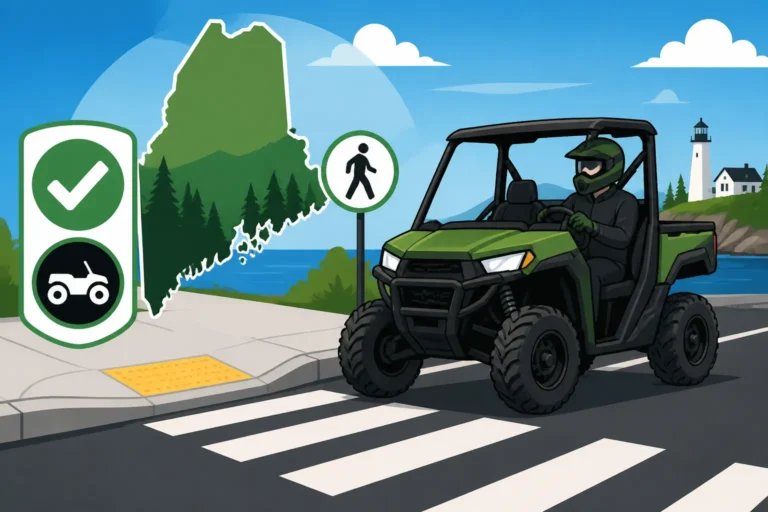
Before any part of an ATV or UTV operated by a young rider, or any rider for that matter, enters or crosses a public way, a complete stop is mandatory. This isn't a rolling stop, a slow crawl, or a quick glance. It means coming to a full, absolute halt, just as you would at a stop sign in a car. This stop must be made at a point where the operator has a clear view of approaching traffic and can do so safely without impeding the public way itself.
After the complete stop, the responsibility shifts to yielding. The ATV operator, including a young one, must yield the right-of-way to all vehicular traffic, pedestrians, and bicyclists utilizing the public way. This is non-negotiable. You must ensure the way is clear in both directions, and that any approaching traffic has ample time and space to pass, before proceeding. Teaching young riders to look left, right, and then left again, and to wait patiently for a safe window, is paramount. They need to understand that cars are faster, heavier, and less forgiving. This skill isn't instinctive; it requires practice and consistent reinforcement from supervising adults. [Maine's Stop-and-Yield Rule Before a Public Way] offers more information on this critical safety measure.
Riding the Extreme Right and Single File
When a young rider finds themselves on a public way for that brief 500-yard traverse or designated access route, two other critical rules come into play: riding on the extreme right and maintaining a single file formation. These are not minor details; they are vital for visibility and minimizing disruption to regular traffic.
Riding on the "extreme right of the traveled portion of the public way" means literally hugging the right edge of the road, as far over as safely possible, without driving into ditches or off the shoulder if it's unsafe. This position maximizes the space for other vehicles to pass safely and clearly indicates that the ATV is not a regular part of traffic. It's about being seen and staying out of the way. For young riders, who might be less experienced with judging distances and traffic flow, this keeps them as far from danger as possible.
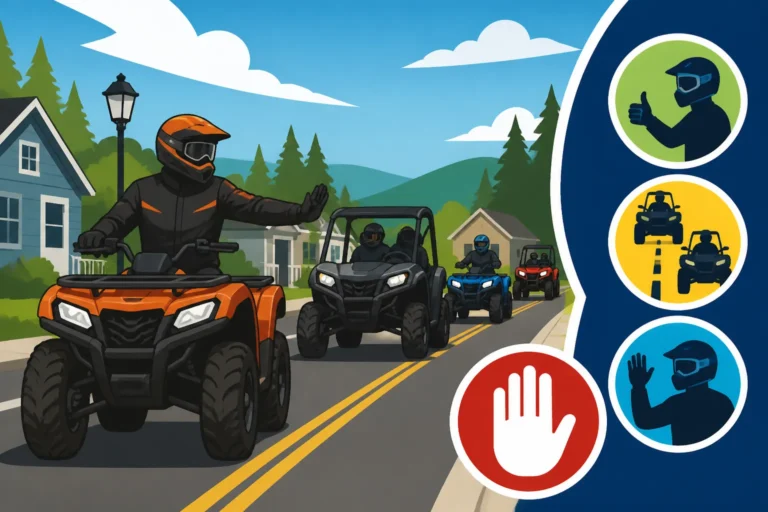
Additionally, when multiple ATVs are crossing or using a public way, they must proceed in single file. This rule prevents a line of ATVs from stretching across a wide section of the road or impeding traffic flow more than necessary. It keeps the group cohesive, predictable, and easier for drivers to anticipate. Imagine a parent supervising a young rider; the parent would likely lead or follow directly behind, both in single file, to ensure the child adheres to these rules. Adhering to [Riding the Extreme Right of a Maine Road] is not just about compliance; it's about minimizing risk in a potentially dangerous environment.
Essential Safety Gear and Training for Young Riders
Riding an ATV or UTV carries inherent risks, and for young operators, these risks can be amplified. Maine law, recognizing this vulnerability, has put in place stringent requirements for safety gear and mandatory training. These aren't suggestions; they are critical components of ensuring a safe and enjoyable experience for younger riders.
Mandatory Helmet and Eye Protection
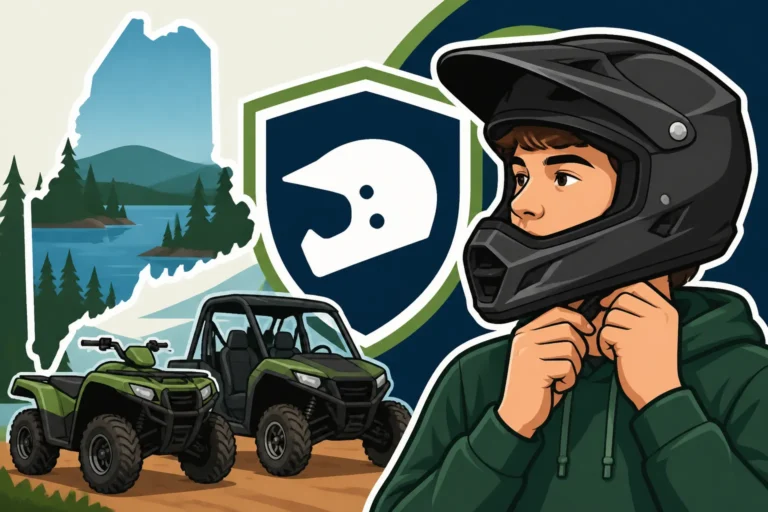
This is perhaps one of the most visible and consistently enforced safety rules in Maine: any ATV or UTV operator under the age of 18 is legally required to wear a helmet. But it's not just any helmet; it must be a protective headgear that meets U.S. DOT (Department of Transportation) standards. This means a helmet specifically designed and rated for powersports use, not a bicycle helmet or a construction hardhat. These DOT-approved helmets are engineered to protect against significant impacts, a crucial feature given the dynamic nature of ATV riding. It's a non-negotiable item, and wardens frequently check for compliance.
Beyond the helmet, appropriate eye protection is also essential for all riders, but especially for young ones whose eyes are more sensitive and less accustomed to high speeds and debris. This could be goggles that fit snugly with the helmet, or a full face shield integrated into the helmet itself. Dust, bugs, branches, and mud can all impair vision instantly, leading to a loss of control. Teaching a young rider to always have their eye protection on, even for short stints, is a habit that could prevent a serious accident. For detailed helmet requirements, you can refer to [Maine Helmet Rules for Riders Under 18].
The Maine ATV Safety Course
For any child aged 10 to 16 who wishes to operate an ATV or UTV on public land or designated trails in Maine, successfully completing an approved ATV safety course is not just a good idea—it's the law. This course is a comprehensive program designed to equip young riders with the knowledge and skills necessary for safe and responsible operation. It covers everything from basic machine controls and maintenance to understanding trail etiquette, environmental considerations, and, crucially, the rules for operating on or near public roads.
The course helps instill a fundamental understanding of risk assessment, teaching young operators how to anticipate hazards, react appropriately, and make responsible decisions on the trail. It's hands-on, often involving practical riding exercises that reinforce classroom learning. For parents, it provides peace of mind knowing their child has received formal training. For the wardens, it's proof that a young rider has been educated on Maine's specific laws and best practices. If you're looking to get your child certified, more information can be found in [Maine ATV Safety Course for Riders 10 to 15].
Machine Size and Supervision Requirements
Maine law isn't just concerned with the rider's age and training; it also considers the appropriateness of the machine itself for a young operator. There are specific engine size limits for youth riders based on their age and safety course completion status. For example, a 10-year-old who has completed the safety course might be limited to a machine with a smaller engine displacement compared to a 15-year-old. These limits are designed to match the machine's power and weight to the rider's physical capabilities and experience level, preventing them from operating a machine that's simply too much for them to handle safely. A supervising adult needs to ensure their child is on an appropriately sized machine. More details on these limits can be found in [Engine Size Limits for Maine Riders Under 16].
Furthermore, for riders aged 10 to 16, direct adult supervision is non-negotiable when they are operating an ATV or UTV on public lands or trails. This isn't a "check in every hour" kind of supervision. It means an adult, at least 18 years old, must be in a position to provide immediate control and assistance. Often, this means the adult is riding on another ATV or UTV, directly with or just behind the young operator, maintaining a direct line of sight. This constant presence allows the adult to coach, correct, and intervene if a dangerous situation arises, particularly when navigating road crossings or busy trail sections. It’s an active role, not a passive one, and it's fundamental to the safety and legality of youth ATV operation in Maine.
Special Considerations for UTVs and Road Access
While many of the fundamental rules apply across both ATVs and UTVs (side-by-sides), there are some distinct characteristics and perceptions surrounding UTVs, particularly when it comes to road access. Their car-like appearance can sometimes lead to different expectations from the public and even pose unique challenges for young operators.
UTV Road Rules vs. ATV Road Rules
For the most part, Maine law treats UTVs similarly to ATVs when it comes to road access: the 500-yard limit, complete stops, yielding, and riding on the extreme right still apply. However, there are nuances. UTVs, with their larger size, multiple seats, and often enclosed cabs, can sometimes be mistaken by other drivers for more traditional road vehicles. This can be a double-edged sword: drivers might initially give them more respect, but they also might not anticipate the UTV's limited road capabilities or slow speeds when entering or crossing.
One significant difference lies in passenger rules. UTVs are designed to carry passengers, unlike most single-rider ATVs. When a young person is operating a UTV, the number of passengers must not exceed the manufacturer's designed capacity, and all occupants must use available seatbelts. The roll cage design of UTVs offers increased protection in the event of a rollover, which is a major safety advantage, but it doesn't negate the need for seatbelts. You'll often see UTV owners upgrading their machines with accessories from brands like SuperATV, adding features like full windshields, roof kits, or even enhanced lighting. While these additions enhance comfort and protection on the trail, they don't necessarily change the legal status of the UTV on public roads. The core rules for crossing or limited access remain, regardless of how tricked-out the machine is.
Designated ATV-Access Routes
Not all public roads are created equal in the eyes of Maine's ATV laws. Many towns across the state have recognized the economic and recreational benefits of ATV tourism and have officially designated specific sections of their public ways as "ATV-Access Routes." These routes are explicitly opened for ATV and UTV travel, providing crucial links between trail systems, access to services like gas stations and restaurants, and connections through towns.
For young riders, these designated routes are a fantastic opportunity for legal and safer road travel, but they still come with strict guidelines. These routes are always clearly marked with official signage, typically indicating "ATV Access" or "Shared Roadway." It is absolutely critical that young riders (and their supervisors) only use roads that are clearly marked as such. Just because a dirt road looks like a trail doesn't mean it's an approved ATV route. On these designated routes, ATVs and UTVs still generally must adhere to posted speed limits, ride on the extreme right, and yield to other vehicles. They offer a much longer travel distance than the 500-yard crossing rule, but they are still shared spaces. Learning to identify and respect these signs is a key part of responsible riding. More on how these routes are established and marked can be found in [Maine ATV-Access Routes and How Towns Post Them].
Avoiding Misinterpretations and Common Mistakes
It's easy for young riders, in their enthusiasm, to make common mistakes that can lead to unsafe situations or legal trouble. One prevalent misinterpretation is assuming that any gravel or dirt road is automatically an "ATV trail." This is a dangerous assumption. Most dirt roads are public ways, maintained by the town or state, and subject to the same strict ATV rules as paved roads unless specifically designated as an ATV access route.
Another common mistake is extending the "500-yard limit" into an indefinite journey. A young rider might get on a road, realize they missed their turn, and continue riding for well over the allowed distance. This is illegal and puts them directly in harm's way. Similarly, failing to come to a complete stop before entering a public way is a frequent infraction. The temptation to "roll through" when no traffic is visible is strong, but it eliminates a crucial moment for observation and decision-making.
Parents must constantly reinforce these points with their young riders. Emphasize that these rules are not designed to hinder fun, but to preserve safety and the privilege of trail access. Educating young riders on these nuances is key to fostering a responsible ATV community.
Enforcement, Penalties, and Responsible Riding
Maine's extensive ATV trail system, which relies heavily on private landowner cooperation, is maintained through a combination of thoughtful regulations and diligent enforcement. For young riders, understanding the consequences of non-compliance isn't just about avoiding a fine; it's about appreciating the collective effort required to keep trails open for everyone.
Warden Service Patrols and Spot Checks
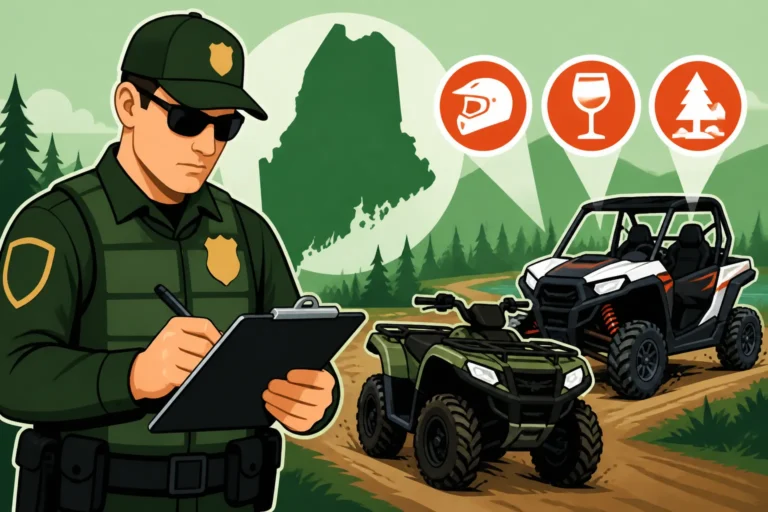
The Maine Warden Service plays a crucial role in ensuring the safety and legality of ATV and UTV operation across the state. They are regularly out on the trails, at trailheads, and near road crossings, conducting patrols and spot checks. It’s not uncommon for wardens to set up checkpoints, especially during peak riding seasons, specifically looking for compliance with registration, safety gear, and age-related rules.
When a warden stops a young rider, they will typically ask for proof of registration, inquire about the rider's age, and check for the presence of a DOT-approved helmet and eye protection. They might also ask if the rider has completed the mandatory ATV safety course and if a supervising adult is present. For youth operators, wardens often prioritize education over immediate penalties for minor infractions, but consistent or blatant disregard for the rules will lead to citations. It's a system designed to protect, but also to uphold the law. Being prepared and compliant means a brief, respectful interaction with law enforcement, rather than a troublesome one. [Maine Warden Service ATV Patrols] provides more insight into their operations.
Fines and Consequences for Violations
Ignoring Maine's ATV laws, especially those pertaining to young riders, can lead to a range of penalties, and these consequences often fall on the supervising adult or the parent/guardian. Fines for operating an unregistered machine, failing to wear a helmet (for riders under 18), or allowing an underage, uncertified rider on public trails can be substantial. These aren't just minor inconveniences; they can significantly impact your wallet and your future recreational opportunities.
Beyond monetary fines, repeated violations or serious offenses can sometimes lead to suspension of riding privileges or even impoundment of the machine. These penalties underscore the seriousness of operating an ATV or UTV responsibly. More importantly, every violation, especially those involving young riders, chips away at the goodwill of landowners who generously provide access to their property. A single incident of an unregistered or improperly supervised youth rider on a public way can lead to a landowner closing their land to all ATV traffic, impacting hundreds of other riders. Understanding [Fines Maine Wardens Write Most Often] can help emphasize the importance of compliance.
Instilling a Culture of Respect
Ultimately, fostering a culture of respect is the most important lesson a young rider can learn. This means respect for the law, for private landowners, for other trail users, and for the environment. When a young rider encounters a public road, that respect translates into making a complete stop, yielding to traffic, and adhering strictly to the 500-yard rule or designated access routes. It means wearing the helmet not just because it's the law, but because it protects them.
ATV clubs across Maine work tirelessly to maintain trails and cultivate positive relationships with landowners. These clubs are the backbone of the state's trail system. When young riders and their families operate responsibly, they contribute positively to this community effort, helping to ensure that the privilege of riding these incredible trails continues for generations to come. Teaching a child that their actions reflect on the entire ATV community is a powerful motivator for compliance and courteous behavior.
Practical Tips for Parents and Young Riders
Even with a thorough understanding of the rules, the real world can present unexpected challenges. Proactive planning, consistent communication, and leading by example are invaluable tools for parents guiding young riders through Maine's ATV road regulations.
Pre-Ride Planning and Route Awareness
One of the best ways to ensure a safe and legal ride, especially with young operators, is to plan your route meticulously before you even load the machines. Don't just head out hoping for the best. Sit down with your child and a map – a physical one or a digital app like onX Offroad Maps for Maine Trails – and trace your intended route. Point out every road crossing, every section of designated ATV access route, and any areas where public ways might be encountered.
Discuss potential hazards specific to those road sections: "This crossing is busy during lunch hour," or "Watch out for logging trucks on this dirt road." Talk through the complete stop procedure for each crossing and identify clear sightlines. This pre-ride briefing is not just about logistics; it’s a critical mental exercise that prepares young riders for the transitions between trail and road. Understanding the route creates anticipation and reinforces the rules in a practical context, making them less abstract.
Communication and Practice
Constant communication is key. Before each ride, reiterate the essential road rules: "Remember, full stop before the pavement," "Look both ways, then look again." Use everyday scenarios to reinforce these ideas. When driving in your car, point out stop signs and talk about yielding. When you encounter another vehicle on a shared dirt road, explain why you pull over to the side.
Practical, supervised practice is also incredibly valuable. Find a safe, open private area where you can simulate road crossings. Have your child practice coming to a complete stop, scanning for imaginary traffic, and accelerating safely. Practice riding in a straight line on the extreme right. The more they practice these motions in a low-pressure environment, the more instinctive they will become when they encounter a real public way. Consider investing in safety accessories from SuperATV, such as bright LED lights or an aftermarket horn, which can enhance visibility and communication, though always remember that state regulations dictate specific requirements.
Leading by Example
Perhaps the most powerful teaching tool a parent has is their own behavior. Young riders are highly impressionable and will mimic what they see. If you, as an adult rider, consistently come to a complete stop at road crossings, patiently wait for traffic, ride on the extreme right, and always wear your helmet, your child will learn to do the same. If you cut corners, speed on public ways, or skip your helmet, your child will likely adopt those habits as well.
This commitment to responsible riding extends to all aspects: respectful interaction with landowners, proper trail etiquette, and adherence to environmental guidelines. When parents consistently demonstrate safe and legal operation, they instill not just knowledge of the rules, but a deep-seated respect for the sport, the land, and the community. This leadership by example is the foundation for creating safe, confident, and responsible young ATV and UTV riders in Maine.
Maine ATV Road Rules for Young Riders: A Quick Reference Guide
| Category | Age 10-15 (with Safety Course) | Under 10 (on Private Land) | Adult (16+ or 18+ for Supervision) |
|---|---|---|---|
| Public Land/Trails | Yes, with Adult Supervision | No | Yes |
| Public Road Crossing (500-Yard Limit) | Yes, with Adult Supervision | No | Yes |
| Designated ATV-Access Routes | Yes, with Adult Supervision | No | Yes |
| Mandatory Helmet (DOT-Approved) | YES (Required) | N/A (Private Land) | No (Recommended) |
| Mandatory Eye Protection | YES (Recommended for all) | YES (Recommended for all) | YES (Recommended for all) |
| ATV Safety Course Required | YES | No | No (Recommended) |
| Adult Supervision (18+) | YES (Direct & Immediate) | YES (Direct) | N/A |
| Complete Stop at Public Way | YES | N/A (No Public Way Access) | YES |
| Yield to Traffic | YES | N/A (No Public Way Access) | YES |
| Ride Extreme Right | YES | N/A (No Public Way Access) | YES |
| Ride Single File | YES | N/A (No Public Way Access) | YES |
| Machine Engine Size Limits | YES (Specific to Age) | N/A (Private Land) | No |
This article is for general informational purposes only and does not constitute professional advice. Laws, prices and regulations vary by location and change over time. Consult a qualified professional for guidance on your specific situation.