What a Maine ATV Registration Does Not Cover
A Maine ATV registration is an important starting point, but it is easy to mistake it for an all-purpose permit. It does not automatically give you permission to use every trail or road, insure the machine, or establish that you own it. Knowing what registration leaves out helps you avoid an expensive misunderstanding before riding, especially if you are visiting from another state or province.
What a Maine ATV registration actually does
Registration connects a particular ATV to a current registration record and the required identifying decal or documentation. It helps show that the machine has been registered for the applicable use. It is not a driver’s license, a trail pass for every property, a vehicle title, or an insurance policy.
The important distinction is between registering the machine and being authorized to ride it in a particular place. Registration may be one requirement for a ride, but other rules and permissions can apply at the same time.
| What you might assume registration covers | What to check instead |
|---|---|
| Permission to ride any trail | Trail status, landowner permission, club rules and posted closures |
| Permission to use any public road | Whether the road is legally open to ATVs and what local rules apply |
| Liability or damage coverage | Your insurance policy and any specific coverage requirements |
| Proof that you own the ATV | Bill of sale, dealer paperwork and other ownership records |
| Permission for every rider | The rider’s age, supervision, training and equipment requirements |
| Permission to ride a second machine | Registration for that specific machine |
| A permit for a trailer or another vehicle | Separate registration and operating requirements for that vehicle |
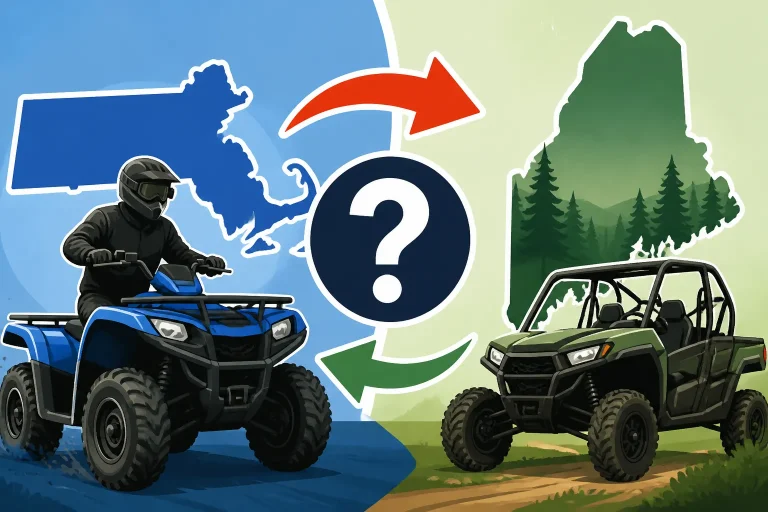
A registration decal is not a general access badge. Even if the ATV is properly registered, a landowner or trail manager may close a route, limit access to certain machines, or require riders to follow additional conditions. Likewise, a registration for one ATV does not register a second ATV or a UTV. If you are unsure which category applies to a side-by-side, see Maine UTV Registration and How It Differs.
Registration also should not be treated as conclusive proof of ownership. Keep purchase documents with your records, particularly if you bought the machine privately, inherited it, or received it as a gift. A registration record and a bill of sale serve different purposes. For a closer look at the paperwork, read Proof of Ownership for a Maine ATV Registration and Maine ATV Bill of Sale: What to Include.
If you are preparing a first registration, check what the office or online process requires rather than assuming that the registration itself fills in missing purchase records. What It Takes to Register an ATV in Maine explains the broader registration process.
Registration does not guarantee trail access
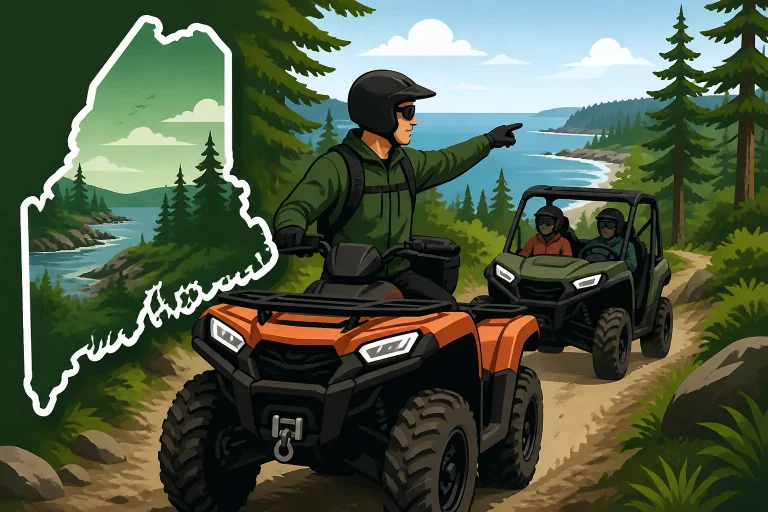
Maine riding access depends heavily on where a trail goes and who controls the land. A registered ATV does not give its operator permission to cross private property. Many routes rely on landowner consent, and access can depend on club arrangements, seasonal conditions, posted signs, or a landowner’s decision to close a section.
That means a trail shown on a map is not automatically open for riding today. Maps can help with planning, but they do not replace checking current trail conditions and closures. A route may be closed because of mud, maintenance, a landowner withdrawal, or another access issue. If the route is closed, having a current registration does not make it lawful to continue.
Before setting out:
- Check current information from the club or organization responsible for the trail.
- Look for signs, barriers and posted notices at the access point.
- Respect private property boundaries and any stated restrictions.
- Turn around if a trail is closed or permission is unclear.
- Avoid creating a new route around a closure; that can put access at risk for other riders.
If you are riding on land that is not part of an open, established route, ask the landowner for permission before entering. Do not assume that a trail crossing private property is open simply because other riders have used it before. Landowner Permission on Maine ATV Trails describes why permission matters, while Maine Trails That Cross Private Land explains the access issue behind many Maine routes.
Registration also does not override club rules. Clubs and landowners may set conditions for their trails, including restrictions related to machine size, speed, group conduct, or temporary closures. Those requirements can be more specific than the basic fact that the ATV is registered. A wide side-by-side, for example, may not fit every trail or bridge even if it is legally registered. Check the route for machine-width limits before you travel.
This is especially important when riding with visitors. A rider may have a valid registration and still be on a trail that is closed, too narrow for the machine, or restricted to permitted users. For practical planning, Maine ATV Trail Maps and Club Boundaries and Checking Maine Trail Status Before You Drive are useful complements to registration paperwork.
Registration does not make an ATV road legal
A Maine ATV registration does not turn an ATV or UTV into a passenger vehicle, and it does not grant permission to ride on any public way. Road use depends on the type of road, local authorization, signs and the rules that apply to the specific route. A road that looks suitable for an ATV is not necessarily open to one.
Where an ATV may use an authorized route, riders still have to follow applicable operating rules. Those may address where the machine travels on the road, how it approaches a crossing, whether it must stop, lighting, helmets, passengers and other safety requirements. Registration does not waive any of them. It also does not excuse riding on a road that is closed to ATVs.
Check the route before riding between trails, lodging, fuel stops or restaurants. A short road connection can have different rules from the trail you have just left. Do not rely on another rider’s description or on a map alone when the legal status is uncertain. For more on the distinction, see Riding an ATV on the Road in Maine and Maine ATV-Access Routes and How Towns Post Them.
A few practical reminders:
- A registration decal does not establish that a road is an ATV-access route.
- A route being open in one town does not mean the next town allows the same use.
- A road crossing and a longer ride along a road may be treated differently.
- Local restrictions and posted signs still matter.
- A UTV’s registration does not by itself make it street legal.
The last point can be confusing for owners of side-by-sides. Registration as a UTV is not the same as registration as a road vehicle. Do not assume that adding road equipment or holding a Maine ATV registration is enough to make a machine legal for ordinary street use. The applicable vehicle classification, equipment and registration requirements need to be checked separately. Can a UTV Be Made Street Legal in Maine? covers that issue in more detail.
Registration does not insure the machine or qualify every rider
When you pay to register an ATV, you are not buying an insurance policy. Registration does not pay for damage to your own machine, injuries to another person, medical expenses, theft, or recovery costs. Those protections depend on the insurance you actually have and the terms of that policy.
Do not assume a homeowners or automobile policy automatically covers an ATV. Recreational vehicles can be subject to exclusions, limits or conditions, and coverage may depend on where and how the machine is used. Ask your insurer what is covered before a trip, especially if you plan to carry passengers, ride on public ways, lend the ATV to someone, or travel out of state. See Maine ATV Insurance and When You Need It and Does Homeowners Insurance Cover an ATV in Maine? for related questions.
Registration also does not establish that every person may operate the ATV in every situation. Age-related requirements, adult supervision, safety training, helmet rules and passenger restrictions can apply independently. A parent or group leader should check the rules for each rider instead of relying on the fact that the family machine is registered. Maine ATV Safety Course Requirements and Maine ATV Age Rules for Riders Under 16 cover important rider-specific requirements.
The same principle applies when someone borrows your machine. Your registration record does not necessarily answer whether that person is allowed to ride on the route, meets the age or training rules, or is covered by your insurance. Before lending an ATV, confirm the operator is eligible, understands the route restrictions and has permission to ride there.
Registration is also machine-specific. If a household has several ATVs, do not assume a registration for one covers all of them. A passenger does not need a separate registration for riding on a properly equipped machine, but a second machine needs its own applicable registration. A trailer used to haul the ATV is a separate vehicle with its own requirements; the ATV’s registration does not register the trailer. See Maine Trailer Registration for an ATV Trailer for that separate issue.
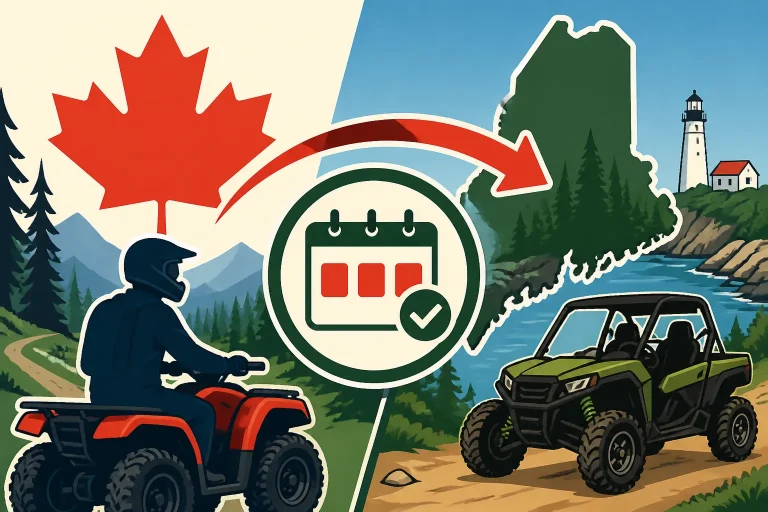
Finally, a Maine registration is not a universal pass for riding in another state or province. Out-of-state riding can involve separate registration, trail permits, land access and insurance rules. Visitors to Maine should also confirm which registration option applies to them. Maine’s reciprocity arrangements are limited, so riders should not assume that a registration from a neighboring state is automatically accepted for every trip. Maine ATV Registration for Non-Residents explains the visitor options, and Maine’s Three-Day Non-Resident Exception covers the limited Canadian exception.
A quick check before you ride
Think of registration as one item in a larger checklist. Before leaving home or the staging area, confirm the ATV is registered for the intended use, the route is open, the land access is authorized, and the operator meets the relevant requirements. Check insurance and make sure the machine is suited to the trail or road segment you plan to use.
Keep registration documentation and purchase records accessible, but do not treat either as a substitute for permission, insurance or compliance with operating rules. If you are riding out of state, operating a UTV, or using a public-road connection, verify those requirements separately. A few minutes spent checking the details can prevent a registration that is technically current from creating a false sense of permission.
Disclaimer
This article is for general informational purposes only and does not constitute professional advice. Laws, prices and regulations vary by location and change over time. Consult a qualified professional for guidance on your specific situation.