Woodlot and Logging ATV Use in Maine
It’s a common scenario across Maine: you’ve got a piece of land, maybe a beautiful woodlot, and your ATV or UTV isn't just for ripping around on the trails. For many of us, these machines are essential workhorses, making quick work of chores that would otherwise be back-breaking. You use it to haul firewood, check on boundary lines, clear brush, or even drag out a small log. It feels like an extension of your farm or forest management equipment, and naturally, you might wonder, "Do I really need to register it if I'm just using it for work on my own property?" This guide is here to untangle the specific rules and exemptions surrounding ATV and UTV registration when your machine is dedicated to woodlot and logging tasks in Maine, helping you understand when you’re exempt and when you absolutely need to get that registration sticker.
Understanding Maine's ATV Registration Laws for Work Use
Let's start with the fundamental principle of ATV and UTV operation in Maine. Generally speaking, if you're riding an ATV or UTV in Maine, it needs to be registered with the Maine Department of Inland Fisheries and Wildlife (IF&W). This is the rule that allows the state to fund trail maintenance, law enforcement, and other programs that benefit riders. However, like many laws, there are specific nuances and exemptions, particularly when your machine is being used for practical work rather than purely recreational pursuits.
The biggest point of confusion often arises when people assume that "my land, my rules" automatically means no registration. While there's a significant exemption for private land use, it's not a blanket pass. The law is designed to ensure that any machine operating on public lands or public ways contributes to the system and is identifiable. So, if your woodlot ATV never, ever leaves your property, and your property doesn't include any public rights-of-way, then you're likely in the clear. But as we all know, property lines and access points in Maine can be incredibly complex, involving easements, shared drives, and quick hops across town roads. It's these complexities that often trip up well-meaning landowners.
Think about it: many Mainers have a woodlot that might be bisected by a small town road, or you might share a private access road with a neighbor before you even get to your own acreage. Perhaps you have an easement that crosses another property to reach a specific stand of timber. In all these common situations, you’re no longer solely on land that you own or have exclusive permission for. These are the moments when the general registration rule can suddenly apply. It's not about what you're doing with the ATV, but where you're doing it. For a deeper dive into these specifics, you might want to read [Maine ATV Registration Exemptions] and [Maine Registration Exemption on Your Own Land]. These resources can help you understand the foundational principles before we get into the nitty-gritty of farm and woodlot use.
Specific Exemptions for Farm and Woodlot ATVs
Maine law does recognize that ATVs and UTVs are valuable tools for agricultural and forestry work. This isn't just about recreational fun; it's about making a living or managing your resources. Because of this, certain specific exemptions exist that acknowledge the working nature of these machines. However, these exemptions are not open-ended and rely heavily on the primary purpose of the ATV's operation.
Let's break down what generally qualifies for these exemptions:
-
Farm Use: This typically applies to ATVs and UTVs used on a legitimate farm operation. Imagine hauling feed to livestock, checking fences across sprawling pastures, moving tools for field maintenance, or inspecting crops. The key here is that the machine is directly supporting an active agricultural enterprise. It's about efficiency and necessity for the farm's daily functions. If you're using your UTV to bring hay bales from one barn to another, or to check on the health of your blueberry bushes, that's almost certainly covered under farm use, as long as it's exclusively on your private farmland.
-
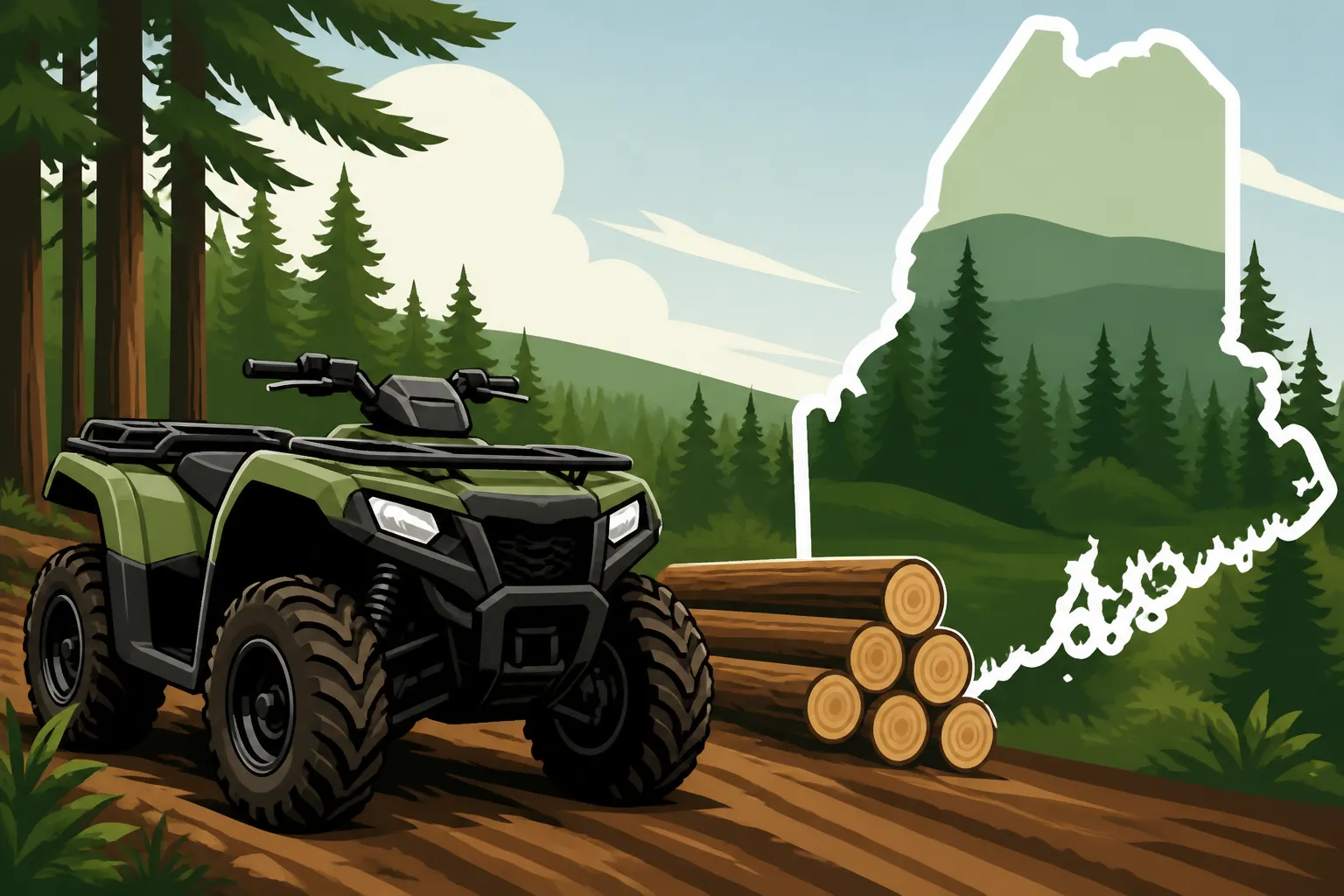
Woodlot and Logging Use: This exemption is tailored for those who manage timber resources, whether it's for personal firewood, small-scale logging operations, or ongoing forest management. Picture yourself hauling firewood out of the back forty for your own home heating, clearing storm-damaged trees, or pulling small logs to a landing. Perhaps you're using it to scout timber stands, mark trees, or move tools for building or maintaining logging roads on your property. This is where the ATV truly acts as a utility vehicle. The intention here is to facilitate the work of managing and harvesting timber, not to go joyriding.
The crucial distinction for both farm and woodlot exemptions is that the operation must be solely for these purposes and solely on land that you own or land on which you have explicit permission to conduct these activities. The moment your "woodlot ATV" crosses a public road, even briefly, or enters land that's part of the public trail system, the exemption often evaporates. It's not the machine itself that defines the exemption, but the combination of its purpose and its location of use. We're talking about legitimate work here, not an excuse to avoid registration while heading to your favorite fishing spot. For more clarity on specific situations, consider researching [Farm ATV Exemptions From Maine Registration] and Woodlot and Logging ATV Use in Maine.
It's also worth noting that "logging use" can sometimes blur with "commercial use." If you're running a full-fledged logging company and using your fleet of UTVs to transport timber for sale off-site, particularly if you're doing this on land you don't own, you might actually be looking at requirements for [Commercial ATV Registration in Maine]. The scale and intent matter significantly.
When Your Woodlot ATV Needs to Be Registered
This is where many Maine landowners find themselves caught off guard. You might be diligently using your ATV for woodlot work, believing you're fully exempt, only to encounter a situation that suddenly requires registration. The truth is, the line between exempt work use and registrable use can be surprisingly thin, often just a few feet wide.
Here are the most common scenarios where your work-focused ATV or UTV will need to be registered, regardless of its primary purpose:
-
Crossing a Public Way: This is perhaps the most frequent pitfall. Even if your property is large and your primary use is on your own land, if you need to cross any public road—be it a paved state route, a town-maintained gravel road, or even a public easement—to get from one section of your woodlot to another, your ATV needs to be registered. A "public way" doesn't just mean a highway; it can be any road or street maintained by a municipality or the state. That quick hop across the town line to access the back forty? Yes, that requires registration. The state has specific rules about how you can even do this, often limiting it to 500 yards or less, and requiring a complete stop before entering. For details, see [Maine's 500-Yard Limit on a Public Way] and [Riding an ATV on the Road in Maine].
-
Using Shared Private Roads or Easements That Are Also Publicly Accessible: Maine has many private roads that are either maintained by associations or have informal public access, or are even signed as official ATV access routes. If the private road you're using to reach your woodlot also serves as part of a public ATV trail system, or if it's generally open to recreational use by the public (even if it's technically private), you'll likely need to register your machine. The "private land" exemption only applies when the land is not open to the public for recreational ATV use.
-
Transporting Timber Off-Site for Sale: If you're not just moving firewood for your personal use but engaging in commercial logging where you're transporting timber or wood products off your property to a buyer or mill, and this involves using public roads or trails, your ATV transitions from a personal woodlot tool to a commercial vehicle. This almost always necessitates registration. While the purpose is work, the context becomes commercial public use.
-
Riding on Designated Public ATV Trails, Even for Work: Sometimes, a public ATV trail might cross or run adjacent to your woodlot. If you decide to use this trail, even if it's just to get to a specific cutting area or to haul materials, you must have your ATV registered. The trail is designated for public recreational use, and all machines on it are expected to be registered.
-
Using Your ATV for Commercial Logging Operations on Other People's Land: This is a clear-cut case. If you're hired to log a neighbor's property or a commercial forestland parcel, and you're using your ATV as part of that operation, it falls under commercial use. Unless all operations are confined to private land without any public access, registration will be required.
The takeaway here is simple: if your ATV or UTV so much as touches a public way, or any land that isn't exclusively private and under your control (or explicit permission for your private work use), you need to register it. The fines for riding an unregistered ATV can be significant, so it's always better to err on the side of caution. If you're unsure, registering it is the safest bet to avoid [Penalties for Riding an Unregistered ATV in Maine].
Practical Considerations and Documentation for Woodlot ATV Use
Even when you believe your ATV is exempt due to farm or woodlot use, it's wise to always be prepared. Wardens and law enforcement officers are tasked with enforcing the registration laws, and they often encounter individuals who think they're exempt but aren't. Being able to quickly and clearly demonstrate your compliance or exemption can save you a lot of hassle.
Here are some practical tips and documentation considerations:
-
Carry Proof of Ownership and Land Ownership: If you're stopped and claim exemption based on owning the land, you should be able to prove it. This means carrying your deed, property tax bill, or a copy of your property boundaries. For the ATV itself, always have your bill of sale handy. This is proof that the machine belongs to you. Creating a clear bill of sale can be easily done using online resources like LawDepot, ensuring all necessary details are included. For tips on what to include, see [Maine ATV Bill of Sale: What to Include] and [Proof of Ownership for a Maine ATV Registration].
-
Obtain Written Permission for Other Lands: If you're operating your ATV for woodlot work on someone else's property—even a neighbor or a family member—it is absolutely crucial to have written permission. A simple, signed document stating that you have permission to use your ATV for specific purposes (like cutting firewood, clearing land, etc.) on their property can be invaluable. This not only supports your claim of exemption but also protects you from potential trespass charges. Again, a platform like LawDepot can help you generate a clear and legally sound land use agreement or permission slip. Understanding [Landowner Permission on Maine ATV Trails] and [Asking a Landowner for Permission to Ride] can guide you further.
-
Understand the "Primary Use" Test: When a warden encounters an ATV, they often try to determine its primary use. Are you hauling a chainsaw and a log arch, clearly indicating work? Or are you packed with a cooler, fishing gear, and wearing recreational riding attire? The context matters. Be prepared to explain your activities clearly and concisely. If you're genuinely engaged in woodlot management, your gear and actions should reflect that.
-
Be Aware of Grey Areas: Sometimes, the line is genuinely fuzzy. For example, using your UTV to haul hunting stands into a remote area of your property could be seen as "work" in preparing for the hunting season, which might fall under the woodlot exemption. However, if you then take the same UTV out for a day of pure recreational riding on the same property, you’re in a different category. The intent for that specific ride is what often counts. If you find yourself frequently using your machine for both work and recreation, especially if there's any chance you'll cross a public way or use shared access, registering it is the safest and least stressful option.
Here's a quick reference table to help visualize common scenarios and their registration implications:
| Scenario | Registration Typically Needed? | Explanation |
|---|---|---|
| Hauling firewood solely on your own private 50-acre woodlot. | No | Exempt if use is exclusively on private land you own, not crossing any public ways. |
| Crossing a town road to access another section of your woodlot. | Yes | Any operation on a public way, even a brief crossing, legally requires current ATV registration. |
| Hauling logs from your land to a sawmill on a publicly accessible gravel road. | Yes | Operating on a public way, even if for commercial or farm use, removes the private land exemption. |
| Using your ATV on a friend's private land (with permission) to help clear brush. | No (if entirely private) | Exempt if solely on private land with owner's explicit permission, and no public ways or public trail access points are utilized. |
| Riding on a shared private camp road that's also an official ATV trail. | Yes | If the road is part of a designated public ATV trail system, even if privately owned, registration is required. |
| Bringing a new piece of equipment to your woodlot via a public road. | Yes | Any road travel, even for the purpose of work or equipment transport, necessitates proper registration. |
| Using your UTV to check fences on your farm, which borders a public road but you stay off it. | No | As long as the operation remains exclusively on your private farmland and does not enter or cross any public ways. |
| Using your ATV on your woodlot, then loading it onto a trailer to transport to a different private woodlot. | No (for woodlot use) | The ATV itself doesn't need registration for the woodlot use. The trailer would need to be registered, and you'd need permission for the second woodlot. |
| Using an ATV for a commercial logging business on multiple private properties (not your own). | Yes (often) | While technically private land use, the commercial nature and multiple properties often mean crossing public ways or using shared access, requiring registration. |
Navigating the rules for ATVs and UTVs used for woodlot and logging in Maine can feel like walking a tightrope. The exemptions exist for a reason – to support the working backbone of our state – but they are not without their boundaries. Always think about where you are riding and for what purpose, and when in doubt, getting your machine registered is the safest way to ensure you can continue your important work without unnecessary fines or legal headaches.
Disclaimer
This article is for general informational purposes only and does not constitute professional advice. Laws, prices and regulations vary by location and change over time. Consult a qualified professional for guidance on your specific situation.