Farm ATV Exemptions From Maine Registration
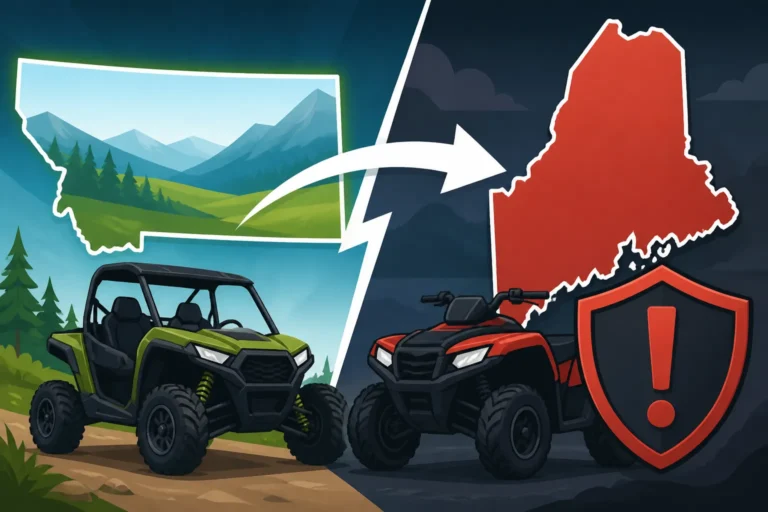
It’s a common scenario in rural Maine: you've got an ATV or UTV, and it's not just for weekend trail rides – it's a vital piece of equipment for getting work done around the farm or woodlot. Many folks naturally assume that if a machine is strictly used for agricultural purposes on their own property, it might be exempt from the usual registration requirements. While there are indeed specific exemptions in Maine law, navigating them can be a bit trickier than you might expect, leading to frustration and sometimes even a hefty fine if you get it wrong. This guide will help you understand the nuances of Maine's farm ATV exemptions, clarify what's allowed and what's not, and help you stay on the right side of the law while keeping your farm operations running smoothly.
Understanding Maine's ATV Registration Exemptions for Farm Use
Maine law does provide some specific carve-outs for ATVs and UTVs used in agricultural settings, but these aren't a blanket pass for every kind of farm-related activity. The core of the exemption hinges on where and how the machine is being operated, emphasizing use on your own land or in very specific, limited ways related to farming or forestry. It's designed to acknowledge that these machines are tools for many rural Mainers, not just recreational vehicles.
The "Own Land" Exemption for Agricultural Work
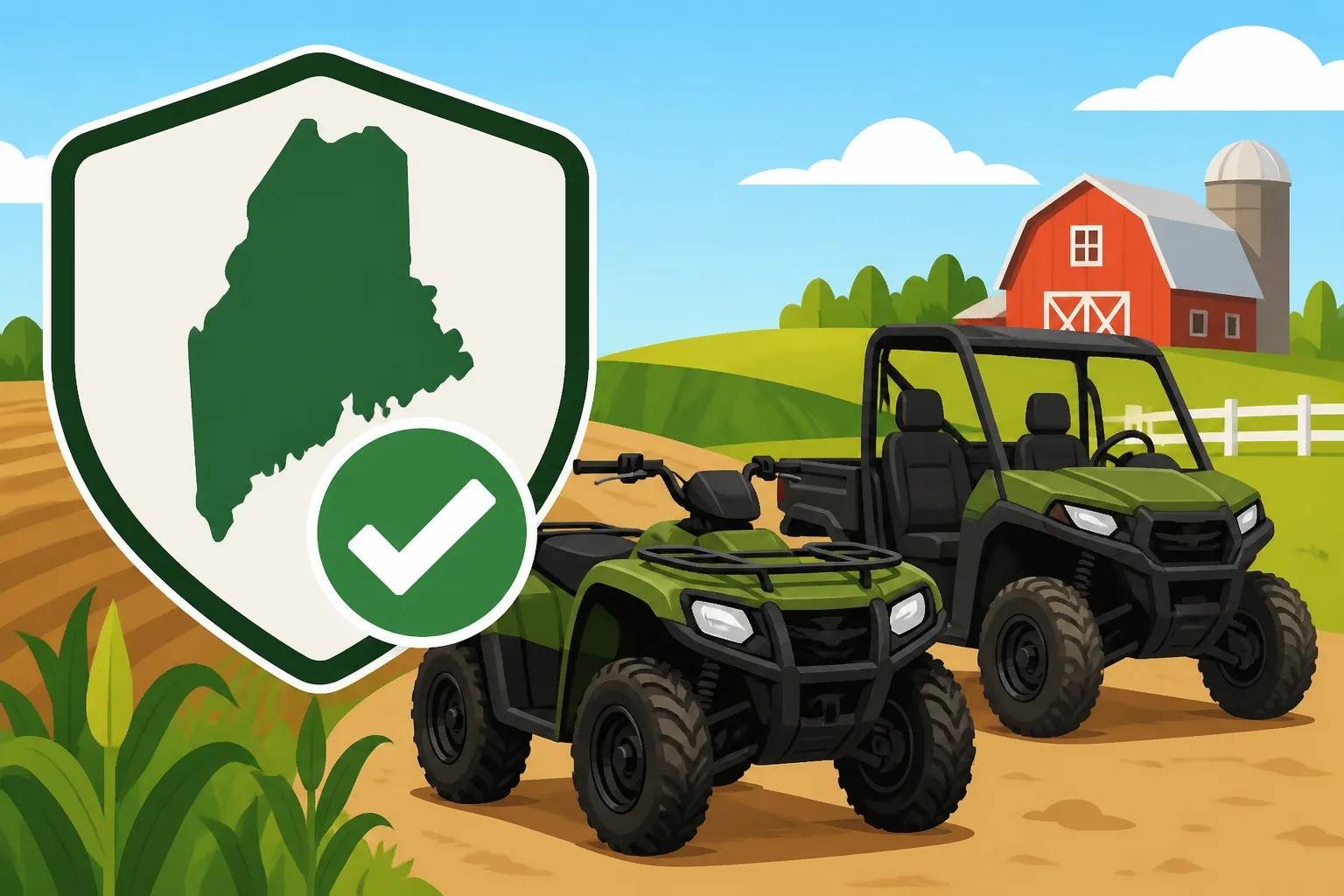
The most straightforward exemption applies when you're operating your ATV or UTV exclusively on land you own, lease, or have permission to use, and you're engaged in bona fide agricultural or forestry activities. Think about it: if you're driving your side-by-side to check on your cattle in a back pasture, hauling firewood from your woodlot to the sugar shack, or spreading fertilizer across your fields, and all of this is happening entirely on your own private property, Maine generally doesn't require that machine to be registered. The key here is "on your own land." This is where a lot of confusion can arise, because the moment you step off your private parcel, even if it's just to cross a small town road to another part of your property, the rules change dramatically. This exemption is really about internal farm logistics.
Imagine Farmer John in Aroostook County. He uses his ATV to check potato rows, move irrigation pipes, and scout for deer damage on his sprawling fields. All of this is confined to his family's farm property. In this context, his ATV doesn't need to be registered. However, if he needed to take that same ATV down the road, even for a short distance, to pick up a part from a neighbor or access a different, non-contiguous parcel of his land, he would likely need to be registered or be subject to specific road crossing rules. This is why many farmers choose to register their machines anyway, just to cover all their bases and avoid potential headaches. You can find more details in [Maine ATV Registration for Farm and Woodlot Use].
Limited Road Crossings for Farm Purposes
While the "on your own land" rule is pretty strict, Maine law does allow for extremely limited interaction with public ways for agricultural purposes, even if your ATV isn't registered. This is a very narrow exception, though, and it's critical to understand its precise boundaries. An unregistered ATV may be operated on a public way only for the purpose of crossing from one portion of the operator's property to another, provided the crossing is made at approximately a 90-degree angle to the public way and at a place where no undue hazard is created. You must yield to all vehicular and pedestrian traffic. This isn't permission to ride along the road for any distance, even if you're trying to get from one field to another that's just a stone's throw away. It's a quick, direct cross, and that's it. Any deviation from this narrow definition can lead to a citation for operating an unregistered ATV on a public way.
Consider a farmer who has a field on either side of a quiet country lane. To move his ATV from the north field to the south field for plowing, he can make a direct, perpendicular crossing. He must stop, look both ways, and ensure no traffic is coming before proceeding. He can't, however, ride for 100 feet down the road to get to a gate on the other side. That 100-foot ride would require a registered machine and adherence to specific ATV-access route rules. The temptation to bend this rule can be strong when you're busy with farm work, but the penalties for doing so can quickly outweigh the convenience.
The Nuance of Woodlot and Commercial Use Exemptions
Similar to agricultural use, machines primarily used for logging or other forestry operations on private land also fall under a comparable exemption. If you're using your UTV to scout timber, pull small logs, or transport tools within your own private woodlot, and you're not traversing public ways beyond direct crossings, registration isn't required for that specific use. However, if you start doing commercial logging, where your ATV or UTV is consistently used off your property, or if you're hauling wood for sale beyond your own land, the commercial nature of the operation might bring you out of the exemption. It really depends on the scale and scope of the activity.
For a small landowner in Washington County who occasionally cuts firewood for personal use on their own 20-acre parcel, the exemption likely applies. They might use their ATV to drag out small logs. However, if that same landowner starts a small logging business and begins using their ATV to transport equipment between different clients' properties, traveling on public roads in the process, they would almost certainly need to register that machine. The line can feel blurry, so it's always safer to err on the side of caution or consult with the Maine Department of Inland Fisheries and Wildlife (IF&W) if you're unsure.
What's NOT Covered by the Farm Exemption
It's just as important to understand what the farm ATV exemption doesn't cover, because this is where many riders get into trouble. The spirit of the law is to allow working machines to operate unencumbered on private land, not to provide a loophole for general recreation or convenience. Misinterpreting these limitations can lead to fines, inconvenience, and potential legal issues.
Recreational Riding, Even on Farm Land
This is probably the biggest misconception. Just because you live on a farm doesn't mean your ATV is automatically exempt from registration when you're using it for fun. If you finish your chores and decide to take your kids for a spin around the back forty, or you go out looking for deer sign in the woods behind your barn, that's generally considered recreational use. And recreational use, even on your own land, typically requires registration unless your property is explicitly designated for such use and meets specific criteria for a [Maine Registration Exemption on Your Own Land].
Let's revisit Farmer John. While he can use his ATV to check potato rows without registration, if his son takes the same ATV out on Sunday afternoon to ride trails through the woods on the farm for enjoyment, that ATV should ideally be registered. The purpose of the ride changes everything. The law is concerned with the intent and nature of the operation. This distinction is crucial, and it’s where many rural residents often unknowingly fall afoul of the regulations.
Riding on Public Ways (Beyond a Direct Crossing)
As mentioned, direct, perpendicular crossings of a public way for agricultural purposes are narrowly permitted without registration. However, any operation along a public way, no matter how short the distance, immediately voids the exemption. This includes riding in the ditch, on the shoulder, or even just parallel to the road on what might seem like private land but is actually within the public right-of-way. Maine's laws around ATV access on public roads are very specific, generally requiring a registered machine and often a designated ATV-access route.
Imagine a farmer who needs to move his ATV from one barn to another, and the easiest route involves riding down a quarter-mile stretch of a dirt town road. Even though it's a dirt road, and even though it's directly related to his farm operations, that quarter-mile ride would require the ATV to be registered. He cannot rely on the farm exemption for that distance. This is a scenario where the convenience of a short road ride can quickly turn into a fine for an unregistered machine, plus potential penalties for illegal operation on a public way.
Using the ATV for Non-Agricultural Tasks or Personal Errands
The exemption is tied specifically to agricultural and forestry work. If you use your ATV to drive to the mailbox at the end of your driveway, or to visit a neighbor for a non-farm related chat, or to run into the nearest village for a gallon of milk, that machine needs to be registered. These are not agricultural purposes. The machine may be on a farm, but its use isn't for the farm in these instances.
Think of it this way: your farm truck is registered, insured, and inspected, even though you might use it primarily for hauling feed and equipment. Why? Because sometimes you take it to town for groceries. The same logic applies to ATVs. If there's any chance you'll use it for something beyond strictly agricultural/forestry work on your private land, or if it will touch a public way for more than a quick, direct crossing, getting it registered is the safest and simplest approach.
Practical Considerations and Risks of Relying on Exemptions
While exemptions offer some relief, relying solely on them can introduce a set of practical challenges and risks that many farmers overlook. It's not just about avoiding a registration fee; it's about understanding the bigger picture of legal compliance, safety, and liability.
Warden Stops and Proving Exemption
Maine Game Wardens are out on the trails and roads, and they enforce ATV laws rigorously. If you're stopped on a public way, even for a quick crossing, or if you're spotted on what appears to be public land without a registration, you will need to articulate and prove your exemption. This isn't always straightforward. You might need to demonstrate proof of ownership, explain the specific agricultural task you're performing, and show that you're operating within the narrow bounds of the law. If you're on your own land but a warden has reason to believe you're using it recreationally, you could still be questioned.
Imagine a warden observing an unregistered ATV crossing a public road. Their first assumption might be illegal operation. You, as the operator, then have the responsibility to explain that you are moving from one part of your farm to another, at a 90-degree angle, and for a legitimate agricultural purpose. Having your farm registration or land deed handy, or at least being able to articulate the specific parcel boundaries, can be helpful. However, the burden of proof is often on the operator, and it can be a stressful encounter if you're not prepared or if your use case doesn't perfectly fit the narrow legal definition. The penalties for an unregistered ATV can be significant, as detailed in [Penalties for Riding an Unregistered ATV in Maine].
Liability and Insurance Concerns
This is a huge one. Even if your ATV is legally exempt from registration for certain farm uses, that doesn't necessarily mean it's exempt from liability or insurance requirements. If you're involved in an accident while operating an unregistered, uninsured ATV, even on your own property, the financial and legal consequences could be devastating. Your homeowner's insurance might offer some limited coverage, but it's often insufficient for ATV-related incidents, especially if someone else is injured or significant property damage occurs.
For example, if you're operating an unregistered farm ATV, legally, on your own property, and you accidentally hit a visitor, or cause damage to a neighbor's fence while working near a property line, your lack of specific ATV liability insurance could leave you personally exposed. A registered ATV, on the other hand, often comes with some level of basic liability coverage as part of the package or at least makes it easier to obtain specific [Maine ATV Insurance and When You Need It]. Even if Maine doesn't explicitly require insurance for all ATVs, it's a critical safety net that many choose to have, registered or not. When you consider the cost of potential lawsuits or medical bills, a small registration fee and insurance premium can look like a bargain.
The "What If" Scenarios and Ease of Mind
Life on a farm is unpredictable. What if you need to quickly transport a sick animal to a vet, and the fastest route involves a short ride down a public way? What if a fire breaks out on a distant part of your property, and you need to get there fast, crossing a small section of town-owned land in the process? In these emergent situations, you don't want to be second-guessing whether your ATV is legally compliant. Having your machine registered provides a significant layer of flexibility and peace of mind.
Many farmers choose to register their machines simply because the slight annual cost is far outweighed by the freedom it provides. It means they can ride to a neighbor's farm for help, access public ATV trails that might border their property, or even run a quick errand to the general store without worrying about legal ramifications. If you think there's any chance your ATV will leave your private property beyond the very strict crossing rules, or be used for anything beyond core agricultural work, registration is a prudent decision.
Ensuring Compliance: When to Register and How to Do It
Given the narrow scope of exemptions and the potential risks, many farm and woodlot owners ultimately decide that registering their ATV or UTV is the safest and most practical course of action. It provides flexibility and reduces the chances of misunderstandings with law enforcement or insurance companies.
When Registration is Your Best Bet
If any of these situations describe your anticipated use, registration is highly recommended:
- Mixed Use: You use your ATV for farm work and for recreational riding, even if it's mostly on your own land.
- Public Way Travel: You need to operate your ATV along any public way, even for short distances, or for more than a direct, perpendicular crossing.
- Accessing Different Parcels: Your farm or woodlot consists of non-contiguous parcels separated by public roads, and you frequently need to travel between them by ATV.
- Off-Property Work: You occasionally use your ATV for work on land you don't own (e.g., helping a neighbor, commercial services) that involves traveling on public roads or trails.
- Peace of Mind: You simply want the flexibility to use your machine without constantly worrying about whether you're breaking a specific rule.
It’s often easier to just register the machine once a year and be done with it, rather than constantly trying to parse legal definitions in the field.
The Registration Process for Farm ATVs
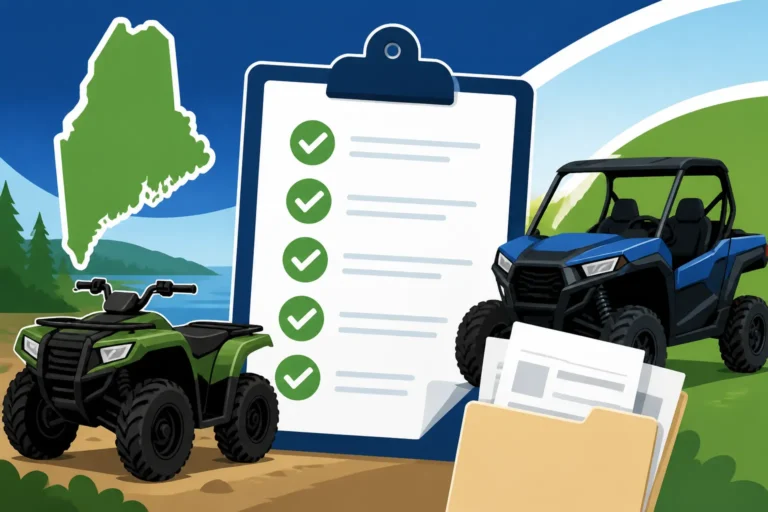
Registering an ATV or UTV in Maine is a fairly straightforward process, whether you're a resident or non-resident. You can do it online through the Maine Department of Inland Fisheries and Wildlife (IF&W) website, or in person at many town offices or authorized registration agents.
- Proof of Ownership: You'll need to demonstrate you own the machine. This usually means a bill of sale, a previous registration, or a certificate of origin for a new machine. Make sure your bill of sale is thorough. Services like LawDepot can help you generate comprehensive forms for private sales to ensure all necessary details are included, which can be useful when you need [Proof of Ownership for a Maine ATV Registration].
- Payment: There's an annual fee for registration. The specific cost depends on whether you're a resident or non-resident, and it's always best to check the current figures on the IF&W website or with your local town office. You can find more information about [Maine Resident ATV Registration Fee] or [Maine Non-Resident Annual ATV Registration].
- Sales Tax (if applicable): If you've recently purchased the ATV, you might need to pay Maine sales tax or use tax at the time of registration, especially if it was a private sale or an out-of-state purchase. See [Maine Sales Tax on an ATV Purchase] for more details.
- Decals and Card: Once registered, you'll receive a registration card and a decal (sticker) that needs to be affixed to your ATV. Keep your registration card with you while riding. Instructions on [Where Maine ATV Stickers Go and When They Arrive] can guide you.
Remember, even if your machine qualifies for an exemption for some farm uses, if you plan to ever ride on designated ATV trails, attend organized rides, or cross public roads regularly, that registration is essential. It's an investment in both your legal compliance and your enjoyment of Maine's vast trail network. Don't forget to keep your physical registration paperwork with you when you ride, as [Maine Warden Stops and ATV Paperwork] are common, especially in high-use areas.
Disclaimer
This article is for general informational purposes only and does not constitute professional advice. Laws, prices and regulations vary by location and change over time. Consult a qualified professional for guidance on your specific situation.