Maine ATV Purchase Paperwork Checklist
Buying an ATV or UTV in Maine can feel like a thrilling adventure waiting to happen, but the excitement can quickly turn to a nagging worry when you start thinking about all the paperwork. Many folks get caught up in the thrill of finding the perfect machine and overlook the critical steps needed to ensure a smooth, legal transfer of ownership. This guide is here to walk you through every piece of paperwork you'll need, whether you're buying new from a dealer or finding a gem from a private seller, ensuring you can hit the trails with peace of mind.
Why Paperwork is Your Best Friend When Buying a Maine ATV
Let's be real, nobody enjoys paperwork. It often feels like a necessary evil, a hurdle between you and the open trail. But when it comes to purchasing an ATV or UTV in Maine, having the right documents isn't just about following the law; it's about protecting yourself as a buyer and ensuring you can actually register your machine and legally enjoy it. Without proper documentation, you could find yourself with a shiny new quad that you can't register, can't ride, and can't prove you own. That's a headache no one needs.
Establishing Clear Ownership
One of the biggest reasons to be diligent about paperwork is to establish a clear chain of ownership. Imagine buying an ATV only to find out later that it was stolen, or that the seller didn't actually have the legal right to sell it. It sounds like a far-fetched scenario, but it happens. Proper documentation, like a solid bill of sale and proof of previous ownership, creates a legal record that protects you from these unfortunate situations. It's your legal shield, proving that you are the rightful owner. Without it, you could face immense frustration, potential legal battles, and the loss of your investment. This is especially true for older machines where the paper trail might be a bit murkier.
Meeting Maine's Registration Requirements
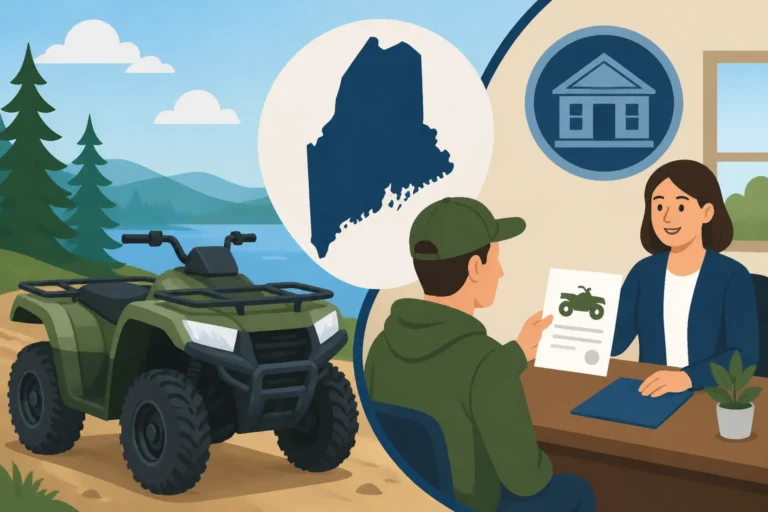
Before you can even think about hitting those beautiful Maine trails, your ATV or UTV needs to be registered with the Maine Department of Inland Fisheries & Wildlife (IF&W). And guess what? They're going to ask for paperwork. A lot of it. Without the correct forms and proofs, your registration application will be denied, leaving your machine sitting idle. Whether it's showing [Proof of Ownership for a Maine ATV Registration] or providing a bill of sale, each document serves a specific purpose in the registration process. Trying to register a machine without the proper paperwork is like trying to start a campfire without a spark – you'll get nowhere fast and just end up frustrated.
Navigating Sales and Use Tax in Maine
Ah, taxes. Another delightful piece of the puzzle. Maine has specific sales and use tax laws that apply to ATV and UTV purchases, whether you buy from a dealer or a private individual. The paperwork you receive at the time of purchase is crucial for accurately calculating and paying these taxes. Forgetting this step can lead to penalties down the road. When you register your ATV, the state will often require proof that sales tax has been paid, or they'll assess the "use tax" if you brought the machine in from out of state or bought it privately without sales tax collected. Understanding [Maine Sales Tax on an ATV Purchase] is vital, and the purchase paperwork is your foundation for getting it right.
Essential Paperwork for a New ATV or UTV from a Dealer
Buying a new ATV or UTV from a licensed dealer in Maine often feels simpler because the dealer typically handles a lot of the heavy lifting when it comes to paperwork. However, it's still your responsibility to understand what you should receive and what you need to keep safe. Don't just sign everything put in front of you; read it, understand it, and make sure you get copies.
The Sales Agreement or Purchase Contract
This is the foundational document for any new purchase. It outlines all the terms of the sale: the ATV's make, model, VIN (Vehicle Identification Number), sale price, any trade-in value, financing details, and any accessories included. This document legally binds both you and the dealer to the agreed-upon transaction. It's not just a receipt; it's a comprehensive agreement that details every aspect of your purchase. Keep this in a safe place, as it will be your primary proof of purchase. Make sure the VIN on the agreement matches the VIN on the actual machine exactly. A discrepancy here can lead to major headaches later on when you go to register.
Manufacturer's Certificate of Origin (MCO)
For a brand-new ATV or UTV, the Manufacturer's Certificate of Origin (MCO), sometimes called an MSO (Manufacturer's Statement of Origin), is the closest thing you'll get to a title. Since Maine does not title ATVs, this document is incredibly important. The MCO is issued by the manufacturer and certifies that the machine is new and has not been previously registered. When you purchase from a dealer, they will typically transfer the MCO to your name. This is your definitive proof of new ownership and is absolutely essential for your [First-Time Maine ATV Registration at the Town Office]. Without an MCO for a new machine, you simply can't register it in Maine. Double-check that your name and address are correct on the MCO before you leave the dealership.
Sales Tax Form
When you buy from a licensed dealer, they are generally required to collect Maine sales tax at the time of purchase. They should provide you with a sales tax form or a clear line item on your sales agreement that shows the amount of sales tax collected. This serves as proof that you've fulfilled your tax obligation for the purchase. When you go to register your machine, the town office or IF&W will ask to see this. If the tax isn't clearly documented, you might find yourself having to pay it again, or at least proving you already did. Always ask for a separate receipt or a clearly marked section on your purchase contract detailing the sales tax payment.
Odometer Disclosure Statement (for UTVs)
While less common for traditional ATVs, if you're purchasing a UTV that might be used on limited public ways in Maine or has an odometer, you might receive an odometer disclosure statement. This document certifies the mileage on the machine at the time of sale. Even if your UTV isn't intended for road use, it's good practice to have this if it's provided, as it adds another layer of documentation regarding the machine's condition at the time of purchase. It's more of a consumer protection measure but can be helpful for establishing the machine's history.
Crucial Documents for Buying a Used ATV or UTV from a Private Seller
Buying privately can often net you a great deal, but it also means you are responsible for ensuring all the paperwork is in order. There's no dealer to guide you, so you need to be extra vigilant. This is where most people encounter problems, and where proper preparation is key to avoiding future headaches. Knowing what to ask for upfront can save you a world of trouble.
Bill of Sale
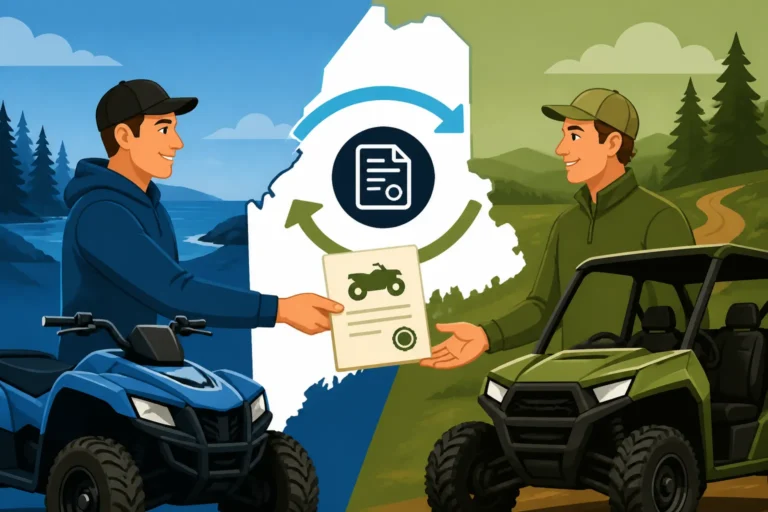
This is, without a doubt, the most important document when buying a used ATV or UTV from a private seller. A well-drafted bill of sale is your legal proof of purchase and a record of the transaction. It should include:
- Date of Sale: The exact date the transaction took place.
- Buyer and Seller Information: Full names, addresses, and contact information for both parties.
- ATV/UTV Details: Make, model, year, color, and most importantly, the VIN. Double-check that the VIN on the document matches the machine itself.
- Purchase Price: The agreed-upon price in dollars. Even if it's a gift, you should put a nominal value (e.g., $1.00) for transfer purposes.
- Condition of Sale: Often, private sales are "as-is," but it's good to have this stated.
- Signatures: Both the buyer and seller should sign and date the bill of sale.
Many people wonder about the specifics of what to include; our guide on [Maine ATV Bill of Sale: What to Include] goes into even more detail. You can find free templates online from reputable sources, or use services like LawDepot to generate a legally sound document specific to your needs. Having a clear, comprehensive bill of sale protects both parties and is essential for future registration. Without it, you might struggle to prove ownership.
Previous Registration Certificate
Since Maine doesn't title ATVs, the previous owner's registration certificate is typically their proof of ownership. You should absolutely ask the seller for this. Seeing the previous registration helps confirm that the person selling you the machine is indeed the rightful owner. It provides a chain of custody and helps verify that the VIN on the machine matches the VIN on the registration, reducing the risk of buying a stolen vehicle. The IF&W also wants to see this when you go to register the machine in your name, linking your purchase back to the last registered owner. If the seller can't produce a previous registration, or if the name on the registration doesn't match the seller's ID, that should be a major red flag.
Proof of Sales Tax Payment (if applicable) or Use Tax Form
When you buy a used ATV or UTV from a private seller, it's unlikely that sales tax was collected directly by the seller. Instead, you, as the buyer, are responsible for paying Maine's "use tax" on the purchase price when you register the machine. The bill of sale will be crucial here to establish the purchase price for tax calculation. If, by some chance, the private seller did collect sales tax (perhaps they are acting as a dealer without a license, which is a red flag), ensure you get a receipt for that. Otherwise, be prepared to pay the use tax at your town office when you register. Understanding [Use Tax When You Bring an ATV Into Maine] is important for private sale purchases.
Photos of the ATV and VIN
While not "paperwork" in the traditional sense, taking clear photos of the ATV from multiple angles, especially close-ups of the VIN plate and any unique features, is incredibly smart. These photos can serve as additional proof of the machine's condition at the time of sale and can be invaluable if there's ever a dispute or if you need to prove the identity of the machine for insurance or law enforcement. This is particularly helpful when buying something older or with a less clear history. The VIN is usually stamped on the frame; knowing [Where the VIN Is Stamped on a Quad] can help you find and photograph it.
Other Supporting Documents (Manuals, Service Records)
While not strictly required for registration, any service records, owner's manuals, or original purchase receipts the seller has can add value and peace of mind. Service records can give you insight into the machine's maintenance history, indicating whether it's been well-cared for or neglected. An owner's manual is invaluable for understanding operation, maintenance schedules, and troubleshooting. These documents might not be legally binding, but they contribute significantly to the overall value and transparency of the transaction.
What to Do If Paperwork is Missing
Sometimes, you find a great deal on an ATV or UTV, but the seller has lost some of the paperwork. This is a tricky situation, and it requires careful handling. While it's not impossible to register a machine with missing documents, it will definitely make the process more challenging and requires extra steps from you. Always weigh the "deal" against the potential for a bureaucratic nightmare.
Lost Bill of Sale
If the seller has lost the original bill of sale, the simplest solution is to create a new one. Use a template (LawDepot or a similar service can help with this) and ensure all the necessary details are included, as outlined above. Both you and the seller should sign and date this new bill of sale. If the original sale was many years ago and you are the second private buyer, you may need to rely on the seller's previous registration and have them sign a new bill of sale directly to you. This might also be the time to consider a notarized bill of sale, adding an extra layer of legal verification, though it's not strictly required in Maine.
Missing Previous Registration
This is a more significant hurdle. If the seller doesn't have the previous registration certificate, it can be tough to prove a clear chain of ownership. In Maine, without a title, the registration acts as that crucial link. You might need to ask the seller to apply for a duplicate registration from IF&W or contact their town office where it was last registered. Sometimes, a sworn affidavit of ownership, detailing how they came to possess the machine and why the registration is missing, might be accepted by IF&W, but this is a less common route and often requires additional scrutiny. Our guide on [Maine ATV Registration for a Machine Without Paperwork] delves deeper into these specific challenges. This scenario can definitely add time and frustration to your registration process.
No MCO for a New Machine
If you're buying a new ATV or UTV and the dealer can't produce the Manufacturer's Certificate of Origin, do not proceed with the purchase. This is a critical document for new machines, and its absence is a major red flag. It could indicate the machine isn't actually new, has had prior registration issues, or is being sold by an unlicensed entity. Walk away from that deal, as you will likely be unable to register the machine in Maine without a valid MCO.
Checklist for Your ATV/UTV Purchase Paperwork
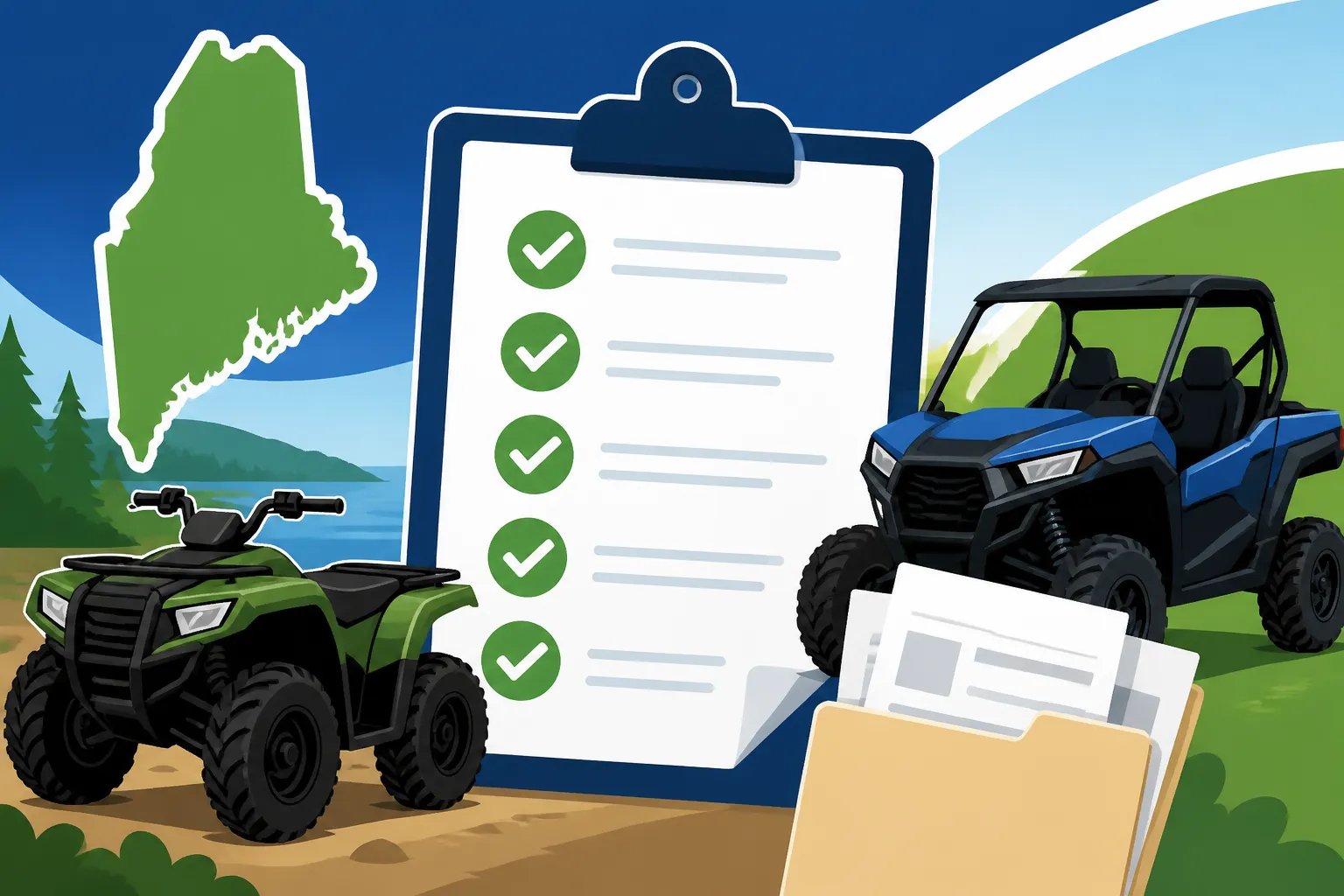
To help you keep track, here's a handy checklist you can use whether you're buying from a dealer or a private seller. Remember, the goal is a smooth purchase and hassle-free registration, so don't cut corners here!
| Document Type | New (Dealer) | Used (Private Seller) | Notes |
|---|---|---|---|
| Sales Agreement / Contract | ✅ | ❌ | Your comprehensive agreement with the dealer. |
| Manufacturer's Certificate of Origin (MCO) | ✅ | ❌ | Essential for new machines, acts as initial proof of ownership. |
| Bill of Sale | ❌ | ✅ | Absolutely crucial for private sales, details buyer/seller/machine. |
| Previous Registration | ❌ | ✅ | Verifies seller's ownership and smooth transfer for registration. |
| Sales Tax Proof / Form | ✅ | ✅ (Use Tax) | Required for registration; collected by dealer or paid as use tax. |
| Odometer Disclosure (UTV) | ✅ | ✅ | For UTVs, shows mileage at sale. |
| Photos of ATV & VIN | 👍 | ✅ | Good practice for record-keeping and condition verification. |
| Service Records / Manuals | 👍 | 👍 | Not mandatory, but good for understanding machine history. |
| VIN Verification (Pre-Purchase) | 👍 | ✅ | Highly recommended for used machines to prevent buying stolen goods. |
This table serves as a quick reference, but remember to read the comprehensive details in each section above. Being prepared with this checklist will greatly improve your buying experience and get you on the trails faster. It’s also wise to research [Pre-Purchase Inspection Before You Buy a Quad] to ensure you're not just getting the right paperwork, but also a sound machine.
Final Thoughts on Your Maine ATV Purchase
The journey to owning a new-to-you ATV or UTV in Maine is exciting, and getting the paperwork right is a crucial first step toward many memorable rides. Don't let the administrative details overshadow the joy of your purchase. By understanding what documents you need, asking the right questions, and being thorough, you'll protect your investment and ensure a smooth path to registration. Always make sure to get copies of everything for your records, and don't hesitate to use resources like LawDepot for reliable bill of sale templates. Once your paperwork is squared away, you'll be one step closer to exploring the vast and beautiful [Maine's 6,000 Miles of ATV Trails]. Happy riding!
Disclaimer
This article is for general informational purposes only and does not constitute professional advice. Laws, prices and regulations vary by location and change over time. Consult a qualified professional for guidance on your specific situation.