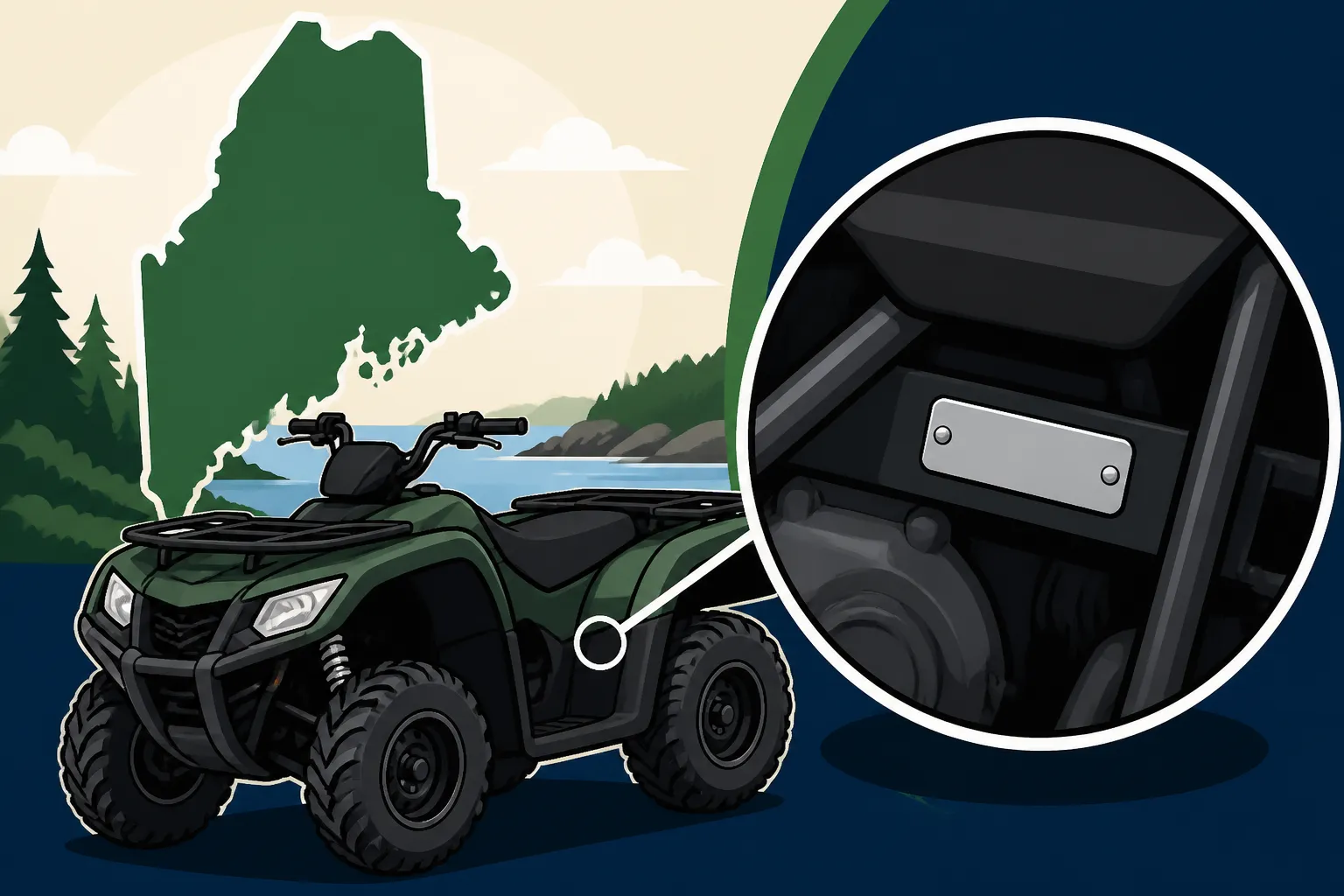
Where the VIN Is Stamped on a Quad
Trying to locate that all-important Vehicle Identification Number (VIN) on your quad can feel like a treasure hunt without a map, especially when you're scrambling to get it registered, sell it, or just confirm its identity. It's a common frustration, fumbling around in the dirt or under rusty components, wondering if you're even looking in the right place. This guide is here to walk you through exactly where to find that crucial VIN on your ATV, what its numbers mean, and what to do if it's proving elusive.
Why Your ATV's VIN is So Important in Maine
The VIN isn't just a random string of characters; it's the unique fingerprint of your ATV or UTV. In Maine, just like everywhere else, this number is fundamental to nearly every aspect of owning, operating, and transferring your machine. Without it, you're essentially dealing with a ghost vehicle, and that comes with a whole host of headaches.
The Legal Cornerstone of Ownership and Registration
For every ATV owner in Maine, the VIN is the bedrock of legal ownership. When you head down to your local town office or hop online to register your quad with the Maine Department of Inland Fisheries & Wildlife (IF&W), the VIN is the first piece of information they'll ask for. It's how the state identifies your specific machine and ties it directly to you, the registered owner. Think of it as your ATV's social security number. Without an accurate VIN, the registration process simply cannot proceed.
Beyond initial registration, the VIN is absolutely critical for proving ownership, especially when you're buying or selling a used machine. It needs to be prominently displayed on your [Maine ATV Bill of Sale: What to Include] and should match any existing registration documents or titles (though Maine doesn't title ATVs, other states might). This ensures a clean transfer of ownership and protects both the buyer and the seller from future disputes. It's the proof that the machine is indeed yours, or that you're legally transferring it to someone else. Getting your paperwork in order, perhaps through a service like LawDepot to ensure all the necessary details like the VIN are correctly included, can save you a lot of grief down the road.
A Critical Identifier for Theft, Insurance, and Safety Recalls
Unfortunately, ATV theft is a reality, and the VIN is your most powerful tool in its recovery. If your quad is ever stolen, law enforcement agencies use the VIN to identify it, track it, and return it to you. Without this unique identifier, locating a stolen ATV becomes incredibly difficult, often impossible. It's the primary piece of data entered into national databases to flag a machine as stolen. Learning [How to Check If a Used ATV Is Stolen] by cross-referencing its VIN can save you from inadvertently purchasing a hot machine.
For insurance purposes, the VIN is equally vital. When you're looking into [Maine ATV Insurance and When You Need It], your insurance provider will require the VIN to accurately identify the machine they are covering. In the event of an accident, damage, or theft claim, the VIN confirms the specific ATV involved, its make, model, and year, which directly impacts the claim process and payout. Without it, you might face significant hurdles in getting your claim processed efficiently.
Finally, the VIN plays a crucial role in safety and quality control. Manufacturers use VINs to identify specific production runs and models that might be subject to safety recalls. If a defect is discovered in a particular batch of ATVs, the manufacturer can quickly identify affected machines by their VINs and issue a recall notice to owners. This ensures that potential hazards are addressed, keeping riders safe.
Common Places to Find the VIN on Your Quad
Locating the VIN on your ATV is usually a straightforward process, but it can sometimes feel like a game of hide-and-seek, especially if the machine has seen a lot of trail time or wasn't cleaned meticulously by a previous owner. The key is knowing the usual suspects, and then being prepared to do a little searching.
The Frame: Your Primary Search Zone
For the vast majority of ATVs and UTVs, the VIN is stamped directly onto the vehicle's frame. This isn't just a sticker that can be peeled off; it's physically etched into the metal, designed to be a permanent identifier. The most common and primary spot to look is on the front part of the frame, specifically around the steering stem or head tube area. This is the strong, upright tube where your handlebars and steering column connect to the main frame. Look on the right side, left side, or directly on the front facing part of this tube.
Sometimes, the VIN might be found on the main frame rail, typically on the left-hand side of the machine as you sit on it, often near the front wheel well, a footrest, or even closer to the engine mounts. It might be low on the frame, or a bit higher up. You'll need to bend down, get a good light source, and possibly run your hand along the frame to feel for the raised or indented characters. Keep an eye out for a rectangular area where the numbers are clearly grouped. Often, it's stamped horizontally. Be prepared to wipe away dirt, mud, or even some light surface rust to reveal the numbers. A wire brush can be handy for this, but be gentle – you don't want to damage the stamping itself.
Less Obvious Spots and Manufacturer Variations
While the steering stem area is prime real estate for VINs, manufacturers do have some freedom in their placement, and some brands favor slightly different spots. Don't despair if it's not immediately obvious on the head tube.
Here are some other places to expand your search:
- Engine Block/Crankcase: While less common for the main frame VIN, some manufacturers might have a secondary identification number stamped on the engine itself. This is usually not the primary 17-character VIN you need for registration, but it's worth noting.
- Under the Seat: On some models, especially UTVs, you might find a VIN decal or a stamped number on a crossmember or structural component directly under the seat. This area is often protected from the elements, making the VIN clearer.
- Frame Cross-Members: Look for horizontal or diagonal support beams within the main frame structure, particularly in the mid-section or closer to the rear.
- Fender Wells: Sometimes, though less common, the VIN might be stamped inside a fender well, often near where the fender bolts to the frame.
It's important to remember that specific brands often have consistent (though not identical) placement. For example, knowing [Where to Find the VIN on a Polaris Sportsman] might involve looking at a slightly different spot than on a Honda Rancher or a Yamaha Grizzly. Polaris often stamps their VINs on the frame near the left front tire, sometimes requiring you to turn the wheel for better access. Honda often favors the front steering head, while Yamaha and Kawasaki might use various spots on the main frame rails or even on a sturdy crossmember. If you're really stumped, checking your owner's manual for a diagram or searching online forums specific to your ATV's make and model can provide precise guidance.
Decoding Your ATV's VIN: What the Numbers and Letters Mean
Once you've found that elusive 17-character VIN, it's not just a random jumble. This alphanumeric code contains a wealth of information about your ATV, revealing its origin, specifications, and even its exact birth year. Understanding how to decode it can be fascinating and incredibly useful.
Understanding the 17-Character Standard
Every modern ATV (manufactured from 1981 onwards) uses a standardized 17-character VIN, an international system designed to make each vehicle truly unique. This code is broken down into three main sections, each providing specific details about your machine.
-
World Manufacturer Identifier (WMI) – Characters 1-3: This first trio of characters tells you who manufactured the ATV and where.
- The first character indicates the geographical area of the world where the manufacturer is located (e.g., '1' or '4' for North America, 'J' for Japan, 'L' for China).
- The second character identifies the country within that geographical area (e.g., 'G' for USA, 'H' for Canada, 'S' for UK).
- The third character is assigned by the manufacturer itself to uniquely identify the specific manufacturer. For instance, a Polaris Sportsman VIN might start with '1H5', indicating North America, USA, and then the specific Polaris manufacturer code.
-
Vehicle Descriptor Section (VDS) – Characters 4-9: These six characters describe the general attributes of the vehicle. This section varies significantly between manufacturers, but it typically includes details about the vehicle's type, engine size, brake system, gross vehicle weight rating (if applicable), and other specific model features. For an ATV, this might tell you if it's a utility or sport model, its approximate engine displacement, and other build characteristics. There isn't a universal chart for these characters across all brands, so you'd often need the manufacturer's specific decoding guide to fully interpret this section. The ninth character in this section is the "check digit," a single digit used to verify the authenticity of the VIN and help detect fraudulent or tampered VINs.
-
Vehicle Identifier Section (VIS) – Characters 10-17: This final eight-character sequence is the unique serial number or production sequence of the vehicle. It's what makes your particular ATV distinct from every other one of the same make and model.
- The 10th character is extremely important as it indicates the model year of the vehicle. This isn't necessarily the calendar year it was built, but the model year designation given by the manufacturer. We'll dive into this more in the next section.
- The 11th character typically indicates the manufacturing plant where the vehicle was assembled.
- Characters 12-17 are the sequential production number, showing the order in which the vehicle rolled off the assembly line.
Knowing this breakdown allows you to quickly identify key facts about your ATV even without special tools.
Specifically Identifying Model Year and Production Plant
Of all the characters in the VIN, the 10th character is often the most frequently referenced, especially when discussing a used ATV. This character specifically designates the model year, which is crucial for determining value, parts compatibility, and often for registration purposes, particularly if there are age-related restrictions or classifications.
The model year codes use a repeating sequence of letters and numbers (excluding I, O, Q, U, and Z to avoid confusion with 1, 0, 2, V, and 7). This sequence typically cycles every 30 years. So, 'A' might represent 2010, 'B' might be 2011, and so on. After 'Y' (for 2000), the sequence reverted to numbers, with '1' for 2001, '2' for 2002, etc. This is a common industry standard, though it's always good to double-check against a specific manufacturer's VIN decoder if you're unsure.
Here's a simplified example of how the 10th character model year typically works, but remember this is a general guide and specific manufacturers might have slight variations, especially for older models:
| VIN 10th Character | Model Year |
|---|---|
| A | 2010 |
| B | 2011 |
| C | 2012 |
| D | 2013 |
| E | 2014 |
| F | 2015 |
| G | 2016 |
| H | 2017 |
| J | 2018 |
| K | 2019 |
| L | 2020 |
| M | 2021 |
| N | 2022 |
| P | 2023 |
| R | 2024 |
| S | 2025 |
| T | 2026 |
| V | 2027 |
| W | 2028 |
| X | 2029 |
| Y | 2030 |
By checking the 10th character, you can quickly ascertain the intended model year of your quad. For a more exhaustive list that covers older models as well, you can often find detailed charts online or in ATV owner resources. This is how you go about [Reading an ATV VIN Model Year Code].
The 11th character, which denotes the manufacturing plant, is also interesting. While perhaps not as critical for the average owner as the model year, it indicates precisely where your ATV was assembled. This can be useful for historical purposes, or if you're ever looking into specific production batches that might have had particular characteristics or issues. Again, manufacturer-specific decoders will provide the exact plant codes.
When the VIN is Missing, Damaged, or Unreadable
Encountering a VIN that's hard to read, or worse, completely missing, can be a major roadblock. This isn't just an inconvenience; it can have serious implications for your ability to legally own, register, or sell your ATV in Maine.
Dealing with a Corroded or Obscured VIN
It's common for an ATV's VIN to become obscured over time, especially if the machine is frequently ridden in muddy or salty conditions. Dirt, grime, and rust are the most frequent culprits. Before you panic, try these steps:
- Clean the Area Thoroughly: Start with a stiff brush and some degreaser or soapy water to remove accumulated dirt and mud. Many times, the VIN is perfectly intact underneath.
- Use a Wire Brush for Rust: If surface rust is the issue, a small wire brush can carefully remove it without damaging the stamped numbers. Be gentle and work slowly. You want to clear the rust from the numbers, not grind into them. Penetrating oil can also help loosen stubborn rust before brushing.
- Enhance Visibility: Once clean, try rubbing a piece of chalk or a crayon over the numbers. The chalk dust will fill the indentations, making the characters stand out against the clean metal. A flashlight held at an angle can also create shadows that highlight the stamping.
- Take Photos: Document your efforts with clear, well-lit photographs. If you still can't make out all the characters, these photos can be helpful for officials at the IF&W or your town office to assess the situation.
If, despite your best efforts, the VIN remains unreadable or only partially legible, you'll need to contact your local Maine IF&W office or consult with your town clerk. They may have specific procedures for verifying the VIN, which could involve a physical inspection by a law enforcement officer or an IF&W game warden. They understand that machines get old and dirty, and they often have protocols in place to help legitimate owners.
The Serious Implications of a Missing or Altered VIN
A completely missing VIN, or one that appears to have been tampered with (ground off, re-stamped incorrectly, or covered by a plate not from the factory), is a significant red flag. This instantly raises concerns about the machine's history and legality.
- Theft: The most immediate concern with a missing or altered VIN is that the ATV may be stolen. Criminals often try to remove or change VINs to obscure the machine's true identity, making it harder to track and return to its rightful owner. This is why it's incredibly important to exercise extreme caution if you're [Buying an ATV With a Missing VIN Plate] or from a seller who can't provide clear VIN information.
- Illegal Modifications: In some cases, a VIN might be obscured to hide illegal modifications or a machine that was pieced together from various salvaged parts without proper documentation.
- Registration Challenges: In Maine, registering an ATV with a questionable or missing VIN is going to be incredibly difficult, if not impossible. The state needs to be able to uniquely identify the machine. You'll likely face challenges trying to pursue [Maine ATV Registration for a Machine Without Paperwork] or if the VIN is not verifiable. The authorities might require extensive investigation to clear the machine's history before it can be registered.
- Legal Consequences: If you unknowingly purchase a stolen ATV with a tampered VIN, you could lose the machine without compensation if it's recovered by the police and returned to its rightful owner. In some cases, depending on the circumstances, you could even face legal scrutiny yourself.
If you encounter an ATV with a VIN that looks suspicious, do not proceed with the purchase. It's always best to err on the side of caution. If you already own such a machine and suspect tampering, contact your local law enforcement agency. They can investigate the VIN and help you determine the machine's true status. Protecting yourself with proper documentation, such as a robust bill of sale from a reputable source like LawDepot, that explicitly states VIN verification was performed, is essential in these scenarios.
Steps to Take Before You Register or Sell Your ATV in Maine
Before you embark on the journey of registering your ATV in Maine or passing it on to a new owner, there are a few crucial steps related to the VIN that can make the entire process much smoother and prevent unnecessary delays or complications.
Verifying the VIN for a Maine Registration
When you walk into a Maine town office or log onto the IF&W online registration portal, the VIN you provide will be cross-referenced with existing databases. Town clerks and IF&W agents rely heavily on accurate VINs to process registrations correctly and to ensure the machine hasn't been reported stolen or has other flags.
Here’s how to ensure your VIN is ready for registration:
- Locate and Clean: As discussed, find the physical VIN on the frame of your ATV. Clean it thoroughly so all 17 characters are clearly visible and legible. Take a clear photograph for your records.
- Match Paperwork: Compare the VIN you found on the machine to any existing documentation you have—your bill of sale, previous registration forms (if applicable), or any manufacturer's certificates. Every single character must match exactly. Discrepancies, even minor ones, will cause problems. If you're using a tool like LawDepot for your bill of sale, double-check the VIN entry before finalizing the document.
- Pre-Check if Possible: If you have any doubts about the VIN's history, you can conduct a basic VIN check through various online services (some free, some paid) to see if it's been reported stolen. This is a crucial part of [VIN Verification Before Registering in Maine], especially for a used ATV.
- Be Prepared for Questions: [What Maine Town Clerks Ask For at the Counter] often includes not just the VIN, but also questions about how you acquired the machine, so having your bill of sale and other ownership documents ready is essential. They want to ensure the machine is legitimately yours before issuing a registration.
Taking these proactive steps will save you from a frustrated trip to the town office only to be told you need to go home and re-verify your VIN.
Ensuring Accurate Paperwork for a Smooth Transaction
Whether you're the buyer or the seller, having accurate paperwork that includes the correct VIN is paramount for a smooth and legally sound transaction. This protects both parties and ensures a clear chain of ownership.
For Sellers:
- Clear VIN on Bill of Sale: When selling your ATV, make sure the VIN is clearly and accurately written on the bill of sale. This document is the legal proof that you transferred ownership of that specific machine. Using a template from a service like LawDepot can ensure all necessary fields, including the VIN, are present and properly formatted, providing a professional and legally robust document. This detail is crucial for [Maine ATV Bill of Sale: What to Include].
- Provide Any Previous Registration: If you have prior registration paperwork, share it with the buyer. This helps them confirm the VIN and establishes a history for the machine.
- Encourage Buyer Verification: Advise the buyer to physically verify the VIN on the machine against the bill of sale before finalizing the purchase. This transparency builds trust and prevents future disputes.
For Buyers:
- Physical Verification is a MUST: Never buy an ATV without physically inspecting the VIN on the machine itself. Compare it meticulously with the VIN listed on the bill of sale or any other ownership documents the seller provides. If they don't match, walk away.
- Use a Reputable Bill of Sale: Insist on a comprehensive bill of sale that includes the full VIN, make, model, year, seller's and buyer's information, and the sale price. A professionally drafted document, possibly created using an online legal document service like LawDepot, can offer significant peace of mind and legal protection.
- Check for Red Flags: Be wary if a seller seems hesitant to show you the VIN, if the VIN looks tampered with, or if they lack proper ownership documentation. These are all signs to proceed with extreme caution. This due diligence can prevent you from accidentally purchasing a stolen or problematic machine.
By putting in the effort to verify and properly document the VIN, you ensure that the registration process is a breeze and that any transfer of ownership is legally sound, protecting everyone involved in the transaction.
Disclaimer
This article is for general informational purposes only and does not constitute professional advice. Laws, prices and regulations vary by location and change over time. Consult a qualified professional for guidance on your specific situation.