Maine ATV Speed Limits Near Buildings
Navigating the beautiful Maine landscape on your ATV or UTV is a truly unique experience, but it comes with a responsibility to understand and respect the rules, especially when you're riding in areas where people live and work. Many riders, myself included, have felt that twinge of uncertainty when a trail suddenly skirts a residential area or a small village. What's the speed limit here? How close is too close? It's a common frustration, and one that the Maine Warden Service takes seriously. This guide aims to clear up the confusion surrounding Maine ATV speed limits near buildings, ensuring you can ride responsibly, safely, and without risking a citation or — perhaps even more importantly — damaging the hard-won access we all cherish.
Understanding the "Near Buildings" Rule for ATVs in Maine
It's easy to get caught up in the thrill of the ride, especially when you're out on wide-open trails. But Maine's laws make a clear distinction for how you operate your ATV or UTV when you approach structures. This isn't just about avoiding a ticket; it's about being a good neighbor and preserving the privilege of riding in a state that offers so much trail access.
The Core Law: What "Near Buildings" Actually Means
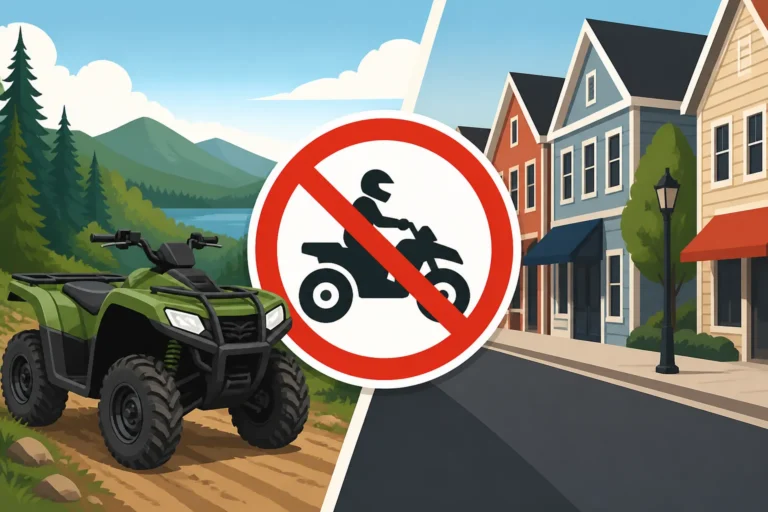
Maine law specifically addresses the operation of ATVs and UTVs near dwellings, sporting camps, and other buildings. The key here is a 200-foot buffer zone. If you find yourself operating your machine within 200 feet of any such structure, whether it's occupied or not, whether it's a private home, a camp, a store, or a public building, a specific speed limit kicks in. This rule is designed to mitigate noise, ensure safety for residents and pedestrians, and protect privacy. It applies consistently across organized and unorganized townships, so you can't assume a more remote area exempts you from the rule.
Think about it: you're out enjoying the peace and quiet of your camp, and suddenly an ATV roars by at full throttle, shaking the windows and drowning out conversation. This kind of disruption is exactly what the 200-foot rule aims to prevent. It's a common-sense regulation that helps maintain harmony between riders and property owners. Even if a building appears vacant or is a seasonal camp, the rule still holds. The onus is on the rider to be aware of their surroundings and anticipate these zones, even if there isn't a prominent sign every few yards.
The Rationale Behind Reduced Speed Zones
The existence of these reduced speed zones around buildings isn't arbitrary. It's rooted in very real concerns that impact communities and the future of ATV trail access. First and foremost, noise pollution is a significant factor. ATVs and UTVs, especially older models or those with aftermarket exhausts, can be quite loud. Traveling at high speeds amplifies this noise, carrying further and causing more disturbance to homes and businesses. Many trail systems in Maine rely heavily on the goodwill of private landowners, and excessive noise is one of the quickest ways to erode that goodwill and lead to trail closures.
Beyond noise, there's the undeniable aspect of safety. Residential and commercial areas often have more pedestrian traffic, children playing, pets, and vehicles entering and exiting driveways. Operating a heavy machine at high speeds in such proximity dramatically increases the risk of accidents. A slower speed provides more reaction time, reduces stopping distances, and generally makes for a safer environment for everyone. Finally, these zones are about respect for privacy. People's homes are their sanctuaries, and feeling like an ATV is speeding through their backyard space, kicking up dust and creating a commotion, is an invasion of that privacy. Adhering to these limits shows respect for residents and helps ensure that the ATV community continues to be seen as responsible users of the land.
Specific Speed Limits and How They Apply
Understanding the principle behind the "near buildings" rule is one thing; knowing the precise speed limits and how they manifest on the ground is another. Maine law is quite specific, and it's vital for every rider to commit these figures to memory, not just to avoid fines, but to be a responsible steward of our trails.
The 15 MPH Limit: Where and When It Applies
The core of Maine's "near buildings" rule is the 15 miles per hour (MPH) speed limit. This applies specifically when you are operating your ATV or UTV within 200 feet of any dwelling, sporting camp, or other building. This isn't a suggestion; it's a mandatory limit. This means if you're on a trail that runs parallel to someone's backyard, or if you're on a designated [Maine ATV-Access Routes and How Towns Post Them] through a small village, you must slow down. Imagine you're riding through a clearing, and suddenly, you spot a camp or a farmhouse tucked away in the trees. From that moment you realize you're within that 200-foot radius, you need to be at or below 15 MPH.
This rule holds true whether you're out in the deep woods passing a remote hunting camp or rolling through the main street of a bustling Maine town that has an approved ATV access route. It’s the rider’s responsibility to be aware and adjust. There might not be a specific sign every 200 feet, so relying on your judgment and an awareness of your surroundings is paramount. This 15 MPH limit is distinct from other speed limits you might encounter, such as the general speed limits posted on public ways, where you might be allowed to travel faster if the ATV-access route permits. However, even on a public way with a higher posted speed limit, the 15 MPH rule still applies when you're within 200 feet of a building. It's an overlay rule, always taking precedence in those specific circumstances.
Expanding Beyond the 200-Foot Rule: Town Ordinances
While the 200-foot/15 MPH rule is state law, it's also crucial to remember that individual towns in Maine have the authority to establish their own, often stricter, local ordinances regarding ATV operation. This means that what might be permissible in one town could be a violation just a few miles down the trail in another. These local rules can cover a range of aspects, including additional speed restrictions, specific hours of operation, or even outright bans on certain roads or areas within town limits.
For example, a town might designate certain roads as ATV-access routes but impose a blanket 10 MPH speed limit throughout the village center, regardless of the 200-foot rule. Or, a town might prohibit ATV operation entirely on specific public ways or near schools. The process for towns to create and enforce these rules involves local select boards or town councils, and they often consider public input, safety concerns, and potential impacts on residents. It's always a good idea to check the town's official website or even call the town office for clarification before riding in an unfamiliar area. Riders often find themselves caught off guard by these local nuances, leading to unexpected citations. Being proactive in checking local regulations is a sign of a responsible rider and can help prevent issues before they arise.
Navigating Designated ATV-Access Routes and Public Ways
Maine's extensive ATV trail network often incorporates sections of public ways and designated access routes. This can create confusion for riders about exactly which speed limits and rules apply. It’s a transition from the wilderness to more regulated areas, and knowing the difference is key.
Riding on Posted ATV-Access Routes
Many Maine towns have embraced the economic and recreational benefits of ATVs by designating certain sections of their public ways as [Maine ATV-Access Routes and How Towns Post Them]. These routes are crucial for connecting trail systems, allowing riders to access services like gas stations, restaurants, and lodging. When you're on one of these routes, you'll typically see specific signs indicating that ATVs are permitted. These signs are usually blue or green, clearly marked, and spaced appropriately to guide riders.
While riding on a designated ATV-access route, the speed limit is generally the posted speed limit for that public way, unless a specific, lower ATV speed limit is also posted. However, and this is a critical point that often trips up riders, the 15 MPH rule within 200 feet of any dwelling or building still applies, regardless of the higher posted road speed. So, if you're on a town road marked for 35 MPH, but you pass a home or business, you still need to drop your speed to 15 MPH within that 200-foot buffer. This dual application can be tricky, but it's essential for safe and legal operation. Always remember to ride on the extreme right of the traveled way, follow traffic laws, and yield to other vehicles. Being aware of the local speed limits for both ATVs and general traffic is paramount when riding these shared routes.
Crossing Public Ways and the Associated Rules
Maine law provides specific guidelines for when ATVs and UTVs need to cross a public way. This is not about riding on the public way for extended periods (which is typically limited to designated access routes or the [Maine's 500-Yard Limit on a Public Way] for direct access to trails or services), but rather about getting from one trail segment to another that's bisected by a road. The most important rule to remember is [Maine's Stop-and-Yield Rule Before a Public Way]. Before crossing any public way, you must come to a complete stop. This means truly stopping, not just slowing down, and looking both ways for traffic.
Once stopped, you must yield the right of way to all vehicular traffic on the public way. Only when it is safe to do so, and you can cross without impeding traffic, should you proceed. The crossing itself must be made at an angle of approximately 90 degrees to the public way. This is to minimize the time your machine spends on the paved surface and to make your intentions clear to other drivers. While crossing, you should maintain a reasonable, safe speed – fast enough to get across efficiently, but slow enough to be in control. The 15 MPH rule within 200 feet of buildings can still apply if there are structures immediately adjacent to the crossing point, so always be mindful of your surroundings. Remember, these crossing rules are not an invitation to ride down the road. They are strictly for direct, safe passage from one trail segment to another.
Enforcement, Penalties, and Responsible Riding
Riding an ATV in Maine is a privilege, and that privilege comes with responsibilities. When those responsibilities aren't met, the Maine Warden Service and local law enforcement are there to ensure compliance, and the penalties can be significant.
Maine Warden Service and Local Enforcement
The primary enforcers of Maine's ATV laws are the dedicated members of the Maine Warden Service. These folks patrol trails, waterways, and remote areas, often on ATVs themselves, and they are highly knowledgeable about the specific regulations governing off-road vehicle use. Local police and sheriff's departments also have the authority to enforce ATV laws within their jurisdictions, particularly in towns with designated ATV-access routes or local ordinances. They respond to complaints from residents and actively monitor areas known for violations. [Maine Warden Stops and ATV Paperwork] checks are a common occurrence, where wardens verify registration, safety certificates, and ensure all riders are following the rules.
Wardens aren't just looking for major infractions; they also pay attention to details like excessive speed near dwellings. In many cases, a stop might be prompted by a complaint from a resident who reported a noisy or fast-moving ATV near their home. [Fines Maine Wardens Write Most Often] include operating unregistered machines, not wearing helmets (for riders under 18), and indeed, speeding in restricted zones. The more complaints that come in from landowners and residents about irresponsible riding, the more likely wardens and local police are to increase their presence and enforcement in those specific areas. It’s a direct cause-and-effect relationship, highlighting why every rider's actions contribute to the overall perception and future of ATV access in Maine.
Consequences of Violating Speed Limits
The penalties for violating ATV speed limits near buildings in Maine can range from fines to more severe consequences, depending on the nature and frequency of the offense. While specific fine amounts can change and vary by the officer's discretion and local ordinances, you can expect a financial penalty for exceeding the 15 MPH limit within 200 feet of a building. These fines are often similar in scale to other minor traffic infractions. For example, while not directly related to speed, a [Fine for an Unregistered ATV in Maine] can be substantial, demonstrating the state's seriousness about ATV regulations. Repeat offenses or particularly egregious violations could lead to higher fines, and in some cases, even the loss of your right to operate an ATV for a period.
Beyond monetary penalties, there's a broader consequence for the entire riding community: the potential loss of trail access. When riders consistently disregard speed limits near homes, or create excessive noise and dust, it directly impacts [Landowner Relations on Maine ATV Trails]. Many trails cross private land, and if landowners experience recurring issues, they have every right to withdraw their permission, leading to trail closures. This not only diminishes the network for everyone but can also sour public opinion towards ATV riders in general. Furthermore, serious incidents or reckless operation can lead to other charges, such as [Maine OUI on an ATV: What Happens] if alcohol is involved, or charges related to endangerment if an accident occurs due to excessive speed in a populated area. Responsible riding is not just about avoiding a fine; it's about preserving the sport for future generations and ensuring the safety of all.
Tips for Maintaining Good Relations with Landowners and Residents
The continued success and expansion of Maine's ATV trail system depend heavily on the positive relationships between riders, landowners, and residents. Operating your machine respectfully and thoughtfully, especially near populated areas, is perhaps the most important contribution you can make to the sport.
Be a Good Neighbor: Beyond the Law
While adherence to the 15 MPH speed limit near buildings is a legal requirement, being a "good neighbor" often means going beyond the letter of the law. The spirit of the law recognizes that noise and disturbance are the main issues. For example, if you're passing a home within that 200-foot buffer, even if you're technically at 15 MPH, aggressively revving your engine or accelerating sharply can still be perceived as disruptive. Consider the time of day: an early morning or late evening ride past someone's bedroom window, even at low speed, might be more intrusive than a midday pass.
Practicing a more subdued riding style in these sensitive areas, even if it means dropping below 15 MPH or coasting a bit, shows a deeper level of respect. It's about being empathetic to the fact that people live, relax, and work in these spaces. [Landowner Relations on Maine ATV Trails] are fragile and built on trust. One negative interaction, one instance of perceived disrespect, can jeopardize access that hundreds of other riders enjoy. Take a moment to wave to residents, make eye contact, and demonstrate that you are a courteous and responsible individual. These small gestures go a long way in building positive connections and ensuring that trails remain open for everyone.
Equipment and Practices for Quieter Riding
Beyond simply slowing down, there are practical steps you can take with your ATV or UTV to minimize your impact on residences and businesses. One of the biggest culprits for noise is a poorly maintained or modified exhaust system. Ensure your machine's muffler is in good working order and that your spark arrestor is intact and functioning correctly, as required by [Spark Arrestor Requirements in Maine]. Aftermarket exhaust systems that boast increased performance often come at the cost of increased noise, and while exciting on an open trail, they can be highly disruptive in residential areas. Stick to stock or approved quiet replacements.
Regular maintenance also plays a role. A loose chain, worn bearings, or rattling components can add to the overall noise profile of your machine. Keeping your ATV or UTV in top mechanical condition, using quality parts, whether OEM or from reputable aftermarket suppliers, ensures it operates as quietly and efficiently as possible. For instance, brands like SuperATV offer a wide range of components that can help maintain your machine's performance and potentially address noise-related issues through proper fitment and quality construction. When riding in groups, try to maintain single-file formation and avoid riding abreast, which can spread out noise and dust over a wider area. Being mindful of these practices and maintaining your machine conscientiously can make a significant difference in how your presence is perceived by those living near the trails.
| Scenario | Default Speed Limit | Additional Considerations |
|---|---|---|
| Within 200 feet of any dwelling/building | 15 MPH | Applies statewide, regardless of other posted limits. Focus on minimizing noise and dust. |
| On a designated ATV-access route (public way) | Posted road speed limit (e.g., 25 MPH, 35 MPH) | BUT the 15 MPH rule applies if within 200 feet of a building. Ride on the extreme right, yield to traffic. |
| Crossing a public way | Safe, controlled speed (no specific number) | Must come to a complete stop, yield to all traffic, cross at a 90-degree angle. The 15 MPH rule may still apply if buildings are directly adjacent to the crossing. |
| On unmarked, remote trails (not near buildings or roads) | Reasonable and prudent speed | No specific limit, but depends on terrain, visibility, weather, and rider skill. Reckless operation is always illegal. |
| In a town with stricter local ordinances | As posted by local ordinance (e.g., 10 MPH) | Always check town-specific rules; these can override state defaults in certain areas. |
Disclaimer
This article is for general informational purposes only and does not constitute professional advice. Laws, prices and regulations vary by location and change over time. Consult a qualified professional for guidance on your specific situation.