Who Pays After an ATV Road Collision
Alright, let's talk about something no ATV or UTV rider ever wants to think about: what happens financially when you're involved in a collision on a public road or designated access route here in Maine. It's a terrifying scenario, and the aftermath can be a confusing mess of insurance claims, legal questions, and unexpected costs. This guide is here to help you navigate the murky waters of liability and financial responsibility if your ride ever encounters an unfortunate incident on Maine's roads.
Understanding Liability in Maine ATV Road Collisions
When an ATV or UTV gets into a fender-bender, or worse, on a paved road, dirt access route, or even crossing a public way in Maine, it’s not as simple as an ordinary car accident. Maine has specific rules, and understanding them is crucial before you even hit the trails or roads.
Maine's "At-Fault" Insurance System
Maine operates under an "at-fault" or "tort" insurance system. What does that mean for you? It means that in any collision, the person who is determined to be at fault for causing the accident is generally responsible for covering the damages and injuries of the other parties involved. This isn't like some "no-fault" states where your own insurance might cover your medical bills regardless of who caused the crash. Here in Maine, we figure out who's to blame, and that's where the financial responsibility often lands.
Determining fault isn't always straightforward. It involves looking at a lot of factors: what the police report says (and yes, they should always be called for a road collision, especially if there are injuries or significant damage), witness statements, traffic laws that might have been violated, and sometimes even accident reconstruction. If an ATV crosses a public way without yielding to traffic, for example, that's a pretty clear indicator of fault. But if a car pulls out in front of a lawfully operating ATV on a designated access route, the car driver might be at fault. This investigation process is why it’s so important to gather as much information as possible at the scene and involve law enforcement from the start.
The Role of Negligence in a Collision
Negligence is a big word that essentially means failing to act with the reasonable care that someone would use in a similar situation. In the context of an ATV road collision, negligence could be a wide range of actions or inactions. Think about it: were you speeding on a posted ATV access route? Were you distracted, perhaps looking at your GPS and not the road ahead? Was someone operating their machine under the influence? All of these could be considered negligent behaviors that could directly lead to a collision.
Let's imagine a scenario: you're riding your UTV on a designated 25 mph ATV access route, but you're actually going 35 mph. Suddenly, a car pulls out from a driveway, and you collide. Even if the car driver was also negligent by not seeing you, your speeding could be seen as contributing to the severity of the crash or your inability to avoid it. This brings us to Maine's comparative negligence rules. If you are found to be partially at fault, your ability to recover damages from the other party can be reduced. For instance, if the damages are $10,000, and you're found 20% at fault, you might only be able to recover $8,000. Crucially, if you are found to be 50% or more at fault, you generally cannot recover any damages from the other party. This is a critical point that can drastically impact who pays what in the long run.
Insurance Coverage for ATV Road Collisions
This is often the most confusing part for riders. We all know car insurance, but what about insurance for our off-road machines when they venture onto the pavement? It's not always as simple as it seems.
Standard ATV/UTV Insurance Policies in Maine
A good, robust ATV or UTV insurance policy in Maine is your first line of defense. These policies typically come with several types of coverage, similar to auto insurance:
- Liability Coverage: This is paramount. If you're found at fault for a collision, your liability coverage is what pays for the other person's bodily injuries and property damage. This could be injuries to a pedestrian, damage to another ATV, or smashing into the side of a pick-up truck. Without this, you're on the hook personally.
- Collision Coverage: This pays for damage to your own machine if you hit something, like another vehicle, a tree, or even roll your ATV. This is typically subject to a deductible, meaning you pay the first portion of the repair costs.
- Comprehensive Coverage: This helps cover non-collision related damage to your ATV, such as theft, vandalism, fire, or hitting an animal. Again, a deductible usually applies.
The critical distinction here, and where many riders get into trouble, is understanding the policy's specific terms regarding road use. Many standard ATV policies are designed primarily for off-road trail riding. If you're frequently riding on public ways, even designated ATV access routes, you absolutely need to verify with your insurance provider that your policy covers collisions that occur on these roads. Some policies might have exclusions or require specific endorsements for such use. Don't assume. A quick call to your agent could save you a world of financial pain. Ensuring your machine is properly insured and registered is a foundational step, as detailed in [What Maine Riders Need Before They Ride].
When Auto Insurance Might Come into Play
This is where things get really nuanced. Generally speaking, your personal auto insurance policy does not cover recreational vehicles like ATVs or UTVs. Auto policies are written for cars, trucks, and SUVs, not machines designed primarily for off-road use. So, if you're riding your ATV and you get into a collision, don't expect your car insurance to step in and cover damage to your quad or your injuries.
However, there can be very specific situations where an auto policy might be relevant, though usually not for the ATV operator's benefit:
- ATV Collides with a Car: If your ATV collides with a passenger vehicle, the car's insurance policy (specifically its liability coverage) would be the one to pay for damages to your ATV and your injuries if the car driver is at fault.
- Uninsured/Underinsured Motorist (UM/UIM) Coverage: This is a complex area. If you, the ATV operator, are hit by a car whose driver is at fault but doesn't have insurance (or enough insurance), your UM/UIM coverage on your personal auto policy might potentially offer some protection for your bodily injuries, though it's often challenged by insurers in an ATV context. This is highly dependent on your specific policy language and legal interpretation, and it's not a guarantee. It's really designed for collisions between insured vehicles. This is a topic to discuss in depth with an attorney or your insurance agent.
Homeowners or Renters Insurance Exclusions
For the most part, do not rely on your homeowners or renters insurance to cover an ATV collision, especially if it happens off your own property. Most standard homeowners and renters insurance policies contain a "motorized vehicle exclusion," meaning they explicitly state that they do not cover accidents involving vehicles that require registration, are used off your premises, or are designed for off-road recreation.
There might be extremely rare exceptions, such as very specific endorsements added to a policy that might cover certain property damage if an ATV accident occurs on your insured property, but these are few and far between and usually don't extend to bodily injury or property damage to others that occurs off-site. The takeaway here: homeowners insurance is for your home, not your quad, especially not when you're out riding the trails or designated routes.
Scenarios and Who Pays
Let’s get into some specific examples to make this a little clearer, because the "who pays" question really depends on the specifics of the collision.
ATV Collides with a Motor Vehicle
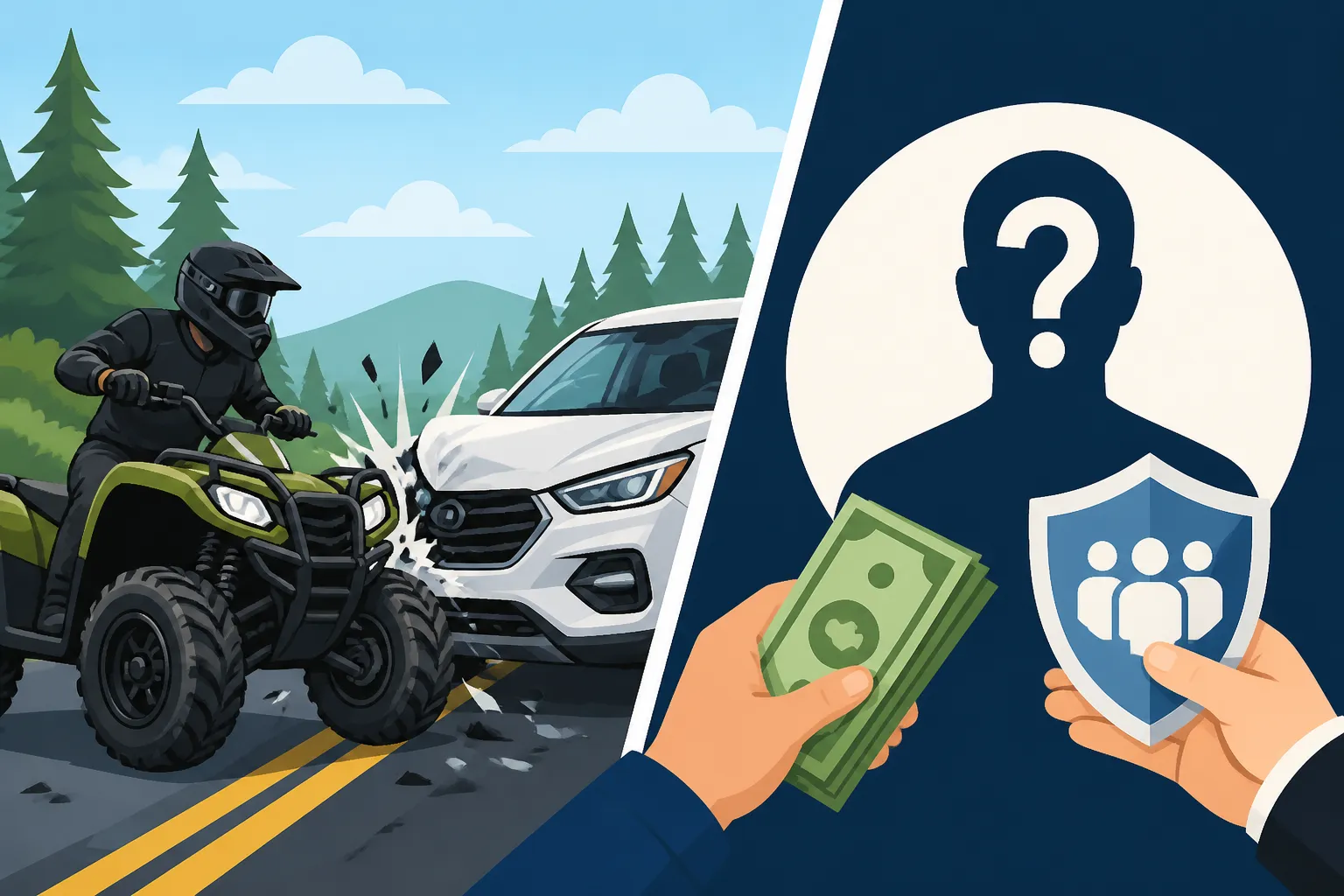
This is a common, and often very serious, type of collision. Imagine you're crossing a public road at a designated crossing point, and a car fails to yield, hitting your ATV. Or, conversely, you misjudge the speed of an oncoming car while crossing and cause the collision.
- If the ATV operator is at fault: Your ATV's liability insurance would be responsible for paying for the damages to the motor vehicle and any injuries sustained by its occupants. If you don't have adequate liability coverage, or any at all, you could be personally sued for these costs, which can quickly become astronomical. This underscores the importance of proper insurance, as outlined in discussions about [Maine ATV Insurance Cost].
- If the motor vehicle operator is at fault: The motor vehicle operator's auto liability insurance would typically pay for the damages to your ATV and your (or your passenger's) injuries. In this scenario, your own collision coverage (if you have it) could pay for the damage to your ATV, and your insurer would then seek reimbursement from the at-fault driver's insurance company (this is called subrogation). If the car driver is uninsured or underinsured, that's where your own UM/UIM coverage on your ATV policy (if you have it) might come into play for your injuries.
ATV Collides with Another ATV/UTV
Picture two friends riding their side-by-sides on a wide ATV access route. One decides to make an unexpected turn without signaling, leading to a collision with the other machine.
- The at-fault operator's ATV liability insurance: This policy would cover the damages to the other machine and any injuries sustained by its operator and passengers. This is the core function of liability coverage – to protect you financially from claims made by others if you cause an accident.
- Collision coverage on each ATV policy: Regardless of fault, if both machines have collision coverage, each owner's policy could pay for the damage to their own machine, after the deductible. This is often an easier route for repairs, though the at-fault party's insurer would ultimately bear the cost through subrogation if applicable. Aftermarket accessories from brands like SuperATV that enhance your machine should also be considered when getting collision coverage, as they might need to be specifically listed.
ATV Collides with Pedestrian or Property (Fence, Mailbox)
Imagine you misjudge a turn on a rural road, lose control, and take out a neighbor's fence and mailbox. Or, even more seriously, you accidentally strike a pedestrian walking along the shoulder.
- At-fault ATV operator's liability insurance: Your ATV's liability insurance is designed precisely for these situations. It would cover the cost of repairing the damaged property (fence, mailbox, etc.) and, critically, any medical expenses, lost wages, and pain and suffering for the injured pedestrian.
- Uninsured scenarios: If you are operating without liability insurance, the financial burden falls squarely on you. A property damage claim might be manageable, but a serious pedestrian injury could result in hundreds of thousands of dollars in medical bills and a lengthy lawsuit, putting your personal assets (savings, home, future earnings) at severe risk. This is why discussions around [Does Maine Require ATV Insurance to Ride?] are so important, even though it's not universally mandated, it's always recommended.
Collisions Involving Unregistered or Uninsured ATVs
This is a scenario that carries heavy legal and financial consequences. If you're involved in a collision while riding an unregistered ATV, or one without insurance, the situation becomes far more dire.
- Severe financial consequences for the at-fault, uninsured operator: If you are found at fault and don't have liability insurance, you are personally responsible for all damages and injuries. This could mean your personal savings, your home equity, and even your future wages could be at risk if the injured party or damaged property owner decides to sue you.
- Legal penalties: Beyond the civil liability, operating an unregistered ATV carries its own set of fines and penalties in Maine, as detailed in [Penalties for Riding an Unregistered ATV in Maine]. These are separate from any civil claims for damages. Furthermore, operating without insurance, even if not strictly mandated for all off-road use, can still increase your legal jeopardy if a collision occurs.
Legal Ramifications and Steps to Take After a Collision
A collision isn't just about bent metal and broken bones; it's also about paperwork, phone calls, and potentially lawyers. Knowing what to do in the immediate aftermath can make a significant difference in the outcome.
What to Do Immediately After an ATV Road Collision
The moments right after a collision are chaotic and stressful, but your actions can be crucial for your safety and any future claims.
- Ensure Safety: First and foremost, check for injuries to yourself and anyone else involved. If anyone is hurt, call 911 immediately. If possible, move your ATV and any other vehicles out of the flow of traffic to prevent further accidents, but only if it's safe to do so.
- Contact Law Enforcement: Always call the police or the Maine Warden Service if a collision occurs on a public road or designated access route, especially if there are injuries, significant property damage, or disputes over fault. A formal police report is invaluable for insurance claims and legal proceedings. [Maine Warden Service ATV Patrols] are often the first responders in rural areas.
- Exchange Information: Get the name, contact information, insurance company and policy number, and registration number of all other operators involved. Also, try to get contact information for any witnesses.
- Document the Scene: If you're able, take photos or videos of the accident scene from multiple angles, including damage to all vehicles, any skid marks, road conditions, traffic signs, and any relevant landmarks.
- Do NOT Admit Fault: It's natural to apologize or try to explain, but avoid admitting fault, even if you think you might be to blame. Let the investigators and insurance adjusters determine fault. What you say at the scene can be used against you later.
Reporting to Insurance Companies
Once the immediate aftermath is handled, your next step is to notify your insurance company.
- Timelines: Most policies require you to report an accident promptly, often within a few days. Delaying could jeopardize your claim. Be honest and provide all the details you have, including the police report number.
- The Claims Process: Your insurer will assign a claims adjuster to your case. They will investigate, review the police report, interview witnesses, and assess damages. This can be a lengthy process, and patience is key.
- Working with Adjusters: Remember that the adjuster works for the insurance company. While they are there to help process your claim, their primary goal is to resolve it efficiently for their employer. Be polite and cooperative, but also be thorough and ensure you provide all necessary documentation. If you're making a claim against another party's insurance, their adjuster will be working on behalf of their insured, so be prepared for a more adversarial process.
Potential Legal Actions and Settlements
Sometimes, insurance alone isn't enough, or there are disagreements about fault or the extent of damages.
- When an Attorney Might Be Necessary: If you've suffered serious injuries, if there's significant property damage, if fault is disputed, or if you feel the insurance company is not offering a fair settlement, it's wise to consult with a personal injury attorney. They can help you understand your rights, negotiate with insurance companies, and represent you in court if necessary.
- Negotiating Settlements vs. Going to Court: Most collision claims are settled out of court through negotiations between the parties' legal and insurance representatives. However, if a fair settlement cannot be reached, a lawsuit might be filed to seek compensation through the court system. This can be a long and expensive process, which is why settlement is almost always preferred.
- Statute of Limitations: It's important to be aware of Maine's statute of limitations, which sets a deadline for filing a lawsuit after an incident. For personal injury claims, this is generally six years from the date of the accident, but it's always best to act quickly rather than waiting.
Avoiding Collisions and Protecting Yourself Financially
The best way to deal with an ATV road collision is to avoid one altogether. And if the worst happens, having the right protections in place is your financial safeguard.
Importance of Proper Registration and Insurance
This cannot be stressed enough. Registering your ATV or UTV in Maine is a legal requirement for riding on public trails and designated access routes. [What It Takes to Register an ATV in Maine] is a crucial first step. Beyond the legal mandate, it connects your machine to you, making it traceable and official.
Equally, if not more, important is securing adequate insurance. While Maine doesn't require liability insurance for all ATV operation, if you're riding on public roads or access routes, it's absolutely essential. Imagine yourself in any of the scenarios above without liability coverage—the financial devastation could be life-altering. The relatively small [Maine ATV Insurance Cost] for a good policy is a tiny fraction of what an uninsured collision could cost you. Don't skimp here; protect your assets and your peace of mind.
Safe Riding Practices on Maine Roads and Access Routes
Riding an ATV or UTV on a road is fundamentally different from riding on a trail, and it demands heightened awareness and adherence to specific rules.
- Follow All Rules: Maine has clear guidelines for [Riding an ATV on the Road in Maine], including specific regulations for young riders detailed in [Maine ATV Road Rules for Young Riders]. Always observe posted speed limits, especially [Maine ATV Speed Limits Near Buildings].
- Be Visible: Wear bright clothing, use your headlights and taillights, and consider reflective tape, especially during dusk or dawn. Remember that ATVs are often smaller and harder to see than cars.
- Yield to Traffic: When crossing or traveling along a public way, vehicles always have the right-of-way unless otherwise posted. Know and follow [Maine's 500-Yard Limit on a Public Way] rules and other specific access guidelines.
- Avoid Impairment: Operating an ATV under the influence is illegal and incredibly dangerous, mirroring laws for other vehicles. [Maine ATV Operating Under the Influence] carries severe penalties and dramatically increases your risk of a collision.
- Wear Proper Gear: Helmets are legally required for riders under 18, as per [Maine Helmet Rules for Riders Under 18], and highly recommended for all riders. Eye protection, gloves, and sturdy footwear can prevent serious injury in a crash.
- Maintain Your Machine: Ensure your brakes, lights, and steering are always in top condition. If you've made modifications using parts from companies like SuperATV, ensure they are installed correctly and don't compromise the safety or legality of your machine for road use.
Reviewing Your Policy Regularly
Your riding habits might change, or you might upgrade your machine. That's why it's a good idea to periodically review your ATV insurance policy with your agent.
- Adequate Coverage: Make sure your liability limits are sufficient to protect your assets. Consider increasing them beyond the minimums.
- Road Use Endorsements: Confirm that your policy specifically covers you for riding on public roads and designated access routes. If not, inquire about adding an endorsement.
- Accessory Coverage: If you've added significant accessories or upgrades, like specialized suspension or a new winch from SuperATV, ensure these are covered under your comprehensive or collision policies. They might need to be explicitly added to your policy's declared value. Don't assume that a standard policy automatically covers several thousand dollars in upgrades.
Taking these proactive steps will not only help you avoid a collision in the first place but will also provide a strong financial safety net should the unthinkable occur on a Maine road.
| Collision Type | At-Fault ATV Operator (Uninsured) | At-Fault ATV Operator (Insured) | At-Fault Motor Vehicle Operator (Insured) |
|---|---|---|---|
| ATV vs. Motor Vehicle | Personally liable for all damages/injuries to vehicle and occupants | ATV liability covers vehicle damage & occupant injuries | Auto liability covers ATV damage & operator injuries |
| ATV vs. ATV/UTV | Personally liable for all damages/injuries to other machine/occupants | ATV liability covers damage & injuries to other machine/occupants | Not applicable (unless a third vehicle involved) |
| ATV vs. Pedestrian | Personally liable for all pedestrian medical/damages | ATV liability covers pedestrian medical/damages | Not applicable (unless pedestrian hit by a vehicle first) |
| ATV vs. Property | Personally liable for all property repair/replacement costs | ATV liability covers property repair/replacement costs | Not applicable (unless a vehicle damaged the property first) |
| Own ATV Damage (No-fault) | No coverage; personally responsible for repair costs | Collision coverage covers ATV repair (subject to deductible) | Your collision coverage (if you have it) or the at-fault driver's property damage liability |
Disclaimer
This article is for general informational purposes only and does not constitute professional advice. Laws, prices and regulations vary by location and change over time. Consult a qualified professional for guidance on your specific situation.