Joining an ATV Club as a Visitor
Visiting Maine to ride and wondering whether you can join a local ATV club for a day? It’s a common point of confusion: club membership, trail access, machine registration, and landowner permission are related, but they are not interchangeable. This guide explains how to approach a Maine ATV club as a visitor, what to ask before riding, and how to avoid arriving at a trailhead with the wrong expectations.
What joining an ATV club as a visitor usually means
Membership can support trails without granting automatic access
Maine ATV clubs help maintain trails, coordinate with landowners, and organize volunteer work. A visitor who joins may be supporting those efforts and building a connection with riders who know the area. But paying dues or attending a club event does not automatically mean every trail is open to you, or that you can ride outside the club’s approved routes.
That distinction matters because many Maine trails cross private property. Access may depend on permission from individual landowners, seasonal conditions, or agreements that apply only to a particular route. A club can help explain local expectations, but it cannot necessarily grant permission to ride every road or trail in the region.
Think of joining as a way to take part in a local riding community, not as a substitute for checking access. Before setting out, confirm which routes are open to visitors, whether the club has a meeting or ride that you can attend, and whether any extra rules apply. For background on the work that keeps trails available, see Maine ATV Clubs and the Trails They Keep Open and Why 80 Percent of Maine Trails Sit on Private Land.
Ask what “visitor” means to that specific club
Clubs may use terms such as visitor, guest, temporary member, or non-resident member differently. One club might welcome out-of-town riders to a meeting or volunteer day; another might require you to contact an officer before joining a group ride. Don’t assume that “visitor-friendly” means walk-in participation is allowed.
A friendly, specific message usually gets you a clearer answer than a general question. Share when you plan to visit, where you hope to ride, what kind of machine you have, and whether you’re interested in a meeting, a work day, or a group ride. If you’re bringing a side-by-side, mention its width. Narrow trails or bridges may not accommodate every machine, even when the route is open to ATVs.
You can start by looking at clubs near your destination, such as organizations serving Presque Isle, Caribou, Greenville, or other trail towns. For example, Star City ATV Club and Its 63 Miles and Madawaska Valley ATVenture Club Trails can help you identify local club areas to research. Treat those pages as a starting point, then contact the club directly for its visitor policy and current local guidance.
How to prepare before you contact a Maine ATV club
Get your machine and paperwork questions sorted out
Before asking to join a ride, check that your machine is properly registered for the riding you plan to do. Club membership does not replace registration, and a registration confirmation is not a club invitation. If you’re traveling from another state or country, review the applicable requirements rather than assuming your home registration will be enough. [Maine ATV Registration for Non-Residents] explains the visitor-registration topic, while Maine ATV Rules for Canadian Visitors is relevant for riders coming from across the border.
Also tell the club what you ride. A full-size side-by-side may have different route limitations from a narrower ATV, and the club may know of bridges, gates, or trail sections that are unsuitable for your machine. If you’re unsure whether a route fits, ask about width restrictions and turning space rather than relying on a vague description such as “easy trail.”
It helps to have a short list of practical details ready: machine type and width, number of riders, registration status, approximate dates, and where you plan to stage. If you’re bringing children, mention their ages and ask what supervision or safety requirements apply. Doing this up front saves everyone time and helps the club give you a useful answer.
Use maps as planning tools, not permission slips
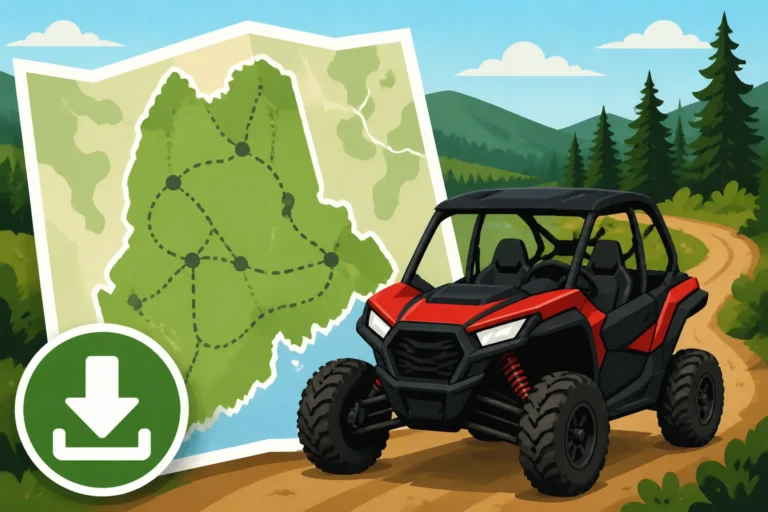
A map can help you understand the area, identify trail connections, and plan where to stage, but it cannot always tell you whether a route is open today or whether you have permission to ride it. Access can change, signs may be posted at local entrances, and a route shown on a map may cross land where permission is limited or has been withdrawn.
Tools such as onX Offroad can be useful for preparing a route and keeping track of your location, particularly when cell service is unreliable. Still, compare any digital map with local club information and posted signs. A mapped line is not a guarantee of legal access, trail condition, or suitability for your machine.
Before leaving home, save the information you’ll need offline and carry a paper map if you have one. Ask the club where visitors should park, which trailhead to use, and whether there are known closures or restrictions. For more planning help, see Maine ATV Trail Maps and Club Boundaries and Checking Maine Trail Status Before You Drive.
What to ask before joining a ride or club activity
Clarify access, timing, and the kind of participation expected
A visitor may be welcome at a club meeting but not automatically included in a group ride. Likewise, a club ride may be open to guests only when arranged in advance. Ask whether you need to register for the event, meet at a specific location, or arrive with a club member. If there is a work day, ask what tools or clothing to bring and whether riders are expected to help before heading out.
Use direct questions so there is little room for misunderstanding. For example: “Are non-members welcome on this ride?” “Do I need to join or pay anything before attending?” “Are we riding club-approved trails only?” “What time and place should visitors meet?” These questions are more helpful than simply asking whether the club is “open to visitors.”
Confirm the details again close to your trip, especially if you’re planning around weather or a long drive. Trail access and conditions can change, and a club contact may be able to point you toward a suitable alternative if a route is closed. If you’re traveling to a trail system for the first time, Maine ATV Club Membership and Dues and Joining an ATV Club as a Visitor offer useful context for understanding how club participation fits into trip planning.
Understand costs and what membership does not include
Ask what the club’s membership options cover and whether visitor participation has any separate requirements. Don’t assume that a membership payment includes machine registration, a trail permit, fuel, lodging, food, or event costs. Those are separate issues unless the club clearly tells you otherwise.
Here’s a simple way to keep the pieces straight:
| Item | What it relates to | What to confirm |
|---|---|---|
| Club membership | Supporting or participating in a local club | Whether visitors can join, attend meetings, or ride with members |
| ATV registration | Legal registration of the machine | Whether your registration is valid for your planned Maine riding |
| Trail access | Permission to use a specific route | Whether the trail is open and whether visitor access is allowed |
| Event participation | A scheduled club ride or activity | Whether advance notice, sign-up, or an event fee applies |
| Machine suitability | Whether your ATV or UTV fits the route | Trail width, bridge limits, gates, and any local restrictions |
If you’re visiting with a group, ask whether everyone needs to contact the club or whether one person can coordinate. Confirm whether the club expects guests to follow a particular riding order, pace, or regrouping plan. This is especially important when riders have different experience levels or when a group includes both ATVs and side-by-sides.
How to be a welcome guest on Maine trails
Ride with care around landowners and local communities
Respectful riding is part of keeping access open. Stay on the authorized route, follow posted signs, close gates only when instructed to do so, and avoid cutting across fields or private driveways. If you’re unsure whether a road is part of the trail, stop and check rather than guessing. A brief detour can create a serious problem for the club and the landowner who allowed access.
Keep your speed and noise considerate near homes, farms, and businesses. Local residents may be sharing a road with riders who have come from far away, and a few careless passes can sour the relationship that supports trail access. Follow the club’s instructions about dust, parking, and regrouping, and leave the trailhead as orderly as you found it.
This matters even when you’re riding with someone who knows the area. A local rider’s familiarity is not blanket permission to take any side road or shortcut. If a route is marked closed, blocked, or posted against access, don’t treat a club invitation as an exception unless the club has clearly confirmed that you’re authorized to use that specific route.
Be prepared for changing conditions and limited service
Maine riding areas can be remote. You may lose cell reception, encounter a downed tree, or find that rain has made a trail difficult for your machine. Ask your club contact what to carry and how riders should handle a breakdown or separation from the group. Bring basic supplies, water, suitable clothing, and a way to navigate without relying entirely on a phone connection.
If you use onX Offroad, download the map area in advance and make sure you understand how to view your saved route without service. Keep the club’s meeting point and contact information available offline as well. A GPS app can help you stay oriented, but it won’t arrange recovery or confirm that a trail remains open.
For your first ride with a club, it’s reasonable to choose a shorter outing and follow the group’s pace. Tell the ride leader if you’re new to the area, unfamiliar with your machine, or need to turn back early. That gives the group a chance to plan regrouping points and helps prevent a small navigation or mechanical issue from turning into a stressful day. The best visitor experience is usually one where expectations are clear, the route matches the group, and everyone treats local access as something to protect.
Disclaimer
This article is for general informational purposes only and does not constitute professional advice. Laws, prices and regulations vary by location and change over time. Consult a qualified professional for guidance on your specific situation.