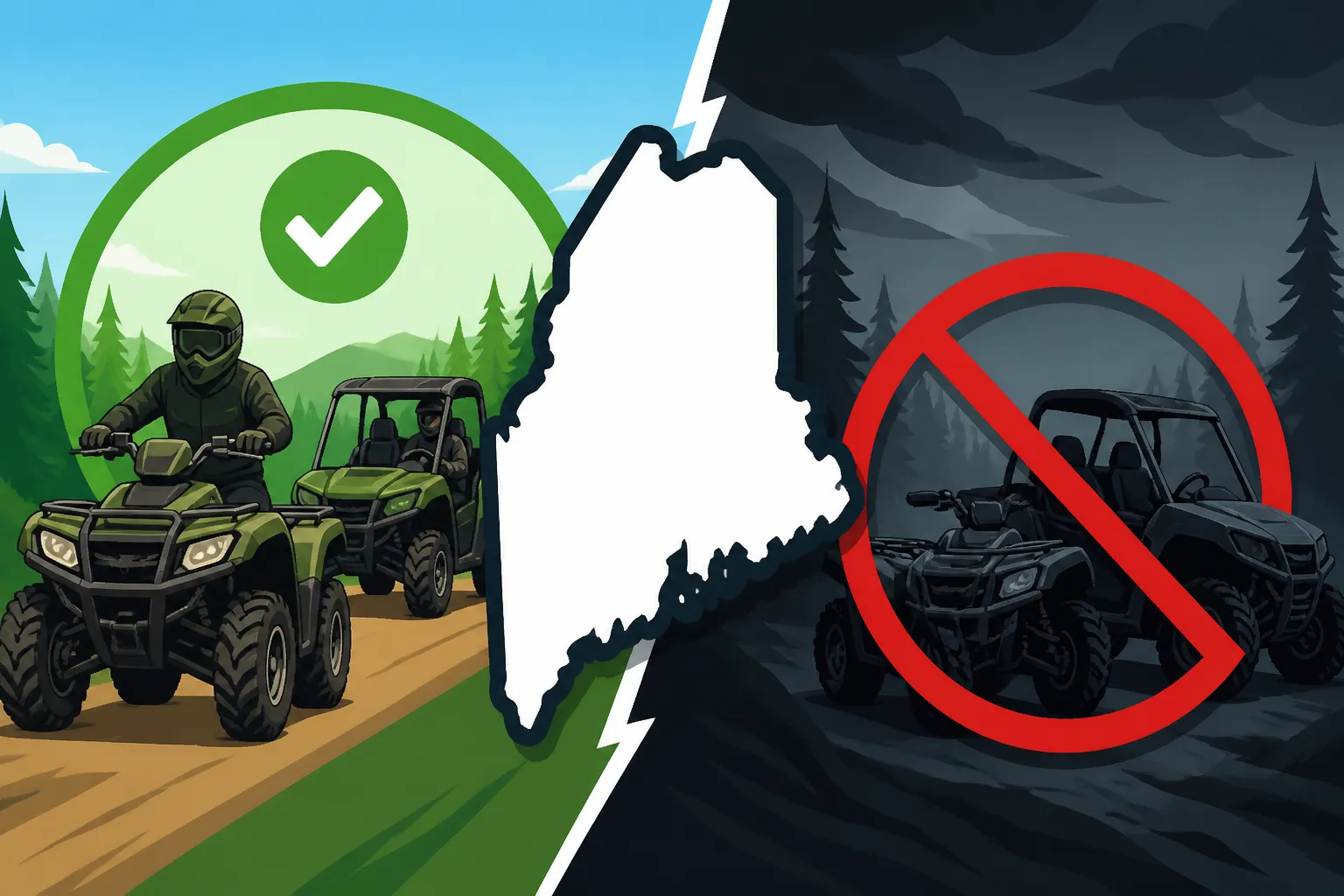
Maine’s ATV Reciprocity, and Why It Ended
A rider can cross into Maine with a registered ATV and still find that the registration does not automatically cover the ride they planned. Maine’s reciprocity rules have changed, and registration, trail access, and local permissions are separate issues. This guide explains why broad reciprocity ended, what the limited exceptions mean, and how out-of-state and Canadian visitors can prepare before unloading.
What ATV reciprocity means in Maine
Registration reciprocity is not trail reciprocity
ATV reciprocity is an agreement or legal arrangement under which one jurisdiction recognizes an ATV registration issued by another. When reciprocity applies, a visitor may be able to ride without buying a separate registration in the place they are visiting. When it does not apply, a registration valid at home may not be enough for a ride in Maine.
That distinction catches people off guard because an ATV registration can look like a travel document. It is not. Registration relates to the machine and its legal operation; it does not, by itself, authorize access to a trail, road, private property, or club trail system. A registered machine can still be barred from a route because the landowner has not granted access or the trail is closed.
A visitor planning a weekend in the woods needs to check three things independently: whether Maine requires a Maine registration for that machine and rider, whether the intended trail is open and accessible to ATVs, and whether any local or landowner rules apply. Maine Non-Resident ATV Registration Options explains the registration choices, while [Landowner Permission on Maine ATV Trails] covers the separate question of where you may ride.
Why the word reciprocity can be misleading
People sometimes use “reciprocity” to mean that their home registration is accepted everywhere they travel. In practice, recognition may depend on the jurisdictions involved, the type of registration, the visitor’s status, and the duration or purpose of the ride. A state-to-state arrangement may also be different from a limited rule that applies to a visitor for only a short period.
The result is that two riders on the same trail can face different registration requirements. One may qualify for a limited exception based on where the machine is registered; another may need a Maine registration because their home jurisdiction does not meet the applicable conditions. A rider should not assume that a friend’s experience from a prior trip applies to their own machine.
It also helps to separate registration reciprocity from Canadian trail permits. A province or neighboring jurisdiction may have its own trail-pass system, club requirements, or access rules. Those may matter when riding there, but they do not automatically answer what Maine requires. For Canadian visitors, Maine ATV Rules for Canadian Visitors and Maine’s Three-Day Agreement With New Brunswick and Quebec address questions that should be checked separately.
Why Maine’s broad ATV reciprocity ended
The change was about who supported Maine’s trail system
Maine ended its broad ATV reciprocity arrangement in 2004. The change reflected a policy question that affects trail systems everywhere: should visitors be able to use a network supported in part by registrations and local volunteer work without contributing through the same registration system as local riders?
Maine’s ATV network depends heavily on private land access, local clubs, and trail maintenance. Trails may cross a patchwork of property rather than a single public corridor. Clubs and volunteers maintain routes, repair bridges, post signs, and work with landowners. Registration revenue also supports the broader ATV program. That makes registration more than a sticker requirement; it is one part of the system that helps keep riding opportunities available.
For a visitor, this can feel frustrating. You may already have paid to register the ATV at home, and you may plan to ride for only a day or two. But a home registration does not necessarily contribute to the Maine network or satisfy Maine’s rules. The end of broad reciprocity means visitors need to establish whether a limited exception applies or choose a Maine nonresident registration.
What changed for riders after the policy shift
The practical change was that riders could no longer treat an out-of-state registration as a general Maine pass. Instead, eligibility depends on the specific rule that applies to the rider and machine. If no exception fits, the visitor needs the appropriate Maine registration before riding where one is required.
That shift also made trip planning more important. Someone trailering from New Hampshire might assume that a short trip across the border is covered by a neighboring state’s registration. A rider from Massachusetts could make the same assumption for a foliage weekend. The safest approach is not to infer eligibility from geography or past practice, but to check the rule for the exact registration jurisdiction and planned dates.
Maine’s policy does not mean that out-of-state riders are unwelcome. Visitors can ride when they meet registration and access requirements. It means that the administrative step is part of the trip, just like confirming trailer parking, checking trail conditions, and knowing which roads or connectors are open. Why Maine Repealed ATV Reciprocity in 2004 provides more background on the change and why visitors should not rely on the old broad-reciprocity expectation.
How the three-day exception differs from broad reciprocity
A short exception is not an unlimited pass
Maine’s limited three-day rule is often described as a reciprocity exception. It is not the same as the former broad arrangement. It is narrow in duration and eligibility, so a rider should confirm that both the machine’s registration jurisdiction and the planned use meet the conditions.
The word “three-day” can tempt people to count casually: arrive Friday evening, ride Saturday and Sunday, and assume the exception covers the whole visit. But the relevant rule may define the period in a particular way, and the rider’s eligibility may depend on more than the calendar. Check the applicable instructions before relying on the exception, especially if travel spans multiple days or includes a stopover.
A useful rule of thumb is to treat the exception as something to verify, not as the default. If there is any uncertainty about whether the rule covers your home jurisdiction, registration status, or trip dates, arrange the Maine registration that applies to your visit. Maine’s Three-Day Non-Resident Exception focuses on the limited rule, and Which Days Count Under Maine’s Three-Day Rule addresses the timing question.
New Brunswick and Quebec riders should check the specific arrangement
Visitors from New Brunswick and Quebec may encounter references to a three-day agreement or exception. That language can sound like a blanket pass for every Canadian machine, but riders should verify the details that apply to their province, paperwork, and itinerary. The fact that a machine is registered or permitted at home does not settle every Maine requirement.
Before leaving, confirm that the document you carry is the relevant registration or authorization, that it is current, and that it identifies the ATV as required. If a province uses separate registration and trail-permit documents, do not assume one substitutes for the other. Keep each document accessible and make sure the name or machine information is consistent where relevant.
If your trip exceeds the limited period, or you cannot establish that the exception applies, look at a Maine nonresident registration rather than trying to stretch the exception. It is also wise to check the route and trail network with the local club, since an eligible registration does not guarantee access to every trail. The details in New Brunswick Registrations Honored in Maine and Quebec Registrations Honored in Maine can help frame the questions to verify before travel.
Choosing a Maine registration for a visit
Match the registration to the length and shape of your trip
When a visitor needs a Maine registration, the right option depends on the trip. A short visit, a full week, and repeated trips through the riding season may call for different choices. Consider the dates you expect to ride, not just the dates you will be staying in Maine. A weather delay, trail closure, or extra day at camp can change the plan.
Do not choose solely by comparing the number of days with the name of a registration option. Read the current terms, including when the registration becomes valid, when it expires, and whether it applies to the machine and rider in your situation. If you are riding more than one ATV, check whether each machine needs its own registration rather than assuming one purchase covers the group.
| Trip situation | What to check | Practical planning point |
|---|---|---|
| A brief visit | Whether a limited exception applies or a short-term Maine registration is needed | Confirm eligibility before unloading |
| A week-long trip | Which Maine registration covers the intended riding dates | Include possible weather or travel delays |
| Several visits in one season | Whether an annual option fits the total use | Compare the stated validity period with your itinerary |
| A Canadian visit | Whether a specific provincial arrangement applies | Carry the correct registration documents |
| A machine registered elsewhere | Whether Maine recognizes that registration for this use | Do not assume home registration alone is sufficient |
Visitors comparing short and longer options can start with Maine Non-Resident Seven-Day ATV Registration and Maine Non-Resident Annual ATV Registration. For a trip that is specifically a week long, Which Maine Registration a Week-Long Trip Needs can help you identify what to verify before you pay.
Prepare your documents before the trip
Make a small document checklist before loading the ATV. Include the machine’s current registration, any Maine registration confirmation or paperwork, proof of ownership if relevant, and identification. If the machine is borrowed or rented, confirm which documents the owner or outfitter provides and what you are expected to carry.
Keep digital records as a backup, but do not rely on a phone screen as your only plan. Remote trail areas can have weak or nonexistent cellular service, and a phone can run out of battery, get wet, or become difficult to use with gloves. A paper copy or securely stored offline copy can save time if a document is requested at a trail stop.
A waterproof document sleeve can keep papers together in a pack or vehicle. Riders who shop on Amazon may find basic document pouches there; the important thing is choosing a durable, weather-resistant option that fits the paperwork without obscuring it. Do not leave documents loose in a damp glove box or strapped where they can blow away.
What out-of-state riders should verify
New Hampshire and Massachusetts registrations
Being from a neighboring state does not automatically create reciprocity. New Hampshire riders, Massachusetts riders, and visitors from other states should confirm the exact Maine requirement for their registration jurisdiction. Look at the rule in effect for the planned ride rather than relying on a club conversation, an old forum post, or what a friend remembers from a previous season.
Check that your home registration is current and that the paperwork matches the machine. If the ATV has recently changed hands, has a registration in a previous owner’s name, or has a missing or unclear VIN, resolve those issues before travel. A registration card that cannot be matched confidently to the ATV may create a problem even if you believe the machine is otherwise eligible.
Visitors from New Hampshire can review Do New Hampshire Riders Need a Maine Registration? as a starting point for the specific question. The same general discipline applies to riders from Massachusetts and elsewhere: confirm the rule, confirm the documents, and confirm the route. A border crossing is not a substitute for checking Maine’s requirements.
Canadian visitors and cross-border paperwork
A Canadian rider should check both the registration rule and the border-crossing logistics. If the ATV is being transported on a trailer, the trailer and tow vehicle have their own requirements. Carry ownership and registration documents for the machine, and make sure the person transporting it can explain who owns it and why it is being brought across the border.
Do not confuse permission to bring an ATV into Maine with permission to ride it on a particular trail. The machine can be legally transported while still requiring a Maine registration or other authorization before it is operated. Likewise, a valid provincial document does not settle whether a club trail is open, whether a landowner has granted access, or whether the route is appropriate for your machine.
Canadian riders planning to cross back into New Brunswick or Quebec should also research the separate requirements on the other side. A Maine registration is not a Canadian trail permit, and a Canadian permit is not necessarily a substitute for Maine registration. Keep the documents organized so you can show the relevant paperwork for the jurisdiction where you are riding.
Registration does not guarantee trail access
Private land and club trails require separate attention
Much of Maine’s ATV riding depends on landowner permission. A trail shown on a map may cross private property, and permission can be limited, seasonal, or withdrawn. A registration is not a property-access pass. Riders need to use routes that are open and authorized for ATV use.
That is why it is worth checking with the local ATV club or trail organization before setting out. Trail conditions can change after heavy rain, during mud season, or when a landowner closes a section. A route that was open when you planned the trip may be closed by the time you arrive. Respecting closures helps preserve access for future rides.
Plan for the machine as well as the paperwork. A wide side-by-side may not fit every trail, and some routes may have restrictions or difficult terrain. An online map can be useful, but pair it with current local information where available. For real-time trip decisions, Checking Maine Trail Status Before You Drive is a useful companion to registration planning.
Road connectors and local rules can change the ride
Some trips use a public way or a town-designated ATV-access route to connect trail sections. Do not assume that every dirt road, shoulder, or road between two trailheads is open to ATVs. Town rules and posted signs matter, and the permitted route may be limited to a specific segment.
A rider may be properly registered and still violate a road-use rule by taking the wrong connector. Before riding, learn the route’s posted restrictions and the rules for crossings. If your trail map shows a road segment, confirm that it is currently authorized rather than treating the map line as blanket permission.
In a group, make sure everyone understands the route. The person leading may know the trail, but each rider is responsible for their own conduct and documents. A brief stop before leaving the staging area to review closures, crossings, and access points can prevent a long detour or an avoidable enforcement issue.
A practical pre-ride plan for visitors
Work through the checks in a reliable order
Start with the machine’s paperwork. Identify the jurisdiction where it is registered, confirm that the registration is current, and check whether the machine’s details match the document. If you are relying on a limited exception, confirm that your circumstances meet its conditions instead of assuming the exception applies because your trip is short.
Next, select the Maine registration option if one is required. Read the validity dates and keep the confirmation or registration document with your other riding paperwork. If you buy online, save the confirmation where you can access it offline and consider carrying a printed copy. Buying a Maine Non-Resident Registration Online offers additional context on the online route.
Then verify the trail plan. Check the trail’s open status, local club guidance, machine-width suitability, landowner access, and any road connectors. Finally, pack the papers, identification, phone, and a backup power source. Riders who prefer a physical planning setup may find a weather-resistant map case or document organizer on Amazon, but a printed club map and clear paperwork matter more than the brand on the pouch.
Know what to do if your paperwork is questioned
If a warden or other authorized official asks for documents, stay calm and provide the registration and identification requested. Do not argue from memory about what another state or province accepts. If you are relying on a limited exception, be prepared to show the documents that establish your eligibility and explain the dates of your visit accurately.
Make sure the registration is attached or displayed as required, and keep the paperwork in a place you can reach without unloading gear. If a document is missing, do not assume a photograph or an expired card will be accepted as a substitute. Resolve the issue before riding whenever possible.
A spare paper copy kept separately from the primary document can be helpful if a pack gets wet or misplaced. Amazon and similar retailers offer simple waterproof sleeves and organizers, but the useful habit is checking the documents before every ride. For a clearer idea of what may be requested during a stop, see Maine Warden Checks and What They Ask.
Build a plan that leaves room for changes
A good trip plan includes more than the route from the campground to the trail. Include the registration validity period, contact information for the local club or outfitter, trailer parking details, fuel stops, and an alternative ride if a trail closes. This matters especially on a multi-day visit, when weather and landowner access can change.
If your trip dates shift, recheck the registration conditions and the trails. An extra day may take you beyond a limited exception or the dates covered by your chosen registration. A closure may also mean the route you planned is no longer suitable, even though your paperwork remains valid.
For riders traveling with friends, assign someone to verify the rules and share the information before departure. Everyone should know whether they are riding under the same registration arrangement and what documents they need to carry. That small bit of preparation is easier than trying to sort out different registrations at a remote trailhead.
Disclaimer
This article is for general informational purposes only and does not constitute professional advice. Laws, prices and regulations vary by location and change over time. Consult a qualified professional for guidance on your specific situation.