Maine ATV Rules in State Parks
Maine state parks can look like a natural extension of the trail network, but an ATV registration does not give you permission to ride through them. The key is to distinguish a designated, authorized route from park trails and roads where ATVs are not allowed. Here’s how to check access, avoid common assumptions, and plan a ride without putting park access at risk.
The basic rule: park access must be specifically allowed
Maine ATV access depends on both the machine’s registration and the landowner’s permission. A valid registration is not a trail pass, and it does not authorize riding anywhere a vehicle can physically travel. State parks have their own rules and managed facilities, so don’t assume that a route open to ATVs elsewhere continues through park property.
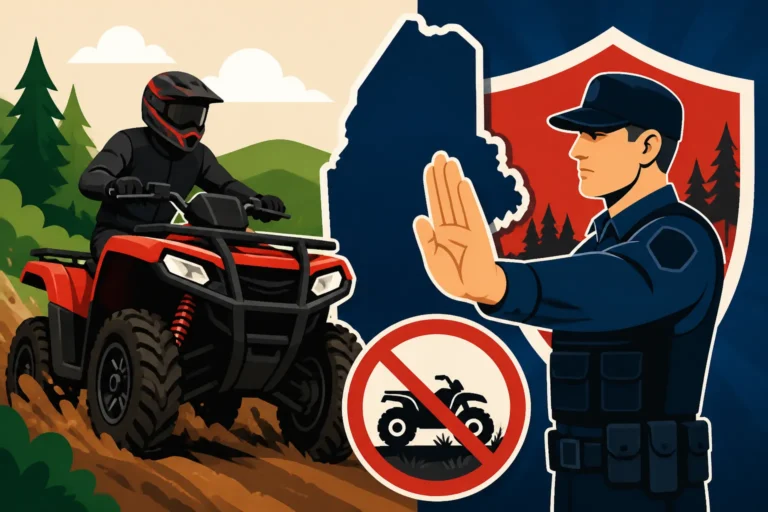
As a practical starting point, assume ATVs and UTVs are not allowed on state park trails, beaches, campsites, or other park areas unless the park or land manager specifically identifies an authorized route or grants permission. A trail appearing on an app or map is not enough to establish that the route is currently open or permitted.
This cautious approach matters because “state park” can refer to more than one kind of place. A trail might pass near a park, use a road outside the park boundary, or cross land managed under a different designation. The name of a nearby recreation area does not tell you who controls the exact section you want to ride.
If a route enters state park property, confirm the rule for that specific park before you go. Check official park information or contact the park or land manager. If the answer is unclear, treat the route as closed to ATV use until you can verify otherwise.
The same principle applies to side-by-sides. A UTV’s wider body, road-like appearance, or different registration category does not automatically make it welcome on a park road or trail. Check the specific rules for your machine and the exact route.
A useful distinction is:
- A trail or road near a park: It may be outside park property and governed by a town, club, private landowner, or another agency.
- A trail inside a park: Use it only if ATV or UTV access is expressly allowed.
- A road shown on a map: A mapped road is not automatically an authorized ATV route.
- A park road open to regular traffic: That does not necessarily mean ATVs may use it.
When in doubt, check both ends of a proposed connection. A route may be open up to the park boundary but not through it. An authorized trail may also have a temporary closure, seasonal restriction, or machine-size limit.
For a broader overview of where access depends on land ownership and permission, see Landowner Permission on Maine ATV Trails. If your planned ride involves land outside a state park, Maine ATV Rules on Public Reserved Land can help you distinguish another type of public land with its own management rules.
State parks, nearby trails, and other public land are not interchangeable
A common source of confusion is treating all publicly owned land as if it had one set of ATV rules. Maine’s public lands include areas with different purposes, managers, and access policies. A state park, a public reserved land unit, a wildlife management area, a town forest, and a club-maintained trail can each have different rules.
The table below is a planning aid, not a substitute for checking the rules for a specific location.
| Place or route | What to assume before riding | What to verify |
|---|---|---|
| Maine state park property | ATV and UTV access is not allowed unless specifically authorized | Park rules, posted signs, official route information, and any temporary closures |
| A designated ATV trail near a park | Access may stop at the park boundary | Exact route alignment, landowner permission, and current trail status |
| Public reserved land | Rules depend on the unit and designated routes | Managing agency rules, route designation, and seasonal restrictions |
| Wildlife management area | Access may be limited or subject to special conditions | Area-specific rules and current notices |
| Town or private land | Public access should not be assumed | Local rules and the relevant landowner’s permission |
| Park road or parking area | A road or parking area does not automatically authorize ATV travel | Whether ATVs may use that specific road and how they may reach it |
If you’re considering a wildlife management area rather than a state park, check Maine ATV Access to Wildlife Management Areas. The distinction matters: one area’s permission or route designation does not establish access in another.
Check the exact boundary, not just the destination
A ride plan often identifies a destination but not the property lines along the way. That can lead riders to assume a corridor is open because the route appears continuous on a map. Before you set out, identify whether the route crosses park property, and look for an official description of the permitted section.
Be especially careful where:
- A trail follows a park boundary or enters a park briefly.
- A public road meets a trail at a park entrance.
- A route is shown in a third-party mapping app but not on current official materials.
- A trail sign and a map seem to disagree.
- A trail connects several towns or landowners, each with separate access conditions.
A route’s status can change when a landowner withdraws permission, a manager closes a section, or conditions make travel unsafe. Check for current notices before loading the machine, not just when you first plan the trip.
Do not treat a park’s vehicle access as ATV access
A road being open to cars does not mean an ATV can use it. Likewise, a parking lot that serves visitors is not an ATV staging area unless the park says so. These spaces are designed and managed for their stated use, and riding through them can create safety and access problems even when the road looks suitable.
If the park’s information does not clearly say that ATVs are allowed on a particular road or route, ask before riding. Keep the answer specific: name the park, the road or trail, the type of machine, and the direction or connection you plan to use.
Registration, reciprocity, and park permission solve different problems
It helps to think of access as several separate checks rather than one yes-or-no question. Registration addresses whether the machine meets applicable registration requirements. Reciprocity may affect how an out-of-state registration is treated. Park permission addresses whether you may operate the machine on that particular property.
Passing one check does not replace the others. A registered ATV can still be barred from a park, and a route that allows ATV use does not remove registration obligations.
| Question | What it answers | What it does not answer |
|---|---|---|
| Is the ATV or UTV properly registered for the ride? | Whether registration requirements have been met | Whether the machine may enter a state park |
| Does reciprocity apply to this rider and machine? | Whether an out-of-state registration or limited exception may be recognized | Whether a park route is open |
| Is this particular route authorized for ATVs? | Whether the route permits ATV travel | Whether your registration and other riding requirements are satisfied |
| Is the route open today? | Whether current closure or seasonal information permits travel | Whether every connected route is also open |
Visitors should not assume that another state’s registration provides unrestricted Maine access. Rules about out-of-state registrations and exceptions are separate from park rules. For background, read Maine ATV’s Reciprocity, and Why It Ended and Maine’s Three-Day Non-Resident Exception. If you’re visiting from elsewhere, Maine ATV Registration for Non-Residents can help you identify the registration question to check.
Even if an exception applies to your registration, it does not create permission to ride in a state park. Confirm the current registration rules through the appropriate official source, and separately confirm access with the park or land manager.
The same separation applies to paperwork on the machine. A registration card, sticker, receipt, or online confirmation can show information relevant to registration, but none of these documents works as a general access permit. For more detail on that distinction, see [What a Maine ATV Registration Does Not Cover].
Permission must cover the route and the machine
If a manager or landowner tells you that a route is open, make sure the answer covers your actual plan. A permission that applies to one access road, one machine type, or one part of a trail may not extend to another section or to a wider UTV.
Ask whether:
- The route is open to ATVs, UTVs, or both.
- The permission covers the full connection you intend to ride.
- Any sections are restricted by date, season, or road condition.
- There is a width, weight, or other machine limitation.
- You must use a specified entrance or follow a marked route.
- The route has recently closed or changed.
If you receive an unclear answer, ask for clarification before riding. Do not assume that a route is open because another rider has used it, because it is shown on a map, or because the machine can physically fit.
How to confirm access before your trip
A few checks before departure can prevent a long detour or an avoidable violation. Use current, official information for the park, and verify the trail connection rather than relying on a general map label.
- Name the exact park and route. Write down the park, trail or road name, access point, and the section you plan to ride. “Near the park” is too vague to get a reliable answer.
- Check official park information. Look for rules that address ATVs, UTVs, motorized use, road access, and closures. If the information does not clearly settle the question, contact the park or managing office.
- Confirm the boundary and connection. Determine whether the route stays outside the park or enters park property. Check both the approach and the exit so you do not arrive at a closed segment mid-ride.
- Ask about machine type. Say whether you are riding an ATV or UTV. A route suitable for a narrow ATV may not be suitable or permitted for a wider side-by-side.
- Check for current restrictions. Look for seasonal openings, temporary closures, construction, weather-related limits, and posted notices. A route that was open on an earlier visit may not be open now.
- Verify your registration separately. If you are visiting from out of state, check the rules that apply to your registration. Do not use a registration answer as proof of park access.
- Save the information you relied on. Keep the official route information or a note of the contact and guidance you received. Carry your registration documents as required, while remembering that they do not grant access.
- Make a legal alternate plan. If the park section is closed or the answer remains uncertain, choose a route that avoids it rather than trying an unmarked bypass.
When asking a park or land manager, a short, precise question is more useful than asking whether “ATVs are allowed in the area.” For example: “May a registered UTV use the marked trail between these two access points, and is that section open now?” The manager can then address the actual route and vehicle.
Do not use an unauthorized road or shoulder to get around a closure. A closed park section is not an invitation to create a detour across another property. If you need to change the ride, confirm that the replacement route is legal before proceeding.
Use maps as planning tools, not permission
A trail map is useful for understanding distance, connections, and likely access points. But maps can be outdated, incomplete, or designed for a different type of travel. A line on a map may show a road or path without indicating whether ATVs are allowed on it.
This is especially important when using a general-purpose navigation app. It may not distinguish a park boundary, a private road, a temporarily closed trail, or a route available only to certain vehicles. Use map information to form questions, then verify the answers with current official materials.
If signs at the site conflict with a map or an older route description, do not ride past the signs while trying to resolve the discrepancy. Stop and contact the responsible manager or choose another route.
Common mistakes and how to avoid them
Most park-access problems start with an assumption rather than a deliberate decision to ignore a rule. These are the assumptions most likely to cause trouble.
“It is public land, so ATVs are allowed”
Public ownership does not mean unrestricted motorized access. Land can be public and still have restrictions intended to protect visitors, natural resources, facilities, or the purpose of the site. Check the rules for the specific designation and managing authority.
“My ATV is registered, so I can ride there”
Registration and permission are different. A registration does not turn a closed park road into an ATV route, and it does not authorize riding on a park trail. Verify both requirements independently.
“The road is open to cars”
A road open to ordinary traffic may still prohibit ATVs. Do not infer ATV permission from the presence of cars, a gate, or a paved surface. Ask whether the specific road is open to the machine you are operating.
“The route is on the app, so it must be legal”
A map pin or track is not the same as authorization. Check the route’s current status with the official source, especially where it touches a park, private parcel, or managed recreation area.
“A friend rode it last season”
Access can change. A prior ride does not guarantee that the same route is open now, or that the other rider had permission. Verify current conditions before relying on a story or an old track.
“A UTV is different, so it can use a road an ATV cannot”
A UTV is not automatically permitted wherever an ATV is prohibited. Its size may create additional limits, and the rules can depend on vehicle type and route. Ask directly about the machine you will bring.
“If the gate is open, the trail is open”
A gate’s position may not indicate permission. It might be open for park staff, maintenance, emergency access, or other authorized users. Follow signs and official instructions, not the apparent condition of a gate.
Respecting posted restrictions protects more than an individual ride. State parks serve a range of visitors, and off-route motorized use can damage sensitive ground, create hazards, or undermine access arrangements. When riders stay on authorized routes and respect closures, they help avoid conflict and preserve the possibility of responsible recreation elsewhere.
For rules that apply to other well-known protected areas, compare the specific guidance in Maine ATV Rules in Baxter State Park and Maine ATV Rules at Acadia. Those locations have their own management rules; their restrictions should not be treated as a substitute for checking a different state park.
Frequently Asked Questions
Can I ride an ATV on a Maine state park trail?
Assume no unless the park or land manager specifically identifies the trail as open to ATV use. Confirm the route and current conditions before riding.
Does a Maine ATV registration let me ride in a state park?
No. Registration concerns the machine’s registration requirements; it does not grant permission to use a state park road or trail.
Can a non-resident ride in a state park using an out-of-state registration?
First confirm whether the registration or any applicable exception is valid for your circumstances. Then check park access separately. Reciprocity or a registration exception does not establish that a park route is open.
Are UTVs allowed where ATVs are allowed?
Not necessarily. Confirm that the route permits your specific type and size of machine. A route open to ATVs may have different limits for UTVs.
What should I do if a map shows a trail through a park?
Treat the map as a planning aid, not proof of access. Check the route with the park or land manager, and do not ride through the park unless access is clearly authorized.
Disclaimer
This article is for general informational purposes only and does not constitute professional advice. Laws, prices and regulations vary by location and change over time. Consult a qualified professional for guidance on your specific situation.