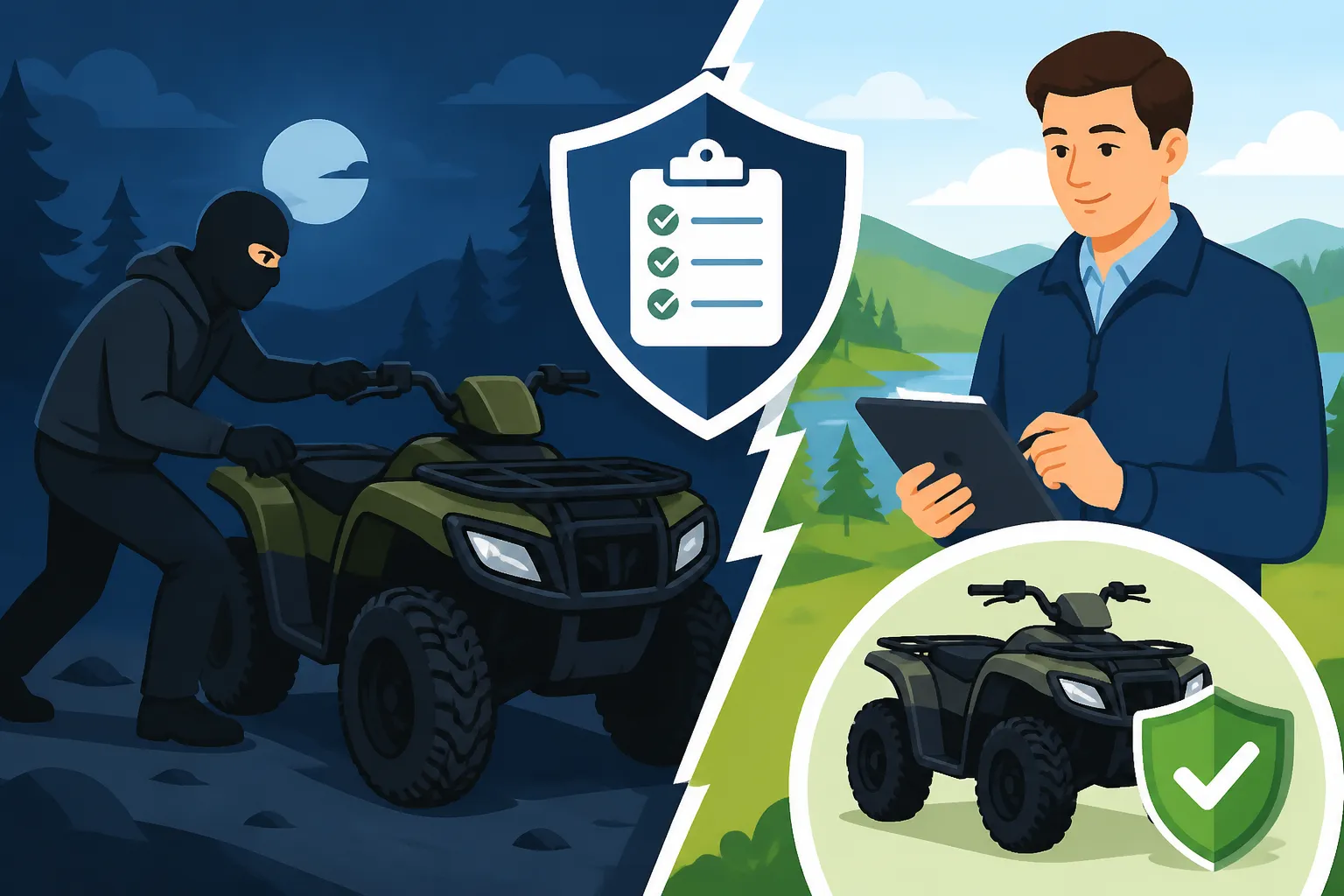
ATV Theft Claims and What Insurers Want
There's nothing quite like the sinking feeling in your stomach when you walk out to where your ATV or UTV should be parked, and it's just… gone. The immediate panic, the frustration, the sheer violation of it all – it's a terrible experience no rider wants to face. This guide is here to walk you through the essential steps to take when an ATV or UTV is stolen in Maine, focusing on exactly what insurance companies will expect from you to process a theft claim quickly and efficiently.
The Initial Shock: What to Do Immediately After Discovering Your ATV is Missing
That moment of realization, when you see an empty spot where your quad used to be, is a punch to the gut. Your mind might race, hoping you just parked it somewhere else, but deep down, you know. When theft happens, the clock starts ticking, and your immediate actions can significantly impact the success of your insurance claim and even the chances of recovery. Don't freeze up; take a deep breath and start moving.
The First Call: Contacting Law Enforcement
Your very first priority, even before calling your insurance company, is to contact the local authorities. This isn't just about reporting a crime; it's a critical step for your insurance claim. Insurers almost always require a police report number to even begin processing a theft claim. Without one, you're essentially telling them it wasn't a crime, which goes against the very nature of a theft claim.
Think about it: the police report officially documents the incident, the date, time, and circumstances of the theft. When you call, be ready to provide as much detail as possible. This includes the make, model, year, color, and most importantly, the Vehicle Identification Number (VIN) of your ATV or UTV. If you don't have it memorized, that's okay, but you should know exactly where to find it on your registration paperwork. The police will enter your machine's VIN into national databases, flagging it as stolen, which is vital for [Stolen ATV Recovery and the Registration Trail]. They'll also provide you with a case number, which is gold for your insurance company. Don't be surprised if they ask about any distinguishing features, aftermarket parts, or unique scratches. Every detail helps paint a clearer picture for investigators.
Gathering Evidence and Documenting the Scene
While waiting for law enforcement to arrive, or immediately after you've made the call, take a moment to look around the scene. This might feel intrusive or even painful, but any evidence you can gather could be invaluable. Did they cut a lock? Were there tire tracks? Are there any security camera systems nearby, perhaps from a neighbor or a local business, that might have captured something? Even seemingly small details, like a dropped tool or a footprint, can be important.
Grab your phone and take photos or videos of the area where the ATV was stored. Document any signs of forced entry, broken gates, cut chains, or disturbed ground. These visual proofs corroborate your story and help both the police and your insurer understand the circumstances. If you had any specific security measures in place, such as a heavy-duty chain, a tracking device, or an alarm system, document how those were defeated. This information helps your insurance company assess your efforts to prevent the theft, which can sometimes influence their view of your claim. Remember, you're building a comprehensive picture for those who weren't there.
Notifying Your Insurance Company
Once you have a police report number, it's time to call your insurance provider. Don't delay this step. Most policies have a clause requiring you to report a loss within a reasonable timeframe. The sooner you report it, the better it looks to your insurer. When you call, have all your policy information handy, along with the police report number and the details you gathered at the scene.
Be prepared to answer a lot of questions. They'll ask for the make, model, year, and VIN of your stolen machine, just like the police did. They'll also want to know when and where the theft occurred, who discovered it, and what security measures were in place. It's crucial to be honest and thorough. Don't speculate or exaggerate; just stick to the facts as you know them. This is also a good time to ask about the specific documents they will require from you, which can vary slightly depending on your policy and the insurer. Understanding their requirements upfront will save you time and frustration later in the claims process. This initial call sets the stage for everything that follows regarding your [Maine ATV Insurance and When You Need It].
Understanding What Insurers Want: Building a Strong Theft Claim
Dealing with the aftermath of an ATV theft is tough enough without feeling like you're fighting your own insurance company. To make the process smoother, it helps to understand what they're truly looking for when you file a theft claim. They're not trying to be difficult, but they need solid evidence to approve a payout. Essentially, they want proof of ownership, proof of theft, and assurance that you took reasonable steps to protect your investment.
Proving Ownership and Value
This is arguably the most critical part of your claim. Your insurance company needs to be absolutely certain that the ATV or UTV was yours and what its fair market value was at the time of the theft. Without clear proof of ownership, your claim can hit a serious roadblock.
The first piece of the puzzle is your registration. Your current [Proof of Ownership for a Maine ATV Registration] is a primary document, clearly linking you to the specific machine by its VIN. Make sure you have the physical copy or can access a digital one. If your registration was in the machine when it was stolen, inform your insurer immediately; they’ll work with you to verify it.
Next, think about your purchase records. A bill of sale is incredibly important, especially for machines bought from a private seller. A well-drafted [Maine ATV Bill of Sale: What to Include] will detail the buyer, seller, date of sale, purchase price, and VIN. Even if it’s a simple handwritten document, it provides crucial evidence. If you bought from a dealer, your sales contract will serve the same purpose. These documents help establish the original value of the machine and your legal ownership. If you need a template for a bill of sale, resources like LawDepot can provide standard forms that cover all the necessary details.
Beyond the initial purchase, insurers will want to know about any significant upgrades or modifications you made, as these can affect the machine's value. Did you add an expensive plow, a new winch, or a specialized suspension? Keep receipts for these additions. Photos of your ATV before the theft, showing these features, are also incredibly helpful. The more documentation you have to establish what you owned and what it was worth, the stronger your case. Remember, the insurer wants to pay out the actual cash value (ACV) of the machine at the time of theft, not necessarily what you paid for it years ago or what it would cost brand new.
Demonstrating Reasonable Care and Theft Prevention
Insurance companies want to see that you, as the owner, took reasonable steps to prevent the theft. They understand that no security measure is foolproof, but negligence can sometimes complicate a claim. This isn't about blaming the victim; it's about assessing risk.
Think about how and where your ATV was stored. Was it left unlocked in an open driveway? Or was it secured in a locked garage, perhaps chained to an immovable object? Did you use a steering lock, a kill switch, or a GPS tracker? These details matter. If you routinely parked your ATV in a secure location, like a locked shed or garage, mention that. If you used security chains, disc locks, or even a basic cover, those are all indicators of reasonable care.
Some insurance policies even offer discounts for specific anti-theft devices. If you invested in a high-tech alarm, a GPS tracking system, or heavy-duty security measures, make sure to highlight this to your insurer. Providing photos of your storage setup or receipts for security devices can further demonstrate your efforts. While it might seem unfair to be scrutinized after being a victim, proving you took reasonable precautions shows due diligence and helps solidify your claim. It illustrates that you weren't leaving your valuable asset vulnerable, but rather that a determined thief overcame your efforts.
The Importance of Timely and Thorough Reporting
We touched on this briefly, but it bears repeating: timeliness and thoroughness are paramount. Delaying your report to the police or your insurer can raise red flags. A significant gap between the theft and the report might lead an insurer to question the circumstances or suggest the machine was already lost or damaged before you reported it.
When you communicate with your insurance company, provide all the requested information promptly. If they ask for specific documents, gather them as quickly as you can. Keep a detailed log of all your communications: who you spoke to, the date and time, and a brief summary of the conversation. This record can be invaluable if there are any discrepancies or misunderstandings later on. Be prepared to provide copies of your registration, bill of sale, maintenance records, and photos. If you've ever had a [Replacing a Lost ATV Registration] or updated your information, ensure you have the most current paperwork. A complete and organized submission demonstrates your cooperation and helps expedite the claims process. Don't leave any gaps in your story or your documentation; insurers are looking for a clear, consistent narrative backed by verifiable facts.
Navigating the Claims Process and Understanding Your Settlement
Once you've filed your claim, the real work for the insurance company begins. This isn't usually an overnight process, and there can be a few twists and turns along the way. Knowing what to expect can help you manage your expectations and prevent further frustration.
What to Expect During the Investigation
After you've submitted your initial report, your insurance company will assign a claims adjuster to your case. This person is responsible for investigating the theft and determining the validity and value of your claim. Their job is to ensure everything is legitimate before a payout is made.
The adjuster will likely review the police report, contact the reporting officer if necessary, and cross-reference the information you provided. They may also ask for additional documentation beyond what you initially supplied. This could include photos of your ATV, maintenance records, previous appraisals, or even statements from witnesses if the theft occurred in a public place. They might also check public records to verify the VIN and ownership history, a process similar to how one might [How to Check If a Used ATV Is Stolen] when buying.
One common step in the investigation is a waiting period. Insurers often require a certain amount of time to pass (e.g., 30 days) before settling a theft claim. This gives law enforcement a chance to recover the stolen ATV. If your machine is recovered during this period, your insurance company will work with you to assess any damage and determine if it's repairable or a total loss. If it's recovered undamaged, the claim may be closed without a payout, beyond any costs for recovery. This waiting period can be frustrating, especially when you just want closure, but it's standard procedure. Keep lines of communication open with your adjuster and the police department during this time.
Factors Affecting Your Claim Payout
So, you've done everything right, and the waiting period has passed without recovery. Now comes the moment of truth: the payout. The amount you receive isn't simply what you paid for the ATV. Several factors come into play:
- Actual Cash Value (ACV) vs. Replacement Cost Value (RCV): Most standard ATV policies pay out the Actual Cash Value (ACV). This means the value of your ATV at the time of the theft, taking into account depreciation, wear and tear, and market conditions. If your ATV was three years old and had a few dings, the ACV will be less than what you paid for it new. Some premium policies might offer Replacement Cost Value (RCV), which would pay to replace your stolen ATV with a brand-new one of similar make and model, without deducting for depreciation. It’s crucial to know which type of coverage you have.
- Depreciation: This is the biggest factor for ACV policies. ATVs, like cars, depreciate in value the moment they leave the showroom. Age, mileage, condition, and even the popularity of the model all contribute to how much value your machine has lost over time.
- Policy Limits: Your policy will have a maximum payout limit for theft. Make sure you were adequately covered. If you have an expensive custom build or a high-end UTV, your standard coverage might not be enough. This is why it's so important to review your [Maine ATV Insurance Cost] and coverage levels regularly.
- Deductible: This is the amount you agreed to pay out of pocket before your insurance coverage kicks in. For example, if your ATV was valued at $8,000 and you have a $500 deductible, your payout would be $7,500.
- Aftermarket Parts and Accessories: This goes back to those receipts for upgrades. If you have specific coverage for aftermarket parts, they will be included in the valuation. If not, they might only be covered up to a certain percentage of the ATV's value or not at all. Always clarify this with your insurer when purchasing or updating your policy.
- Salvage Value: In rare cases, if the ATV is recovered but declared a total loss, the insurance company might take ownership of the damaged machine and sell it for salvage to recoup some costs. Your payout would reflect the total loss less the deductible.
The adjuster will use market data, their own valuation tools, and the documentation you provided to determine the ACV. It's a negotiation, in a way, so having strong evidence for your machine's condition and any upgrades is critical to getting a fair settlement.
Potential Roadblocks and How to Address Them
Even with all your ducks in a row, sometimes things don't go perfectly smoothly. Here are a few common roadblocks and how you might address them:
- Lack of Documentation: If you can't provide a bill of sale, registration, or proof of VIN, your claim will be much harder to prove. For situations where paperwork is scarce, like a machine inherited or bought without a formal bill of sale, you might need to lean on alternative proofs of ownership, such as old registration cards, photos of you with the ATV, or even sworn affidavits. [Maine ATV Registration for a Machine Without Paperwork] discusses similar challenges.
- Disagreement on Value: You might feel your ATV was worth more than the adjuster's valuation. This is where your detailed receipts for maintenance, upgrades, and photos of its excellent condition come in. You can also research comparable ATVs for sale in your area (online marketplaces, dealers) to demonstrate a higher market value. Present your evidence calmly and professionally.
- Policy Exclusions: Review your policy carefully. Some policies have specific exclusions, such as theft if the keys were left in the ignition, or if the theft occurred in an unsecured public area against policy terms. Understanding your coverage beforehand can prevent these surprises.
- Fraud Investigation: In rare cases, if there are inconsistencies in your story or a complete lack of evidence, the insurance company might suspect fraud. This is a serious accusation. Being honest and transparent from the start, and providing all requested information, is your best defense.
- Delayed Communication: Sometimes claims just move slowly. Be persistent but polite in your follow-ups. Keep that log of calls and emails handy. If you feel your claim is being unduly delayed without good reason, you might escalate it to a supervisor or contact the Maine Bureau of Insurance for assistance.
Remember, the goal is to get a fair settlement for your loss. Be prepared, be patient, and be persistent.
Proactive Protection: Safeguarding Your ATV Against Future Theft
While this guide focuses on what to do after a theft, a truly comprehensive approach includes steps to prevent it from happening again, or at all. The trauma of having a valuable possession stolen is something no one wants to repeat. Thinking proactively can save you a lot of grief, and even potentially lower your [Maine ATV Insurance Cost] over time.
Physical Security Measures and Deterrents
The best defense against theft is making your ATV as difficult and unappealing to steal as possible. Thieves are often looking for quick, easy targets. The more obstacles you put in their way, the more likely they are to move on.
- Lock it Up, Lock it Down: Never leave your ATV unlocked and unattended, even for a short time. Use strong, hardened steel chains and padlocks to secure your ATV to an immovable object – a ground anchor in your garage, a sturdy post, or even a heavy-duty trailer. Wheel locks, disc brake locks, and U-locks can also provide a good deterrent.
- Secure Storage: If possible, store your ATV in a locked garage, shed, or dedicated storage unit. Make sure the doors and windows of the storage area are also secure. Don't underestimate the value of simply keeping your machine out of sight.
- Ignition Kill Switch or Battery Disconnect: For an added layer of protection, consider installing a hidden kill switch that prevents the engine from starting without being disengaged. A battery disconnect switch is another simple yet effective measure, especially for long-term storage.
- GPS Tracking Devices: These can be invaluable for recovery. Many aftermarket GPS trackers can be discreetly installed on your ATV and allow you to monitor its location in real-time via a smartphone app. If your ATV is stolen, law enforcement can use this information to track it down. This is directly tied to [Stolen ATV Recovery and the Registration Trail].
- Alarms and Motion Sensors: An alarm system, especially one with a loud siren, can startle thieves and draw attention, making them reconsider. Motion-activated lights around your storage area are also effective deterrents, as thieves prefer to operate in darkness.
- Remove the Keys: It sounds obvious, but you’d be surprised how many thefts occur because the keys were left in the ignition, or even hidden nearby. Always remove your keys and store them securely indoors, away from your machine. If your [Storing Registration Paperwork on the Machine] includes your keys, rethink that strategy.
The Role of Documentation and Record-Keeping
Even with the best security, theft can still happen. That's why meticulous record-keeping is your second line of defense. When your ATV is stolen, having immediate access to critical information dramatically speeds up the reporting and claims process.
- Keep a "Theft File": Create a dedicated folder, physical or digital, with all essential documents. This should include:
- Copies of your current registration (confirming your [Maine ATV Registration Numbers and Where They Go] are accurate).
- Your bill of sale or purchase agreement.
- Photos of your ATV from various angles, especially showing any unique features or aftermarket accessories.
- Receipts for expensive upgrades, security devices, or major maintenance.
- Your insurance policy declaration page.
- The location of your VIN (and maybe a pencil rubbing of it). The [Where the VIN Is Stamped on a Quad] can vary by manufacturer and model.
- A completed template for a bill of sale, even if you never sell it, knowing what information is crucial can help if you ever need to document ownership for an insurer. Websites like LawDepot offer these templates.
- Take Detailed Photos: Snap pictures when your ATV is new, and after any major upgrades. These visual records are powerful evidence of its condition and modifications.
- Regularly Update Records: If you move, get new insurance, or add major accessories, update your theft file.
- Consider Engraving or Etching: Some owners engrave a unique identifying number (like the last few digits of their VIN or driver's license number) in inconspicuous spots on their ATV's frame or major components. This makes it harder for thieves to sell parts and easier for law enforcement to identify.
Reviewing Your Insurance Coverage Regularly
Your life changes, and so should your insurance coverage. What was adequate when you first bought your ATV might not be enough years later.
- Annual Check-up: At least once a year, sit down with your insurance agent and review your ATV policy. Discuss any new accessories you've added, changes in where you store the machine, or how often you ride.
- Understand Your Coverage Types: Reconfirm whether you have Actual Cash Value (ACV) or Replacement Cost Value (RCV) for theft. If you have an expensive or vintage machine, RCV might be worth the extra premium.
- Deductibles: Consider if your deductible is still appropriate for your financial situation. A higher deductible means lower premiums, but a bigger out-of-pocket expense if you have to file a claim.
- Liability vs. Comprehensive: Most theft claims fall under the comprehensive portion of your policy. Make sure you have adequate comprehensive coverage, not just liability. [Maine ATV Liability Coverage Limits] are important for riding, but it won't help you replace a stolen machine.
- Homeowners Insurance Limits: Don't assume your homeowners policy will fully cover an ATV theft. While some policies offer limited coverage, it's often not enough, and your ATV might need its own dedicated policy. [Does Homeowners Insurance Cover an ATV in Maine?] is a common question, and the answer is often "not sufficiently."
By being proactive, documenting everything, and regularly reviewing your insurance, you're not just preparing for the worst-case scenario; you're taking meaningful steps to protect your investment and ensure a smoother path to recovery or compensation should the unthinkable happen.
Disclaimer
This article is for general informational purposes only and does not constitute professional advice. Laws, prices and regulations vary by location and change over time. Consult a qualified professional for guidance on your specific situation.