Checking Whether a Used ATV Is Registered
Buying a used ATV or UTV can be incredibly exciting, but nothing puts a damper on that thrill faster than realizing you've bought a machine with questionable paperwork. You don't want to show up at the trailhead only to find out your new-to-you quad can't legally hit the dirt. This guide will walk you through the essential steps and considerations for checking a used ATV's registration status in Maine, helping you navigate the process with confidence and avoid potential headaches.
Why Registration Status Matters Beyond Just Riding
When you're eyeing that perfect used ATV, it's easy to get caught up in checking the engine, tires, and overall condition. But neglecting the paperwork side of things, especially its registration status, can lead to a world of frustration. It’s not just about whether you can legally ride it; it touches on ownership, financial obligations, and even avoiding legal trouble.
Avoiding Legal Headaches Down the Road
Imagine you’ve just brought your new-to-you quad home, polished it up, and you’re ready to hit the trails near Moosehead Lake. You load it up, drive to the trailhead, and a Maine Game Warden pulls up. If that ATV isn’t properly registered, you could be facing a significant fine right off the bat. Nobody wants that kind of start to their riding season! Unregistered machines are a common reason for stops, and the penalties can range from monetary fines to more serious repercussions, especially if there are other issues at play. It's a quick way to lose that new-machine glow. Knowing the registration status beforehand means you can factor in the immediate need to register it or, worse, decide if the machine is simply too much of a risk. You can learn more about what to expect if you're caught without proper registration by reading [Penalties for Riding an Unregistered ATV in Maine].
Beyond just fines, an unclear registration history can complicate things if you ever need to sell the machine yourself or if there’s an accident. Clear, up-to-date registration shows a traceable history of the vehicle, which is a huge benefit for everyone involved.
Confirming Ownership and Preventing Fraud
A current and valid registration certificate names the legal owner of the ATV. This is crucial for your peace of mind. If the person selling you the ATV can’t produce a registration in their name, or if the name on the registration doesn’t match their ID, that's a massive red flag. You could inadvertently buy a machine that doesn't legally belong to the seller, or even one that has been stolen. In Maine, where ATVs aren't titled like cars, the registration certificate often serves as the closest thing to formal proof of ownership, alongside a well-documented bill of sale. Verifying the registration helps confirm that you are purchasing the ATV from its rightful owner. This step is critical in protecting yourself from fraud and ensuring you have legitimate claim to your new machine. It also helps prevent the painful experience of having your newly acquired ATV seized if it turns out to be stolen. For more on this, check out [How to Check If a Used ATV Is Stolen].
The Buyer's Responsibility to Do Due Diligence
In almost any private sale, the adage "buyer beware" rings especially true. When you’re buying an ATV from an individual, you are largely responsible for doing your homework. The seller might not always be upfront about past issues or even fully aware of registration quirks. It's not their job to ensure you have a smooth registration process; it's yours. This means actively asking questions, requesting documentation, and performing checks. Don't assume everything is in order just because the seller seems friendly or the price is good. A little investigative work upfront can save you significant time, money, and stress down the road. Taking this responsibility seriously means you'll know exactly what you're getting into, from the mechanical condition to the legal standing of your potential new ATV.
Methods for Checking a Maine ATV's Registration Status
So, you’ve found an ATV you like. Now, how do you actually go about verifying its registration? There are several avenues you can explore, starting with the most direct approach and moving to more official channels if needed. Remember, persistence and attention to detail are your best allies here.
Asking the Seller Directly and What to Ask For
Your first and most immediate step should always be to ask the seller for proof of current registration. A responsible and legitimate seller should have no problem providing this. What you're looking for is the official registration certificate issued by Maine's Department of Inland Fisheries and Wildlife (IF&W) or a local town office.
When you get the certificate, check a few key details:
- Owner's Name and Address: Does it match the seller's identification? If not, ask for a clear explanation and supporting documentation, like a previous bill of sale from the registered owner to the current seller.
- Registration Dates: Is the registration current or expired? If it’s expired, that’s not necessarily a deal-breaker, but it means you'll have to factor in immediate registration costs and the potential lag time for new stickers. See [Maine ATV Registration Year Start Date] for context on when registrations typically begin.
- Vehicle Identification Number (VIN): Crucially, does the VIN on the registration certificate exactly match the VIN stamped on the ATV itself? We'll get into the VIN more in a moment, but this is a critical cross-reference.
- Make, Model, and Year: Do these details align with the ATV you're looking at?
If a seller claims they "lost" the registration certificate, it's a significant red flag. While it's possible, it also opens the door to potential issues. Ask for a compelling reason and any other proof of ownership they might have, such as a previous bill of sale or insurance documents. Without a current registration in their name, you'll need to be extra cautious and rely heavily on a well-drafted bill of sale to protect your interests. For guidance on what makes a bill of sale effective, check out [Maine ATV Bill of Sale: What to Include].
Contacting Maine IF&W or Your Local Town Office
While you might not get every detail due to privacy laws, Maine's Department of Inland Fisheries and Wildlife (IF&W) maintains a central database of ATV registrations. Similarly, your local town office, if it processes ATV registrations, will have records for machines registered through them.
Maine IF&W: You can often call the IF&W office. Be prepared to provide the VIN of the ATV. They may be able to confirm whether a specific VIN is currently registered in Maine and perhaps even tell you the last recorded owner's name. However, don't expect them to release personal information about previous owners without a valid legal reason. They can often confirm if the machine has a clean record or if it's been reported stolen, which is incredibly valuable information. This process is essentially a [Maine ATV Registration Lookup].
Town Office: If the seller registered their ATV at their local town office, that office might have records accessible to you. Again, you'll likely need the VIN and possibly the last known owner's name. Town clerks are generally very helpful, but their primary role is processing new registrations, not conducting historical searches for potential buyers. However, knowing which [Maine Town Offices That Register ATVs] might offer some insight into local practices.
The key here is managing expectations. While these official channels can provide invaluable pieces of the puzzle, they may not give you a complete historical registration ledger. Their role is primarily focused on current registration and law enforcement support, not assisting with private sale due diligence in every instance.
Checking the VIN Vehicle Identification Number
The Vehicle Identification Number (VIN) is the most critical piece of identifying information for any ATV or UTV. Think of it as the machine's unique DNA. It's a 17-character code that provides details about the manufacturer, model year, and specific vehicle features. Every legitimate ATV has one, and it's essential for tracking its history and ownership.
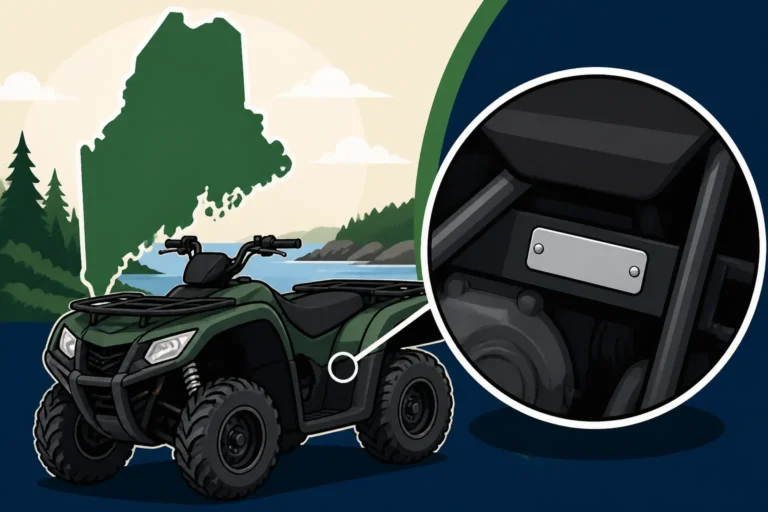
Where to find the VIN: On most ATVs, the VIN is stamped on the frame. Common locations include:
- On the front frame tube, often behind the front bumper.
- On the left or right lower frame rail, near the footpeg or engine.
- On the steering headstock (the part of the frame where the handlebars attach).
- Sometimes on a plate attached to the frame.
Always compare the VIN you find on the ATV itself to any paperwork the seller provides (registration certificate, bill of sale, or old insurance cards). If there’s any discrepancy, or if the VIN appears to have been tampered with, scratched off, or replaced, consider it a giant red flag and likely walk away from the deal. A clean, unaltered VIN is paramount for a legitimate purchase. For specific information on finding this crucial identifier, check out [Where the VIN Is Stamped on a Quad].
A VIN check can also reveal if the ATV has been reported stolen or has a salvage title in other states (though Maine doesn't title ATVs, other states do, and that history can sometimes be accessed). While Maine IF&W might not offer a full VIN history report to the public, there are often online services (some free, some paid) that can run a VIN check against national databases for stolen vehicles or insurance claims. This can be a worthwhile investment to ensure you're not buying a problem. Before you even think about registering a machine in your name, understanding the importance of [VIN Verification Before Registering in Maine] is a crucial step.
What to Do If the Registration Is Unclear or Missing
Sometimes, despite your best efforts, you might encounter a situation where the ATV’s registration status is murky. The seller might have let it expire years ago, or they might genuinely not have any records. This doesn't automatically mean it's a bad deal, but it does mean you need to proceed with extreme caution and understand the extra steps involved.
Red Flags and When to Walk Away
Knowing when to walk away is just as important as knowing what to look for. Here are some undeniable red flags regarding registration and ownership that should make you seriously reconsider the purchase:
- No Current Registration Paperwork: If the seller can't produce any valid registration document, even an expired one in their name, it's a major concern.
- Evasive or Uncooperative Seller: If they get defensive, change the subject, or refuse to let you check the VIN or contact IF&W, that’s a clear sign something is amiss.
- VIN Tampering: As mentioned, any signs of the VIN being altered, ground off, or replaced is an immediate deal-breaker. This often indicates a stolen machine or one with a highly problematic history.
- Discrepancies in Information: The VIN on the paperwork doesn't match the machine, or the seller's ID doesn't match the registered owner's name, without a compelling, documented explanation.
- Price Too Good to Be True: A suspiciously low price often hides underlying problems, and questionable registration is a common one.
Trust your gut feeling. If something feels off, it probably is. It's far better to miss out on a seemingly good deal than to buy a machine that will cause endless legal and financial headaches. For deeper insight into these kinds of challenging scenarios, take a look at [Buying an ATV With No Registration History].
Steps to Take for a Non-Registered Machine
If you've determined the machine hasn't been registered in Maine for a while, or the registration is severely expired, it doesn't always mean the end of the road. You can still purchase it, but you'll need to be diligent about establishing clear ownership for yourself.
The most critical piece of documentation you will need is a comprehensive bill of sale. This document serves as your official proof that you legally purchased the ATV from the person selling it. Make sure the bill of sale includes:
- The full names and addresses of both the buyer and seller.
- The date of the sale.
- The purchase price.
- A detailed description of the ATV, including make, model, year, and crucially, the complete and accurate VIN.
- Signatures of both the buyer and seller.
- Ideally, contact information for both parties.
Consider using a reputable template service like LawDepot to ensure your bill of sale is thorough and legally sound. Having a solid bill of sale is your best defense if you ever need to prove ownership, especially when there's a gap in the registration history. It is often the only proof you'll have. For more details on proving ownership without typical paperwork, consider reading [Proving Ownership Without a Bill of Sale].
The Process of Registering an Unregistered Used ATV
Once you've safely acquired an unregistered used ATV with a solid bill of sale, the next step is getting it properly registered in your name. As the new owner, you are responsible for initiating this first-time registration, even if the machine has been registered before but let lapse by previous owners.
Here's a general overview of what you'll need:
- Proof of Ownership: Your primary document will be the bill of sale from the person you bought the ATV from. Ensure it includes all the details mentioned above.
- Sales Tax: Maine requires sales tax to be paid on the purchase of ATVs, even from private sellers. If you haven't paid sales tax at the point of sale (e.g., to a dealer), you'll typically pay it when you register the ATV at your town office or online with IF&W. The sales tax is usually calculated on the purchase price listed on your bill of sale. For more information, see [Maine Sales Tax on an ATV Purchase].
- VIN: You'll need the ATV's VIN for the registration form.
- Identification: Your valid driver's license or other state-issued ID.
You can often complete the initial registration at your local municipal office if they are a designated registration agent. This is usually the quickest way to get your temporary registration certificate and get riding sooner. Alternatively, you can register online through the Maine IF&W portal, though for a first-time registration of a used machine with potentially incomplete history, an in-person visit might be smoother. [Maine ATV Registration After a Private Sale] delves deeper into what this process entails, ensuring you have all your ducks in a row for your first [First-Time Maine ATV Registration at the Town Office].
Key Documentation and Legal Considerations
Understanding the specific legal landscape in Maine regarding ATV ownership and registration is crucial. Because Maine handles ATVs differently from vehicles that receive traditional titles, certain documents become even more important for establishing and proving ownership.
The Importance of a Solid Bill of Sale
In Maine, where ATVs are not titled like cars, the bill of sale is truly your most important document of ownership after a private purchase. It's not just a receipt; it's a legal record of the transaction. A well-crafted bill of sale protects both the buyer and the seller by clearly stating the terms of the sale and transferring ownership. This becomes especially critical if you ever need to resolve a dispute, prove you own the ATV, or register it for the first time.
Beyond the basic information (names, addresses, date, price, VIN), a strong bill of sale should also include:
- Condition of Sale: "As-is" is common for private sales, but it's good to have it noted.
- Odometer/Hour Meter Reading: If applicable, record the current mileage or hours.
- Signatures and Dates: Ensure both parties sign and date the document.
- Witnesses: While not strictly required in Maine for an ATV bill of sale, having a witness sign can add another layer of legitimacy.
Think of your bill of sale as your ownership deed for your ATV. Keep it in a safe place! You can find excellent, customizable templates from resources like LawDepot, which can help you create a document that covers all the necessary legal bases. Having a properly worded document can make the difference between a smooth registration process and a bureaucratic nightmare. For specific language recommendations, see [Bill of Sale Wording for an ATV Sale].
Maine's Approach to ATV Titles and Registration
This is a point of frequent confusion for new ATV owners, especially those coming from states where powersports vehicles are titled. Maine does not title ATVs. What this means is that there is no separate document, similar to a car title, issued by the state to prove ownership. Instead, your primary proof of legal ownership and the right to operate the ATV comes from its registration certificate and, for private sales, a robust bill of sale.
Because there's no title to transfer, the registration process itself is the mechanism by which the state recognizes you as the operator and, implicitly, the owner. When you register an ATV in Maine, IF&W records your name as the registrant associated with that particular VIN. This is why having a clear path from the previous owner to you, supported by a bill of sale, is so vital. It bridges any gaps in the registration history. Understanding this distinction is fundamental to navigating ATV ownership in the state. If you're still fuzzy on this, [Does Maine Title ATVs?] can provide even more clarity.
Protecting Yourself as a Buyer
Beyond the paperwork, there are practical steps you can take to protect yourself when buying a used ATV from a private seller:
- Meet in a Safe, Public Location: Avoid meeting at isolated locations. A well-lit, public place, or even the seller’s home if you feel comfortable, can offer more security.
- Verify Seller's Identity: Ask for their driver's license to confirm their name and address match what's on any registration paperwork or bill of sale.
- Perform a Pre-Purchase Inspection: Even if you're not a mechanic, give the ATV a thorough once-over. Check for obvious damage, fluid leaks, tire condition, and ensure the engine starts and runs smoothly. If you're unsure, consider bringing a knowledgeable friend or even paying a local shop for a quick inspection. This isn't just about registration, but overall value and safety. [Pre-Purchase Inspection Before You Buy a Quad] provides a great checklist.
- Don't Rush the Transaction: Take your time, ask all your questions, and review all documents carefully. A seller pressuring you to hurry is another red flag.
- Clear Sale Agreement: Make sure your bill of sale explicitly states everything that's included in the sale (e.g., accessories, spare parts). Using a template from LawDepot can assist in crafting a comprehensive agreement. Detailed advice on [Writing a Safe ATV Sale Agreement] will help you secure your purchase.
By combining thorough document verification with practical buyer precautions, you can significantly reduce the risks associated with buying a used ATV in Maine and ensure your new adventure starts on solid ground.
Navigating Registration Status: Scenarios and Actions
To summarize and provide clear next steps, here's a helpful table outlining different registration scenarios you might encounter when buying a used ATV in Maine, along with recommended actions.
| Registration Status Scenario | Description | Buyer's Action / Recommendation |
|---|---|---|
| Clear & Current | Seller provides valid, unexpired registration in their name, matching VIN. | Best Scenario. Verify VIN, owner ID, and match to ATV. Get a detailed bill of sale. You can immediately register it in your name, paying any applicable sales tax, and be ready to ride. |
| Expired (in Seller's Name) | Seller provides expired registration in their name, matching VIN. | Good Scenario. Verify VIN, owner ID, and match to ATV. Get a detailed bill of sale. You will need to complete a new registration in your name and pay sales tax. This is a common situation for used ATVs. |
| Never Registered in Maine | Seller claims they never registered it, or it was used solely on private land. | Caution Required. If they have original purchase paperwork (e.g., from a dealer) and a bill of sale to them, proceed cautiously. Verify VIN. Get a detailed bill of sale from them to you. You will be doing the first-ever Maine registration for that VIN and will pay sales tax. |
| Unknown / Missing Paperwork | Seller has no registration, no original purchase paperwork, or vague answers. | High Risk. This is a significant red flag. Unless you have absolute certainty of ownership (e.g., from a long-time trusted friend or family member), it's generally best to walk away. If you proceed, obtain a very thorough bill of sale and be prepared for potential hurdles when you attempt to register it yourself. |
| Name Discrepancy | Registration in a different name than the seller's, without explanation. | Immediate Red Flag. Do NOT proceed without a clear, documented chain of ownership from the registered name to the seller. This typically means previous bills of sale bridging the gap. Without it, you could be buying a stolen or unlawfully possessed machine. |
| VIN Tampered/Missing | VIN is altered, unreadable, or doesn't match paperwork. | Absolute Deal-Breaker. Do NOT buy. This is highly indicative of a stolen vehicle or serious legal problems. |
Remember, your diligence as a buyer is your strongest protection. By understanding Maine's unique registration requirements and knowing what questions to ask and documents to verify, you can ensure your next ATV purchase is a smooth journey from start to finish. Happy trails!
Disclaimer
This article is for general informational purposes only and does not constitute professional advice. Laws, prices and regulations vary by location and change over time. Consult a qualified professional for guidance on your specific situation.