Getting Help on a Remote Trail
A breakdown or injury on a remote Maine ATV trail can feel much bigger when your phone has no signal and the nearest road is miles away. The safest response is to pause, assess what happened, and make it easier for someone to find you. This guide explains how to prepare, contact help, share your location, and handle common trail emergencies.
Before You Ride, Make It Easier to Get Help
Tell someone where you’re going
Before leaving the trailhead, tell a reliable person your route, where you plan to park, who is riding with you, and when you expect to return. Be specific: “riding near Greenville” is less useful than naming the trailhead, planned route or destination, and likely turnaround point.
Agree on a check-in time and what that person should do if you miss it. For example, they might try calling you first, then contact local emergency services if they cannot reach you and have reason to believe you may be in trouble. Give them your machine description and trailer details, too. If the trail plan changes, update them when you can.
This simple step is especially important on a solo ride or a route with long stretches between towns. It also gives a friend or family member useful information if you end up waiting for help without cell service. For more preparation ideas, see What to Carry on a Remote Trail Ride and Riding Trails Solo Safely.
Pack for a delay, not just the ride
A short planned ride can take longer than expected. A machine may need a repair, a trail may be blocked, or a rider may get hurt. Pack enough essentials to stay warm, visible, hydrated, and able to communicate while you wait. Consider bringing:
- A charged phone, plus a portable power bank and charging cable
- A paper map or offline map that covers the route
- A first-aid kit and any personal medication you may need
- Water, food, and an extra insulating layer
- A flashlight or headlamp
- A whistle and a bright-colored cloth or vest
- Basic tools and any small repair supplies suited to your machine
- A satellite messenger or other communication device if the route has limited coverage
Keep emergency supplies somewhere you can reach even if the ATV or UTV is difficult to access. A first-aid kit strapped inside a loaded cargo box may not help much if the box is jammed or the vehicle is on its side.
A map app such as onX Offroad can help you review routes and save map information for offline use before leaving coverage. Do not treat a phone map as your only navigation tool: batteries fail, devices get damaged, and GPS location on a screen does not guarantee that you can contact anyone. Pair it with a paper map and a clear route plan. For coverage planning, read Maine Cell Dead Zones on ATV Trails and Navigating Trails Without Cell Service.
Check trail access and conditions
A planned route can become unusable because of a closure, damage, mud, or a landowner’s decision to withdraw access. Check trail information before you drive to the staging area, and look for current notices from the relevant club or local authority. A route shown on an older map is not proof that it is open today.
This matters in Maine because many ATV trails cross private land. If you encounter a closure or an unclear sign, do not assume you can continue simply because the trail appears on a map. Turn around where it is safe, follow posted directions, and avoid creating a new route around a blockage. Checking Maine Trail Status Before You Drive and Landowner Relations on Maine ATV Trails offer useful background.
What to Do When Something Goes Wrong
Stop, assess, and avoid making the problem worse
When a machine stops working or someone is hurt, take a moment to make the scene safer before trying to solve the original problem. Move out of the path of other riders or traffic if you can do so safely. If the ATV or UTV is unstable, leaking fluid, near a steep edge, or obstructing a narrow trail, do not put yourself at greater risk trying to move it.
Check riders for injuries and identify whether anyone needs urgent medical attention. If someone may have a serious injury, avoid moving them unless staying where they are creates immediate danger. Keep them warm, offer reassurance, and watch for changes while you arrange help. Do not let an injured person ride out just because they say they feel able to; pain, shock, or a head injury can make it difficult to judge what is safe.
If the issue appears to be mechanical and everyone is uninjured, decide whether a simple repair is safe and within your ability. A loose connection or flat tire may be manageable with the right tools; a damaged steering component, fuel leak, or unstable machine is a different situation. If you are unsure, stop working and focus on getting help rather than risking a worse breakdown.
Try communication options in a sensible order
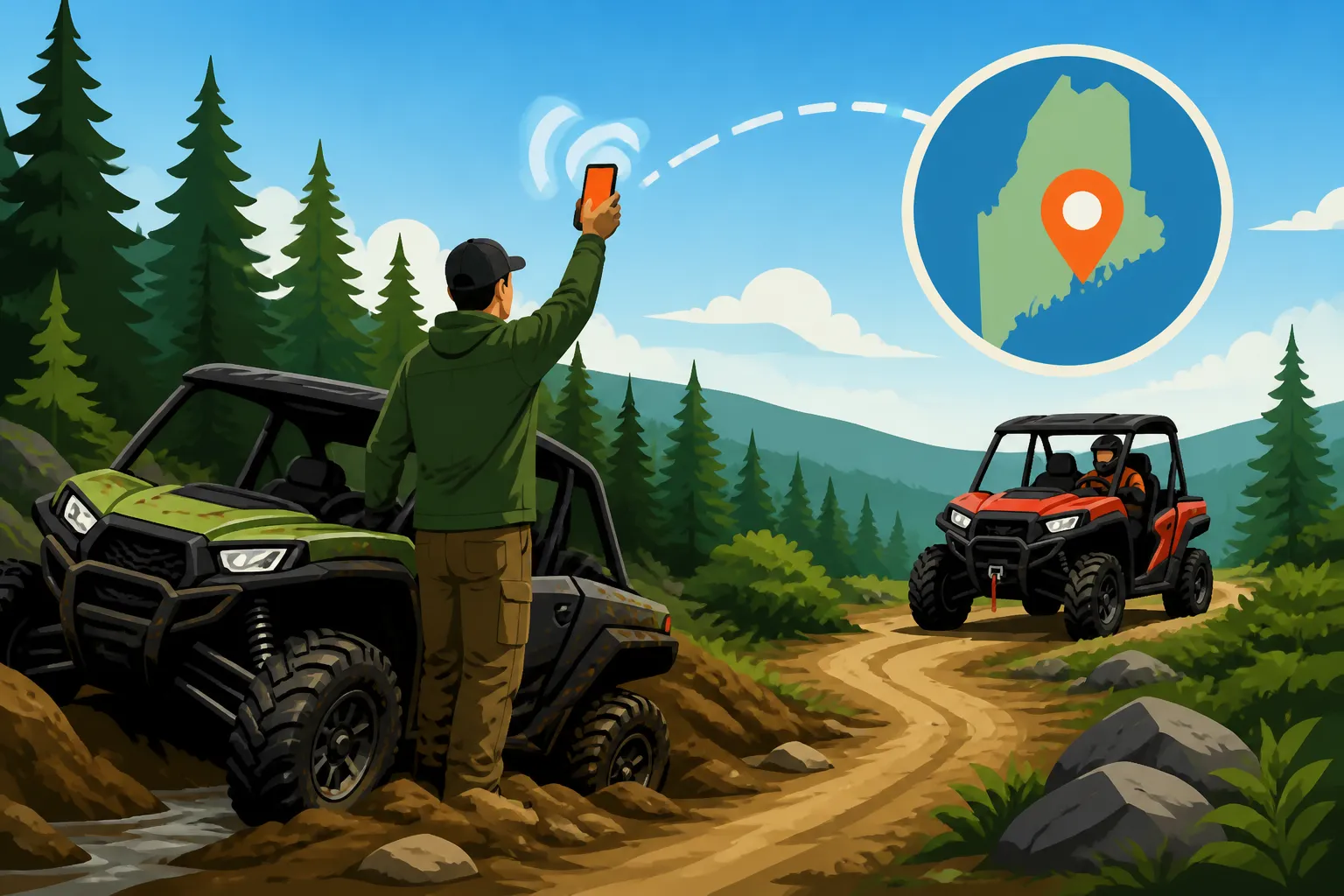
If there is an emergency, try calling 911. A call may connect even when ordinary service seems weak, so it is worth trying from a safe location. If you can’t get through, don’t keep moving randomly in search of a signal, especially if someone is injured or you are uncertain where the trail goes.
If you have a satellite messenger or satellite communication device, use its emergency function according to the device instructions. Some devices allow a user to send a distress message with location information; others support messages to selected contacts. Set up the device and learn how it works before the ride, not while you are cold, stressed, and trying to find the right menu.
If you have no working communication, stay with your group and your machine unless remaining there is unsafe. A machine is easier for rescuers to spot than a person walking through unfamiliar woods, and leaving it can make your location harder to determine. If your group has to split up for a compelling safety reason, make sure someone remains with the injured or stranded rider whenever possible. See Satellite Messengers for Backcountry Riders for more on planning communication beyond cell coverage.
Share details that help rescuers find you
When you reach emergency services or a trusted contact, give clear information slowly. Start with the nature of the problem and whether anyone is injured. Then share your location as precisely as you can, the number of people in your group, your machine type and color, and any immediate hazards.
A useful report might sound like: “We are two riders on green ATVs, stopped at a trail junction north of the trailhead we left from. One rider has a leg injury. We are staying with the machines.” If you can read coordinates from your phone or GPS, provide them carefully and state which format the device shows. A dropped pin or screenshot may help if you can send it, but explain the location in words too.
Trail names, junction signs, mile markers, nearby roads, bridges, and recognizable landmarks can all help. If the trail has no signs, describe the direction you traveled, the last known place you passed, and how long you have been moving since then. onX Offroad may help you identify your position or nearby mapped features, but give rescuers the actual location details shown on your device rather than assuming they can see your map.
How to Wait Safely and Help Others Find You
Stay visible and conserve energy
Once you have called or sent a distress message, avoid unnecessary travel. Stay near the machine if it is safe, keep your group together, and conserve phone battery by limiting screen use. If you are waiting in cold or wet conditions, add layers early rather than waiting until you are shivering. Keep dry clothing protected from rain and avoid sitting directly on cold or wet ground.
Make yourselves easier to see without creating another hazard. Use a bright layer, reflective material, or a flashlight when appropriate. A whistle can carry farther than a shouted voice and takes less energy to use. If it is safe to do so, position the group where rescuers can see you from the trail, but do not stand in the path of oncoming machines or vehicles.
If you have a satellite messenger, keep it powered and follow its instructions for staying available to the people responding. Keep your phone on if possible, but use a battery-saving mode if you are waiting for a callback. Avoid repeatedly sending messages that might create confusion; follow the device’s guidance and keep updates clear if your situation changes.
Don’t turn a breakdown into a search problem
Walking out may seem faster, but it can create a second emergency. You could lose the trail, get separated from your group, worsen an injury, or leave rescuers looking in the wrong place. If a person must leave the machine to reach help, make that decision only after considering the injury, weather, daylight, terrain, and whether anyone else can remain behind.
If you do need to move, leave a clear note at the machine with the direction of travel, the time you left, the number of people, and the reason. Take a map, communication device, water, warm clothing, and light if available. Stay on a known trail rather than cutting through the woods, and avoid splitting a group into smaller parties without a clear plan.
A trail app can be useful for retracing a route, but it cannot assess whether a route is safe to walk or whether a machine can get through. onX Offroad can be one part of your navigation plan when its maps are downloaded in advance; it should not replace judgment, preparation, or a physical backup map.
Understand what local responders may need
Emergency response in a remote area can involve locating the trail access point, identifying the right route, and reaching a place where an ATV or UTV can travel. Give dispatchers the information they request, and follow their instructions. Do not assume that a warden or rescue team is already patrolling nearby or can reach every location quickly.
For a non-emergency mechanical problem, a riding partner, club contact, property owner, or local service may be able to help, but respect private property and do not expect someone to access land without permission. If a responder asks you to stay put, do so unless remaining there becomes unsafe. If you need to move because of immediate danger, communicate the change as soon as possible.
After an incident, follow applicable reporting requirements and keep a record of what happened. For guidance on reporting a crash, see Maine ATV Accident Reporting Rules. If you’re curious about enforcement and patrols, Maine Warden Service ATV Patrols explains why riders should not rely on a routine patrol as their emergency plan.
A Simple Decision Guide for Trail Emergencies
| Situation | First priority | What to do next |
|---|---|---|
| Serious injury or immediate danger | Protect people from further harm | Call 911, share your location, and follow instructions |
| Broken machine with no injuries | Keep the group and machine safe | Try only a repair you can do safely; otherwise arrange assistance |
| No cell signal | Avoid wandering without a plan | Try 911, use a satellite device if available, and stay in a safe, known location |
| Lost or uncertain location | Stop moving and compare available map information | Use coordinates, trail signs, junctions, and the last known point to describe your position |
| Weather or darkness becoming dangerous | Keep people warm and visible | Add layers, conserve battery, and update your contact or responders |
The best emergency plan is one you can use when you are tired, worried, or dealing with an injured riding partner. Share your route before departure, pack for a delay, download maps in advance, and know how your communication devices work. Those steps cannot prevent every breakdown or accident, but they can make it much easier to explain where you are and get the right help.
Disclaimer
This article is for general informational purposes only and does not constitute professional advice. Laws, prices and regulations vary by location and change over time. Consult a qualified professional for guidance on your specific situation.