No Trespassing Signs and ATV Riders
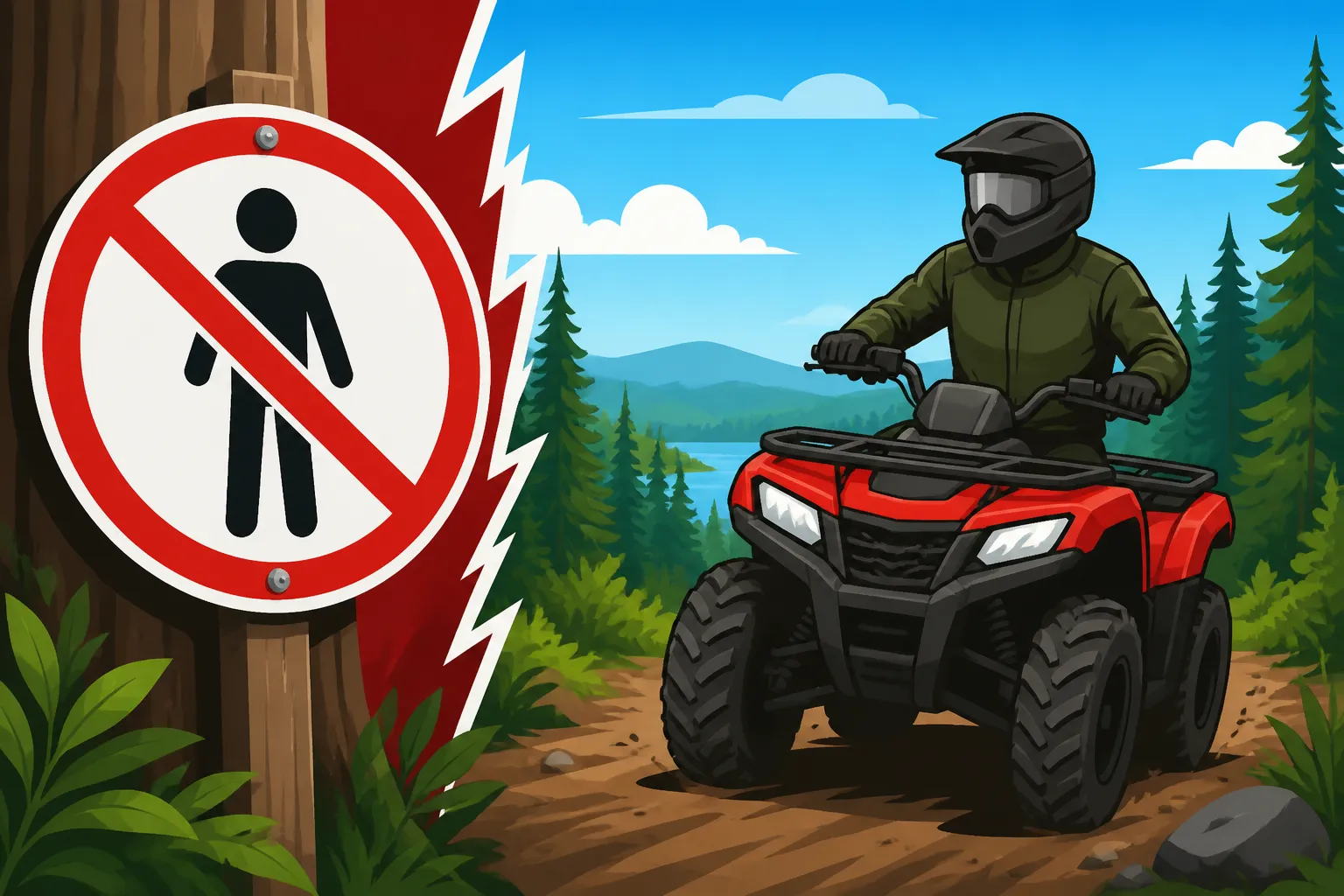
A marked trail, familiar woods road, or route shown on a map can make it seem safe to keep riding. But a No Trespassing sign can change the situation, especially where Maine ATV trails cross private land. The safest approach is to treat the sign as a boundary, not a suggestion: stop, confirm who controls the land and whether your route is authorized, and do not ride through on an assumption.
What a No Trespassing Sign Means for ATV Riders
In Maine, a large share of ATV trails crosses private property. Landowners may allow a club or trail organization to maintain and use a route, but that permission is limited to the agreed trail and conditions. It does not automatically give every rider permission to explore adjoining woods, take a shortcut, or continue past a sign.
A No Trespassing sign is a clear warning that you should not enter the marked property or area without permission. It may apply to an entire parcel, a particular road, a field, or a section of woods. The sign might be beside the trail, at a driveway, or near a gate. Its exact placement can be hard to interpret from a machine, which is a reason to stop rather than guess.
An ATV registration does not give you access rights. Nor does a trail map, a GPS line, a prior trip through the area, or a route’s appearance. These can help you plan, but none proves that a landowner currently allows riding there. For the difference between having a registered machine and having permission to use a trail, see What Maine ATV Registration Does Not Cover.
Signs can also be one part of how a landowner communicates that access is restricted. Maine recognizes purple paint markings as well as posted signs in some situations. If you see purple paint, a gate, a chain, or other obvious restriction, do not assume the route remains open because you have ridden it before. Maine Trespass Law for ATV Riders and Maine ATV Rules on Posted Land offer more detail on how posted property affects riders.
A sign may apply even when the trail looks established
A trail can remain visible after permission has changed. Tire tracks, old markers, a worn bridge, or a trail line on a navigation app are not proof of current access. A landowner may close a route, restrict it to a particular club, or permit use only during certain conditions.
This can be confusing when a sign appears to interrupt an established trail. The sign may be directed at people entering a side road, or it may close the trail itself. From the trail, you may not be able to tell. Don’t cross the marked boundary just to find out. Contact the local ATV club, landowner, or other organization responsible for the route and ask whether the specific section is open.
| What you encounter | Safer response |
|---|---|
| A No Trespassing sign at the trail edge | Stop before entering the marked area and confirm that the route is currently authorized. |
| A sign on a side road or driveway | Do not use that access unless you have permission; check whether the main trail continues on an authorized route. |
| A gate, chain, or barricade | Do not go around, lift, or drive over it. Treat it as a closure. |
| Purple paint or other posted markings | Treat the area as restricted unless you have clear, current permission. |
| A sign that conflicts with a map or GPS track | Follow the sign until the route’s status is confirmed. |
| A trail you rode in a previous season | Check its current status; prior access does not establish ongoing permission. |
Signs are not invitations to negotiate from the machine
If the sign lists a contact number or identifies a club, you can use that information later, from a safe and appropriate place. Avoid riding up to a home or entering a driveway to ask. If you cannot identify the person responsible, turn back and check with the club or local trail organization.
Do not move a sign, open a gate, or follow tracks around a closure. Those actions can make it harder for the landowner to control access and can put future trail access at risk for other riders. If you think a marker was placed by mistake or that a route is still approved, verify that before continuing.
How to Handle Signs on or Near a Maine ATV Trail
Treat access signs as current unless a reliable, up-to-date source confirms otherwise. Clubs often work with landowners to keep trails open, but a club map or trail marker cannot always communicate a new closure immediately. When a sign conflicts with what you expected, pause the ride and check before proceeding.
Stop, locate the boundary, and avoid entering
When you see a sign, slow down and stop before crossing the point where it applies. Do not drive beyond it to look for another marker or to decide whether the sign is meant for you. Take note of the sign’s location and what it appears to restrict, without entering the land to get a closer look.
If a safe turnaround is available, return to the last confirmed open junction. Do not cut across private property to rejoin the trail. A detour that looks harmless on a screen may cross land that has not been opened to ATV use.
Check with the right person
The local ATV club is often a useful first contact when a sign appears on a club trail. The club may know whether a section is closed, whether a landowner has changed access terms, or whether a reroute is available. If the club cannot confirm access, contact the landowner or the organization responsible for managing the route.
Ask about the exact segment, not just the general trail. A useful question is whether ATV riders are currently authorized to pass the sign on that particular road or trail. If access is allowed only for certain dates, machines, or directions, confirm those details too.
For a route that crosses private land, Asking a Landowner for Permission to Ride explains how to make a clear request. If permission is granted, written confirmation can help avoid misunderstandings about where you may ride and what conditions apply. See Getting Written Permission to Ride Private Land.
Respect a closure even if you think it is temporary
A sign may be posted because of mud, logging, repairs, hunting activity, a landowner’s request, or a permanent withdrawal of access. You may not know the reason, and you do not need to determine it before turning around. If the landowner or club later confirms that the route has reopened, you can use it under the terms they provide.
Closures can happen during the riding season. A route’s status when you planned a trip may differ from its status on the day you arrive. Check for recent notices before setting out and again when you reach an unfamiliar section. Trails Closed by a Landowner Mid-Season and Losing Permission on a Maine Trail explain why access can change and what riders should do when it does.
Permission, Club Trails, and Common Misunderstandings
The central issue is not whether the trail looks public. It is whether the landowner or responsible authority has allowed ATV use on that particular route. A sign can signal that the permission riders assumed is missing, restricted, or no longer in effect.
A club trail is not a blanket right to roam
Clubs may develop and maintain trails through agreements with landowners. The agreement may cover a narrow corridor, a particular season, or defined operating conditions. Riders should stay on the marked route, follow club notices, and avoid widening the trail or creating side paths.
If a No Trespassing sign appears directly on a trail that is normally marked, do not decide on your own that the club’s permission overrides it. The sign may have been posted by the landowner after a change in access, or it may apply to the entire route. The club can help determine whether there is an authorized reroute, but until the conflict is resolved, do not ride past the sign.
Even a sign that appears old or weathered should be treated seriously. It may still communicate the landowner’s wishes. Report it to the relevant club rather than removing it or riding through.
Verbal permission needs clear boundaries
A landowner may give permission directly, but a casual conversation can leave important details unclear. Confirm where the permission starts and ends, what machine types it covers, whether passengers or guests are included, and whether the access is temporary. Ask whether you must use a particular gate or stay on a specific track.
Permission from one landowner does not authorize travel across neighboring land. A route may cross several parcels, each with separate access terms. If one section is closed, you cannot assume another landowner’s permission allows you to bypass it.
This is especially important for riders visiting from out of state. Registration or reciprocity rules concern whether your machine may be registered or operated under particular conditions; they do not grant permission to cross private land. Plan the route and access separately from the registration question.
Don’t rely on what other riders do
Seeing another ATV pass a sign does not establish that you have permission. That rider may have direct authorization, may be on an approved work detail, or may simply be trespassing. Likewise, a route displayed in an app may be outdated or may show a road without indicating current landowner permission.
Treat digital maps as planning tools, not legal confirmation. If you use a phone or GPS device, mark the last confirmed access point and be prepared to turn around when you reach a closure. Carrying a paper map can help you retrace your route if service is unavailable, but it cannot replace permission from the people who control the land.
A Practical Plan Before and During Your Ride
A little checking before departure can prevent an uncomfortable stop or an avoidable conflict. It also helps protect the relationships that keep private-land trails open.
- Check current trail notices. Look for updates from the club or organization that maintains the route, especially after weather, logging activity, or a reported closure.
- Confirm unfamiliar sections. If a route crosses private land or a posted area, ask whether ATV access is currently authorized on the exact segment you plan to use.
- Stay on the marked trail. Do not explore side roads, fields, logging spurs, or shortcuts unless they are clearly open to ATV traffic.
- Stop at signs and barriers. Do not go around a gate or cross a posted boundary while you investigate.
- Turn back when access is uncertain. Use the last confirmed open trail rather than improvising a detour across private property.
- Report conflicting information. Tell the club about the sign’s location and what the map or trail markers show. Do not remove or alter the sign.
- Keep a record of permission. If a landowner has granted access for a specific ride or route, save the message or written agreement and follow its limits.
No Trespassing signs are not a challenge to find another way through. They are a cue to stop and verify access. When permission is unclear, choose a confirmed open route and contact the people responsible before returning. That approach helps riders avoid trespass disputes and supports the trust on which many Maine ATV trails depend.
Disclaimer
This article is for general informational purposes only and does not constitute professional advice. Laws, prices and regulations vary by location and change over time. Consult a qualified professional for guidance on your specific situation.