Trailhead Parking That Fits a Trailer
Finding a Maine ATV trailhead with enough room for a truck and trailer can be harder than choosing the ride itself. A parking lot may look open on a map but prove too tight for turning, backing, or unloading. This guide explains how to assess a trailhead before you leave, plan for your rig, and avoid blocking roads or private access.
Plan for the full truck and trailer footprint
Measure your setup before choosing a trailhead
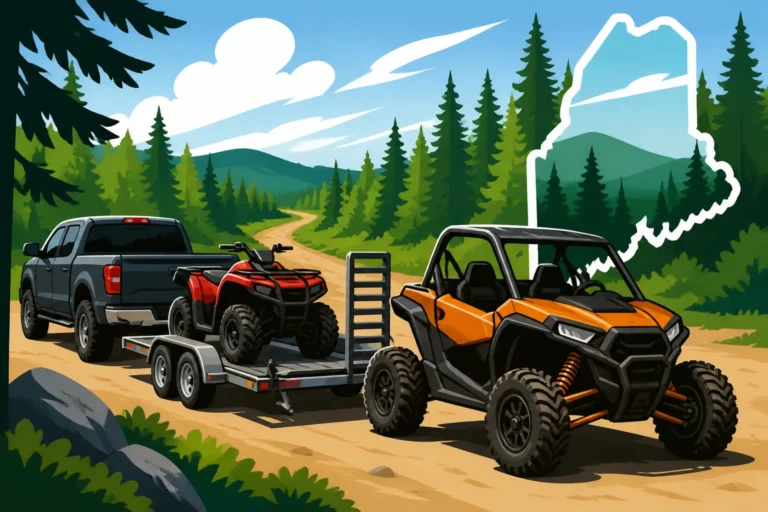
Start with the combined length of your tow vehicle and trailer, not just the trailer’s advertised length. Measure from the front of the truck to the rear of the trailer with the two connected. Also record the trailer width, the turning space you need, and how much room you use to lower ramps and unload machines. If you bring more than one ATV or UTV, account for the space needed to move each machine safely.
A parking space that fits your truck may not fit your whole rig. For example, a pickup could fit in a regular space while the trailer extends into a travel lane or blocks access to another vehicle. A long trailer may also need room to swing wide when turning into a lot. If you are unsure whether a space is workable, plan as though you’ll need more room than the trailer’s dimensions alone suggest.
Consider what you will do after parking, too. You might need space to open a ramp, walk around the machine, strap down loose gear, or turn the truck around before leaving. A tight spot can become especially frustrating when other riders arrive while you are unloading. A little extra room makes the start and end of the ride calmer—and helps keep the lot usable for everyone.
Check the whole approach, not just the parking symbol
A map pin can show where a trail begins without telling you whether the final approach suits a truck and trailer. Look at the roads leading in, the entrance angle, and whether there is a practical way to turn around if the lot is full. Narrow lanes, sharp corners, steep driveways, soft shoulders, and low clearance can make a route unsuitable even when the destination itself appears spacious.
Use a combination of current trail information, local directions, and mapping tools. onX Offroad can help you understand the surrounding trail network and plan a route, but a mapped access point is not a guarantee of trailer parking, permission, or available space. Check the relevant club or land manager’s information when possible, and call ahead if parking details are unclear. You can also review [Maine ATV Trail Maps and Club Boundaries](Maine ATV Trail Maps and Club Boundaries) to understand how the route relates to the trail system.
Pay attention to whether directions lead to a public staging area, a business, a club facility, or a private road. Those are not interchangeable. A business lot may be intended for customers, and a private entrance is not automatically open for trailer parking. If you cannot confirm that a location welcomes your vehicle and trailer, choose a different staging point rather than assuming you can use the space.
Use a parking checklist before you commit
A quick check can prevent a long reverse maneuver on a narrow road. Before driving to the trailhead, confirm the parking location, permitted use, access route, turnaround options, and whether the surface is suitable for your vehicle. If your rig is large, ask specifically whether there is room for the combined truck-and-trailer length—not simply whether “parking” is available.
Use this checklist when comparing possible starting points:
| What to check | Why it matters | What to do if unclear |
|---|---|---|
| Space for the connected rig | A trailer can extend beyond a standard vehicle space | Ask about usable length or choose a larger staging area |
| Turning and backing room | Tight entrances can make parking difficult or unsafe | Inspect the approach and have a backup location |
| Legal permission to park | Some lots or roads are private or restricted | Confirm with the club, land manager, or property owner |
| Surface and slope | Loose ground or a steep grade can complicate parking and unloading | Avoid a spot that may not support the loaded vehicle |
| Room to unload | Ramps and machines need clear space | Plan to unload without blocking traffic or other spaces |
| Overnight rules | A place that works for a day ride may not allow overnight parking | Ask before leaving a vehicle or trailer overnight |
For a broader look at staging choices, read [Maine ATV Trail Parking and Staging](Maine ATV Trail Parking and Staging). It can help you think through how parking, unloading, and trail access fit together rather than treating the trailhead pin as the whole plan.
Choose a parking option that suits your rig
Look for a designated staging area first
A designated staging area is often the simplest choice because it is intended to serve trail users. Even so, do not assume every staging area can accommodate every combination of truck, trailer, and machines. Some spaces may be limited, shared, seasonal, or affected by local conditions. Verify access and parking instructions before setting out, particularly if you are traveling with a long trailer or several vehicles.
When comparing options around areas such as Greenville, Jackman, Millinocket, or Aroostook County, focus on confirmed access rather than choosing a spot just because it appears close to a trail on a map. The best starting point may be a few miles from your preferred section but offer a safer approach and more room to unload. A short drive to a suitable lot can be preferable to trying to maneuver a trailer in a crowded or uncertain location.
If a staging area is busy, park within marked or otherwise designated spaces and leave room for other users to enter and exit. Keep ramps, machines, and gear out of travel lanes. On a busy weekend, arriving early may reduce the chance of finding a full lot, but have a second approved option ready. [Busy Maine Trails on a Holiday Weekend](Busy Maine Trails on a Holiday Weekend) is useful background for planning around heavier trail use.
Ask local clubs or businesses when details are missing
Trail clubs and local businesses can often clarify what a map cannot: where riders are expected to park, whether trailers are accommodated, and whether a particular access point is currently usable. Ask clear questions. Instead of asking only, “Is there parking?” try: “Can a pickup with a connected trailer about this long park and turn around there?” Include the number of machines and whether you need daytime or overnight parking.
A local business may offer parking only for its customers or may have limited space during peak periods. Confirm the arrangement rather than treating a visible lot as public parking. Likewise, do not pull into a driveway, field entrance, or wide shoulder simply because it seems large enough. A space can be physically convenient but still block farm equipment, emergency access, logging traffic, or a landowner’s daily use.
If you plan to leave your tow vehicle or trailer overnight, get explicit permission and ask where it should be left. Overnight parking can have different rules from daytime staging, and an unattended trailer can cause concern if it is left in an unapproved area. For planning a longer trip, see [Overnight Trailer Parking in Trail Towns](Overnight Trailer Parking in Trail Towns) and [Planning a Multi-Day Ride Across Maine Trails](Planning a Multi-Day Ride Across Maine Trails).
Keep a backup lot in your plan
A backup parking option matters because trail conditions, events, and crowding can change your plan after you are already on the road. Save a second approved location before leaving home and note how to reach it. Do not rely on turning around wherever convenient: narrow rural roads, soft shoulders, and limited sightlines can make an improvised turn risky for a long trailer.
Mapping apps can help you compare routes, but use them as planning aids, not proof that a road or lot is suitable. onX Offroad can help you orient yourself to trails and nearby access points; pair that information with local confirmation about parking and permission. Save useful details before the drive, especially if you expect unreliable cell service. Check [Checking Maine Trail Status Before You Drive](Checking Maine Trail Status Before You Drive) for another important part of a pre-trip check.
If you arrive and the lot is full, do not create a new space by blocking a gate, trail entrance, driveway, or roadway. Move to your backup location or contact the relevant club or property manager for guidance. A few extra minutes of planning can prevent a stressful unload and help preserve access for the next rider.
Arrive, park, and unload without creating problems
Make your arrival easy for other trail users
When you pull in, pause long enough to assess the lot before committing to a spot. Look for marked spaces, signs, gates, and vehicles that may need room to maneuver. If you need to back in, use a spotter when available and agree on simple signals before moving. Keep people clear of the trailer’s path, and stop if you lose sight of the spotter.
Park so the truck and trailer remain within the space intended for them. Avoid taking two areas unless the lot explicitly allows it, and leave room for other vehicles to pass. If the only available place would force you to block an entrance or extend into a road, do not use it. Choose your backup site instead. A crowded lot is inconvenient, but making it harder for emergency vehicles, residents, or other riders to move through can create a much bigger problem.
Unload with the same care. Keep ramps stable, watch for uneven ground, and move machines away from the entrance once they are ready. Do not leave straps, ramps, or gear where someone could trip or drive over them. The more orderly the unloading process, the less likely you are to frustrate other users or damage the parking area.
Respect land, signs, and trail access
Maine trail access depends on respecting the people and properties that make riding possible. A trail entrance beside a private road does not give riders permission to park on the road or adjacent land. Follow posted instructions, close gates if required, and avoid blocking access used by landowners, forestry operations, or local residents. [Maine ATV Trail Etiquette With Landowners](Maine ATV Trail Etiquette With Landowners) offers useful reminders for keeping those relationships positive.
Check for restrictions before you ride. A trail may be closed, a route may have changed, or a parking area may have different instructions than you expected. Where the trail system crosses private property, stay on the authorized route and do not use an unmarked shortcut to reach a more convenient parking spot. If access is unclear, ask rather than guessing.
Finally, carry out everything you bring in. Take packaging, food containers, straps, and other waste with you, and leave the space as clean as you found it. A tidy staging area is more welcoming to the next group and supports continued access for riders.
Use a simple pre-departure routine
Before pulling out, walk around the truck and trailer. Confirm that ramps and gear are secured, the trailer connection and safety equipment are in order, and no item has been left behind. Check that the parking spot is clear and that you have room to exit without cutting across another vehicle’s space.
Before the ride, make one last check of trail status and local directions. onX Offroad may help you keep your route oriented, but use local trail information for closures and access rules. If you are riding with a group, share the parking location and backup plan so late arrivals do not improvise a separate, unapproved staging spot. For visitors bringing a trailer into a new area, the guide to [Maine ATV Trail Maps and Club Boundaries](Maine ATV Trail Maps and Club Boundaries) can support route planning, while [Maine Trail Openings and Mud Season](Maine Trail Openings and Mud Season) helps explain why seasonal conditions deserve a final check.
A workable trailhead is not merely one where the trailer can fit. It is a place where you can enter, park, unload, and leave without blocking others or using land without permission. Measure your rig, confirm the details, and keep an alternate location in mind. That small amount of preparation can turn the parking part of the trip from a guessing game into a smooth start.
Disclaimer
This article is for general informational purposes only and does not constitute professional advice. Laws, prices and regulations vary by location and change over time. Consult a qualified professional for guidance on your specific situation.