Tying an ATV Down for the Highway
There’s nothing quite like the feeling of anticipation when you’re loading up your ATV or UTV, ready for a weekend of adventure on Maine's incredible trails. But that excitement can quickly turn into dread if you don’t properly secure your machine for the drive. Many riders underestimate the forces at play on the highway, leading to machines shifting, straps failing, and even serious accidents. This guide will walk you through everything you need to know to tie down your ATV or UTV safely and securely, ensuring your machine—and everyone else on the road—arrives at the trailhead without incident.
Why Proper Tie-Down Is Non-Negotiable for Highway Travel
Think about all the bumps, sudden stops, quick accelerations, and evasive maneuvers you might encounter on a highway trip, especially when you’re driving through winding sections of Route 9, or dealing with construction delays on I-95. These aren't just minor jiggles for your ATV; they are significant forces that can make an unsecured machine a dangerous projectile.
An ATV or UTV weighs hundreds, if not over a thousand, pounds. When that much weight isn't properly anchored, it can shift violently, potentially damaging your trailer, your towing vehicle, and the machine itself. Far more critically, it poses an immense safety risk to other drivers on the road. Imagine an ATV coming loose at highway speeds—it’s a terrifying thought, and unfortunately, it's a scenario that has led to devastating consequences. Taking the time to do it right isn't just about protecting your investment; it's about being a responsible member of the motoring public.
Protecting Your Investment
Your ATV or UTV represents a significant investment, from the initial purchase price—which can involve quite a bit of [Maine Sales Tax on an ATV Purchase]—to all the upgrades and maintenance you put into it. The last thing you want after a long drive is to find dents, scratches, or even structural damage from your machine bouncing around on the trailer. Even seemingly minor shifts can cause components to rub against the trailer bed or other parts of the machine, leading to cosmetic damage that devalues your quad and is simply frustrating to deal with.
Beyond the visible damage, constant jarring can loosen bolts, stress suspension components, and even affect engine mounts over time. Proper tie-down distributes these forces evenly, minimizing wear and tear during transport. It’s an act of preventative maintenance that extends the life and maintains the value of your machine, allowing you to focus on enjoying the ride once you hit the trails, rather than worrying about what might have broken on the way.
Ensuring Road Safety for Everyone
While damage to your own property is certainly a concern, the paramount reason for meticulous tie-down is the safety of everyone on the highway. An improperly secured ATV or UTV can become detached from the trailer, falling onto the roadway or even flying into other vehicles. The results of such an event can be catastrophic, leading to serious injury or even fatalities. This isn't just a theoretical danger; accidents involving unsecured cargo happen every year across the country.
Even if your machine doesn't fully detach, a shifting load can make your trailer unstable, causing it to sway uncontrollably, especially at higher speeds or during braking. This instability can lead to a loss of control of your towing vehicle, putting you and your passengers at grave risk. You could face significant legal penalties if you're involved in an accident due to an unsecured load, not to mention the emotional burden. Always remember that when you're on the highway, you're sharing the road, and your actions directly impact the safety of others.
Essential Gear for Secure ATV/UTV Transport
Before you even think about backing your ATV onto a trailer, you need to make sure you have the right equipment. Skimping on tie-down gear is a false economy that can cost you dearly in the long run. There's a wide range of options out there, but certain items are non-negotiable for safe transport.
Investing in quality tie-down straps, knowing the best places to secure your machine, and perhaps adding a few extra safeguards will give you peace of mind on the road. Remember, cheap straps are often cheap for a reason; they might not hold up to the stresses of highway travel and could fail when you least expect it. Always prioritize strength and reliability.
Understanding Tie-Down Strap Types
Choosing the right type of strap is foundational to secure transport. There are primarily two types you'll encounter, each with its own advantages and disadvantages.
Ratchet Straps: These are the workhorses of serious cargo securement. Ratchet straps use a mechanism to apply significant tension, cinching your ATV down firmly. They are ideal for heavy loads like ATVs and UTVs because they provide a powerful, non-slip hold. When selecting ratchet straps, pay close attention to the working load limit (WLL), not just the breaking strength. The WLL is the maximum weight a strap is designed to safely hold in daily use. You should always aim for a combined WLL of your straps that is at least equal to, if not greater than, the weight of your ATV or UTV. For example, if your UTV weighs 1,500 pounds, you want at least four straps, each with a WLL of at least 500-600 pounds to provide a good safety margin. It's often better to go slightly overkill here than to risk failure. Ensure the hooks are robust and designed to clip securely into your trailer's anchor points without deforming under tension.
Cam Buckle Straps: Lighter duty cam buckle straps are generally less robust than ratchet straps. While easier and quicker to use, they don't offer the same level of tensioning power. These might be acceptable for very light loads or to supplement ratchet straps on smaller ATVs, but they are typically not recommended as the primary means of securing a full-size ATV or UTV for highway travel. The cam mechanism can slip under extreme vibration or shock loads, reducing the tension and allowing the machine to shift. For the peace of mind you need on a long drive down I-295, stick with heavy-duty ratchet straps for your main tie-down points.
Secure Anchor Points on Your Trailer and Machine
Knowing where to attach your straps is just as important as the straps themselves. Most utility trailers designed for ATVs will have D-rings, E-track, or stake pockets that serve as dedicated anchor points. These are engineered to withstand significant force. Avoid simply wrapping straps around the trailer frame or relying on flimsy rails, as these points may not be strong enough. If your trailer doesn't have sufficient anchor points, consider having them professionally installed.
On your ATV or UTV, you need to find solid, structural points that won't bend or break under tension. Good options include:
- A-arms: These sturdy suspension components are often ideal, particularly the lower A-arms. Make sure to route the strap in a way that doesn't put pressure on brake lines, wiring, or CV boots.
- Frame members: Look for accessible parts of the main frame.
- Bumpers/Brush guards: If they are firmly mounted to the frame, these can be good points. Avoid using plastic bodywork or handlebars, as these are not designed to withstand the forces of tie-down and can be damaged or snap.
- Wheels/Tires: Using specialized wheel chocks and wheel straps that go over the tires can be an extremely effective way to secure a machine, as it allows the machine's suspension to still absorb some road shock without letting the machine itself move. This is often the preferred method for many professional haulers.
When in doubt, consult your ATV or UTV owner's manual for recommended tie-down locations. Often, there are specific guidelines to prevent damage to your machine.
Additional Securement Tools
Beyond the basic straps, a few other items can significantly enhance the safety and security of your ATV or UTV during transport.
Soft Ties: These are fabric loops that connect your ratchet strap to your machine's anchor points. They're invaluable for preventing metal-on-metal scratching and reducing wear on your straps. By using a soft tie wrapped around an A-arm, for example, you can hook your ratchet strap to the soft tie instead of directly to the A-arm, protecting the finish and providing a more flexible connection point. They also help keep the strap from slipping on smooth surfaces.
Wheel Chocks or Wheel Nets: As mentioned, securing the wheels directly can be one of the most effective methods. Wheel chocks prevent forward and backward movement, especially crucial if your trailer deck is smooth. Wheel nets are specialized straps that go over the top of the tires, pulling the tires down against the trailer deck. This method is excellent because it allows the ATV’s suspension to still work, absorbing road bumps, while the tires remain firmly planted. This significantly reduces stress on the ATV's chassis and suspension compared to cinching down directly on the frame, which effectively "locks out" the suspension.
Trailer Locks: While not directly related to tie-down, a trailer lock for your hitch and separate locks for your ATV or UTV can deter theft, especially if you stop at a rest area or restaurant on your way to [Riding the Moosehead Lake Region by ATV]. Thieves often target ATVs on trailers due to their easy accessibility. A sturdy lock on the trailer coupler and perhaps a cable lock through the ATV's frame and around a trailer rail adds a layer of protection that can save you a lot of heartache.
| Strap Type | Tensioning Power | Ease of Use | Best Use Case | Pros | Cons |
|---|---|---|---|---|---|
| Ratchet | High | Moderate | Primary securement for ATVs/UTVs on highways | Maximum tension, highly secure, reliable | Can overtighten, slower to use, potential for strap twist |
| Cam Buckle | Low | High (quick) | Light loads, supplementary securement, quick fixes | Fast to apply, gentle on cargo, simple | Prone to slipping, insufficient tension for heavy loads |
| Wheel Net | High | Moderate | Preferred for professional ATV/UTV transport | Secures tires, allows suspension to work | Specific to wheel size, can be more costly |
Step-by-Step Guide to Secure Tie-Down
You've got the right gear; now let's get your machine safely loaded and secured. This isn't a race; take your time, double-check everything, and imagine how it would hold up if you had to slam on the brakes or swerve suddenly. Rushing this process is a recipe for disaster.
Before you begin, make sure your trailer is properly hitched to your towing vehicle and the parking brake is engaged on your vehicle. This prevents the trailer from rolling or shifting while you're loading and securing your ATV.
Positioning Your ATV/UTV on the Trailer
Proper placement is key to good weight distribution, which in turn affects your towing vehicle's stability and handling. Generally, you want about 60% of the ATV's weight to be forward of the trailer's axle(s) and 40% behind. This creates a positive tongue weight, which helps prevent trailer sway. If too much weight is at the rear, your trailer will likely sway dangerously at highway speeds, a phenomenon known as "tail wagging the dog."
Center the ATV or UTV left-to-right on the trailer deck. If you're hauling two quads, distribute them evenly. Once positioned, engage the parking brake on your ATV/UTV, if it has one, and put it in park or gear to prevent any rolling. Turn off the engine and remove the key. Taking the key is a good habit, preventing accidental starts and offering a small layer of security.
Securing the Front of the Machine
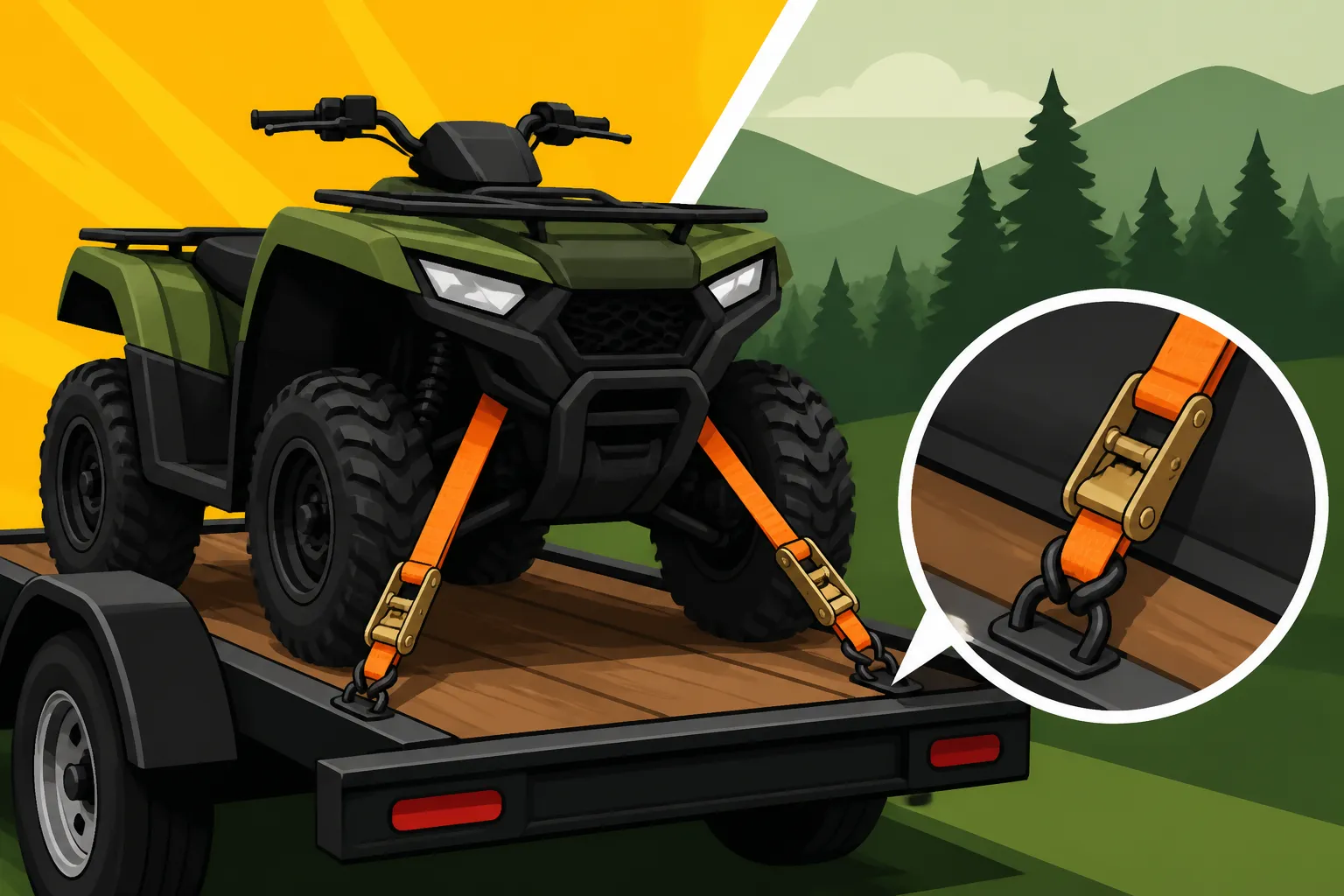
Start with the front of your ATV or UTV. Use at least two high-quality ratchet straps. Connect each strap from a solid anchor point on the front of your ATV (like the lower A-arms or a sturdy bumper) diagonally down and forward to separate anchor points on the front corners of your trailer. The diagonal angle is crucial as it pulls the machine both forward and downward, preventing it from sliding backward or bouncing vertically.
Crank down the ratchet straps until they are very snug. The suspension on your ATV or UTV should compress slightly. You don't need to completely flatten the suspension, but it should be compressed enough that the machine can't bounce freely. A good rule of thumb is to compress it about one-third to halfway. This pre-loads the suspension, allowing it to still absorb minor bumps on the road while preventing large, uncontrolled movements of the ATV. Ensure the straps are not rubbing against sharp edges or twisted, as this can weaken them.
Anchoring the Rear of the Machine
Once the front is securely fastened, move to the rear. Again, use at least two high-quality ratchet straps. Connect them from solid anchor points on the rear of your ATV or UTV (such as the frame near the rear axle or a sturdy rear bumper) diagonally down and backward to separate anchor points on the rear corners of your trailer. This mirrors the front tie-down, pulling the machine both backward and downward.
Just like the front, tighten these straps until the rear suspension is slightly compressed. The goal is to create a "four-point" securement, with straps pulling in opposing directions (forward-down and backward-down) and downward pressure at all four corners. This combination prevents any significant movement in any direction—forward, backward, or side-to-side. If your ATV has a handbrake, make sure it’s engaged, but don’t rely solely on it for securement.
The Essential Bounce Test and Re-Check
After all four main straps are tightened, give your ATV or UTV a good shake. Try to rock it side-to-side, forward, and backward. If it moves significantly, your straps aren't tight enough, or your anchor points aren't optimal. Go back and re-tighten. You want the machine to feel like it's part of the trailer, not just sitting on top of it.
Before you hit the highway, take one final walk-around. Check all straps for twists, fraying, or loose hooks. Ensure no straps are resting on exhaust pipes or other hot surfaces that could melt them. Tuck away any excess strap length to prevent it from flapping in the wind, which can be noisy, distracting, and cause wear on the straps. You can loop it and secure it with a bungee cord or knot it neatly. It's also a great idea to pull over after the first 10-15 miles of driving to re-check the tension on all straps. Road vibrations and initial settling of the load can sometimes loosen straps slightly. This quick check can prevent major issues later in your journey.
Common Mistakes to Avoid When Hauling an ATV/UTV
Even with the best intentions and gear, it's easy to fall into common traps when tying down an ATV or UTV. Being aware of these pitfalls can save you from frustration, damage, or even accidents. Understanding these mistakes is part of becoming a seasoned rider who not only knows how to navigate trails but also how to get to them safely. For example, if you just purchased your machine, understanding proper care also includes having [Maine ATV Purchase Paperwork Checklist] in order.
Using Inadequate or Worn-Out Straps
This is arguably the most critical mistake. Using cheap, flimsy straps not rated for the weight of your machine, or straps that are old, frayed, cut, or sun-damaged, is an accident waiting to happen. The working load limit (WLL) is a critical number here; ignore it at your peril. A strap might look fine, but if the stitching is compromised or the webbing has been weakened by UV exposure, it can fail suddenly.
Always inspect your straps before each trip. Look for tears, cuts, excessive fraying, and signs of stretching. Check the hooks for bending or corrosion, and ensure the ratchet mechanism operates smoothly without sticking. If a strap shows any significant signs of wear, replace it immediately. It’s a small investment compared to the cost of a damaged ATV or, worse, an accident on the highway. Think of it like checking your tires before a long drive—it’s non-negotiable for safety.
Overtightening and Incorrect Angles
While you want your ATV to be snug, overtightening straps can cause damage. Excessively compressing the suspension for long periods can put undue stress on shocks, bushings, and other components. It can also deform plastic bodywork or even bend lighter frame parts if you're not careful. The goal is firm compression, not crushing.
Equally important are the angles of your straps. Straps should pull diagonally, creating both downward and opposing horizontal tension. Straps that pull straight down only prevent vertical movement but leave your machine vulnerable to sliding forward or backward. Straps that are too horizontal might prevent sliding but won't hold the machine down effectively against bouncing. The ideal is a balance, creating a "web" of force that secures the machine in all directions. If you're borrowing a friend's machine or trailer, ensure you understand the tie-down points and methods; sometimes having a simple agreement in place, which you might find templates for via services like LawDepot, can clarify responsibilities in case of damage.
Forgetting to Secure Loose Accessories
It's not just the ATV itself that needs securing; anything on the ATV or trailer that isn't bolted down can become a projectile. Fuel cans, coolers, toolboxes, spare tires, riding gear, and even your helmet can fly off the trailer at highway speeds. This creates a significant hazard for other motorists and can mean losing valuable gear.
Before you roll out, perform a thorough check of your ATV and trailer. Secure all loose items in closed compartments, storage boxes, or with additional bungee cords or cargo nets. Even small items like recovery ropes or fire extinguishers should be properly stowed. Consider how a sudden stop or a strong gust of wind might affect everything on board. It's an easy step to overlook in the excitement of heading out, but it's crucial for a safe journey. Sometimes, even the paperwork for your [Maine Non-Resident Annual Registration] or your [Maine ATV Registration Confirmation for Immediate Riding] can go flying, so keep those secured in a waterproof bag inside your vehicle, not loose on the ATV.
Not Re-Checking Straps During the Trip
Road vibrations, bumps, and temperature changes can cause straps to stretch or loosen over time. One of the most common mistakes is to simply tighten the straps at the start of the journey and then forget about them. As mentioned earlier, a crucial step is to pull over after the first 10-15 miles of driving, perhaps at the first gas station or rest area you encounter.
Give each strap a firm tug and re-ratchet any that feel loose. This initial re-check is often the most important, as the load settles. For longer trips, make it a habit to re-check your straps every time you stop for gas, a meal, or a driver change. This proactive approach ensures continuous securement throughout your journey. Imagine driving for hours only to discover a strap has completely come loose; a quick five-minute check can prevent hours of headaches—or worse. If you are ever pulled over by a [Maine Warden Service ATV Patrols], one of the first things they'll likely check is the security of your load.
By avoiding these common errors and diligently following proper tie-down procedures, you can ensure that your ATV or UTV remains safely secured for every mile of your highway journey, allowing you to focus on the fun that awaits you on Maine’s beautiful trails.
Disclaimer
This article is for general informational purposes only and does not constitute professional advice. Laws, prices and regulations vary by location and change over time. Consult a qualified professional for guidance on your specific situation.