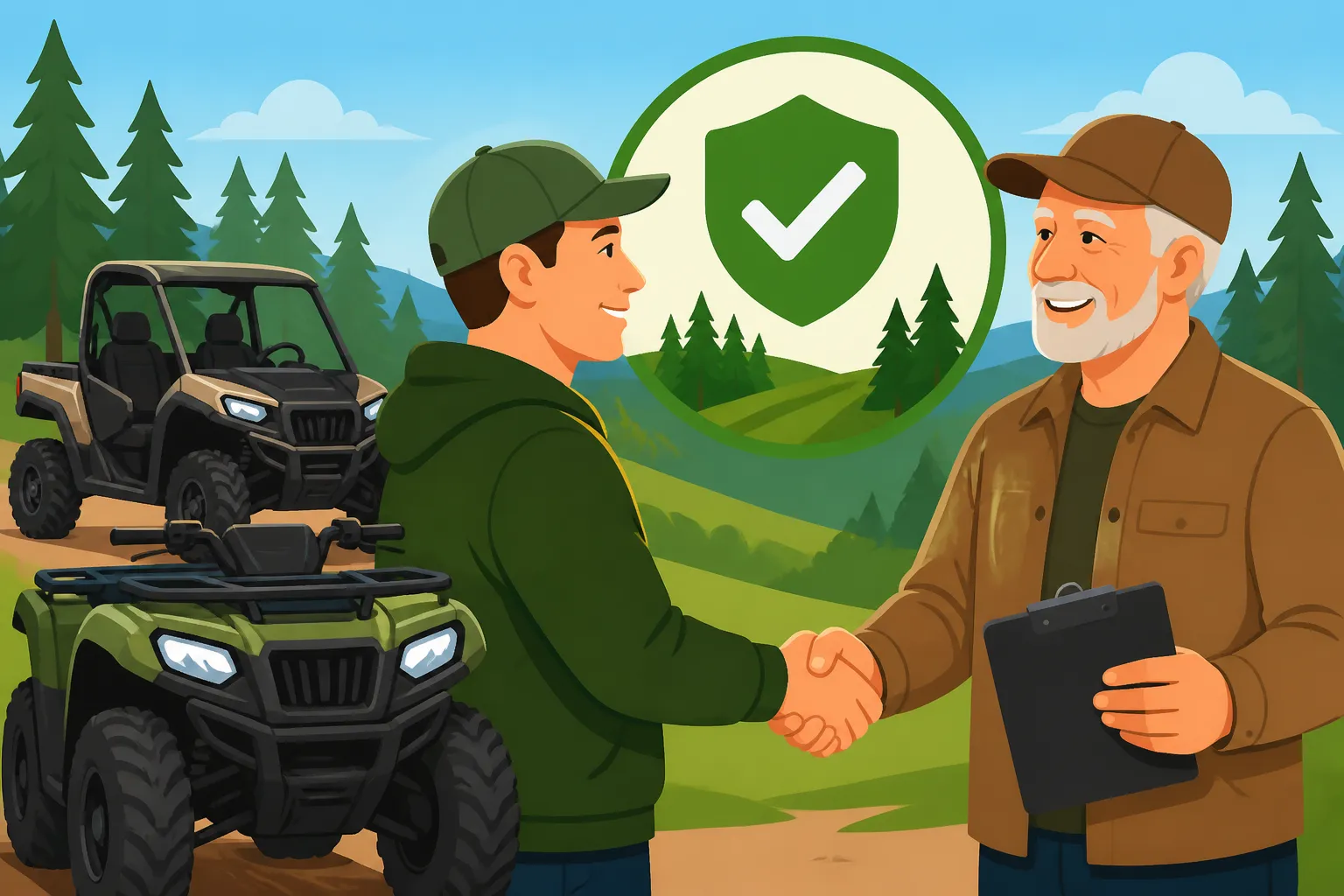
Getting Written Permission to Ride Private Land
Riding on private land in Maine starts with permission, not assumptions about an old woods road, a trail map or a neighbor’s past practice. A short written agreement can prevent confusion about where you may ride, when access ends and who else is covered. Here’s how to ask for permission and record it clearly without treating a simple ride as a complicated legal contract.
Why written permission matters in Maine
Private land access is central to ATV riding in Maine, but a trail crossing private property does not automatically give every rider permission to use it. Access may depend on an arrangement with a landowner, a club, or another party responsible for the route. Permission for one trail, rider or season should not be treated as permission for another.
A landowner may give permission directly, or access may be arranged through a club or trail organization. If you are joining a marked trail system, check the club’s current information and respect signs and closures. A route shown on a map is useful for planning, but it does not replace permission where permission is required. For context on how these arrangements work, see Maine Trails That Cross Private Land and Maine Landowner Permission Rules.
Written permission helps both sides remember what was agreed. It can show that the landowner allowed a particular kind of access, while setting clear boundaries around dates, riders, machines and activities. It is especially useful when:
- You are asking to ride land directly rather than using a club-managed trail.
- The landowner is not going to be present when you ride.
- Several family members, guests or machines are involved.
- You have permission for a specific route, but not the surrounding property.
- Access is temporary, seasonal or subject to conditions.
- You want to avoid misunderstandings about parking, gates, speed or other land uses.
A written note is not the same as an ATV registration, a trail permit, or permission to ride on a public way. It also does not make a route legal if other rules or restrictions apply. Keep the distinction clear: the landowner’s permission covers access to the property described in the agreement, not every road or trail you might encounter on the way there.
Maine landowners may allow access under a variety of arrangements, and some trail access is coordinated through clubs. Do not assume that permission given to a club automatically covers your private ride, a side route, or travel outside the marked trail. If you are unsure who controls access, ask the landowner or the club responsible for that section. Asking a Landowner for Permission to Ride can help you prepare for that conversation.
What to include in a permission note
A useful permission note answers the practical questions a rider and landowner might otherwise interpret differently. It does not need formal legal language. It should be specific enough that a person who was not part of the original conversation can understand where access is allowed and what limits apply.
| Detail to record | What to clarify |
|---|---|
| Landowner and rider | Names and a way to contact each person |
| Property or route | A clear description, map, marked entrance or agreed boundaries |
| Dates and hours | When permission begins and ends, including any seasonal limits |
| Riders and machines | Who may ride and whether the permission covers listed machines or guests |
| Allowed activities | Riding only, or also parking, loading, unloading or other agreed uses |
| Conditions | Speed, noise, gates, parking, route direction or other site-specific rules |
| Withdrawal or changes | How the landowner can change or end access |
| Confirmation | Date and signatures, or another clear record of agreement |
Identify the property and route
“Permission to ride the land” can be too broad. Specify the route or area the landowner intends to allow. You might describe the entrance, identify a woods road by its local name, or mark the approved path on a map. If you attach a map, label it with the date and make clear that the highlighted route is the permitted area.
Avoid relying on a vague description such as “the back lot” if the property has multiple parcels or access roads. Ask the landowner to confirm the boundaries. Do not create your own route around a closed section or assume that a neighboring parcel is included. If a route passes over more than one owner’s property, permission may be needed from each owner unless an authorized club or other arrangement covers the full route.
For posted boundaries or restrictions, follow the signs and markings you see on the ground. Access by Permission Only Markings explains why those notices should not be treated as informal suggestions. If conditions change after you receive permission, such as a new sign or a blocked route, stop and check before continuing.
Name the riders and machines
Write down who is covered. Permission for one rider does not necessarily mean that the rider may bring a group. If family members, friends or guests will use the property, list them or state clearly how many people are included and how additional riders must be approved.
Be equally clear about the machines. If permission is for an ATV, do not assume it also covers a larger UTV, a trail-maintenance vehicle or a different type of off-road machine. A larger machine may have different space, noise or ground-impact considerations. Ask before switching machines or inviting someone with a different vehicle.
If children will ride, state that when you ask. Their presence can affect how the landowner wants the route used and who will supervise them. Permission to use property does not remove the need to follow applicable rider, safety and operating rules.
Set dates and conditions
A note can make access seasonal, limited to particular days, or conditional on the landowner’s approval each time. Write down any hours or dates that matter. If the agreement is meant to cover a single outing, say so rather than leaving the end date open to interpretation.
Include practical conditions that matter on this property. These might cover where to park or unload, whether a gate must be closed, whether riding is allowed after rain, or which areas are off limits. If the landowner asks you to avoid a field, building, livestock area or active work site, describe that restriction plainly. Do not rely on a broad phrase such as “be respectful” to communicate a specific boundary.
Keep the conditions realistic and easy to follow. A short list is often better than a dense document that riders are unlikely to read before setting out. If the landowner gives permission subject to a condition you cannot meet, say so before riding.
How to ask and document the agreement
A good request is specific, polite and easy to decline. Contact the person who owns or manages the land, explain who wants to ride, what machines are involved, when you hope to go and which route you have in mind. If the access is connected to an established club trail, say that and ask whether the club or landowner manages permission for that section.
Do not treat silence, a neighbor’s past access or a trail line on a map as approval. If you do not know who owns the land, ask the relevant club or local contact for help identifying the person responsible for access. Avoid approaching someone at a busy time or beginning to ride while you wait for a response.
A simple process helps:
- Make a clear request. Describe the planned outing, including riders, machine types, dates and intended route.
- Ask about limits. Confirm parking, gates, route boundaries, hours and any other rules specific to the property.
- Write down what was agreed. Use a short note or agreement, and attach a marked map if that makes the route clearer.
- Get confirmation. Ask the landowner to sign or otherwise confirm the terms. Keep a copy of the confirmation and any map.
- Share the limits with everyone riding. Each rider should know the approved route and conditions before arriving.
- Check before a later ride. If the dates, riders, machines or route change, ask whether the permission still applies.
A brief email or text can sometimes create a useful record of what the parties discussed, but only if it clearly confirms the terms and the person granting permission. If the arrangement is important or ongoing, ask the landowner what form of written confirmation they prefer. Do not assume that a message covers an additional guest or a different weekend.
For a paper copy, keep the signed note with your ride paperwork and make sure the riders can access it. A digital copy can be stored on a phone, but remote areas may have limited service or a dead battery. Carrying a printed copy is a simple backup. A waterproof document pouch from Amazon or another retailer can help protect paper from rain and mud; it is optional, not a permission requirement.
Make sure the agreement reflects what was actually approved. Do not add a landowner’s name to a form, copy a signature, or change a map after the fact. If either side wants different terms, get agreement to the changes before riding.
Riding within the permission and responding to changes
Permission is not a general license to explore. Stay on the approved route, follow the stated conditions and leave areas outside the agreement alone. Close gates as directed, avoid disturbing property, and do not bring extra riders without checking. If the landowner asks you to stop or leave, comply and clarify any future access later, not during a disagreement on the property.
Written permission also does not transfer responsibility for how you ride. You remain responsible for operating safely, obeying applicable laws and avoiding damage or unreasonable disturbance. A permission note should not be treated as a release from every possible claim, nor as proof that every legal requirement has been satisfied. Landowner liability can depend on the circumstances and applicable law; a signed note does not settle every question. For more detail, see Maine Landowner Liability for ATV Riders.
Respect the property beyond the trail itself. Keep noise down near homes, do not litter, and avoid riding through yards or work areas unless that access was specifically approved. If you encounter a landowner, worker or other person using the property, slow down and follow any reasonable direction about access. Good conduct helps preserve access for you and other riders. Maine Trail Etiquette With Landowners covers the habits that make shared access more workable.
Permission may be changed or withdrawn. A landowner might close a route for maintenance, logging, weather, hunting activity, damage concerns or another reason. If access is withdrawn, do not keep riding because you have a previous note. Contact the landowner or relevant club to ask whether another route is available. Trail closures and landowner decisions can affect a route after you have planned a trip; see Trails Closed by a Landowner Mid-Season.
If you discover a damaged gate, blocked route, new sign or conflict about the boundary, stop and ask before proceeding. Do not move a barrier or assume that an old agreement overrides a current closure. If your route connects to a public way, a club trail or another owner’s land, treat those as separate access questions. Private-land permission covers only the access the landowner agreed to provide.
A clear written record will not prevent every disagreement, but it can reduce avoidable confusion. The best permission note is specific, current and shared with everyone riding. When the details change, ask again rather than stretching an old approval beyond what the landowner intended.
Disclaimer
This article is for general informational purposes only and does not constitute professional advice. Laws, prices and regulations vary by location and change over time. Consult a qualified professional for guidance on your specific situation.