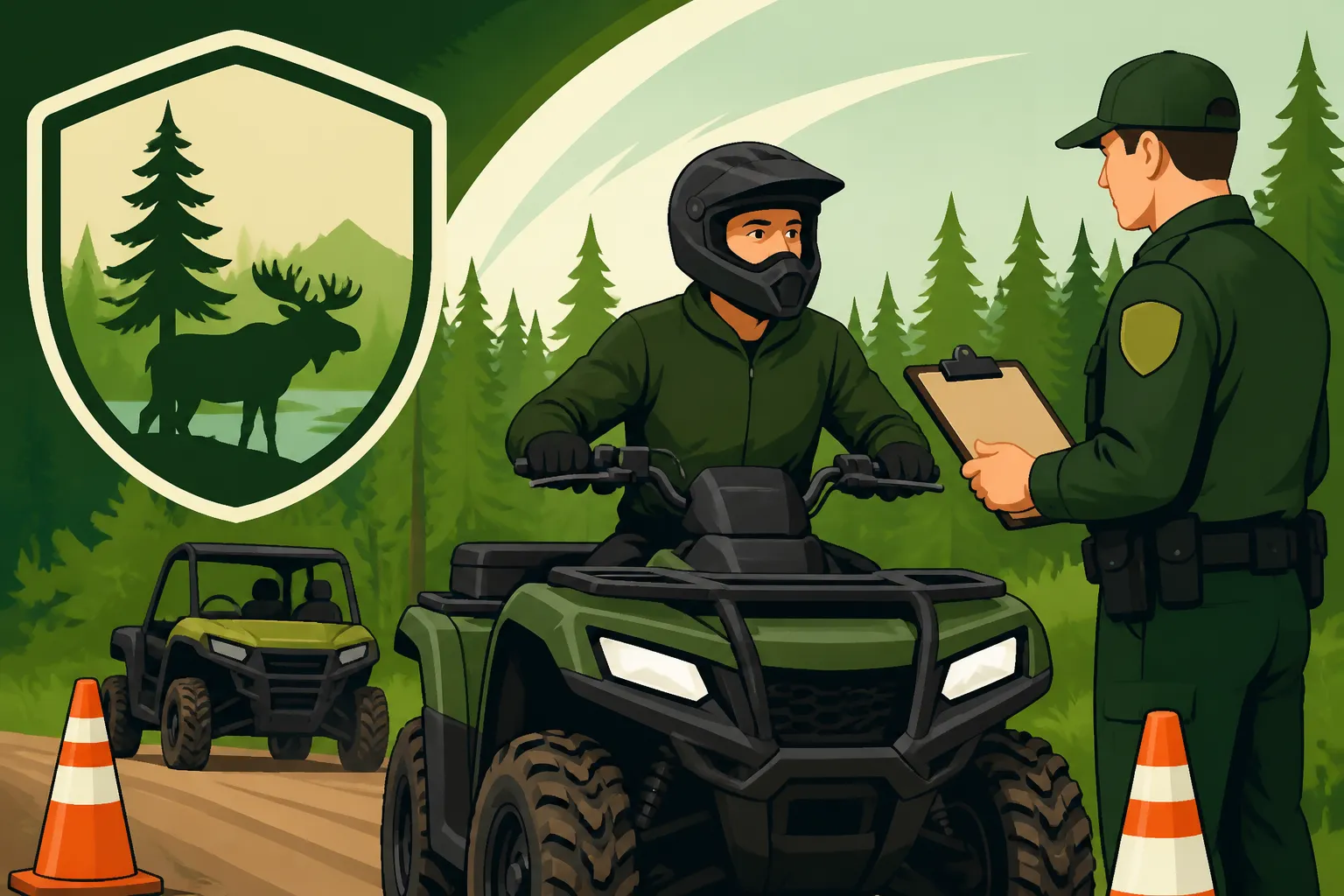
Maine Warden Service ATV Checkpoints
A Maine Warden Service ATV checkpoint can be unsettling if you are unsure what an officer may ask to see. Knowing what to carry, how registration rules apply to visitors, and how to respond calmly makes a stop easier to handle. Here’s what riders should prepare for—and what to do if a question or citation comes up.
What to expect at a Maine ATV checkpoint
A checkpoint may be set up on or near a trail, at an access point, or in another area where riders are passing through. It may be part of routine enforcement, a focused safety effort, or a response to local concerns. The presence of a checkpoint does not, by itself, mean you have done something wrong.
A Maine game warden may ask questions or check for compliance with rules that apply to the machine and the ride. The details can vary with the location, the type of machine, the rider’s age, and whether you are on a trail, private land, or a public way. A stop is a poor time to discover that the registration is in a truck at the trailhead or that a young rider’s safety certificate was left at home.
A checkpoint is also not proof that the trail or route you are using is open to ATVs. You are still responsible for checking whether the route is authorized and whether you have permission to cross private land. Registration does not grant access. For a broader overview of authorized places to ride, see Where Maine Lets You Ride an ATV and Maine Landowner Permission Rules.
Wardens may check several things, including:
- Whether the ATV or UTV has the registration required for the ride.
- Whether the registration information matches the machine.
- Whether the rider is following rules that apply to their age and situation.
- Whether equipment or operation complies with rules for the place being ridden.
- Whether the route is open and the rider has the required land access.
- Whether another issue, such as an apparent safety concern or suspected violation, needs attention.
Not every stop involves every item. A quick registration check may be all that is needed; a stop prompted by a complaint or an observed violation may involve more questions.
What to have ready before you ride
The most helpful preparation is to sort out registration, documents, and rider-specific requirements before unloading the machine. Do not assume that a registration from another state automatically gives you permission to ride in Maine. Visitor rules and any narrow exceptions can depend on where the machine is registered and how long you are riding. Review Maine ATV Registration for Non-Residents and Maine’s ATV Reciprocity, and Why It Ended before traveling.
| Checkpoint topic | What to prepare | Why it helps |
|---|---|---|
| Registration | Current registration information for the machine and any required decal | Lets you show that the machine is registered for the ride |
| Out-of-state visitors | Confirm whether your home registration is accepted or whether you need Maine registration | Reciprocity should not be assumed |
| Young riders | Required safety-course proof and appropriate adult supervision, where applicable | Youth requirements depend on the rider’s age and circumstances |
| Trail access | Route information and any permission needed to cross private land | A registration does not authorize use of a closed or private route |
| Equipment and operation | Required safety gear and compliant equipment for the location | Rules can differ between trails and public ways |
| Multiple machines | Keep each machine’s information easy to identify | A family or group may have different registration details for each ATV |
Carry the registration documents in a way that keeps them readable and reasonably protected from water, mud, and wear. A waterproof sleeve or small document pouch can help; if you use one from Amazon or another retailer, make sure it fits the papers without obscuring information. Avoid storing the only copy somewhere you cannot reach while seated on the machine.
For details on which documents may be needed, read Do You Carry Registration Papers While Riding? and Storing Registration Paperwork on the Machine. If you have just registered and are relying on a confirmation page, check whether that document is accepted for your situation and keep it accessible. Maine ATV Registration Confirmation for Immediate Riding explains why it is worth confirming that point in advance.
If you are riding with children, check each rider’s requirements separately. Age can affect safety-course, supervision, and helmet rules. Do not assume that an adult’s documents cover a youth rider. The articles Maine ATV Safety Course Requirements and Maine Helmet Requirements by Age can help you identify questions to resolve before departure.
How to handle the stop
When a warden signals you to stop, slow down and stop in a safe place as directed. Keep control of the machine, avoid sudden movements, and do not ride away. If you are in a group, make sure the others stop too, without crowding the officer or blocking a trail junction.
A calm, direct response is usually the most useful approach. Listen to the question, answer truthfully, and show the requested documents if you have them. If you do not understand what the officer wants, ask politely. If a document is on another machine or in a parked vehicle, explain where it is and ask what to do rather than leaving without permission.
A few practical habits can keep the interaction clear:
- Stop promptly and safely when signaled.
- Keep your hands visible and follow instructions before reaching for paperwork.
- Tell the warden where your registration or other document is if you need to retrieve it.
- Give concise, accurate answers about the machine and your route.
- If you are traveling as a group, let one person speak unless the officer asks others questions.
- If you receive a citation, read it before leaving and note any instructions or response deadlines shown on it.
Do not argue on the trail about whether a rule applies. If you believe the stop or a citation is mistaken, stay respectful and address the issue through the appropriate process afterward. Record the details you can safely and lawfully retain, such as the date, location, officer’s identifying information, and what was said. Keep the citation and related registration or access records together.
A routine document check and a citation are different situations. If you are issued a citation, do not treat an informal explanation at the checkpoint as a substitute for following the instructions on the paperwork. For general information about what happens after a citation, see Appealing an ATV Citation and Maine ATV Ticket Costs by Violation.
Common reasons riders are caught unprepared
Assuming an out-of-state registration is enough
Visitors sometimes arrive with a valid registration from home and assume it automatically authorizes riding in Maine. That may not be true. Check the rules for your state or province and the length and purpose of your trip before setting out. If Maine registration is required, arranging it before the ride can prevent a stressful stop and avoid losing riding time.
Having the decal but not the supporting information
A visible decal is useful, but it may not answer every question about the machine or registration. Keep required paperwork available and make sure the information relates to the ATV or UTV you are riding. When you use several machines, check each one rather than carrying documents for only the lead machine. [Maine ATV Registration for a Second Machine] covers the practical issue of registering more than one ATV.
Treating a trail map as proof of permission
A map can help with navigation, but it may not establish that every route is open today or that permission is still in place. Private-land access can change, and trail status may be affected by closures or local conditions. Confirm the route with current club or landowner information. For background on enforcement on private property, see Can a Maine Warden Stop You on Private Land?.
Forgetting youth or passenger requirements
A family may have more than one set of rules to consider. The rider’s age, whether a passenger is carried, and the type of machine can matter. Check those requirements before leaving, and make sure the young rider has any required certificate or supervision. A checkpoint is not the time to rely on someone else’s memory of what the rule was last season.
Riding on a road as though it were a trail
ATV access on public ways is limited and depends on the route and applicable rules. A trail connection or local custom is not enough to establish that riding on a road is allowed. Before using a road segment, check its status and the rules for that specific kind of public way. See Riding an ATV on the Road in Maine for the distinction between trail riding and road access.
Preparation cannot guarantee that a ride will be free of questions, but it can make a checkpoint straightforward. Confirm registration and access, carry the paperwork you need, check requirements for every rider, and stop safely when signaled. If an officer identifies a problem, deal with it calmly at the scene and use the proper process afterward.
Disclaimer
This article is for general informational purposes only and does not constitute professional advice. Laws, prices and regulations vary by location and change over time. Consult a qualified professional for guidance on your specific situation.