What Wardens Ask at a Trail Stop
A trail stop can interrupt a ride, especially if you are unsure which papers a warden expects or whether your out-of-state registration is enough. In Maine, questions may cover your machine’s registration, who is riding, and whether you have permission to use the trail. Knowing what to have ready—and how to answer when something is unclear—can make the stop calmer and quicker.
What a warden may ask at a Maine ATV trail stop
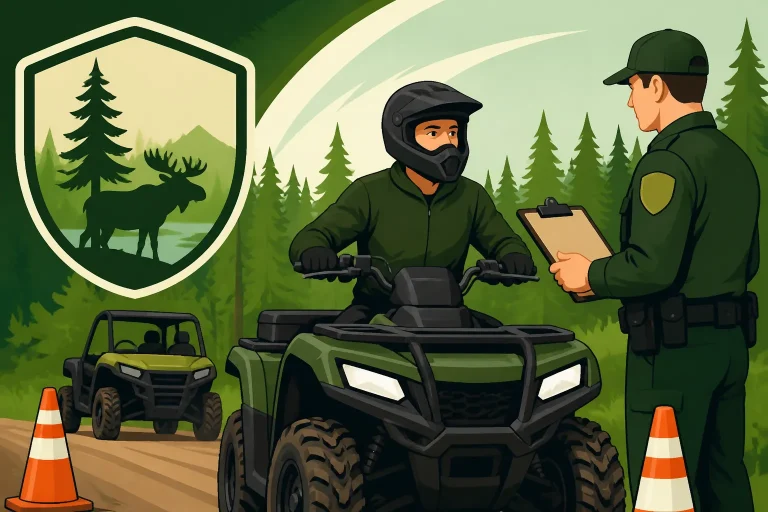
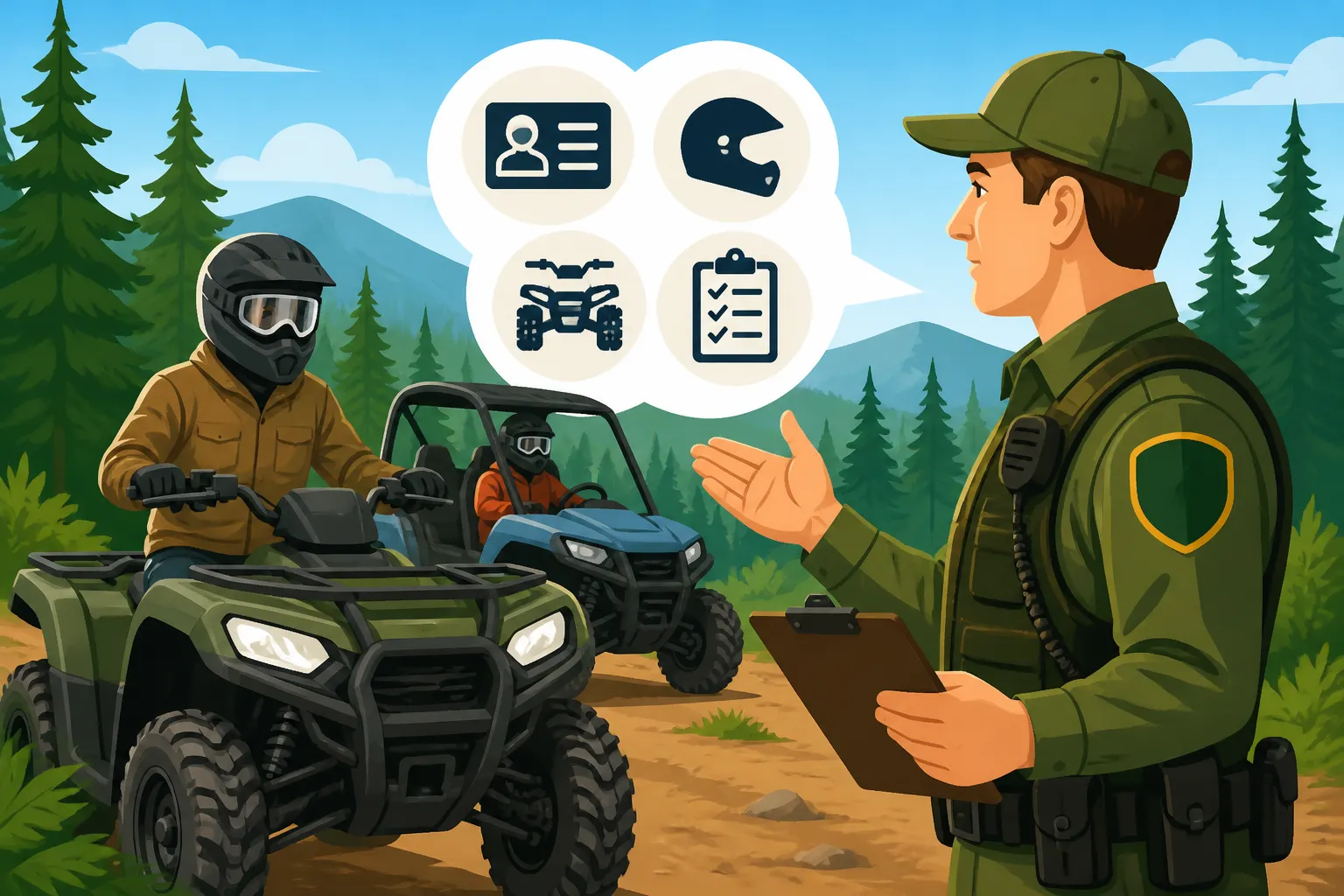
A warden may ask questions to confirm that your machine and your ride comply with applicable rules. The questions can depend on where you are, who is riding, and what the warden observes. A stop does not necessarily mean you have done something wrong.
Common questions include:
- “Can I see your registration?” Be ready to show the current registration for the machine. If you are visiting from another state or Canada, the warden may ask how you are meeting Maine’s registration requirements. Rules can differ by visitor situation, so check Maine ATV Registration for Non-Residents and Maine ATV Rules for Canadian Visitors before the trip.
- “Who does this machine belong to?” A warden may ask about ownership if the registration details do not seem to match the rider or if there is another reason to clarify who is responsible for the machine. If you borrowed it, say so plainly. Carrying the owner’s contact details can help resolve confusion, although it does not replace any required registration.
- “Where are you headed?” The answer can help establish whether you are using a designated route, a trail, or private land with permission. Be able to describe your route without assuming that every woods road or connecting path is open to ATVs.
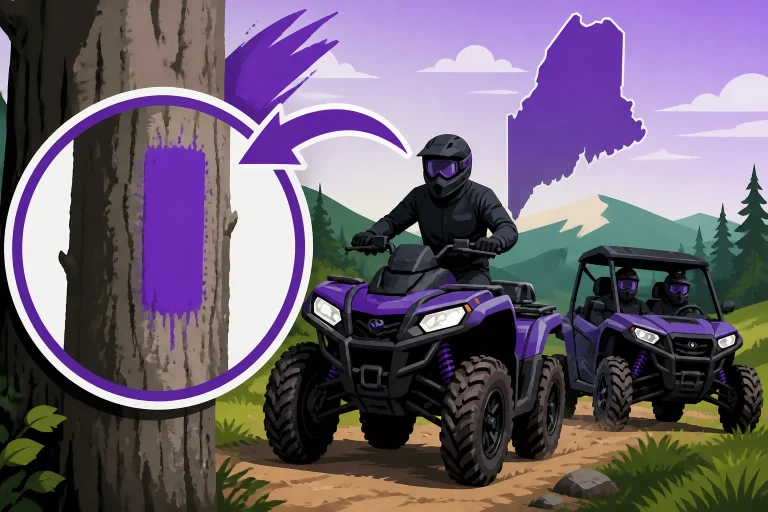
- “Do you have permission to ride here?” Many Maine trails cross private property. A marked trail or a route shown on a map does not mean that access is unlimited or permanent. If the route depends on landowner permission, know where that permission applies and respect closures. See Landowner Permission on Maine ATV Trails for more on access.
- “How old is the rider?” A warden may ask about age when a young person is operating or riding as a passenger, because age can affect supervision, training, helmet, and operating rules. If a rider’s age makes a rule relevant, answer accurately rather than guessing.
- “Have you taken the required safety course?” This may come up when a rider’s age or circumstances make a course requirement relevant. If a certificate is required, have proof available or know how to retrieve it. For out-of-state visitors, Out-of-State Safety Certificates Accepted in Maine can help clarify whether a certificate from elsewhere is recognized.
- “Are you carrying passengers?” The warden may check whether the machine is designed and equipped for the number of people riding it. Do not treat a seat, rack, or cargo area as a passenger seat unless the machine is designed for passengers.
- “Are you aware of the trail or road rules here?” A warden may ask about the route, a crossing, a posted restriction, or a particular operating practice. Answer based on what you know, and do not claim that a road or trail is open just because you have seen other machines use it.
These questions are examples, not a fixed script. A warden may focus on registration and route access at one stop, and on a safety concern at another. What Wardens Ask at a Trail Stop is a useful companion topic for understanding the kinds of details that may come up.
What to have ready before you ride
The simplest way to prepare is to keep the documents and details a warden may ask for accessible, and to check that they match the machine and the riders. Requirements can vary with the machine and the rider’s situation, so use official Maine information to confirm what applies to your trip.
| What may come up | What to prepare | Why it helps |
|---|---|---|
| Registration | Current registration information for the machine, in a form you can access while riding | Lets you respond if asked to show that the machine is properly registered |
| Nonresident or Canadian status | The registration or other documentation that applies to your situation in Maine | Helps explain how you are meeting Maine requirements as a visitor |
| Young riders | Any required safety-course proof, plus a clear understanding of supervision and age-related rules | Makes it easier to answer questions about who may operate or ride |
| Route and access | A current map or route information, plus confirmation of any required landowner permission | Helps you avoid assuming a road or trail is open |
| Machine identity | The machine’s identifying details and, if borrowed, the owner’s contact information | Can help resolve questions if registration or ownership details need clarification |
For general paperwork questions, see Maine Warden Stops and ATV Paperwork and Do You Carry Registration Papers While Riding?. Requirements for registration can differ for nonresidents, and special arrangements may apply in some circumstances. Do not assume that a registration from another state automatically covers riding in Maine. Check the current rules before you leave home. Maine’s ATV Reciprocity, and Why It Ended and Maine’s Three-Day Agreement With New Brunswick and Quebec explain why visitors should confirm their specific situation rather than rely on an old understanding of reciprocity.
Keep paperwork protected from rain and easy to reach without digging through cargo while a warden waits. A document pouch or a secure storage pocket can help, but do not leave original documents somewhere you cannot access during the ride. If you use a digital copy, make sure you can open it where you are riding; remote areas may have weak or no cell service. A saved file on your device can be useful, but check whether it is acceptable for the document in question.
Before starting, match the paperwork to the machine. If you are riding a borrowed or newly purchased ATV, confirm that you have the correct registration information and can explain the arrangement. Registration papers for one machine do not establish that another machine is registered. If your documents are missing or the details conflict, resolve that before riding rather than hoping a stop will sort it out. Maine ATV Registration Confirmation for Immediate Riding covers a related issue for riders waiting on registration materials.
How to handle the stop calmly
A trail stop is easier to manage when the group knows how to respond. Pull over safely when directed, keep control of the machine, and follow the warden’s instructions. If you are riding in a group, make sure everyone stops in a safe place rather than continuing ahead or crowding the warden.
A practical approach is:
- Stop safely and stay attentive. Choose a safe stopping place if you have room to do so, and do not make sudden movements or leave the area. Keep passengers seated until it is safe to get off.
- Listen to the question. If you are not sure what the warden is asking, request clarification. It is better to ask than to give a guess that could cause confusion.
- Answer directly and truthfully. Give the information requested. If you do not know an answer or cannot find a document, say so; do not invent an explanation.
- Show the relevant paperwork. Retrieve it carefully and avoid reaching into a bag or compartment without making your movement clear. If a document is on your phone, explain that before handling the device.
- Ask what to do next if there is a problem. If the warden says a route is closed or a document is missing, listen to the instructions and ask a calm, specific question if you need to understand them.
A useful answer is usually brief and factual. For example, if asked whether you have permission to ride a private trail, explain who granted permission and which route it covers, if you know. If you are unsure whether permission applies to a connecting section, say that you are unsure and ask for guidance rather than presenting an assumption as fact.
Avoid arguing over a rule you have not confirmed or relying on “everyone rides here” as proof that a route is open. If you disagree with an enforcement decision, keep the conversation respectful and ask how to follow the proper process to address it. A trail stop is not the right time to escalate a disagreement or obstruct the warden.
If a group is stopped, one person can answer questions about the group’s route while each rider remains ready to provide information about their own machine. Do not assume that one person’s registration or explanation covers the rest of the group. Make sure the group understands any instruction before moving on, especially if it concerns a closure, a detour, or a machine that cannot continue.
Common reasons a ride can raise questions
A little preparation can prevent many avoidable misunderstandings. These are situations worth checking before you start:
- Assuming a neighboring state’s registration is enough. Maine’s requirements may not match the rules where you live. Confirm what registration or exception applies to your specific trip, and keep the relevant proof accessible.
- Relying on an old reciprocity rule. Visitors sometimes hear that Maine recognizes another jurisdiction’s registration and assume the rule is unchanged or applies to every situation. Check the current official guidance; the details may depend on where the machine is registered and how long you plan to ride.
- Treating a mapped line as open access. A map can help with navigation, but it does not by itself establish that a route is open today or that you have permission to cross private property. Check current trail notices and respect posted restrictions.
- Letting paperwork stay with someone who is not on the ride. If the person with the documents leaves the group or loses cell service, the remaining riders may not be able to produce the information they need.
- Guessing about a young rider’s requirements. Age-related rules may apply to operating, supervision, safety training, or passengers. Check the specific rules for the rider and the activity before heading out.
- Continuing after a closure or direction to stop. A trail can close, or access can change. Follow the direction given, and find another lawful route rather than trying to bypass a restriction.
The best preparation is to verify registration, route access, and rider requirements before the trip, then carry the information you may need. For a broader overview of what a stop can involve, see Maine Warden Service ATV Patrols. If you are unsure about a rule, confirm it with the appropriate Maine authority before riding instead of relying on hearsay or another rider’s experience.
Disclaimer
This article is for general informational purposes only and does not constitute professional advice. Laws, prices and regulations vary by location and change over time. Consult a qualified professional for guidance on your specific situation.