Can a Maine Warden Stop You on Private Land?
A private trail can feel different from a public road, but private property does not automatically put an ATV beyond a warden’s authority. The key question is whether the warden has a lawful reason to stop the machine. This article explains the rule, how it differs from a landowner’s authority, and what to do if a warden or property owner asks you to stop.
Can a Maine warden stop an ATV on private land?
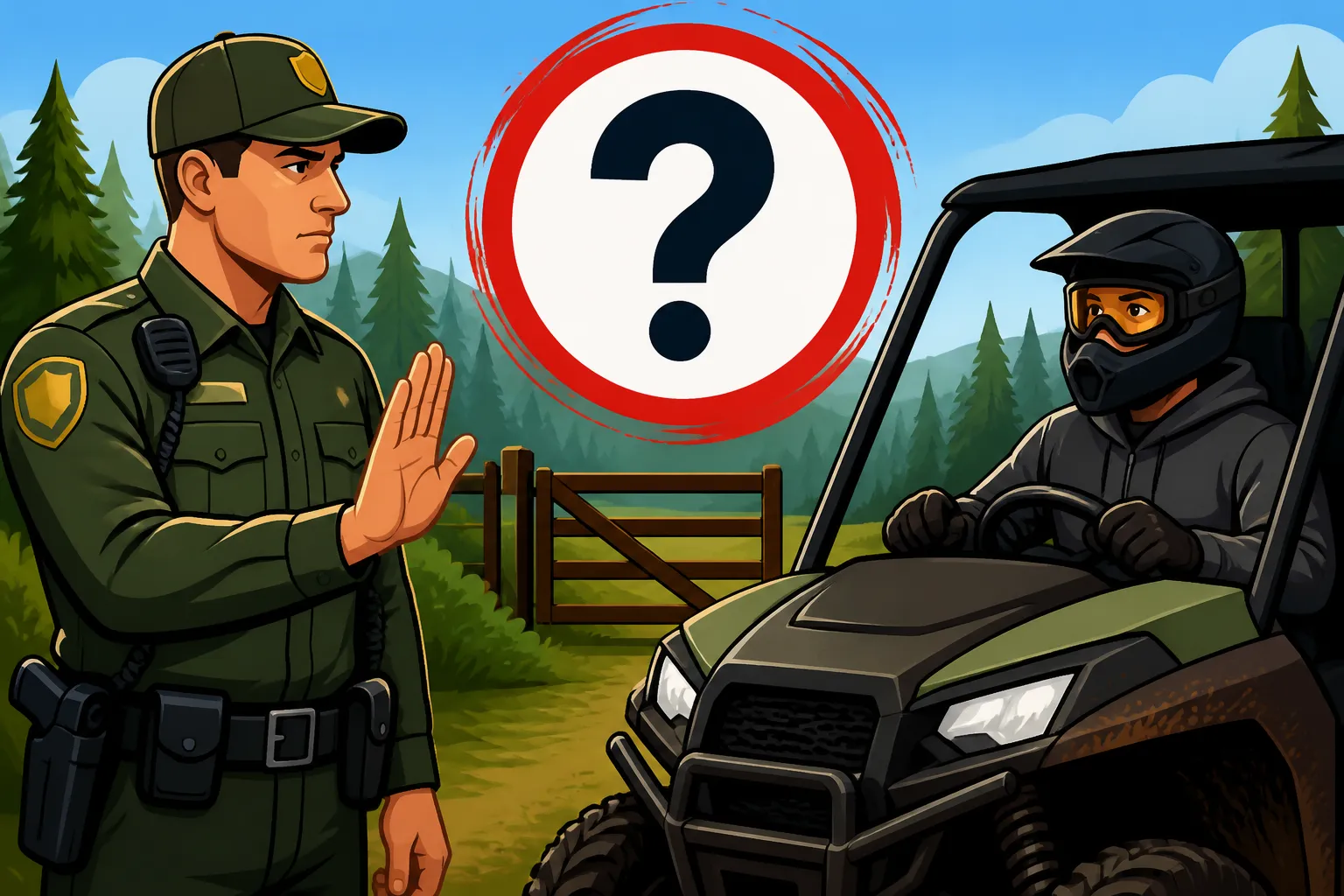
Yes, but a uniformed game warden cannot stop an ATV on private land just because the rider is there. Under Maine law, a uniformed game warden may stop a motor vehicle or watercraft, including an ATV, only when the warden has a reasonable and articulable suspicion that a violation of law has taken place or is taking place. The Maine Legislature sets out that standard.
In practical terms, the warden needs a specific, explainable reason to suspect a violation. Being on private property, by itself, is not identified in the rule as enough. A suspected violation could relate to the way the ATV is being operated or to access rights, but whether particular facts support a stop depends on the situation.
This rule concerns a stop by a uniformed game warden. It does not mean every encounter is a stop, and it does not establish that a landowner has to tolerate riding on their property. It also does not mean that a rider can ignore a warden’s direction once stopped. The Maine Department of Inland Fisheries and Wildlife says failing or refusing to stop an ATV for a law enforcement officer carries a minimum fine of $1,000. Because that consequence is serious, stop safely and address any concern through the appropriate process rather than trying to ride away.
A warden’s presence near a trail is not proof that a rider has broken the law. But a trail’s location on private land does not make it exempt from state law either. Maine’s Department of Inland Fisheries and Wildlife reports that eighty percent of the state-supported ATV trail system is on private land. The arrangement depends on access granted by landowners, while riders remain responsible for complying with applicable rules.
For more about what an encounter may involve, see Maine Warden Checks and What They Ask and Maine Warden Service ATV Patrols. Those topics are useful context, but the key point here is the stop standard: a uniformed game warden needs reasonable and articulable suspicion of a violation.
| Situation | What the rule means for a rider |
|---|---|
| A uniformed game warden stops an ATV on private land | The warden must have reasonable and articulable suspicion that a legal violation has occurred or is occurring, according to the Maine Legislature. |
| A landowner or representative asks a rider to stop on the land | A person operating an ATV on another person’s land must stop and identify themselves when requested, according to the Office of the Revisor of Statutes, Maine Legislature. |
| A rider assumes private property means no rules apply | Private ownership does not, by itself, authorize riding or prevent enforcement of applicable law. |
| A rider is on an authorized trail crossing private land | Trail access does not necessarily mean unrestricted access to all nearby land; stay on the marked route and respect the permission that allows it to be open. |
The warden rule and the landowner rule are different. A warden’s stop is constrained by the reasonable-suspicion standard. A landowner or their representative can request that a person operating an ATV on the land stop and identify themselves, under a separate rule in Maine law. The second situation does not depend on a warden being present.
A landowner’s request is different from a warden’s stop
Private land access is a major part of riding in Maine, but an open trail is not a general invitation to ride anywhere on a property. A route may cross land with permission while nearby fields, woods roads, or other parcels remain off limits. Staying on the marked trail is a practical way to avoid crossing the boundary between authorized access and trespass.
Maine’s Office of the Revisor of Statutes, Maine Legislature, requires written permission from the landowner to use an ATV on cropland, pastureland, or in an orchard. Do not assume that a visible track through one of these areas is open to riders, or that permission for one trail or use covers a different route or activity. Ask the landowner for permission when the situation calls for it, and follow any limits they give.
The same source says that people operating ATVs on another person’s land must stop and identify themselves when requested by the landowner or the landowner’s representative. So, if a property owner or representative calls for you to stop, do so safely and provide your identity. That request is not the same as a warden’s law-enforcement stop, and the legal basis differs.
If you are unsure whether a route is authorized, do not treat the absence of a gate or sign as proof that it is open. Check current trail information, look for the markers that identify an ATV route, and ask the local club or landowner when the status is unclear. The Bureau of Parks and Lands provides information on Maine ATV trails, and local clubs maintain many trails. For background on how access works, see Maine Landowner Permission Rules, Landowner Permission on Maine ATV Trails, and Maine Trespass Law for ATV Riders.
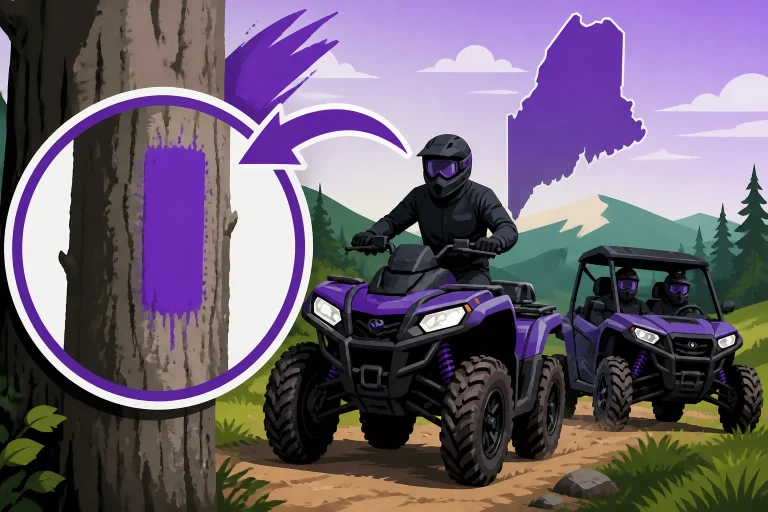
This distinction matters even when a route is part of a well-used trail network. A trail may be open for a particular purpose or season, while a nearby spur or access road is not. Interconnected snowmobile trails, for example, are not automatically ATV routes; the Maine Department of Inland Fisheries and Wildlife says those open to ATV use are posted with ATV trail markers. Confirm the route rather than relying on assumptions about what a property owner has allowed.
What may lead to a stop, and what does not settle the question
The governing standard is suspicion of a legal violation, not simply the fact that a rider is on private property. A complaint, an observed action, or other information may be part of the circumstances a warden considers, but no single example automatically proves that the legal standard is met. Whether there is reasonable and articulable suspicion depends on the facts in the specific encounter.
A disagreement about whether a trail is open can make an encounter confusing. If a warden asks about your route, explain where you entered and which marked trail you were following. If you have a map or other information showing the route, it may help clarify the situation. It does not replace permission where permission is required, and it does not guarantee that an access route is open.
Likewise, a rider should not assume that a registration sticker alone establishes permission to ride across private land. Registration and land access address different questions: registration concerns the machine’s status, while permission concerns the right to use the property. If you need information about registration requirements or exceptions, see Maine ATV Registration Exemptions. If a warden stops you on a public way rather than private land, Maine Warden Enforcement on Public Ways covers that separate setting.
A stop may also bring attention to conduct that is not about access itself. For example, the Maine Legislature generally prohibits operating an ATV on a public way, with an exception for a properly registered ATV crossing for the necessary distance not exceeding 500 yards. That rule is about public ways, not a general limit on private-land riding. It is relevant if a private trail connects to or crosses a public way, so check the crossing and route rules rather than treating the private section as permission to travel along the road.
The Maine Legislature also requires riders to bring an ATV to a complete stop before entering a public way and to yield the right-of-way to other vehicular traffic while operating on a public way. Those requirements apply to that road-related situation; they do not answer whether the landowner has allowed access elsewhere. For related questions about private camp roads, see Riding an ATV on Private Camp Roads.
How to handle a stop without making the situation worse
If a uniformed warden signals you to stop, stop as soon as you can do so safely. Do not try to evade the stop or assume that the private location makes the request optional. The Maine Department of Inland Fisheries and Wildlife identifies failing or refusing to stop for a law enforcement officer, and attempting to elude one, as serious offenses with a minimum fine of $1,000.
Once stopped, remain calm and communicate plainly. You can ask what the concern is and explain where you are riding, but avoid turning the roadside conversation into an argument about the law. If the warden says they suspect a violation, note the details of the encounter and address a disagreement through the proper channels afterward. A calm response is safer than leaving or escalating the interaction.
If the person asking you to stop is a landowner or their representative rather than a warden, stop safely and identify yourself when requested. If you believe you are on a marked, authorized route, explain that respectfully, but do not continue riding across the property if the owner says access is not allowed. The rule requiring identification applies to ATV operators on another person’s land when the landowner or representative requests it, according to the Office of the Revisor of Statutes, Maine Legislature.
A few habits can prevent uncertainty before you ride:
- Check current trail status and use marked routes. Trail conditions and access can change, and many trails are maintained through local clubs.
- Confirm permission before riding on land that is not clearly part of an open, marked route, especially cropland, pastureland, or an orchard, where the Maine Legislature requires written permission.
- Carry information that helps you identify your route, such as a current map or trail details. A map can help explain where you were riding, but it is not a substitute for landowner permission.
- If you are unsure whether a route is open, stop and check before continuing rather than guessing.
- Treat a warden’s request to stop and a landowner’s request to stop as separate situations with separate legal bases.
The bottom line is that a Maine warden can stop an ATV on private land when the required reasonable and articulable suspicion exists; private property alone does not satisfy that standard. A landowner or representative has a separate right to require an ATV operator on their land to stop and identify themselves. Knowing the difference helps riders respond appropriately while protecting access to trails that depend on private-land permission.
Sources
- Office of the Revisor of Statutes, Maine Legislature — Title 12, §13157-A: Operation of ATVs (checked November 3, 2026)
- Maine Dept of Inland Fisheries and Wildlife — Laws & Rules: All-Terrain Vehicles: ATV & Snowmobile: Maine Dept of Inland Fisheries and Wildlife (checked November 3, 2026)
- Maine Dept of Inland Fisheries and Wildlife — Governorâs Task Force on All-Terrain Vehicle Trail Initiatives: Maine Dept of Inland Fisheries and Wildlife (checked November 3, 2026)
- Maine Department of Inland Fisheries and Wildlife — Property%20Damage%20ATV%20and%20Snowmobile%20Accident%20Report%20Form.pdf (checked November 3, 2026)
- Maine Department of Inland Fisheries and Wildlife — 25-MDIFW-45-Snowmobile-standalone.pdf (checked November 3, 2026)
Disclaimer
This article is for general informational purposes only and does not constitute professional advice. Laws, prices and regulations vary by location and change over time. Consult a qualified professional for guidance on your specific situation.