Maine Warden Checks and What They Ask
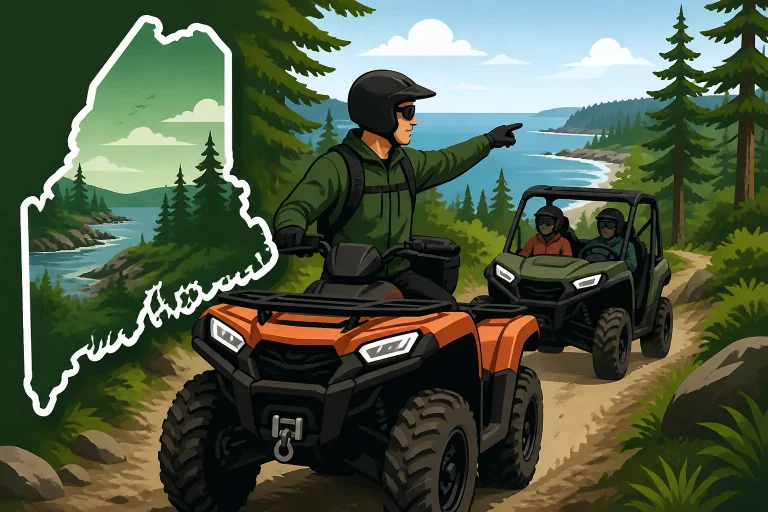
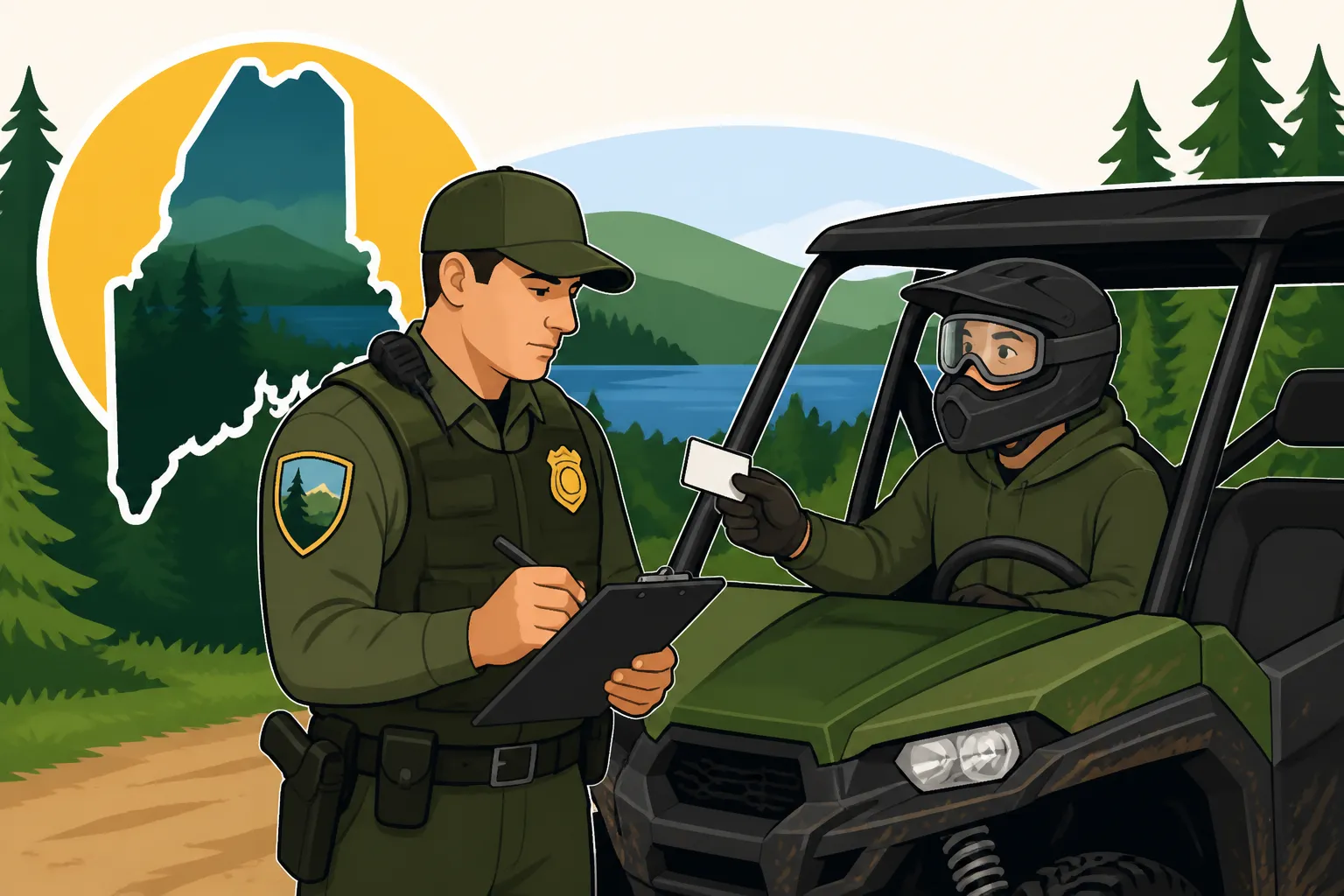
A warden stop can interrupt a ride, especially if you are unsure which papers or permissions matter. In Maine, checks may cover registration, who is operating the machine, where you are riding and whether you have permission to use the route. Knowing what to keep accessible and how to answer straightforwardly can make the stop clearer and less stressful.
What a Maine Warden Check May Cover
A check is not necessarily a sign that you have done something wrong. Wardens may be checking compliance with ATV laws, investigating a reported concern or enforcing wildlife rules in an area where riders are also present. The questions depend on the situation: a routine trail stop may focus on registration and operation, while a stop during hunting season could involve additional questions about hunting activity.
A warden may ask for information about the ATV or UTV, its registration, the operator and the route. They may also ask whether the rider has permission to use private land or whether the machine is being operated in a manner that is allowed there. What is relevant can vary by location, machine, operator age and activity.
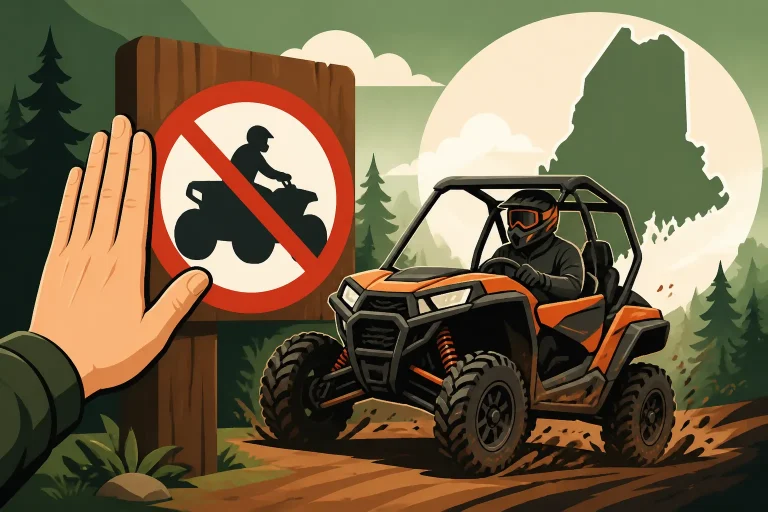
The word “trail” does not automatically mean a route is open to every rider. Much of Maine’s ATV access depends on landowner permission, club arrangements and local rules. A route can close or have restrictions, and a road connection may have conditions that differ from the trail itself. Checking access before you ride is part of being prepared, not just a way to avoid trouble during a stop. For more on that distinction, see Landowner Permission on Maine ATV Trails.
Checks may involve more than registration. Depending on what is happening, a warden could ask about:
- The machine’s registration and identifying information.
- Who owns or is responsible for the machine.
- The operator’s age and, where relevant, safety training.
- Permission or authorization to ride the route.
- Whether the machine is being operated safely and lawfully.
- Hunting, fishing, wildlife or other activity connected to the stop.
A warden may also look at the machine or ask the operator to clarify what they are doing. Do not assume every item will be checked at every stop. A useful approach is to have your basic documents organized and be ready to explain your route and purpose without guessing.
Wardens, club volunteers and landowners are not the same
A trail volunteer may be checking a trail pass or sharing a closure notice. A landowner may ask riders to leave private property. A warden is a law enforcement officer with responsibilities that can include enforcing state laws. These people can all affect a ride, but their roles and authority are different.
If someone stops you, calmly establish who they are and what they need. Do not treat a club volunteer’s request as though it were a law enforcement order, but do take a genuine closure or access warning seriously. If you are unsure how a request applies, ask politely for clarification rather than arguing on the trail.
For a useful outline of the common questions at a trail stop, see What Wardens Ask at a Trail Stop. The exact questions are not a fixed script, and a warden may ask follow-up questions based on your answers or the circumstances.
Documents and Details to Have Ready
Before leaving, check that your registration information is available and belongs to the machine you are riding. Do not rely on being able to look everything up later when you have poor cell service. Keep registration proof in a place where you can retrieve it without unpacking your whole machine or delaying the group.
Requirements can differ based on residency, registration status, machine use and any applicable exemption. Visitors should not assume that an out-of-state registration automatically covers riding in Maine. Maine’s reciprocity rules have changed, and riders need to confirm which registration applies to their circumstances. Maine ATV Registration for Non-Residents explains the visitor-registration issue in more detail.
| What a warden may ask about | What to have clear before riding | Helpful preparation |
|---|---|---|
| Registration | Which registration applies to this machine and trip | Keep registration evidence accessible and check that the machine details match |
| Machine identity | Which machine you are operating and who it belongs to | Know where the VIN is and avoid altering identifying marks |
| Operator | Who is driving and whether age-related rules apply | Make sure the operator meets the rules for the machine and situation |
| Safety training | Whether a youth operator has completed required training | Carry or be able to produce relevant proof when applicable |
| Route access | Whether the route is open and authorized for ATV use | Check current local and club information before setting out |
| Private land | Whether you have permission to cross or ride the property | Know who granted permission and what limits were agreed |
| Wildlife activity | Whether you are hunting, fishing or carrying out another regulated activity | Keep any relevant licenses and follow the rules for that activity |
The table is a planning aid, not a substitute for checking the current requirements that apply to your ride. A warden may ask about something not listed, and not every item will apply to every rider.
Registration proof and machine information
Registration proof is the first thing many riders think of, and for good reason. If asked, you want to be able to identify the registration for the machine you are operating without confusion. Check that the documents or electronic confirmation you carry are readable and match the machine. If you are riding a borrowed ATV, make sure you know who owns it and how to explain the arrangement.
Avoid treating the registration decal as the only information you need. The decal can help identify a registered machine, but it is not a substitute for knowing the status of the registration or having access to supporting evidence. For practical details about carrying paperwork, read Do You Carry Registration Papers While Riding?.
If you recently bought the machine or are waiting for a document, keep the paperwork you were given and confirm what is accepted for riding in your particular situation. Do not assume that a bill of sale, dealer receipt or screenshot automatically replaces registration proof. Registration processing and permitted proof can vary, so verify the current rule through the official source before heading out. Maine ATV Registration Confirmation for Immediate Riding covers the related question of what confirmation means for riding.
Youth operators and training
A stop may involve questions about a young operator’s age, supervision or training. Maine has age-related ATV rules, and riders should check the requirements that apply to the operator and the setting. A parent or adult riding in the group should not assume that being nearby is enough to satisfy every supervision requirement.
If a youth rider is operating, plan for the possibility that the adult may need to explain the relationship and the supervision arrangement. Keep any relevant safety-course proof accessible. The details are important because age, operator status and road use can affect which rules apply. See Maine ATV Safety Course for Riders 10 to 15 and What Maine Riders Need Before They Ride when preparing for a youth ride.
Permission and route details
A good answer to “Where are you going?” is specific and honest: name the trail or road connection you intended to use and explain how you checked that it was open. If the route crosses private property, know the basis for access. A club-marked trail, a landowner’s permission and an officially designated road route are not necessarily interchangeable permissions.
If your permission is limited to a certain section, time or type of use, stay within those limits. If you are not sure who controls a connecting segment, do not improvise by continuing across it. Stop safely and check the route information. Permission can be withdrawn, and closures can happen after a map or trip plan was made. A saved map is useful for navigation, but it does not by itself prove that a trail remains open.
Questions You May Hear and How to Answer
A warden’s questions are usually easier to handle when you answer the question asked, stick to what you know and avoid filling gaps with guesses. If you do not know the answer, say so and offer to check the relevant document or contact the person who arranged access. A confident but inaccurate explanation can create more confusion than a simple admission that you are unsure.
“Is this ATV registered?”
Be ready to show or identify the registration evidence for the machine. If the ATV belongs to someone else, say that plainly and explain whose machine it is. Do not claim a registration is current if you have not checked. If you are relying on a recent purchase, temporary paperwork or an unusual registration situation, explain that and show the documents you have.
If you discover a registration problem before the ride, resolve it before operating on routes where registration is required. A stop is a poor time to find out that the paperwork belongs to a different machine or that you misunderstood an exemption. For the basics of nonresident requirements, see Maine ATV Registration for Non-Residents.
“Who owns the machine?”
The operator may not be the owner. Be prepared to say whether the ATV is yours, borrowed, rented or part of a group’s equipment. If the machine is borrowed, get the owner’s permission before riding and make sure the registration information is available. If it is rented, follow the rental company’s route, operating and document requirements as well as state and local rules.
Being able to name the owner does not settle every issue. You still need to comply with the registration and operating rules that apply to the ride. If you are riding a machine registered to another person, do not assume that its status or paperwork is automatically in order.
“Where are you riding, and do you have permission?”
Answer with the route or area you intended to use. If access depends on permission, explain who granted it and what area that permission covers. If the person who gave permission is not with you, it can help to have their contact information or written confirmation, especially when riding on private land.
Do not suggest that a track on a phone proves access. GPS lines show location, not necessarily permission or current trail status. Similarly, seeing tire marks or other riders is not proof that a route is open. If a warden tells you the route is closed or unauthorized, stop and ask where you should turn around rather than continuing to test the boundary.
“Who is operating, and are they allowed to ride?”
A group should know which person is driving each machine, particularly when young riders are involved. Answer honestly about the operator’s age and training. Do not switch drivers during a stop to avoid a question or let an unqualified rider continue because the group is in a hurry.
If the ride includes road sections, be aware that rules for operating on a public way can differ from trail rules. A rider who is permitted to operate on a trail may not be permitted to operate in every road situation. Keep the planned route and operator qualifications consistent with the rules for the segment you are using.
“Are you hunting or carrying out another activity?”
A warden may ask about hunting, fishing or other wildlife-related activity when it is relevant. If you are hunting, be ready to answer truthfully and show the documents required for that activity. The ATV registration does not replace a hunting license or make an otherwise restricted activity lawful.
Keep any regulated equipment secured and follow the rules for transporting it. If you are not hunting, say so clearly. Do not joke or give an ambiguous answer about firearms, game or licenses; clear responses reduce the chance of misunderstanding.
How to Handle the Stop Safely
The setting matters. You may be on a narrow trail, near a road crossing or in a group where stopping suddenly could create a collision risk. Focus first on coming to a safe stop. Avoid blocking the trail or leaving a machine in a place that creates a hazard, but do not ride away to find a more convenient spot unless the officer directs you to do so.
A calm, predictable response is generally the most practical approach:
- Reduce speed and stop in a safe place when directed.
- Keep your hands visible and follow instructions about the machine.
- Listen to the question before answering.
- Provide the requested information and retrieve documents carefully.
- If you do not understand a request, ask politely for it to be repeated or clarified.
- If you disagree with a decision, avoid escalating the conversation on the trail; note the details and use the appropriate process afterward.
Do not reach suddenly into a pack or storage compartment without saying what you are doing. If documents are in a cargo box or pocket, let the warden know before moving to get them. This is sensible communication in any law enforcement stop, especially when helmets, gloves and bulky riding gear make movement less obvious.
If you are part of a group, let one person handle the conversation unless the warden asks someone else a question. Several riders talking at once can make a simple stop harder to follow. Group leaders can help by keeping other riders back, maintaining a clear stopping area and ensuring nobody restarts a machine until the stop is over.
Be accurate, not argumentative
You do not need to guess at a law or explain what you think another rider did. Give accurate answers about your own machine and actions. If you are uncertain whether a route is authorized, say how you checked and what information you relied on. Do not make up a landowner’s name, claim permission you do not have or present an outdated map as current confirmation.
If you believe a citation or instruction is mistaken, stay respectful and ask how to obtain the relevant information or contest the matter through the proper process. A roadside argument is unlikely to resolve a complicated interpretation. Write down the date, location, names or identifying information you are given, and what was said as soon as practical. Keep any citation or notice and follow the instructions stated on it.
When you are riding with children
Children may be nervous when approached by an officer, especially if they have never experienced a stop. Explain in advance that they should stop when directed, remain with the adult and let the adult answer unless they are asked a direct question. Do not coach a child to give a particular answer. The aim is to keep the interaction safe and truthful.
Before leaving, confirm that each youth rider meets the applicable age and training requirements and is riding under the required supervision. A supervising adult should be close enough to monitor the ride and respond if the group is stopped. Review Maine ATV Rules for Riders Under 16 on Roads if the plan includes road use.
Common Problems That Lead to Confusion
Many avoidable problems begin before the stop. The operator may not know who registered the machine, the group may rely on a trail map that does not reflect a closure, or a visitor may assume an out-of-state registration is enough. Preparation is more effective than trying to sort out a complex detail beside the trail.
Relying on someone else’s paperwork
If a friend arranged the ride, ask ahead of time which machine you will operate and where its registration proof is kept. Confirm that the documents match the vehicle. “The owner has it” is not a useful plan if the owner is in another group or cannot be reached.
This matters for families with several machines, too. Keep each ATV’s papers together and label them clearly. If a group changes machines during the day, make sure the new operator knows which registration information belongs to that machine.
Assuming a trail is open because it was open before
Trail access can change. A landowner may withdraw permission, a club may close a section or conditions may make a route unsafe. A familiar route is not guaranteed to remain available. Check current club or local updates shortly before the ride, not just when planning it weeks in advance.
For a wider view of warden activity and enforcement, Maine Warden Service ATV Patrols provides related context. Remember that a trail club’s update is useful for trail status, but you are still responsible for following the rules that apply to the route and your machine.
Confusing a decal, a map or a receipt with complete proof
A registration decal, map screenshot or purchase receipt can each be useful for a different purpose, but none should be assumed to answer every question. A decal may identify the machine; a map may help with navigation; a receipt may show a purchase. Verify what documentation is required for your circumstances and keep the appropriate registration evidence available.
If documents are electronic, download or save them before leaving. Do not depend on data coverage at a remote trail intersection. If you carry paper copies, protect them from rain and keep them legible. A backup copy is helpful, but it should not create uncertainty about which document is current.
Treating a registration exemption as blanket permission
Some types of use may qualify for a registration exception, but an exception is not a general pass to ride any trail. It may apply only to a particular use or location, while landowner rules, local restrictions and safe-operation duties still apply. Confirm the exact scope before riding under an exemption. If you cannot clearly explain why the exemption applies, obtain official guidance first.
The same principle applies to private property. Riding only on land you own may affect registration requirements, but it does not mean every road or trail beyond your boundary is open. A short connection across neighboring land still requires proper access.
Ignoring the rest of the group
One rider’s poor preparation can hold up a whole group. Before departing, agree who carries the documents, who has the landowner contact and where the group will stop if separated. Make sure each operator knows the machine they are riding and the route plan.
A group leader should not pressure riders to continue after a closure warning or a registration concern. Turn around, choose an authorized route or end the ride. A delay is inconvenient; continuing onto a route without permission can create a more serious problem for both riders and landowners.
Frequently Asked Questions
Can a Maine warden ask to see ATV registration?
A warden may ask about the machine’s registration during a stop. Keep the applicable registration evidence accessible, and confirm current requirements for your machine and use before riding.
Do nonresidents need to register an ATV in Maine?
Visitors should not assume their home-state registration is sufficient. Maine’s reciprocity rules have changed, so confirm which Maine registration option applies to the trip and rider.
What if I cannot find my registration papers during a stop?
Stay calm, explain where you normally keep them and ask whether the warden would like you to retrieve them. Do not make unsupported claims about registration status. Check the official requirements before your next ride and keep the relevant proof accessible.
Can I rely on a trail map to prove that I have permission?
No. A map can help you navigate, but it does not necessarily establish that a route is open or that you have permission to cross private land. Confirm access and any conditions with the appropriate landowner, club or local source.
What should I do if I disagree with a citation?
Remain respectful and follow the instructions on the citation or notice. Keep a record of the stop and use the stated process to address the matter rather than trying to settle a dispute in the trail.
Disclaimer
This article is for general informational purposes only and does not constitute professional advice. Laws, prices and regulations vary by location and change over time. Consult a qualified professional for guidance on your specific situation.