ATV Rules Around Schools and Churches
There’s nothing quite like a day out on the Maine trails, feeling the crisp air and seeing the incredible scenery from the seat of your ATV or UTV. But as you navigate those trails, sometimes they lead you through or near areas that require extra thought and caution – places like schools and churches. It's a common point of confusion for riders: what exactly are the rules when you find yourself near these sensitive locations? This guide will clear up the specific regulations and best practices you need to know to ride responsibly and respectfully in Maine.
The "Why" Behind Special Rules Near Schools and Churches
It might seem obvious, but taking a moment to understand why there are special considerations for operating ATVs and UTVs near schools and churches can help riders appreciate the rules and abide by them more readily. These aren't just arbitrary lines drawn on a map; they're about community safety and respect.
Protecting Vulnerable Populations
Think about a schoolyard during recess or dismissal, or a church during a service or community event. These are places where children, families, and individuals often congregate, sometimes without the same level of awareness for their surroundings as they might have on a busy street. Young children, in particular, can be unpredictable, and their presence demands an elevated sense of caution from any vehicle operator. The sheer size and sound of an ATV or UTV, even operating legally, can startle or distract someone, potentially leading to an accident if not handled with extreme care. The rules are designed to create a buffer of safety, acknowledging that these locations are frequented by those who deserve extra protection and consideration from any motorized traffic.
Minimizing Disturbances
Beyond the immediate safety concerns, schools and churches are often places of learning, quiet reflection, and community gathering. Imagine trying to conduct a classroom lesson with the constant drone of engines outside, or a peaceful Sunday service punctuated by the roar of an exhaust. ATV and UTVs, while exhilarating to ride, can generate significant noise, dust, and general commotion. These disturbances can disrupt the core activities of these institutions and detract from the quality of life for those using them. Maine’s trail system is a privilege, and part of maintaining that privilege is ensuring that our enjoyment doesn't come at the expense of others' peace and well-being. Respecting the quiet zones around schools and churches is a fundamental part of being a good neighbor in the ATV community.
Specific Maine Laws Governing ATV Operation Near These Locations
When it comes to specific statutes, you might be looking for a hard-and-fast rule, like "no ATVs within 500 feet of a school." However, Maine's ATV laws often rely on a combination of general operating principles and local authority rather than prescribing exact distances for every specific type of building. This can sometimes feel a bit ambiguous, but understanding the existing framework helps.
General Maine ATV Operating Laws
First and foremost, all the general rules of ATV operation in Maine still apply when you're near a school or church. This means your machine must be properly registered, you must be riding on approved trails or private land with permission, and you must operate safely and responsibly at all times. Rules regarding speed, reckless operation, and even noise, are always in effect. For instance, [Maine ATV Speed Limits Near Buildings] are not exclusive to residential homes but extend to any structure where people might be present, including schools and churches. These general laws serve as a baseline, and their interpretation becomes even stricter when you are in such sensitive areas.
Maine law also outlines specific requirements for young riders, such as [Maine ATV Rules for Riders Under 16 on Roads], which often influence how towns plan ATV access routes around schools, if at all. The responsibility to know and follow all state laws falls squarely on the operator, no matter where they are riding.
Interpreting General Operating Laws in Sensitive Areas
While there isn't a single, universally applicable state law that dictates a specific buffer zone around every school or church for ATVs, the existing statutes for safe and prudent operation take on greater significance in these locations. Operating an ATV "recklessly" or "negligently" is illegal statewide, and what might be considered acceptable on a remote logging road could be deemed highly inappropriate and illegal when passing a school at dismissal time. The intent behind the law is to prevent situations that could endanger the public or cause undue disturbance.
This often means that while the letter of the law might not give an exact number, the spirit of the law requires an operator to exercise extreme caution, reduce speed significantly, and minimize noise. If your exhaust system is particularly loud, even if it meets general [Maine Muffler and Exhaust Noise Limits], running it at full throttle past a church during a funeral could still be seen as operating in a way that is "not safe or prudent," which is a violation. Law enforcement, like the [Maine Warden Service ATV Patrols], will use their discretion to determine if an operator is abiding by these overarching principles of safe and respectful operation.
Understanding "Reasonable Distance" and Designated Access Routes
The concept of "reasonable distance" is often where riders encounter ambiguity. Without explicit state guidance, how do you know if you're too close? The answer often lies in how towns manage ATV access within their borders and the common sense approach riders must take.
No Universal "Buffer Zone" in State Law
It’s true that Maine state law doesn't typically define a universal "buffer zone" in terms of feet or yards around every school or church for ATV operation. This lack of a specific number can be frustrating for riders seeking clear guidance. Instead, the approach is often left to local municipalities to decide how best to manage ATV access while protecting these specific areas. This means what's permissible in one town might be handled differently in another, creating a patchwork of regulations that requires local knowledge. Riders cannot assume consistency from one town line to the next; due diligence is key.
This absence of a statewide mandate puts a greater emphasis on local bylaws and the general obligation of riders to operate with heightened awareness and respect when near any public gathering place. It means if you're questioning whether you're too close, you probably are, and it's best to err on the side of caution.
Town-Specific Access Routes and Ordinances
This is where local control truly comes into play. Many Maine towns, recognizing the popularity of ATV riding and the desire for trail connectivity, work to establish designated ATV access routes. These routes are carefully planned to minimize impact on sensitive areas. When a town goes through the process of [How a Maine Town Designates an ATV-Access Route], they are usually mindful of schools, churches, residential neighborhoods, and other public spaces. Such routes are often designed to bypass these areas entirely or to route riders along less intrusive roads or shoulders where noise and safety can be better managed.
It's crucial for riders to stick to these designated routes. If an ATV trail or access route is clearly marked as passing near a school or church, it's generally understood that the town has considered the impact and deemed it acceptable under specific conditions – usually meaning significantly reduced speed and respectful operation. However, straying from these marked routes, even for a short distance, can quickly lead to trespassing issues or violations of local ordinances that prohibit ATV travel on unapproved municipal property. Always look for clear signage; if there’s no sign indicating an ATV route, assume it’s not an allowed area.
Noise, Speed, and Behavior Considerations
Even when you're on a legally designated access route near a school or church, your manner of operation still matters immensely. It's not just about where you ride, but how you ride. These considerations are about minimizing your impact and upholding the reputation of the ATV community.
Muffler Laws and Noise Limits
Maine has clear regulations regarding ATV exhaust systems and noise levels. Your machine must be equipped with a muffler in good working order, and any aftermarket exhaust system must meet the same standards as the original equipment. As we discussed, [Maine Muffler and Exhaust Noise Limits] are in place to prevent excessive noise pollution across the board. However, even a legal muffler can still be quite loud, especially if you're accelerating rapidly or revving the engine.
When passing a school or church, the expectation is that you will operate your ATV or UTV in the quietest manner possible. This means avoiding aggressive throttle use, keeping your RPMs low, and coasting where safe and practical. Think about the impact your machine's sound has on someone inside. If you've invested in aftermarket parts, perhaps from a brand like SuperATV, that improve performance, ensure you're also being mindful of how that performance translates to noise, especially in sensitive areas. Opting for components that don't excessively amplify engine sounds is a good practice for all riders, but particularly crucial when sharing space with quiet zones.
Speed Limits Near Congregated Areas
Common sense, reinforced by general safety laws, dictates a significant reduction in speed when you are near any area where people, especially children, are gathered. While there might not be a specific statewide speed limit for ATVs passing a school, the principles outlined in [Maine ATV Speed Limits Near Homes] definitely apply. You should reduce your speed to a bare minimum – think walking pace – when actively passing the immediate vicinity of a school, church, or any associated parking lot or gathering area. This isn't just about avoiding a ticket; it's about reaction time. If a child darts out unexpectedly, or someone steps into an access route without looking, a low speed gives you the critical seconds needed to react safely.
Respectful Operation
Ultimately, a lot of what governs ATV operation around schools and churches boils down to simple respect and good citizenship. This goes beyond just following the letter of the law; it's about embodying the responsible rider image.
- Avoid dust and debris: If you’re on a gravel road, reduce your speed to prevent kicking up dust, which can blow onto buildings or people.
- No "hot-dogging": Leave the wheelies, donuts, and aggressive riding for the open trails. These behaviors are not only dangerous but also create a negative impression of ATV riders.
- Be aware of events: If you see cars parked for a church service or children playing outside a school, adjust your plans if possible. Sometimes, the most respectful thing to do is to find an alternate route or wait until activities have concluded.
- Maintain visibility: While not a strict rule in all areas, ensuring you're easily seen, especially if your route requires any brief road crossing near these areas, is crucial. Aftermarket lighting solutions, potentially from a supplier like SuperATV, could enhance your visibility, but they don't replace the need for careful operation. For example, if you have a SuperATV light bar, use it to ensure you are seen, but don't blind anyone.
- Yield to pedestrians: Always assume pedestrians have the right-of-way and be prepared to stop. This is a general rule for all vehicles, but especially critical where children are present.
By consciously practicing respectful operation, you contribute to positive community relations and help preserve access for all riders.
Local Ordinances and Posted Restrictions
While state law provides a foundational framework, local municipalities in Maine have the authority to enact their own specific rules for ATV operation within their towns. This is a critical point of information for any rider.
Town Power to Regulate
Maine law grants towns and cities the ability to pass ordinances that further regulate ATV use. This means a town can decide to restrict ATV access on certain public ways, create specific ATV-access routes, or even impose outright bans in particular areas, such as around schools and churches. These local ordinances are legally binding, and ignorance of them is not a valid defense if you're cited for a violation. This is why it's so important to be familiar with the local rules of any town you plan to ride through. You can’t just assume that because it’s not explicitly forbidden by state law, it’s allowed. Many towns have specific ordinances governing [Maine Town Ordinances That Restrict ATVs] where local sensitivity to noise, traffic, and safety is high.
These ordinances might, for example, designate an ATV route that avoids passing directly in front of a school, instead routing traffic behind it or along a less-trafficked road. Or, a town might completely prohibit ATV operation on certain streets that are primarily residential or lead directly to a church. The variability is why local knowledge or research is paramount.
Identifying Local Rules
So, how do you find out about these local rules? It takes a bit of proactive effort:
- Check the Town Office: The most reliable source is the town clerk's office. Many towns have their ordinances available online on their municipal website. Look for sections related to "ATV," "Off-Road Vehicles," or "Public Ways."
- Contact Local ATV Clubs: Maine's ATV clubs are often the best resource for local trail information and regulations. They work directly with landowners and towns to maintain trails and establish access, so they'll know the specifics of their area. They can tell you where the established [Maine ATV-Access Routes and How Towns Post Them] are and any special considerations.
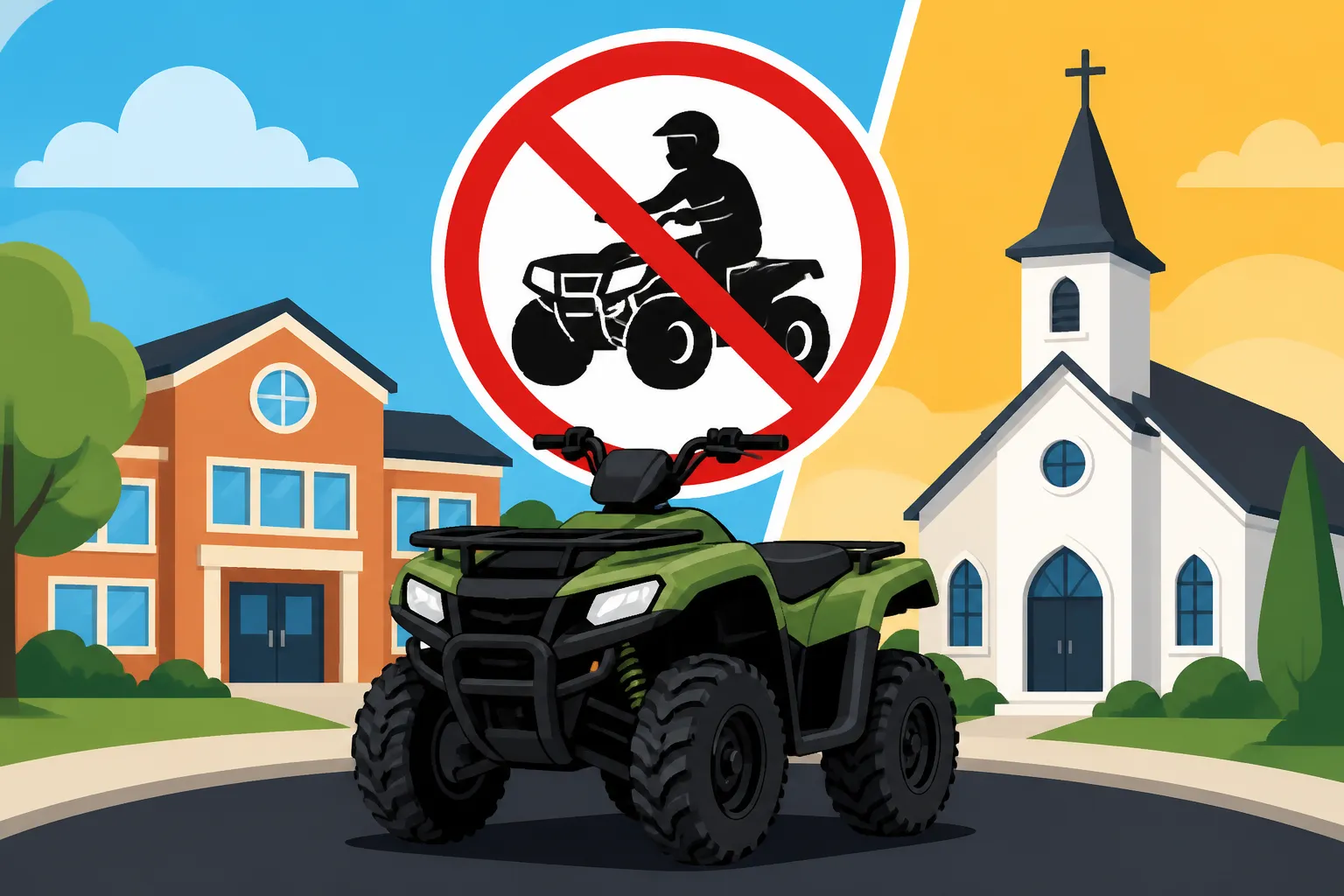
- Look for Signage: Pay close attention to posted signs. Towns are generally good about posting "No ATVs" signs or specific "ATV Route" markers. If you see signs indicating no ATVs in a particular area, especially near a school or church, those signs carry legal weight.
- Ask Law Enforcement: While not always their primary role, local police or the Maine Warden Service can also provide guidance on local regulations if you encounter them, but it’s better to do your research beforehand rather than asking after the fact.
Reading Posted Signs
Perhaps the most direct and unmistakable form of local regulation comes in the form of posted signs. While Maine has general [Maine Trespass Law for ATV Riders] on private land, towns can also restrict access on public land or public ways. If you see a sign near a school or church that says "No ATVs," "No Motorized Vehicles," or "Private Property – No Trespassing," you must respect it. These aren't suggestions; they are legal directives.
Ignoring posted signs can lead to fines, citations, and severely damage the relationship between riders and the community. Even if a specific ordinance isn't immediately obvious, clear signage acts as a legal notification. This is especially true for property that belongs to the school or church itself; these are private entities, and their posted rules must be followed just like any other private landowner's. Always prioritize what's posted on the ground.
Consequences of Violating These Rules
Riding an ATV or UTV in Maine is a privilege, not a right, and disregarding the rules, especially around sensitive locations like schools and churches, carries significant consequences. These penalties aren't just about financial cost; they can impact your riding opportunities and the wider ATV community.
Penalties for Misoperation
If you're caught operating your ATV or UTV in violation of state laws or local ordinances near a school or church, you could face a range of penalties. These could include:
- Fines: The most common consequence is a monetary fine. These fines can vary depending on the severity of the violation, whether it's a state law or local ordinance, and if it's a first offense. For example, while not directly related to schools, general fines like those for [Fine for an Unregistered ATV in Maine] give a sense of the monetary penalties involved for ATV violations. Reckless operation, excessive noise, or trespass can all carry their own specific fine schedules.
- Loss of Riding Privileges: In serious cases, repeated violations or particularly egregious acts could lead to the suspension or revocation of your ATV registration. This means you wouldn't be able to legally ride any ATV or UTV in Maine.
- Machine Impoundment: Law enforcement has the authority to impound your machine if you're operating it illegally, especially in cases of severe reckless operation or repeated offenses. Getting your machine back can be costly and inconvenient.
- Criminal Charges: In extreme cases, such as causing damage to property, endangering individuals, or operating under the influence (like [Maine ATV Operating Under the Influence]), you could face criminal charges beyond simple infractions.
It's important to remember that these are not just theoretical possibilities. Wardens and local police are actively patrolling, and they take violations, particularly those involving public safety or peace, very seriously.
Impact on Trail Access
Perhaps one of the most disheartening consequences of irresponsible riding around schools and churches is the negative impact it has on trail access for all riders. The vast majority of Maine's extensive ATV trail network relies heavily on the goodwill and cooperation of private landowners. When a few individuals operate recklessly, generate excessive noise, or trespass near sensitive community areas, it erodes that trust.
Landowners, towns, and local residents often voice concerns about ATV noise and safety. A few bad experiences near a school or church can lead to:
- Trail Closures: Towns might decide to close access routes that pass near these areas, or private landowners might withdraw their permission for trails crossing their property if they perceive a heightened risk or nuisance. When one landowner pulls out, it can break a critical link in the trail system, impacting dozens or even hundreds of riders.
- Stricter Ordinances: Negative incidents can prompt towns to enact even stricter, more restrictive ordinances, making it harder for responsible riders to enjoy the trails.
- Negative Public Perception: Every time an ATV rider behaves irresponsibly near a school or church, it reinforces negative stereotypes about the entire ATV community. This makes it harder for ATV clubs and advocates to secure new trail access or maintain existing relationships.
Every rider has a responsibility to be an ambassador for the sport. When you operate respectfully, especially in sensitive areas, you help ensure that the privilege of riding in Maine remains available for generations to come. It’s the opposite of [Riding Slowly Past Farmhouses], which is about maintaining good relations; here, it's about avoiding total loss of access.
Community Relations
Good community relations are the bedrock of sustainable outdoor recreation. When ATV riders are seen as respectful, safe, and considerate members of the community, everyone benefits. Conversely, when riders are perceived as disruptive or dangerous, particularly around children or places of worship, it creates animosity and resistance.
Maintaining positive relationships means more than just avoiding a fine. It means understanding that your actions reflect on every other ATV owner. When you operate quietly and cautiously near a school, you're not just being lawful; you're building goodwill. This goodwill is essential for securing future trail grants, maintaining landowner permissions, and ensuring that ATV riding continues to be welcomed as a vital part of Maine's outdoor culture. By demonstrating respect for these special places, we help ensure that our passion can continue to thrive.
Summary of Best Practices for Riding Near Schools and Churches
To help solidify the various considerations, here’s a quick overview of best practices when your ATV route takes you anywhere near a school or church. These are not just legal requirements, but essential courtesies that protect both you and the community.
| Rule Category | General Maine ATV Law (Statewide) | Best Practice / Potential Local Ordinance (Near Schools/Churches) |
|---|---|---|
| Speed | Prudent & reasonable; specific limits near homes/buildings | Significantly reduced speed; walking pace when actively passing; be prepared to stop instantly. |
| Noise | Specific muffler and decibel limits; no excessive noise | Avoid unnecessary revving; keep RPMs low; coast where safe; consider quieter aftermarket options for future upgrades. |
| Trespass | Always requires permission on private land; no riding on public ways unless designated | Absolutely no deviation from marked trails/access routes; strict adherence to property lines of school/church. |
| Operating Hours | No statewide restriction, but local curfews apply; night riding requires lights | Avoid during school drop-off/pickup, during services, or evening events; be mindful of quiet hours. |
| Visibility | Headlights/taillights required after dark or in low visibility | Be highly visible; wear bright clothing; assume pedestrians/drivers may not see you; use appropriate lighting from a brand like SuperATV if needed. |
| Interaction | Yield to pedestrians; safe distances from other vehicles | Always yield to pedestrians; make eye contact; be ready to stop; avoid startling anyone. |
Remember, while some of these are "best practices" rather than explicit state laws for these specific locations, they represent the spirit of safe and responsible riding that the Maine Warden Service and local law enforcement expect. A warden performing [Maine Warden Service ATV Patrols] will always interpret general laws more strictly when public safety or peace is at stake. Always prioritize the safety and well-being of the community above your own desire for speed or thrill when in these sensitive areas. Knowing and respecting these rules helps ensure that everyone, riders and non-riders alike, can enjoy Maine safely.
Disclaimer
This article is for general informational purposes only and does not constitute professional advice. Laws, prices and regulations vary by location and change over time. Consult a qualified professional for guidance on your specific situation.