Maine Snowmobile and ATV Shared Road Corridors
It can be incredibly frustrating to be out on your ATV or UTV in Maine, enjoying the vast trail network, only to hit a dead end or realize you need to traverse a small section of public road to connect to the next segment of trail or reach a gas station. Many riders feel that pang of uncertainty: Is this legal? What are the rules here? This guide is all about navigating those vital connections – the Maine snowmobile and ATV shared road corridors – so you can ride confidently and safely, ensuring seamless trips across our beautiful state.
Understanding Shared Road Corridors in Maine
Maine boasts an incredible network of ATV and snowmobile trails, but these trails don't always connect perfectly or lead directly to the services you need. That's where shared road corridors come into play. These aren't just informal agreements; they're specifically designated sections of public ways that act as crucial arteries, allowing legal passage for off-road vehicles. Without them, our extensive trail system would be a series of disconnected segments, making long-distance touring or even short hops to town incredibly difficult and, more importantly, illegal.
What Exactly is a Shared Road Corridor?
At its core, a shared road corridor is a stretch of public way – often a paved or gravel town road – that a municipality has officially designated for use by ATVs, UTVs, and, in many cases, snowmobiles during their respective seasons. These aren't simply "any road where no one is looking"; they are carefully considered and legally established routes. Think of them as the glue that holds Maine's trail system together. They allow riders to bypass areas where trails cannot be built, cross major highways safely at designated points, and, most importantly, provide access to essential services like fuel, food, and lodging.
The importance of these corridors cannot be overstated for the riding community. Imagine planning a multi-day trip from Aroostook County down to the Moosehead Lake region. You'll inevitably encounter towns, rivers, and privately owned land where a continuous off-road trail isn't feasible. These designated road sections provide the legal means to keep your adventure going. Without them, your journey would either grind to a halt or force you into an illegal situation, risking fines and jeopardizing the landowner relations that make our trail system possible.
For example, consider a scenario where the main trail leads you to the edge of a small Maine village. To get to the next section of trail on the other side, or perhaps to grab lunch at a local diner, you need to traverse a few blocks of the town's main street. If that street is a designated shared corridor, you can legally and safely make that connection. If it isn't, you'd be forced to load your machine onto a trailer, drive the short distance, and unload again – a logistical nightmare that defeats the purpose of seamless trail riding.
How Towns Designate and Mark These Routes
The process of establishing a shared road corridor isn't a casual one. It typically begins with a local ATV or snowmobile club working closely with their town's select board or municipal officers. These clubs are the backbone of Maine's trail system, constantly advocating for rider access and maintaining the trails. The town then considers adopting a local ordinance that specifically outlines which public ways, or sections thereof, are open to ATV and snowmobile traffic. This often involves public hearings to ensure community input and address any concerns from residents.
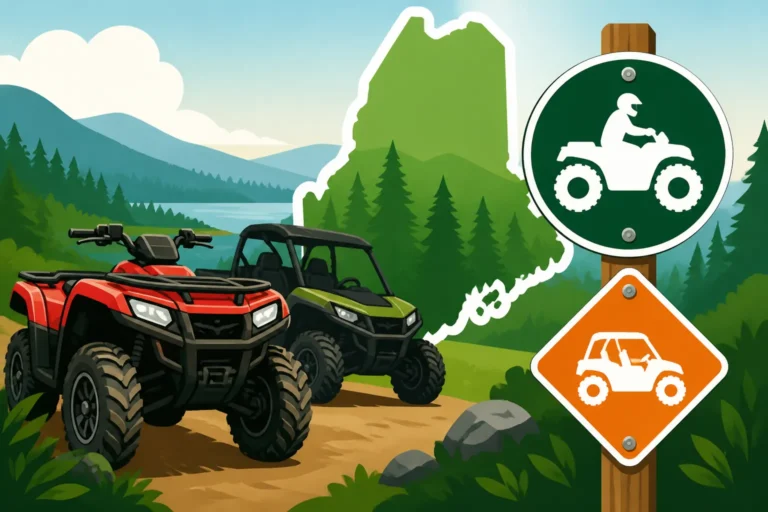
Once an ordinance is passed, clear and consistent signage becomes paramount. You'll see specific signs indicating the presence of an ATV-access route, often with an arrow directing traffic or clearly marking the beginning and end of the designated corridor. These signs are not merely suggestions; they are legal indicators of where you can and cannot ride. [How a Maine Town Designates an ATV-Access Route] It's crucial for riders to understand that if a road isn't clearly marked, it's generally not an open corridor, even if it looks like a suitable path.
Think of it this way: You're riding with friends near Greenville and come to an intersection. One road looks like a shortcut to the gas station, but there are no ATV corridor signs. The other road has clear, official signage. The temptation might be to take the shortcut, but doing so would be riding illegally. The signs are there to guide you and protect both you and the landowners/residents. Relying solely on your GPS or a printed map that might be out of date isn't enough; always look for the physical signage on the ground. These signs might also indicate specific operating hours or other restrictions set by the town.
Rules of the Road for Shared Corridors
Operating an ATV or UTV on a public way, even a designated corridor, comes with specific responsibilities and rules that differ significantly from riding on a private trail. These regulations are designed to ensure the safety of all road users – ATV riders, motorists, pedestrians, and cyclists. Understanding and adhering to these rules is not just about avoiding a fine; it's about being a responsible recreationalist and helping to preserve these crucial access points for everyone.
Maine's "Extreme Right" Rule and Safety
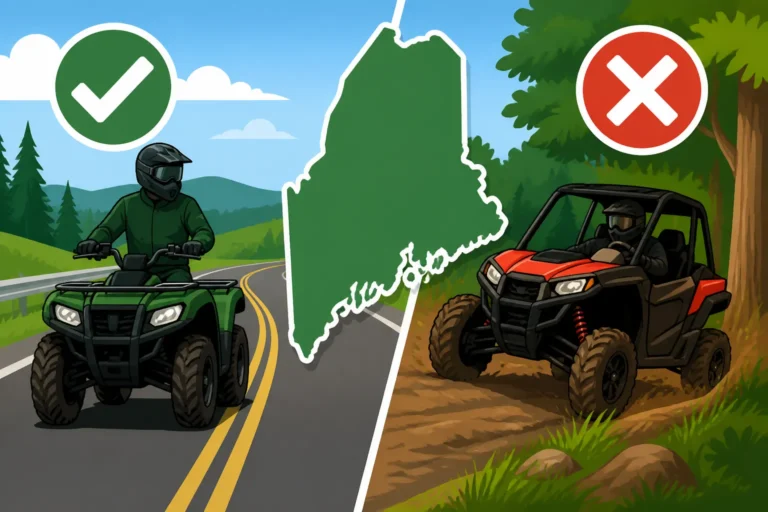
One of the most fundamental rules when operating on a shared road corridor is the "extreme right" rule. Maine law stipulates that when an ATV or UTV is operated on a public way that is open to these vehicles, it must be operated "on the extreme right of the traveled portion of the public way." This is a critical distinction: it doesn't mean the shoulder, the ditch, or the side of the road. It means as far to the right as safely possible on the paved or gravel surface where vehicles typically drive. [Riding the Extreme Right of a Maine Road]
This rule exists for your safety and the safety of others. Public roads are designed for cars and trucks, which are faster and heavier. By staying to the extreme right, you maximize the distance between your machine and oncoming or passing traffic, giving everyone more reaction time. It's a defensive riding strategy that acknowledges your vehicle's limitations on a public thoroughfare. Furthermore, maintaining a predictable path is vital; weaving or suddenly swerving can be incredibly dangerous.
Consider a real-life scenario: you're on a shared corridor, a paved road connecting two sections of trail near the town of Dover-Foxcroft. Even if the road seems quiet, you must hug the right edge of the lane. A car could come around a blind curve, or a delivery truck might pull out of a driveway. Your machine, while capable, is not built for highway speeds, and being as visible and out of the way as possible is your best defense. Staying alert, minimizing distractions, and constantly scanning your surroundings become even more critical when sharing the road with other vehicles.
Speed Limits and Right-of-Way in Shared Areas
Speed is another critical factor on shared road corridors. While you might be able to open up your machine on an open trail, public ways demand a much more conservative approach. Many towns that designate these corridors will impose specific speed limits for ATVs and UTVs, often much lower than the posted speed limit for cars. For instance, you might see signs indicating an ATV speed limit of 15-20 mph, even if cars are allowed to go 35 mph. [Maine ATV Speed Limits Near Buildings] Always pay attention to any specific signage related to speed on these corridors.
In the absence of specific ATV speed limit signs, you should always operate at a speed that is reasonable and prudent for the conditions, and significantly slower than you would on a dedicated trail. The goal is to maintain control, react quickly to hazards (potholes, pedestrians, other vehicles), and avoid disturbing residents with excessive noise or dust. Speeding through a village on a shared corridor is a sure-fire way to generate complaints, which can jeopardize the continued existence of that corridor for all riders.
Furthermore, when on a shared corridor, ATVs and UTVs are essentially guests on the road. This means you must yield to all other motor vehicle traffic. You do not have the right-of-way simply because you are on a designated route. Treat every intersection, every driveway, and every oncoming vehicle with the utmost respect and caution. Be prepared to stop or slow down significantly, even if it feels like you have the opportunity to proceed. [ATV Yield Rules in Traffic] This cautious approach prevents accidents and reinforces the image of responsible riders.
Imagine you're approaching an unmarked intersection on a gravel corridor in Patten. Even if you don't see another vehicle immediately, you must approach with caution, scanning for cross-traffic and being prepared to stop. If a car appears, it has the right of way. By consistently yielding and operating at safe speeds, you contribute positively to the perception of ATV riders in the community and help ensure these crucial shared corridors remain open.
When Snowmobiles Enter the Picture
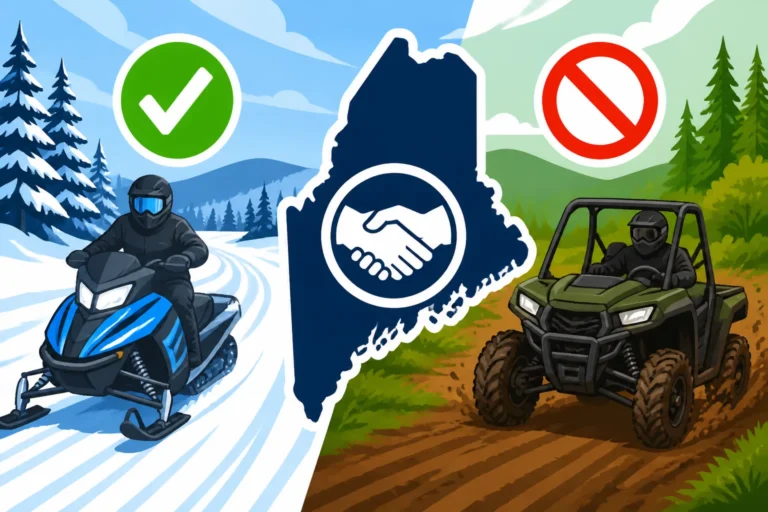
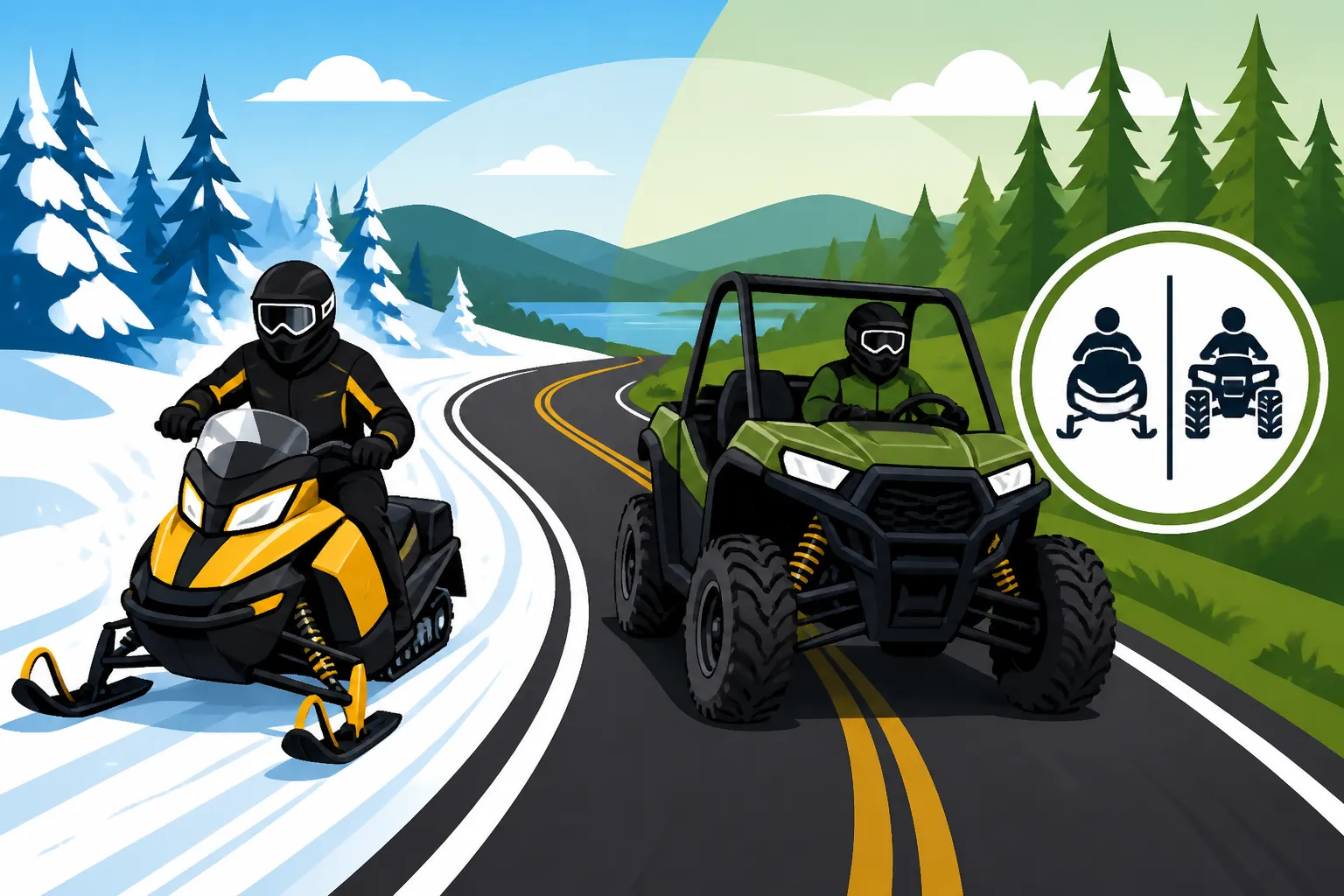
The term "shared road corridor" isn't just about ATVs and UTVs sharing with cars; it also often refers to these routes being shared with snowmobiles during the winter months. Maine's extensive snowmobile trail system frequently utilizes these same public ways as connectors, particularly in areas where snowmobile trails cannot be developed off-road. This creates a unique multi-use environment, where different types of recreational vehicles coexist, albeit at different times of the year.
While the fundamental rules of staying to the extreme right and yielding to motor vehicles generally apply to both, the specific operational seasons dictate which type of recreational vehicle is using the corridor. Typically, ATV and UTV corridors are open when the ground is not snow-covered, usually from May 15th through December 15th, though exact dates can vary by town and conditions. Snowmobile corridors, conversely, are active once sufficient snow cover exists, typically from December 15th to April 30th. It's crucial for riders to be aware of these seasonal distinctions.
In late fall or early spring, you might find yourself on a corridor that is transitioning between seasons. You might see both ATV and snowmobile signage, which can sometimes be confusing. The key is to know which season you are in and which regulations apply. For example, riding your ATV on a designated snowmobile corridor with sufficient snow cover would be illegal and potentially damage the snowmobile trail. Mutual respect between user groups is essential. Riders of all types depend on these shared routes for access, and understanding the seasonal nuances helps prevent conflicts and ensures proper trail etiquette.
Equipment and Legalities for Corridor Use
Taking your ATV or UTV onto any public way, even a designated shared corridor, elevates the level of scrutiny and the specific equipment requirements you need to meet. Unlike riding exclusively on private trails, operating on public roads means interacting with other vehicles and being subject to general traffic laws in addition to specific ATV regulations. Ensuring your machine is properly equipped and you have all the necessary legal documentation isn't optional; it's a fundamental part of responsible riding on these corridors.
Essential Equipment for Road Riding
When you're riding on a shared road corridor, your ATV or UTV transforms from a purely off-road machine into something that needs to be visible and controllable in a mixed-traffic environment. This means specific lighting and signaling equipment is no longer just a good idea, it's a legal requirement. You must have functional headlights, taillights, and brake lights. These are absolutely crucial for visibility, especially if you find yourself on a corridor at dawn, dusk, or in inclement weather. [Maine Lighting Requirements for Night Riding] A burned-out bulb could earn you a stop from a warden and a fine.
Beyond basic lighting, mirrors and a horn become essential for safety. Maine law requires ATVs and UTVs to have at least one mirror that allows the operator to see 200 feet to the rear. This is vital for checking traffic before turning or passing (if legally permitted on a given corridor) or simply being aware of vehicles approaching from behind. [Maine ATV Mirror Rules] A working horn is also required, allowing you to signal your presence to pedestrians, cyclists, or other vehicles in situations where a quick warning is necessary. [Horn Requirements for Road Riding] These are not luxuries; they are fundamental safety devices when sharing the road.
Furthermore, consider your tires. While knobby off-road tires are great for mud and rocks, they wear quickly and offer less traction on pavement. If you frequently use shared corridors, investing in a set of tires designed for mixed terrain, like some options from SuperATV, can significantly improve your machine's handling and longevity on these surfaces. They can also help reduce noise on paved sections, which is an important consideration for community relations. Before every ride that includes a corridor, perform a quick check: lights, horn, mirrors, and tire pressure. A pre-ride inspection ensures you're not only legal but also safe.
Registration and Proof of Ownership
Operating an ATV or UTV on any public land, public reserved land, or legally designated shared road corridor in Maine absolutely requires your machine to be currently registered with the Maine Department of Inland Fisheries and Wildlife (IF&W). There are no exceptions for riding on these public ways; an unregistered machine is an illegal machine, regardless of where it's ridden. [What It Takes to Register an ATV in Maine] This isn't just a formality; registration fees directly support the maintenance and expansion of Maine's entire trail system, including the signage and upkeep of these shared corridors.
When you are stopped by a Maine Game Warden or other law enforcement officer on a shared corridor, they will invariably ask for your registration certificate and proof of ownership. This means carrying these documents with you while you ride. While some riders store their papers on the machine, many prefer a waterproof pouch worn on their person to ensure they're readily accessible and protected from the elements. [Do You Carry Registration Papers While Riding?] Failure to produce valid registration can result in a significant fine and could lead to your machine being impounded.
Imagine this scenario: You're riding through a shared corridor in the Forks region, connecting two beautiful sections of trail. A warden is conducting a routine check, and they pull you over. They ask for your papers. If you can't produce them, even if your machine is registered, it creates a problem. Being prepared saves you time, hassle, and potential legal issues. Always double-check that your current registration sticker is properly affixed to your machine and that you have the physical registration certificate with you before you even leave your staging area.
Insurance and Liability Considerations
While Maine does not legally mandate liability insurance for ATVs or UTVs for all types of riding, it is an incredibly wise investment, especially when operating on shared road corridors. When you're on a public way, the risk of interacting with other vehicles, pedestrians, or property increases dramatically compared to riding exclusively on a remote trail. In the unfortunate event of an accident involving another vehicle or person, your liability could be substantial without proper coverage. [Maine ATV Insurance and When You Need It]
Many homeowners' insurance policies do not cover ATV or UTV operation, particularly if the machine is driven off your private property. It's crucial to check with your insurance provider to understand your coverage. Specialized ATV/UTV insurance policies are available and can provide peace of mind, covering not only damage to your own machine but, more importantly, liability for injuries or property damage you might cause to others. Considering the potential costs of medical bills or vehicle repairs in an accident, a dedicated policy is a relatively small price to pay for protection.
Consider a hypothetical situation: you misjudge a turn on a gravel corridor in Eustis, and your UTV scrapes the side of a parked car. Without liability insurance, you could be personally responsible for the entire cost of the car's repair. Or, worse, if a minor collision causes injury to another person, you could face significant financial hardship. While a quality aftermarket product from SuperATV can enhance your machine's performance and safety, it can't protect you from liability. This is why understanding your insurance situation before you hit the shared corridors is as important as having a working headlight.
Navigating and Planning Your Ride
Successfully integrating shared road corridors into your ATV or UTV adventures requires more than just knowing the rules; it demands careful planning and navigation. These corridors are designed to enhance your riding experience, providing vital connections and access points. However, failing to plan properly can lead to frustration, getting lost, or inadvertently violating local regulations. Think of planning as the compass that guides your machine safely and legally across Maine's diverse landscapes.
Finding Designated Shared Corridors
The absolute best resource for identifying designated shared road corridors in Maine is the local ATV clubs. These clubs are on the ground, working with towns, maintaining trails, and often have the most up-to-date and accurate maps of their specific trail systems, including approved road sections. Many clubs publish detailed maps on their websites, have them available at local businesses, or even integrate them into digital mapping apps. [Maine ATV Trail Maps and Club Boundaries] Always prioritize checking the most current club maps for the specific area you plan to ride.
While the Maine Bureau of Parks and Lands (BPL) also provides general trail information, the local clubs are the experts on the ground for specific, granular details about town ordinances and designated corridors. Before embarking on a ride, particularly in an unfamiliar area, make it a priority to download, print, or otherwise obtain the most recent maps from the relevant clubs. Do not rely solely on old maps, outdated GPS files, or anecdotal information, as routes can change due to landowner requests, trail conditions, or new town ordinances.
For instance, if you're planning to ride the vast network in Aroostook County, you'll want to consult maps from clubs like the Star City ATV Club or the Madawaska Valley ATVenture Club. These maps will clearly mark which sections of public road are open to ATVs and UTVs, along with any specific rules or access points. You might even find local businesses that are designated "ATV friendly" along these corridors, providing a perfect spot to refuel or grab a meal.
Connecting to Trail Systems and Amenities
The primary function of shared road corridors is connectivity. They are the missing links that transform a series of isolated trails into a cohesive, expansive network. Imagine the sheer convenience of riding directly from a remote trail to a gas station in a small town without having to load your machine onto a trailer. This is precisely what these corridors facilitate, providing riders with legal and direct access to essential services and continuing their journey. [Riding an ATV to a Gas Station]
These routes aren't just for gas; they often lead directly to local restaurants, lodging establishments, and general stores, allowing riders to fully immerse themselves in the local economy and culture. [Riding to Dinner on an ATV Route] This access is mutually beneficial: riders get convenience, and local businesses get much-needed patronage from the ATV and UTV community. It's a key part of the economic impact that recreational riding brings to rural Maine.
Think about planning a weekend trip to the Katahdin region. You can ride miles of trails, then utilize a shared corridor to access your lodging in Millinocket, grab dinner, and then ride back to the trails the next morning. This capability greatly enhances the overall appeal of Maine's trail system, making multi-day touring and exploration much more feasible and enjoyable. Without these corridors, the logistics of even simple amenities would be a significant barrier to such adventures.
Respecting Local Ordinances and Private Land
While shared road corridors provide legal access, they also come with a heightened responsibility to respect local rules and private property. Just because a public way is a designated corridor doesn't mean it's a free-for-all. Many towns will have specific ordinances that govern ATV and UTV use, beyond state law. These might include noise restrictions, specific operating hours (e.g., no riding before sunrise or after sunset on certain corridors), or even temporary closures due to local events. [Maine Town Ordinances That Restrict ATVs] It's your responsibility as a rider to be aware of and abide by these local rules.
Beyond municipal regulations, the principles of respecting private land remain paramount, even when riding on a public road corridor. The "extreme right" rule helps ensure you stay on the public way, but it's easy to inadvertently trespass if you're not paying attention. Keep a keen eye out for "No Trespassing" signs or the distinctive purple paint marks on trees or posts, which in Maine, legally denote private property where entry is prohibited. [Purple Paint Marks Along a Maine Road] Even pulling off the road for a moment onto private land without permission is considered trespass.
A common scenario: you're on a shared corridor that passes through a residential area. There might be a speed limit of 15 mph and a local ordinance prohibiting excessive engine braking or loud exhaust. Ignoring these rules could lead to complaints from residents, which, over time, can put pressure on the town to revoke or restrict the corridor. Every rider has a role in being a good ambassador for the sport. By riding respectfully, quietly, and strictly adhering to all signage and local rules, you help ensure that these vital connections remain open for years to come.
Challenges and Community Impact
While Maine's snowmobile and ATV shared road corridors are indispensable for trail connectivity, their existence isn't without challenges. Operating ATVs and UTVs on public ways naturally brings these machines into closer proximity with residential areas, businesses, and other forms of traffic. Balancing the needs of the riding community with the concerns of local residents and the broader community is an ongoing effort that requires careful management, rider responsibility, and consistent advocacy.
Balancing Access with Resident Concerns
One of the most frequent challenges associated with shared road corridors is managing resident concerns. While riders appreciate the access, residents who live along these routes may experience increased noise, dust, and traffic. [ATV Noise Complaints From Neighbors] This can lead to tension and, in some cases, calls for towns to limit or even revoke corridor access. Maintaining a positive relationship between the riding community and local residents is therefore critical to the long-term viability of these routes.
This balance often comes down to rider behavior. Excessive speed, loud aftermarket exhausts, or riding during prohibited hours can quickly erode public support for ATV access. Imagine living in a quiet rural neighborhood, and suddenly, a group of ATVs roars past your house late at night or early in the morning. This can be incredibly disruptive and understandable lead to complaints. Responsible riding, including adhering to posted speed limits, ensuring your machine meets muffler requirements, and being mindful of residential areas, goes a long way in mitigating these concerns.
Local ATV clubs often play a crucial role here, working with towns to address complaints, educate riders, and even assist with dust control on gravel sections if possible. The success of shared corridors relies heavily on the riding community being good neighbors. Each rider's actions reflect on the entire sport, making individual responsibility paramount in preserving these vital connections.
Environmental Considerations and Trail Maintenance
Even on established road corridors, environmental considerations remain important. On gravel sections, excessive speed can kick up significant amounts of dust, which not only impacts visibility and air quality for residents but also contributes to localized erosion. Riding off the designated route, even a few feet into the ditch, can damage vegetation and create new, unauthorized paths, which is detrimental to the local ecosystem and landowner relations.
Maintenance of these corridors, especially the gravel sections, is an ongoing effort. While the state and towns maintain the roads for vehicular traffic, the increased use by ATVs and UTVs can contribute to wear and tear. A portion of your ATV registration fees directly contributes to the Maine ATV Trail Fund, which provides grants to clubs for trail maintenance, including work on bridges, culverts, and signage along these shared routes. [Where Maine ATV Registration Money Goes] This financial contribution is a key argument for maintaining and expanding these corridors.
For example, a shared gravel corridor in Oxford County might see heavy ATV traffic on a busy summer weekend. If riders are constantly exceeding safe speeds, it can lead to washboarding and potholes, which then need to be graded and repaired. Using quality, durable components on your machine, like those available from SuperATV, can help ensure your machine is well-maintained and doesn't cause undue impact on the surfaces you ride on, whether it's a rocky trail or a town road.
Future of Shared Corridors and Advocacy
The network of shared road corridors in Maine is not static; it's constantly evolving. New routes are proposed, existing ones are sometimes modified or even closed, and the legal framework surrounding their use can change. The future of these vital connections depends heavily on continued advocacy, cooperation between state agencies, local municipalities, and, most importantly, the active participation of the ATV and UTV riding community.
ATV clubs are the frontline advocates for maintaining and expanding these corridors. They attend town meetings, present proposals to select boards, and rally support from their members. [Maine ATV Clubs and the Trails They Keep Open] Joining a local club is one of the most impactful ways riders can contribute to the preservation and growth of Maine's trail system, including these shared road sections. Your membership dues and volunteer hours directly support these advocacy efforts, as well as the physical maintenance of the trails themselves.
Looking ahead, as the popularity of ATVs and UTVs continues to grow, the demand for more interconnected trail systems will only increase. This will inevitably mean more discussions about utilizing public ways as shared corridors. Responsible riding, active participation in clubs, and constructive engagement with local communities will be crucial in demonstrating that ATV and UTV riders are a valuable and respectful part of Maine's recreational landscape, deserving of these vital access points.
| Aspect | ATV/UTV Shared Corridor Rules | Snowmobile Shared Corridor Rules (Winter Season) |
|---|---|---|
| Operating Season | Generally May 15 – Dec 15 (may vary by town/conditions) | Generally Dec 15 – April 30 (sufficient snow cover required) |
| Operating Position | Extreme right of traveled portion of public way | Extreme right of traveled portion of public way (often snow-packed) |
| Speed Limits | Often posted, typically lower than vehicular traffic (e.g., 15-20 mph), or reasonable and prudent | Often posted, typically lower than vehicular traffic, or reasonable and prudent |
| Yielding | Must yield to all other motor vehicle traffic | Must yield to all other motor vehicle traffic |
| Equipment | Headlights, taillights, brake lights, mirror, horn required | Headlights, taillights, brake lights required (often no mirror/horn rule) |
| Registration | Required with Maine IF&W | Required with Maine IF&W |
| Primary Purpose | Connect trails, access amenities, bypass unridable areas | Connect trails, access amenities, bypass unridable areas |
| Interaction | Share with cars, trucks, pedestrians, cyclists (sometimes snowmobiles in transition seasons) | Share with cars, trucks, pedestrians (sometimes ATVs in transition seasons) |
Disclaimer
This article is for general informational purposes only and does not constitute professional advice. Laws, prices and regulations vary by location and change over time. Consult a qualified professional for guidance on your specific situation.