Riding Straight From Your Campsite
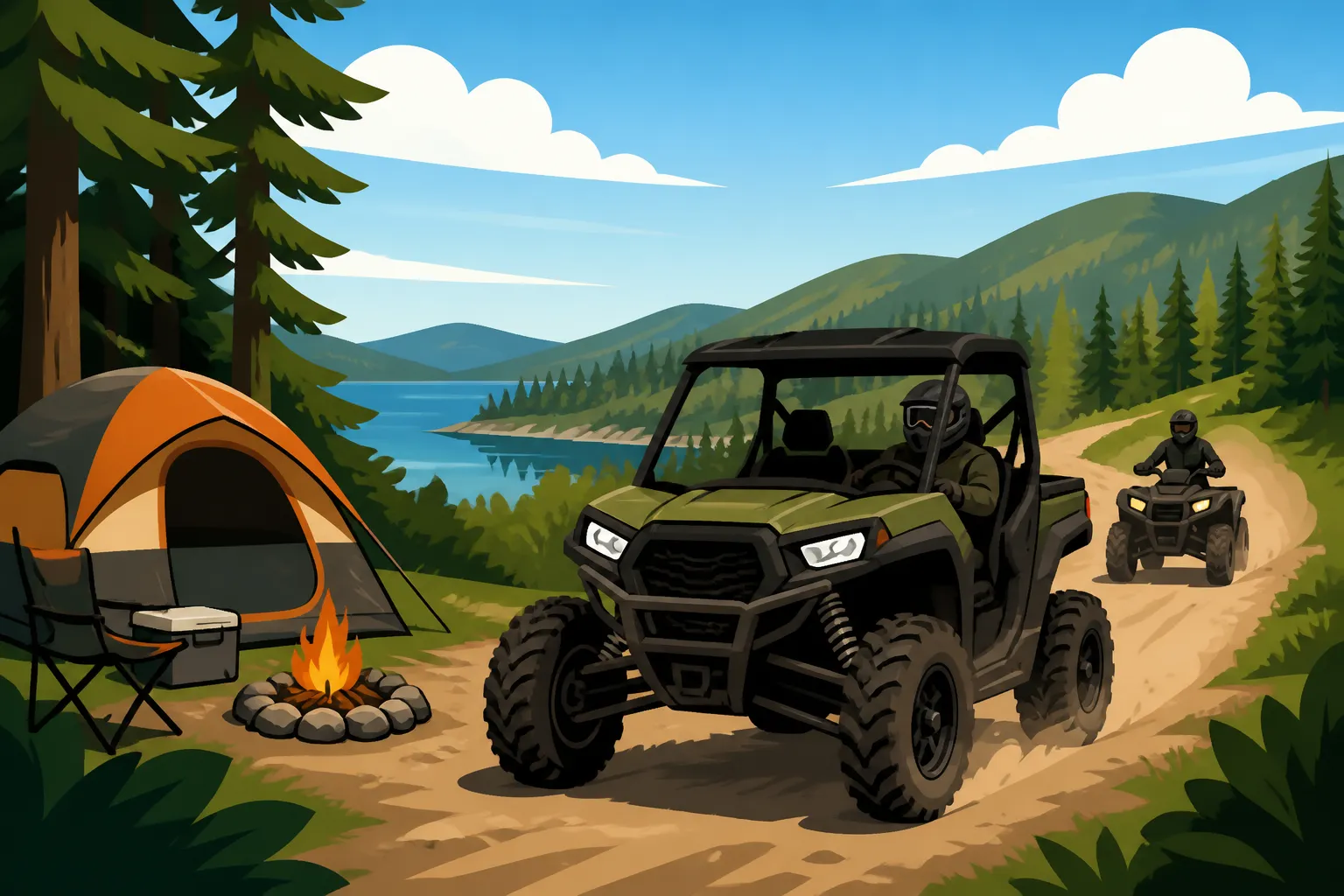
A campsite beside a trail can make an ATV trip feel wonderfully simple: unload, gear up, and ride. But being able to see a trail from your site does not automatically mean you can ride to it. This guide explains how to confirm access, plan a legal route, and avoid the common campsite-to-trail mistakes that can spoil a Maine getaway.
Confirm that your campsite has legal ATV access
Ask what “trail access” means before you book
A campground may advertise trail access because a trail is nearby, a trailhead is a short drive away, or some guests ride from the property to a legal route. Those are different arrangements. Before booking, ask the campground exactly where you can ride from your site and whether the connection is on a designated trail, an authorized road, or private land where the owner has granted access.
Get specific directions rather than relying on “the trail is right there.” Ask which entrance to use, whether you need to cross a road, and whether the connection is open to ATVs, UTVs, or both. If the campground says there is a short connector through woods or across a field, confirm that the landowner has allowed ATV use on that connector. A visible track on the ground is not proof that riding is permitted.
This conversation can prevent an uncomfortable surprise after you have unloaded the machines. For instance, a family staying near Greenville might find that a trail is close to the campground but separated from it by a public road or private property. The practical question is not simply how far away the trail is. It is whether there is a legal, authorized route from your campsite to it.
Confirm what your reservation includes
Ask whether “ride from camp” means riding your own registered machine from your campsite, or whether the campground offers access only through a nearby trailhead. Some properties may have specific rules about where machines can be driven, parked, or unloaded. Others may limit access to certain trails or require riders to follow a marked route across the property.
It is also worth asking whether the campground has different rules for quads and side-by-sides. A narrow connector or gate may suit a single ATV but not a wider UTV. Trail width can also change along a route, so don’t assume that a machine that fits through the entrance can travel the entire network. If you ride a larger side-by-side, ask about width restrictions on the exact trails you plan to use and review Wide Side-by-Sides on Narrow Maine Trails.
Before you pay, clarify what happens if trail access changes during your stay. Maine trails can be affected by landowner decisions, weather, maintenance, or seasonal closures. Ask where the campground posts updates and whether it can suggest an alternate staging area if a connection is closed. A little advance planning is much easier than finding out at the campsite that the route you counted on is unavailable.
Treat private-land permission as a real part of the plan
Many Maine riding routes depend on permission to cross private land. Campground access does not give you permission to leave the marked route, ride down another woods road, or explore an adjacent property. Stay on the route the campground or local club has identified, and close gates if instructed to do so.
Respecting landowners matters beyond a single weekend. A rider who cuts across a field, spins tires near a home, or ignores a closure can create problems for a campground and the local trail network. For more on how to approach access respectfully, see Asking a Landowner for Permission to Ride and Maine Trail Etiquette With Landowners.
If you are uncertain whether a route crosses private land or where permission applies, stop and ask before riding. Do not treat an online map line, tire tracks, or another rider’s directions as permission. Campground staff or a local ATV club may be able to explain the authorized connection and point out any boundaries or seasonal restrictions.
Plan the route from your site to the trail network
Check the route, not just the destination
A useful route plan starts at your campsite, not at the nearest named trail. Trace the full connection from your site to the main trail network, including any driveway, campground lane, road section, crossing, or connector trail. Check whether each piece is open to the kind of machine you are riding and whether it is currently available.
If part of the connection uses a public way, confirm that the road is specifically open to ATV use. A road that looks quiet or unpaved is not automatically an ATV route. Towns may designate particular roads for ATV access, and rules can differ from one town to another. Review Maine ATV-Access Routes and How Towns Post Them and How a Maine Town Designates an ATV-Access Route before treating a road as a link between camp and trail.
A route can also be legal in one direction and impractical in another. The entrance may be easy to find when riding out but difficult to identify when returning after dark. Save the campground location, the connector, and any important junctions before leaving. A map app such as onX Offroad can help you review and save route information, but it does not grant permission or replace local closure notices. Check Maine ATV Trail Maps and Club Boundaries for more on understanding trail information.
Verify current trail conditions before you unload
Trail access changes with the season. A route that worked during a previous visit may be closed for maintenance, wet conditions, landowner concerns, or other reasons. Ask the campground what it has heard recently, then check the local ATV club’s updates or other official notices for the area. If you are heading to the Moosehead Lake region, for example, confirm conditions for your specific starting point rather than assuming every route near Greenville or Rockwood is open.
Spring deserves particular caution. Soft ground and standing water can be damaged quickly by repeated traffic, and local trails may remain closed while crews assess conditions. Riding around a barrier or taking an unmarked bypass can cause lasting trail damage and threaten access. Use Maine Trail Openings and Mud Season and Checking Maine Trail Status Before You Drive as planning topics to investigate before your trip.
A route app can be useful for orientation, but it may not reflect a closure posted that morning or a landowner’s latest instruction. Use onX Offroad as one planning aid, then verify important details with the campground, club, or posted trail notice. If sources conflict, pause and confirm rather than choosing the route that seems most convenient.
Match the route to your machine and your group
A short campground connector may be narrow, steep, muddy, or busy with other riders. Think about your machine’s width, turning space, ground clearance, and trailer setup. A large UTV may have a different route available from a single-rider quad, and a campground’s main driveway may not be an authorized place to ride even if it is wide enough.
For a group, agree on the route and meeting point before starting. Keep riders together at turns, crossings, and junctions, and avoid blocking access for vehicles or other guests. If someone in the group is new to the area, make sure they know what the signs mean and what to do if the group gets separated. Planning with a paper map as a backup can help if phone service is weak or a device loses power.
Here is a practical checklist to use before your first ride from camp:
| Check | What to confirm | Why it matters |
|---|---|---|
| Campground permission | The exact route from your site to the authorized trail | Nearby trails may not connect legally to the property |
| Land access | Permission for each private-land connector | Tracks on the ground do not establish permission |
| Road sections | The specific roads designated for ATV use | Quiet or unpaved roads are not automatically open |
| Machine fit | Trail width and access for your ATV or UTV | Gates and narrow sections may restrict larger machines |
| Trail status | Closures, mud conditions, and local notices | Routes can change during the season |
| Return plan | Landmarks, junctions, and a backup route | The way back can be harder to identify after dark |
Ride from camp with safety and good neighbor habits
Keep campground riding slow and controlled
The campground is part of your ride, not a place to warm up by accelerating between sites. Follow posted speed limits and property rules, yield to pedestrians, and keep noise down around other campers. Children may be walking between sites, dogs may be on leashes, and people may be backing trailers into narrow spaces. Ride slowly enough to stop safely if someone steps into the lane.
Use only the campground routes that staff identify as open to machines. Do not cut through occupied sites, use a neighboring property as a shortcut, or ride on lawns unless the campground has expressly authorized it. If a route crosses a shared driveway, pause and look carefully for approaching vehicles and pedestrians.
When returning from a long day, remember that nearby campers may be settling in for the evening. Avoid unnecessary engine revving and follow any quiet-hour rules. Good behavior at camp helps protect the campground’s reputation with neighbors and landowners, which can matter to continued trail access.
Prepare for the road crossings and route transitions
If your connection crosses or uses a public way, understand the rules before you reach it. Do not assume that an ATV can travel along a road simply because it needs to reach the trail. Check whether the road is designated for ATV access, how the crossing is signed, and what stopping or yielding requirements apply. Crossing a Maine Highway on an ATV and Maine’s Stop-and-Yield Rule Before a Public Way can help you review the issues to ask about.
Transitions deserve extra attention because the surface and traffic can change quickly. A dirt campground lane may meet a paved road, a club trail, or a shared access route. Stop where required, look for signs and traffic, and follow the marked route rather than trying to save time with an unsanctioned shortcut.
If the legal route is unclear when you arrive, do not ride out to “see where it goes.” Ask the campground or check with a local club first. A few minutes spent confirming the crossing is better than discovering that the connector ends at a road or property where you are not permitted to ride.
Bring the basics for a ride that starts at your campsite
Pack the items you would bring for any trail ride, even when you are starting just steps from your tent or cabin. Carry water, weather-appropriate layers, a charged phone, a map or saved route, and the registration documents or other required paperwork for your situation. If your group is riding beyond familiar trails, agree on a check-in plan and what to do if a machine breaks down.
Do a quick machine check before setting off: look over the tires, controls, lights, fuel, and any visible damage. Secure loose gear so it cannot shift or fall off along the connector. If you are carrying tools or supplies in a UTV, stow them so they cannot interfere with passengers or controls.
A campsite close to the trail can make logistics easier, but it does not remove the need to plan for changing weather, weak cell service, or unexpected closures. Keep a paper map or written directions as a backup, and let someone at camp know your general route and expected return. For more ideas, see What to Carry on a Remote Trail Ride and Navigating Trails Without Cell Service.
Make the most of a campsite-based Maine ride
Choose a staging point that fits your trip
The best campsite for an ATV trip is not always the one closest to a trail on a map. Consider where you can park and unload safely, whether there is room for your trailer, and whether the campground has a confirmed legal connection. A site with convenient access to a suitable trail network may be more useful than a site that appears closer but requires a long or uncertain road connection.
Think about what kind of riding your group wants. A family looking for shorter outings may prefer a base near routes with clear junctions and manageable distances. Riders planning longer days may care more about fuel planning, lodging logistics, and whether the network connects to places they intend to visit. The Maine ATV Trail Maps and Club Boundaries guide can help you think through how local routes fit together.
If you are considering a multi-town ride, confirm each section separately. A connector that is open near camp does not guarantee that every town or trail segment along the way is open to ATVs. Check local rules, land access, and trail notices for the full route before setting out.
Have a backup plan for a closed connection
A trail can close during a trip, and sometimes the nearest alternative is a designated staging area rather than another route from camp. Ask the campground in advance where riders should go if its connector is unavailable. Find out whether trailers can be left at the alternative parking area and whether the site has restrictions on overnight parking.
Keep a clear distinction between a backup route and an improvised route. If the first connector is blocked, do not detour across a field, down an unsigned woods road, or through another campground. Check with staff, consult the local club, and follow posted information. onX Offroad may help you orient yourself and compare route options, but local permission and closure information should guide the decision.
A flexible schedule helps too. If the trail is too wet, a connection is closed, or the weather turns rough, switch to a non-riding plan rather than forcing the ride. In Maine’s trail network, responsible riders help keep access dependable for the next visit. The goal is not simply to ride out from camp; it is to return safely while leaving the property and trail in good condition.
Disclaimer
This article is for general informational purposes only and does not constitute professional advice. Laws, prices and regulations vary by location and change over time. Consult a qualified professional for guidance on your specific situation.