Trail Permits for Riding in New Brunswick
A Maine registration does not automatically give you permission to use New Brunswick’s ATV trails. Before crossing the border, you need to sort out trail access separately from vehicle registration, insurance and customs paperwork. This guide explains what to check, how to buy the right permit, and what to carry so a paperwork mix-up does not become the first stop of your ride.
Understand the difference between a trail permit and vehicle registration
A trail permit and a vehicle registration serve different purposes. Registration identifies the ATV or UTV for legal operation under the applicable vehicle rules. A trail permit provides access to participating trails under the trail system’s terms. Depending on the machine and your circumstances, you may need to deal with both.
A Maine registration is not a general pass for New Brunswick trails. Nor does buying a New Brunswick trail permit necessarily satisfy registration, insurance, safety-equipment or operator requirements. Treat these as separate checks rather than assuming one document replaces another.
Before you leave, confirm the rules for your specific vehicle and route with the relevant New Brunswick government and trail-system sources. Ask about:
- Whether your Maine registration is accepted for your machine and intended use
- Whether visitors must buy a trail permit, and whether the permit is required for every machine
- Which trails the permit covers, including club or private-land sections
- Whether your vehicle must meet particular equipment or identification requirements
- Whether your insurance is valid for riding in New Brunswick
- Whether local restrictions or temporary closures affect the route
The details can depend on the vehicle category, where you plan to ride and the current trail system’s rules. A UTV and a conventional ATV may not be treated alike for every purpose, so be specific when you ask. Give the official source your machine type, home registration, expected travel dates and intended trail area.
A permit should also be understood as permission within a defined network, not permission to ride anywhere. It does not authorize you to use a road, private property, closed trail or route that is outside the permit system. Trails may cross land owned by different parties, and access can change when a landowner closes a section or a club posts a restriction.
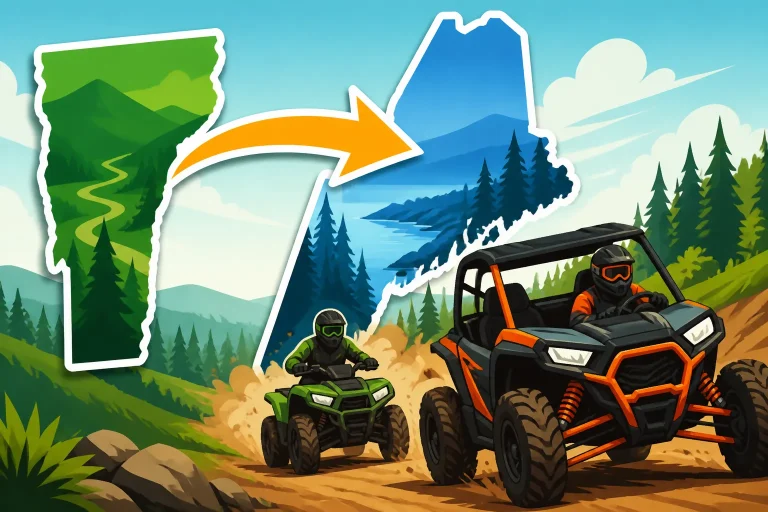
If you are planning a cross-border trip from Maine, read Taking a Maine ATV to New Brunswick alongside the trail-permit information. The trip involves two jurisdictions: Maine rules apply while you are operating in Maine, and New Brunswick’s requirements apply after you enter the province. The limited Canadian reciprocity arrangement described in Maine’s Three-Day Agreement With New Brunswick and Quebec concerns riding in Maine; it should not be treated as a New Brunswick trail pass or proof that you meet every New Brunswick requirement.
Ask the question in terms of your machine
When contacting a trail organization or government office, avoid asking only, “Can I ride with a Maine registration?” That question may not get you a complete answer. Ask instead: “I have a Maine-registered ATV or UTV, and I’ll be visiting for these dates. What vehicle documents and trail permit do I need for the trails I plan to ride?”
Mention whether the machine is owned, borrowed or rented, and whether you expect to ride roads as well as trails. If you are taking a borrowed ATV, make sure the owner is comfortable with you bringing it across the border and that you can show permission if asked.
Find the correct permit and confirm what it covers
Start with the official New Brunswick ATV trail organization or the organization responsible for the trail area you intend to visit. Look for visitor or non-resident instructions, current permit options, authorized sellers and any map or trail-status information. If information is unclear, contact the organization before you pay.
For practical buying steps, see Buying a New Brunswick Trail Permit Online. The important point is to confirm that you are buying the permit intended for an out-of-province visitor and that it covers the dates and machines in your party. Do not assume a permit for a resident, club member or different vehicle category is interchangeable with a visitor permit.
Before completing a purchase, check:
- Who needs a permit. Find out whether each ATV or UTV requires its own permit, and whether any riders or vehicles are exempt.
- What period it covers. Confirm the start and end of validity, including how the system treats the purchase date and the final day.
- Where it is valid. Check whether it applies across the provincial trail network or only to particular club trails or regions.
- How it must be displayed. Some systems require a decal or other visible proof; others may have different instructions.
- What proof you receive. Save the receipt, confirmation email and any permit document. Know whether electronic proof is acceptable while riding.
- Whether a refund or transfer is possible. If your trip changes or a machine is replaced, check the rules rather than assuming the permit follows the rider or can be moved to another vehicle.
Permit prices and products can change, so check the current official details before budgeting. New Brunswick Trail Permit Price for Visitors is a useful topic to check, but rely on the current seller or official trail organization for the amount and terms that apply to your trip.
A permit may not cover every trail a map appears to show. Maps can include roads, connecting routes, club-maintained trails and sections that are temporarily closed. Check both the permit’s coverage and the latest trail notices. A route shown online is not automatically open, and a trail that was open on a previous visit may have changed status.
If you are traveling with a group, assign one person to verify the permit for each machine. Keep a simple list of the rider, machine, registration and permit confirmation. This catches common errors, such as buying one permit for a group when the system requires a permit for each vehicle, or entering the wrong machine details.
Keep the confirmation accessible
Save the permit confirmation on your phone, but do not rely on a single phone screen as your only record. A dead battery, poor reception or damaged device can make a digital receipt difficult to retrieve. Download or screenshot the confirmation before leaving, and keep a backup copy with your travel papers.
If the permit requires a physical decal, apply it exactly as instructed and make sure it is visible and secure. Do not place it where a rack, bag, mud flap or passenger will cover it. If the decal is delayed, damaged or lost, contact the permit issuer for instructions before riding. A receipt may not be a substitute for a required display.
Prepare your registration, insurance and border documents
A trail permit is only one part of a cross-border trip. Before loading the machine, confirm that its registration and ownership documents are in order and that your insurance applies in New Brunswick. Do not assume a policy covers every province, every kind of off-road use or every operator.
Contact your insurer and describe how you will use the ATV or UTV. Ask whether the policy covers off-road operation in New Brunswick, whether liability coverage applies on trails and roads, and whether there are restrictions on borrowed machines or additional riders. If the machine is financed, leased or owned by a business, check whether you need permission or additional documentation to take it across the border.
Bring documents that help establish who owns the machine and that you are authorized to transport it. Depending on your situation, this may include:
- Current registration for each machine
- Proof of ownership or a bill of sale
- Written permission from the owner if the machine is borrowed
- Insurance documents showing coverage details
- The trail permit and its purchase confirmation
- Identification and any paperwork required for crossing the border with the vehicle
For the border portion, review Crossing the Border With an ATV on a Trailer and Customs Rules for Bringing an ATV Across the Border. Border requirements are separate from trail access. A trail permit does not replace customs procedures, and a machine’s entry into Canada does not automatically make it eligible for every trail.
If you purchased the ATV recently, do not wait until you reach the border to sort out proof of ownership. Carry documents that connect you to the machine and explain any mismatch between your name and the registration. For a private purchase, a signed bill of sale and the seller’s details may help clarify the transaction. For a borrowed machine, get the owner’s written permission in advance and make sure the name on the registration is not a surprise to the border officer.
Check insurance rather than guessing
Insurance is especially easy to overlook because a machine can be registered and still have a coverage gap. Ask your insurer what the policy covers in Canada and whether it applies to the exact type of riding you plan to do. If you receive an answer by phone, ask for written confirmation or a policy document that clearly addresses the coverage.
The same caution applies to the permit’s insurance requirements. A trail pass may have conditions that do not match your personal policy, and a personal policy may impose conditions that the trail system does not check at purchase. Review both sides. Insurance Canadian Riders Need in Maine discusses the reverse-direction trip, but remember that riding from Canada into Maine and riding from Maine into New Brunswick are not the same legal question.
Keep insurance contact information with your registration papers. If there is a collision or damage claim, being able to reach the insurer and identify the policy can save time. Do not assume that coverage for towing the ATV on a trailer also means coverage for operating it on trails.
Plan for trail access, seasonal changes and local rules
New Brunswick trail access depends on the actual route, not just the province printed on your permit. Trails can pass through land managed or maintained by different groups, and access may be limited by landowner permission, maintenance work, weather, fire risk or other local conditions. Check the status of the specific trails you intend to ride shortly before departure.
Build a flexible route. If a trail section is closed, do not improvise by taking a nearby woods road or private track unless it is clearly open to ATVs. A GPS line, social media post or old map is not proof that a route is currently authorized. Use current trail information and obey signs, gates and closures.
Ask whether your permit covers connector trails and road sections. A trail pass should not be assumed to authorize public-road travel. Road use may be controlled by separate rules, and a route that appears to connect two trails may have restrictions on vehicle type, equipment or direction of travel. Confirm those details before setting out, especially if your itinerary includes fuel stops, restaurants or lodging reached by road.
Also check the rules for the people riding. Requirements may vary by rider age, machine type and where the machine is being operated. Ask about helmets, passenger limits, required safety equipment, operator qualifications and any restrictions on young riders. If you are bringing children, verify the rules for both the child’s machine and any passenger arrangements. Do not rely on a general trail permit as evidence that every rider is eligible to operate.
Pack for the route and the conditions. In remote areas, phone coverage may be unreliable, and a trail closure or breakdown can turn a short detour into a long wait. Carry a current map or offline navigation, basic repair supplies, water, weather-appropriate clothing and a way to contact help when cell service is unavailable. A waterproof document pouch from Amazon can keep paper registration, insurance and permit copies dry in a gear bag; it does not replace keeping the originals protected or having a digital backup.
A small repair kit can also be useful for a long ride. If you buy tire plugs or other supplies through Amazon, check that they suit your tire type and know how to use them before leaving. A kit you have never opened is not much help on a trail. For navigation, save offline maps before you enter a low-service area and carry a power bank or vehicle charging option. Amazon is one place riders may look for a compact power bank or cable, but test your setup at home rather than discovering a compatibility problem on the trail.
Respect the trail system
Trail access is a privilege that depends on riders following local expectations. Stay on the authorized route, ride at a speed appropriate to visibility and conditions, and yield where required. Do not widen a muddy section by driving around it, cut through a field to bypass a closure or use a trail after a landowner has withdrawn permission.
If you see a closure, damaged bridge, downed tree or unsafe condition, follow the trail organization’s reporting instructions. Avoid moving barriers or signs to get through. A closed route may be protecting a landowner’s property, a repair crew or a section that cannot safely support traffic.
For a group ride, brief everyone before starting. Make sure each operator knows the route, the permit conditions and the plan if the group gets separated. Keep the group together without crowding, and stop in safe places rather than blocking a trail junction or road. A visitor’s poor judgment can affect access for local riders and future visitors.
Use a simple pre-trip checklist
A few checks before departure can prevent most permit and paperwork problems. Work through this list for each ATV or UTV, not just for the lead vehicle:
- Confirm the machine category. Identify whether you are taking an ATV or UTV and provide that information when checking New Brunswick requirements.
- Verify registration acceptance. Ask whether your Maine registration is valid for the intended use and whether any additional vehicle documentation is required.
- Buy the correct visitor permit. Confirm that it covers the machine, dates and trail area. Save the receipt and follow any decal-display instructions.
- Check current trail access. Review closures, club notices, landowner restrictions and any seasonal limitations for your intended route.
- Confirm insurance. Ask your insurer about off-road coverage in New Brunswick and keep proof with the vehicle papers.
- Prepare border paperwork. Carry registration, proof of ownership, written permission if borrowed, and any documents required for the crossing.
- Review rider and equipment rules. Check age, helmet, passenger and equipment requirements for the machine and route.
- Download route information. Save maps and permit confirmations for offline access, and carry a backup plan if your phone fails.
- Tell someone your plan. Share your route and expected return time, particularly if riding in a remote area.
- Recheck before riding. Trail conditions and access can change after you buy a permit, so review official notices again shortly before the ride.
If a requirement is unclear, do not rely on an assumption based on a Maine rule or a past visit. Ask the permit issuer or relevant New Brunswick authority for guidance and keep the response with your trip documents. Taking a few minutes to confirm what applies to your particular machine is easier than trying to resolve a mismatch at a border crossing or trail checkpoint.
A New Brunswick trail permit is best treated as one piece of a complete trip plan: the machine must be properly documented, the insurance must fit the use, the route must be open, and each rider must meet applicable rules. With those pieces checked separately, you can focus on the ride instead of trying to sort out paperwork from the trailhead.
Disclaimer
This article is for general informational purposes only and does not constitute professional advice. Laws, prices and regulations vary by location and change over time. Consult a qualified professional for guidance on your specific situation.