Maine ATV Rules on a Family Woodlot
A family woodlot can feel like the simplest place to ride, but owning the land does not automatically answer every registration, safety, or trail-access question. Maine’s rules depend on where the ATV or UTV travels and who is riding. The key is to separate riding entirely on qualifying private land from using a route that connects to a public road or trail network.
When a family woodlot may qualify for a registration exemption
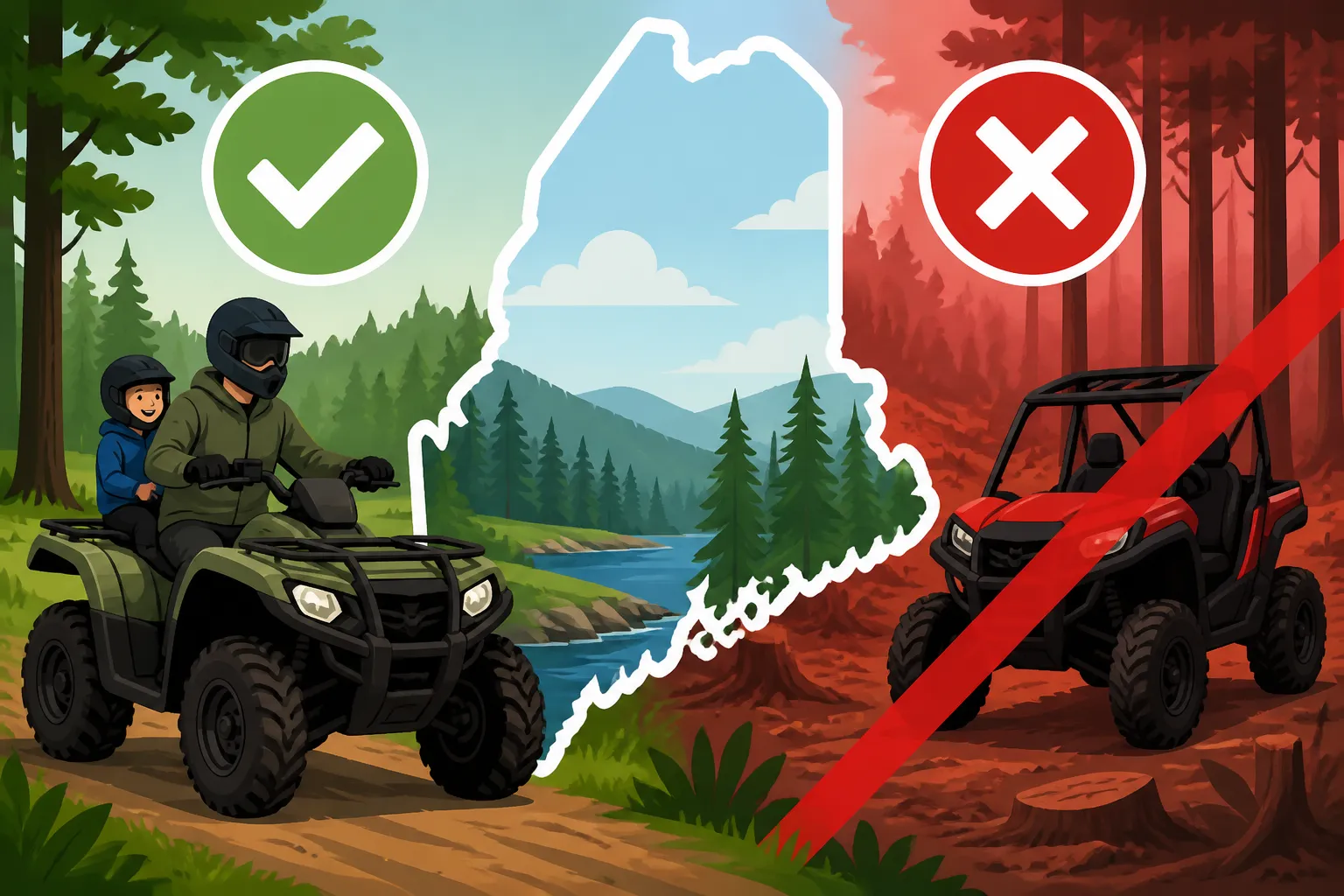
Maine has a limited registration exemption for certain ATVs used exclusively on land owned or leased by the operator or a qualifying family member. The important word is exclusively: a machine that leaves the qualifying property to use a trail, road, or another person’s land may no longer fit the exemption.
The exemption is not a blanket permission to ride an unregistered ATV anywhere because the family owns a woodlot. It depends on the land, the operator’s relationship to the owner or leaseholder, and how the machine is used. If the property is jointly owned, held through a business, or used by riders who are not covered by the exemption, check the current rules with Maine’s official registration authority before relying on it. Maine Registration Exemption on Your Own Land
A woodlot may also be only part of a longer ride. For example, a rider might start at a family camp, travel along a woods road, cross land owned by someone else, and join a club trail. The private-property exemption should not be assumed to cover that whole route. When a ride leaves qualifying land, confirm the registration requirements for the rest of the trip.
| Where the machine is used | What to check |
|---|---|
| Only on qualifying family-owned or leased land | Whether the particular ATV and rider meet Maine’s exemption criteria |
| On a woods road or trail crossing another owner’s land | Permission from that landowner and any registration requirements |
| On a club trail or other trail network | Registration and trail-access requirements |
| On or across a public way | Maine’s separate rules for ATV use on public ways |
| On a family property that connects to a public route | Whether the route is open to ATVs and what registration is required |
An exemption from registration does not necessarily remove other operating rules. It also does not make a route open to the public, grant permission across a neighbor’s land, or authorize riding on a public road. For a broader explanation of private-land use, see Maine Rules for Riding Your Own Woodlot.
Permission, boundaries, and routes through the property
Owning a woodlot gives the owner control over access to that land, but family members and visitors should still know where the property boundaries are. Maine woodlots often meet other private parcels, town roads, club trails, or working forest roads. A route that looks continuous on the ground may cross multiple ownerships.
Before riding, identify the boundary and agree on which roads or trails are open for ATV use. Do not assume that an old logging road, a visible trail, or a track on a map is available to ride. If a route crosses land owned by someone else, get permission from that owner. Permission to ride on one parcel does not automatically extend to adjoining land. Landowner Permission on Maine ATV Trails
Pay particular attention to routes that connect the woodlot to a trail system. A club trail may cross private land with the owner’s permission, and that permission may be limited to the marked route. Riding off the trail, cutting across a field, or continuing after a closure can jeopardize access for everyone. Trail openings and access can change, so check current notices and signs rather than relying on last season’s route.
A private woods road can have its own access limits, even if it looks like a public road. Confirm whether it is on the family parcel, shared with other owners, or subject to a specific access arrangement. For a related situation, Maine ATV Rules on Private Camp Roads explains why a private road is not automatically open to ATV traffic.
When a ride approaches a public way, stop and check the route’s status. Public-way use is controlled by separate rules and local designations; landownership does not create an exception. An ATV’s registration status also does not, by itself, authorize riding along a road. See Maine ATV-Access Routes and How Towns Post Them for the distinction between a designated route and a road that is simply nearby.
Youth riders, helmets, and practical safety on a woodlot
Private land is not a reason to skip age-related requirements or basic safety practices. Maine’s rules for young riders depend on age and where the machine is operated. Before a child rides, check the current requirements for supervision, training, and permitted machine use. Maine ATV Rules for Riders Under 16 on Roads covers road-related rules; a woodlot ride may involve different details, so do not assume that road guidance answers every private-land question.
Helmet requirements also matter on private property. Maine has age-based helmet rules for young ATV riders and passengers. Check the current standard and age requirements before a ride, and use a properly fitted helmet for every rider as a safety measure, including adults. Maine Helmet Requirements by Age
Match the machine to the rider’s size, strength, and experience. A young rider who can reach the controls may still lack the judgment or coordination needed to handle the ATV safely on uneven ground. Keep riding areas away from steep banks, water, soft shoulders, blind corners, and active logging or equipment work. Establish simple rules before starting: where riders may go, how far they may separate, and where everyone should stop if someone gets stuck or hurt.
A woodlot can also hide hazards that are easy to miss at speed. Look for fallen branches, ruts, washouts, loose gravel, wet leaves, and low-hanging limbs. Walk unfamiliar sections first when practical, and do not ride over a bridge, culvert, or crossing unless it is suitable for the machine and the owner permits it. Avoid riding over newly planted areas, wet ground that could rut, or places where tires may damage drainage or soil.
For a family group, agree on a few practical safeguards:
- Keep riders within sight or establish clear check-in points.
- Ride at a pace that allows everyone to stop safely.
- Avoid carrying passengers unless the machine is designed for them.
- Keep children away from operating equipment and active work areas.
- Carry a phone or other communication device, but do not depend on coverage in remote areas.
- Make sure riders know the property boundary and how to return to the starting point.
These measures are especially useful when the woodlot is also used for hunting, forestry, or seasonal work. Coordinate rides around those activities, and pause riding if machinery, workers, or other visitors are using the same roads.
A simple way to check your family’s setup
Before the first ride, work through the details of the machine, land, and route. This helps avoid treating “family property” as a substitute for checking the actual requirements.
- Identify the owner or leaseholder. Confirm who legally owns or leases the land and whether the ATV’s operator falls within the exemption’s criteria.
- Draw the intended route. Mark where it crosses parcel boundaries, joins a club trail, or reaches a public way.
- Check the machine’s status. If any planned use may fall outside the exemption, confirm whether registration is required before riding.
- Confirm permission. Ask other landowners before crossing their property, and follow posted restrictions and route closures.
- Review the rider rules. Check current age, supervision, training, and helmet requirements for each operator and passenger.
- Set boundaries for the group. Tell riders where they may travel, which areas are off limits, and what to do if they become separated.
If you are unsure whether an ATV qualifies for an exemption, describe the exact situation when contacting the appropriate state office: who owns or leases the woodlot, who will operate the machine, and whether it will ever leave that property. Those details are more useful than asking only whether “family land” is exempt.
Also keep registration and ownership paperwork in order for any machine that does need registration. Exemption questions and proof of ownership are separate issues, particularly if the ATV changes hands or is later used beyond the property. Proof of Ownership for a Maine ATV Registration can help clarify what documents may be relevant.
The safest working rule is straightforward: treat the exemption as narrow, keep riding on the land and routes you are authorized to use, and verify current requirements before the machine leaves the woodlot. A family property can be a good place to ride, but land ownership alone does not settle every question about registration, youth safety, or access.
Disclaimer
This article is for general informational purposes only and does not constitute professional advice. Laws, prices and regulations vary by location and change over time. Consult a qualified professional for guidance on your specific situation.