Sporting Camps That Allow ATVs
A Maine sporting camp can be a perfect base for an ATV trip, but a booking does not automatically include permission to ride from the property or use nearby trails. Access rules can vary by camp, trail club, landowner, and season. This guide explains what to ask before you reserve, how to plan a route, and how to avoid arriving with a trailer and nowhere to ride.
What ATV access at a Maine sporting camp really means
A place to stay is not automatically a trail connection
“ATV-friendly” can mean several different things. A camp may offer trailer parking but require you to haul your machine to a public trailhead. Another may allow you to ride on its private roads but not connect to a club trail. Some properties may have direct access to a trail network, subject to seasonal openings and landowner permission.
That distinction matters in Maine, where many trails cross private land. A trail shown on a map may depend on permission from a landowner or access maintained by a local ATV club. Permission to stay at a sporting camp does not necessarily give you permission to ride across neighboring property, and permission to use one camp road does not automatically extend to every nearby road or trail.
Before you book, ask the camp to describe exactly where you can ride from the property. Find out whether the route is open to guests, whether it connects to a maintained trail, and whether you need to trailer to a staging area. For a broader look at places to ride, see Where Maine Lets You Ride an ATV.
How Maine regions shape the trip
The riding experience can differ considerably between regions. Around Moosehead Lake, Greenville, and Rockwood, riders may plan trips around a mix of regional trail connections and remote backcountry destinations. In the Jackman area, long distances between services make fuel planning and route confirmation especially important. Rangeley and western Maine offer their own trail connections, but access can depend on local club networks and property permissions.
A camp’s location on a map is only a starting point. A short-looking road connection may not be an authorized ATV route, and the nearest mapped trail may not be open to your machine or during your travel dates. Ask the camp for the name of the local ATV club or trail system it connects with, then check the club’s current information before you set out.
If you are choosing between regions, think about the kind of day you want. A family looking for shorter rides and a comfortable return to camp may want different access than experienced riders planning a long day through remote terrain. Guides such as Riding the Moosehead Lake Region by ATV and Rangeley Area ATV Trails can help you compare the general riding areas before you choose lodging.
Questions to ask before you book
Confirm permission, machines, and staging arrangements
When you call or message a sporting camp, ask direct questions rather than relying on a general claim that the property is near trails. It helps to be specific about your machine, group, and travel dates. A narrow trail may not suit a wide side-by-side, and a route that is available during one part of the season may be closed during another.
Ask whether you can ride from the property, whether guests may use private camp roads, and which public or club trails are accessible from there. Confirm if access requires a trail pass, registration, or a separate permit. If you will be hauling machines, ask about trailer parking, unloading space, and whether a truck and trailer can remain on the property while you ride.
| Question for the camp | Why it matters |
|---|---|
| Can guests ride directly from the property? | Clarifies whether you need to trailer to a trailhead |
| Which trails or roads are authorized for ATV use? | Helps separate permitted routes from nearby roads that are not open to riding |
| Are there machine-width limits? | Important for side-by-sides and wider machines |
| Are trails open during my dates? | Seasonal conditions and closures can change access |
| Is trailer parking available? | Confirms you have room to unload and store your rig |
| Do I need separate registration or permits? | Helps you prepare required documents before arrival |
| Who should I contact about trail conditions? | Gives you a local source for route updates |
For a first trip or a multi-day stay, request directions to the authorized access point and ask whether the camp can identify the relevant trail club. You can use Maine ATV Trail Maps and Club Boundaries to understand why the club network matters, but treat a map as a planning tool—not as permission to ride.
Check the practical details that affect the stay
A camp may have the right location but still not fit your group’s needs. Ask about machine storage overnight, whether machines can be parked near cabins, and whether the property has a designated unloading area. If you are bringing several machines, confirm that parking will accommodate both the vehicles and trailers without blocking other guests or camp operations.
Also ask about fuel, meals, and supplies. In remote areas, a ride can take longer than expected, and a convenient gas station may not be close to your planned route. Find out whether fuel is available at or near the camp, where the nearest reliable stop is, and whether the camp recommends carrying extra fuel. For route planning in the north, Fuel Range Between Remote Trail Towns is a useful reminder to plan around actual distances rather than assumptions.
If the camp provides a route suggestion, ask whether it is a current, authorized route and whether it is appropriate for your machine and experience level. A local recommendation is valuable, but road construction, seasonal conditions, landowner decisions, and club closures can affect access. Confirm before riding, especially if you are traveling far from the property.
Planning a safe, low-stress ride from camp
Verify trail status and navigation before leaving
Do not rely on a saved route, an old printed map, or a line on a phone screen as proof that a trail is open. Check the local ATV club’s updates and ask the camp for recent information. Trail openings and closures can be affected by weather, mud, maintenance, and landowner access. During spring, an apparent route may be closed to protect soft ground and prevent damage.
Digital tools can help you see terrain, estimate a route, and prepare for areas with limited cell service. For example, riders may use onX Offroad to review mapped routes and organize a ride plan. Still, check the trail club’s current notices and confirm that access is authorized. A mapped line should never be treated as a substitute for posted signs, local rules, or landowner permission.
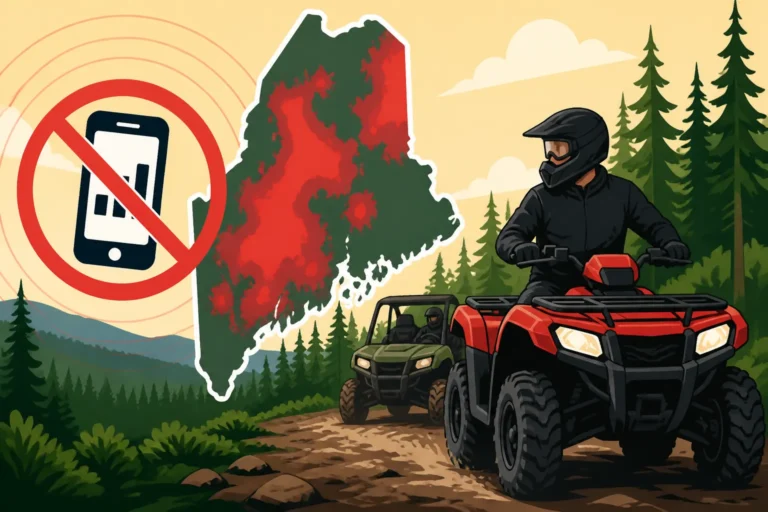
Save or print the route information you need before you leave camp. Cell coverage can be unreliable in remote parts of Maine, and a phone battery can drain quickly when it is used for navigation. A paper map, charged phone, backup battery, and clear turnaround plan can make a real difference if your group takes a wrong turn or encounters a closure. See Navigating Trails Without Cell Service for more ways to prepare.
Match the ride to your group and your machine
A route that feels manageable to an experienced adult on a small ATV may be a poor fit for a family group or a wide side-by-side. Before setting out, check the trail-width limits, surface, elevation, and length. Ask whether bridges or narrow sections are suitable for your machine. If the camp cannot confirm that a route accommodates your vehicle, choose another route or trailer to a more appropriate access point.
Build flexibility into your day. Choose a shorter first ride so you can learn the local layout, see how long travel takes, and identify fuel or rest stops. Carry water, food, basic tools, and any medication your group may need. Agree on a turnaround time before setting out, especially when the ride includes remote sections or a return through unfamiliar trails.
For a trip involving children or less experienced riders, plan stops and keep the route conservative. A long ride can become tiring even when the trail is technically easy, and fatigue can lead to rushed decisions. Family-Friendly Maine ATV Trails can help you think through suitable ride options, while What to Carry on a Remote Trail Ride offers a practical packing reference.
Choosing a camp and protecting access
Compare the whole trip, not just the lodging
The best camp is not always the one that appears closest to a trail on a map. Consider how you will reach the authorized trail system, where you can park, how far you will travel for fuel, and whether the riding matches your group’s ability. A camp that requires a short trailer ride to a suitable trailhead may be a better choice than a property with uncertain or limited ride-out access.
When comparing options, keep notes about what each place confirms. Record the trail or access point named by the camp, any machine restrictions, parking arrangements, and the person who provided the information. If a policy is important to your plans—such as riding directly from the cabin—ask for confirmation in writing before making a nonrefundable reservation.
Use onX Offroad or another navigation resource to help visualize distances and organize possible routes, then cross-check the plan with the camp and local trail club. This is especially helpful when comparing a remote camp near Jackman with a stay closer to Greenville or Rangeley. A digital map can support the decision, but current local access information should guide it.
Respect the land and leave the route open for others
A good guest helps protect the access that makes Maine riding possible. Stay on authorized routes, obey posted signs, close gates if instructed, and avoid riding around a closure. Do not assume that a path is open because tire tracks are visible. If you are unsure whether a road or trail is permitted, stop and check with the camp or club rather than guessing.
Keep speed down near cabins, homes, farms, and other trail users. Be considerate about dust and noise, and do not block roads or driveways when stopping. If you see a damaged bridge, downed tree, or confusing sign, report it to the camp or local club. Small acts of care help maintain working relationships with landowners and communities.
Finally, ask the camp what it expects from guests riding on or near its property. Each place may have its own rules for parking, unloading, quiet hours, and machine use. A little clarification before arrival can prevent awkward surprises—and help make your sporting camp stay a relaxing base for exploring Maine’s trails.
Disclaimer
This article is for general informational purposes only and does not constitute professional advice. Laws, prices and regulations vary by location and change over time. Consult a qualified professional for guidance on your specific situation.