New York Riders Coming to Maine Trails
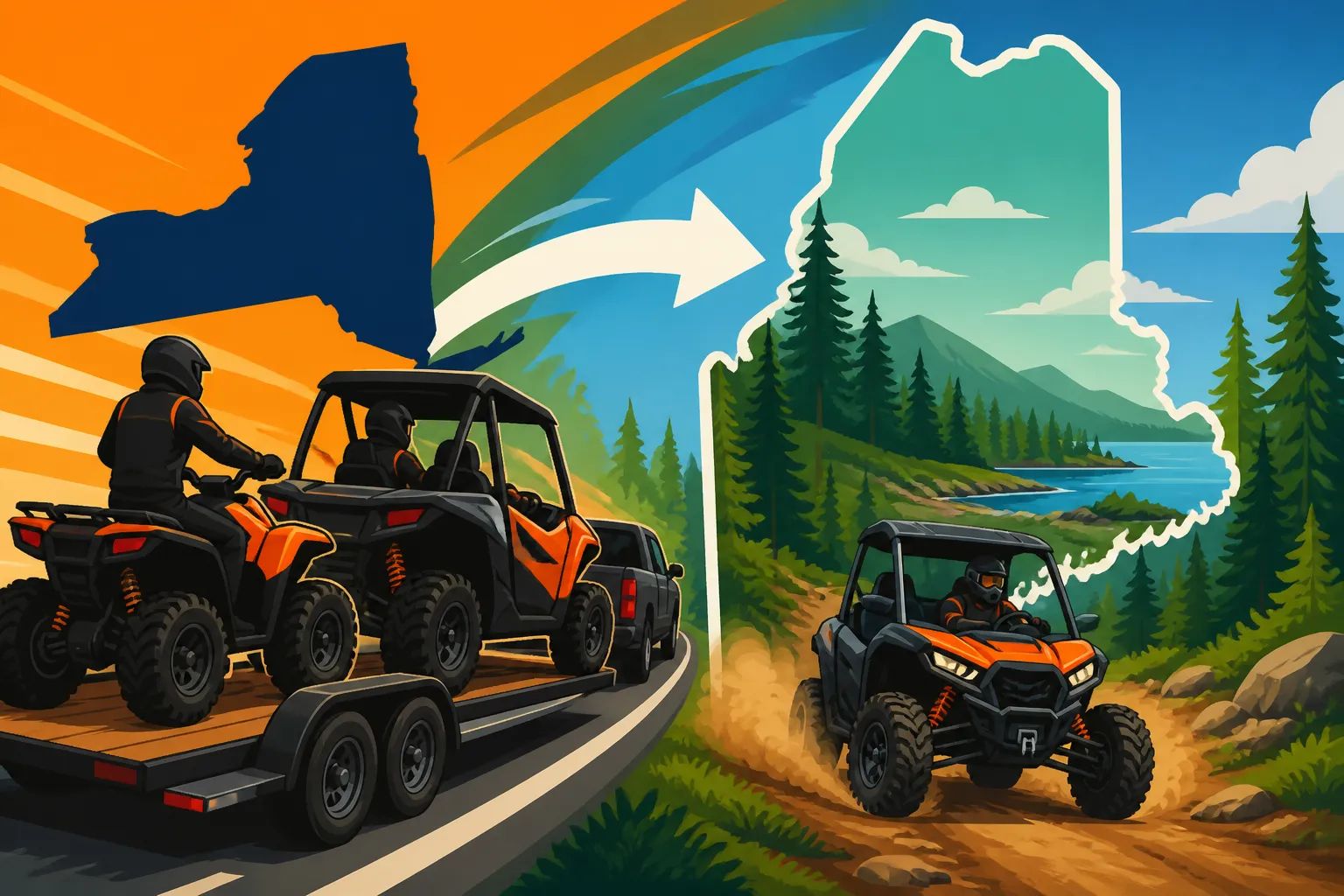
New York registration may let you ride at home, but it does not automatically authorize riding Maine’s ATV trails. Before hauling north, sort out Maine registration, check where access is open, and understand the difference between trail permission and permission to ride a road. This overview helps you prepare without mistaking a New York registration for a Maine one.
Does a New York ATV Registration Work in Maine?
In general, no. Maine does not treat a New York ATV registration as a substitute for Maine registration. The state ended broad ATV registration reciprocity with other states, so bringing a machine with New York paperwork does not by itself make it legal to ride in Maine. For background, see Maine’s ATV Reciprocity, and Why It Ended.
That distinction matters even if your ATV is properly registered in New York, has a visible New York sticker or plate, and is insured. Those documents may be useful for confirming your machine’s identity and registration at home, but they do not automatically satisfy Maine’s requirements. Check what Maine requires for your particular machine and trip before you unload it.
Maine offers nonresident registration options, including a seven-day option and an annual option. Which one fits depends on how long and how often you plan to ride. A short visit may call for Maine Non-Resident Seven-Day ATV Registration, while repeat visits or a longer season may make Maine Non-Resident Annual ATV Registration worth comparing. Confirm the current registration choices, validity dates, and requirements with Maine’s official registration service before purchasing.
Do not confuse the Canadian exception with a rule for New York riders. Maine has a limited exception associated with certain Canadian registrations; it does not create a general exemption for an ATV registered in a U.S. state. Details are covered in Maine’s Three-Day Non-Resident Exception. If you are traveling from New York, plan on meeting Maine’s nonresident registration requirement unless an official source confirms a specific exception applies to your situation.
| What you bring | What it does for a New York rider | What to check |
|---|---|---|
| New York ATV registration | Shows the machine’s home-state registration; does not generally replace Maine registration | Whether your machine also needs Maine registration |
| Maine nonresident registration | Meets Maine’s registration requirement when properly obtained and applicable | Current options, dates, and machine classification |
| Proof of ownership | Helps document who owns the machine | Which documents Maine accepts for your registration |
| Insurance information | Helps you respond to an accident or other incident | Whether your policy covers riding in Maine |
| Trail map or GPS route | Helps you follow mapped routes and avoid closed or unauthorized paths | Current club and trail status |
| Landowner or route permission | Allows access where permission is required | Whether the route is open and permission remains in effect |
Registration is only one part of legal riding. It does not give you permission to cross private property, use a closed trail, or ride on a public way that is not open to ATVs. It also does not turn an ATV into a street-legal vehicle. Treat registration, trail access, and road access as separate checks.
If you are bringing a side-by-side, do not assume its registration requirements match those for a quad. UTVs may be treated differently, so identify the machine’s classification before selecting a registration. Maine UTV Registration and How It Differs explains why the machine’s type matters.
Choosing and Getting a Maine Nonresident Registration
Start with the dates of your trip, not with assumptions about your New York paperwork. If you expect to ride for a brief visit, compare the seven-day option with the current rules for its validity period. If you expect several trips or a longer stay, compare the annual option. The best fit depends on your actual riding schedule and the current registration terms.
You can look at Buying a Maine Non-Resident Registration Online for the online process. Before submitting an application, have your machine details and ownership documents ready. Requirements can depend on the machine and how it was acquired. If you are unsure which documents will be accepted, confirm that before you pay or travel; a bill of sale, prior registration, or other ownership record may be relevant, but do not assume one document will cover every case. See Proof of Ownership for a Maine ATV Registration for common ownership questions.
A practical preparation sequence is:
- Identify the machine. Confirm whether you are registering an ATV or a UTV, and note its vehicle identification number and other details requested by the registration system.
- Gather ownership records. Bring the documents that show how you acquired the machine and any prior registration records that may help identify it.
- Choose the right nonresident option. Compare the available registration periods against your trip dates and planned future visits.
- Use an official registration channel. Follow Maine’s current instructions for online registration or use another authorized option if that better suits your situation.
- Save your confirmation and documents. Keep the registration information accessible while traveling and riding. Confirm what proof you must carry and whether you need to display a decal before you start.
- Check the machine’s markings. Follow the current instructions for displaying the Maine registration decal and number. Do not rely on a New York sticker being placed where Maine expects its own decal.
A registration confirmation can be useful, but do not guess whether a digital receipt alone is enough to ride while you wait for a decal or other paperwork. Check Maine’s current instructions for what must be in your possession and what must be displayed. The details can matter if a warden or other officer checks your machine.
Also review insurance separately. A registration does not prove that your policy covers off-road riding in Maine, and a New York auto policy may not cover an ATV or UTV in the way you expect. Ask your insurer specifically about the machine, the kind of use you plan, and travel outside New York. The general issues are outlined in Maine ATV Insurance and When You Need It.
Finding Trails and Staying Within the Rules
Maine has extensive trail systems, but a route on a map is not an open invitation to ride anywhere nearby. Many trails depend on landowner permission, club agreements, and seasonal access. A trail can close, change, or become unavailable, so check current information close to your travel date. Maine ATV Trail Maps and Club Boundaries can help you understand how maps and club areas fit together; Checking Maine Trail Status Before You Drive is a useful next step before you tow.
Permission is especially important because many Maine trails cross private land. Registration does not provide a right to cross that land. Stay on marked routes, follow signs, and do not create a shortcut around a closure, gate, or posted area. If a route’s status is unclear, contact the relevant club or landowner instead of assuming that last year’s map or another rider’s GPS track is current. For more on access, see Landowner Permission on Maine ATV Trails.
A trail route and a public road are not interchangeable. An ATV-access route is a public way specifically opened for ATV use under applicable local rules; the fact that a trail meets a road does not mean you can continue down it. Town rules and posted signs matter, and access can vary from one municipality to another. Review Maine ATV-Access Routes and How Towns Post Them and Riding an ATV on the Road in Maine before planning a ride that includes any road section.
For the same reason, do not plan to ride an ATV from a trail onto a road to reach a store, lodging, or a second trail unless the route is legally open for that use. Do not assume that a road is permissible because it is unpaved, quiet, or commonly used by local riders. If a route is not clearly designated or allowed, stop and verify.
Before you leave New York, make a simple route plan:
- Identify a staging area where your truck and trailer can be parked legally.
- Confirm that the trail system is currently open to your machine’s size and type.
- Check any club-specific rules, seasonal restrictions, and posted closures.
- Plan fuel and rest stops around confirmed access rather than map distance alone.
- Download or carry a current map, and avoid relying solely on cell service.
- Make sure your group knows what to do if it becomes separated or encounters a closed trail.
Trail networks can have width limits or restrictions that affect larger machines. A wide side-by-side may not fit on every route open to smaller ATVs. Verify the permitted machine dimensions with the relevant trail organization before choosing a route. This can prevent a frustrating turnaround and help protect the trail and landowner relationships that make access possible.
Be a considerate visitor. Ride slowly near homes and businesses, keep noise under control, yield appropriately, and leave gates as you find them. Do not ride through mud or around a wet section in a way that widens or damages the trail. A few riders ignoring local rules can put access at risk for everyone, including residents and other visitors.
New York Rider’s Pre-Trip Checklist
The most reliable approach is to treat Maine as a separate riding jurisdiction. Handle registration, access, and safety before the trailer is loaded, then recheck conditions shortly before you depart. The following checklist brings those separate tasks together.
Registration and paperwork
- Confirm the correct Maine nonresident registration for your ATV or UTV.
- Check the registration’s current validity dates and the rules for carrying proof.
- Keep ownership documents and registration information available.
- Ask your insurer whether your coverage applies to off-road riding in Maine.
- Make sure the machine’s vehicle identification number is readable and matches your records.
Route and access
- Confirm the trail is open for the dates you plan to ride.
- Check whether your machine’s width and type are allowed.
- Use a current trail map and verify changes with the club or land manager.
- Check town rules before including any public-road section.
- Respect private property, signs, gates, and closures.
Riding and transport
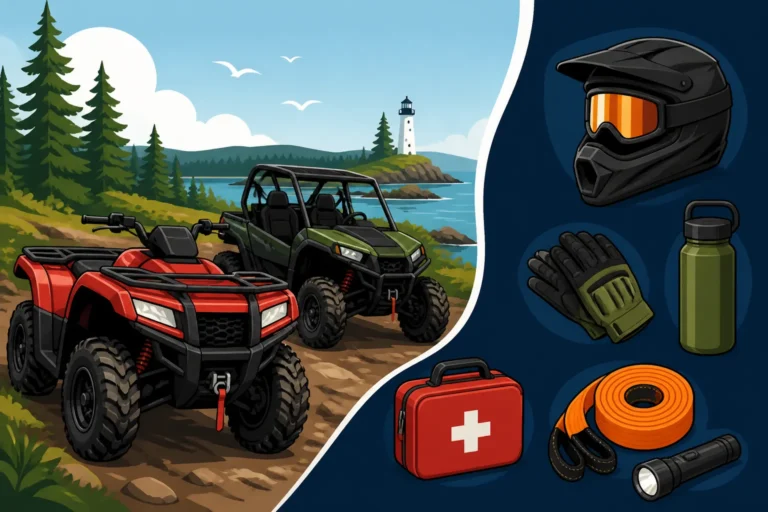
- Carry suitable safety gear and make sure every rider understands the group plan.
- Check the machine before loading and again before setting out.
- Secure the ATV or UTV properly for highway transport.
- Plan fuel, parking, and overnight arrangements before entering remote areas.
- Give yourself enough time to turn around if access is closed or conditions are poor.
For a broader overview of the practical requirements for getting ready to ride, see What Maine Riders Need Before They Ride. It can complement the trip-specific checks above, but always use current official information for registration rules and current trail information from the people responsible for the route.
The short version: a New York registration is not a dependable substitute for Maine registration, and a Maine registration does not grant trail or road access on its own. Choose the proper Maine nonresident option, confirm that the route is open and authorized, and keep your paperwork and plan ready before riding.
Disclaimer
This article is for general informational purposes only and does not constitute professional advice. Laws, prices and regulations vary by location and change over time. Consult a qualified professional for guidance on your specific situation.